
Over the past few years, the healthcare service providers such as hospitals and healthcare centers have launched several digital initiatives to improve the customer experience primarily in the patient management areas such as onboarding, easy interaction with doctors, continuous check-up, etc. This shift to value-based care (VBC) is trying to bring humanity back to healthcare by making services more patient-centric and affordable.
With the advent of IoT, some of its applications have the potential to bring a sea change across all the stakeholders in the healthcare industry. In this PoV, we discuss the emerging IoT use cases that healthcare industry players have started to adopt and the things enterprises should keep in mind while managing connected healthcare solutions.
Internet of Things (IoT) applications are paving the way to make healthcare more patient-centric. It is not a surprise that healthcare is the third-largest consumer of IoT engagements across all major industries (see Exhibit 1). IoT-enabled healthcare solutions have shown promises to overcome the underlying environment complexity, system fragmentation, data swamps, manual processes, and siloed approaches.
Exhibit 1: Healthcare and life science is the third-largest consumer of IoT engagements across all major industries
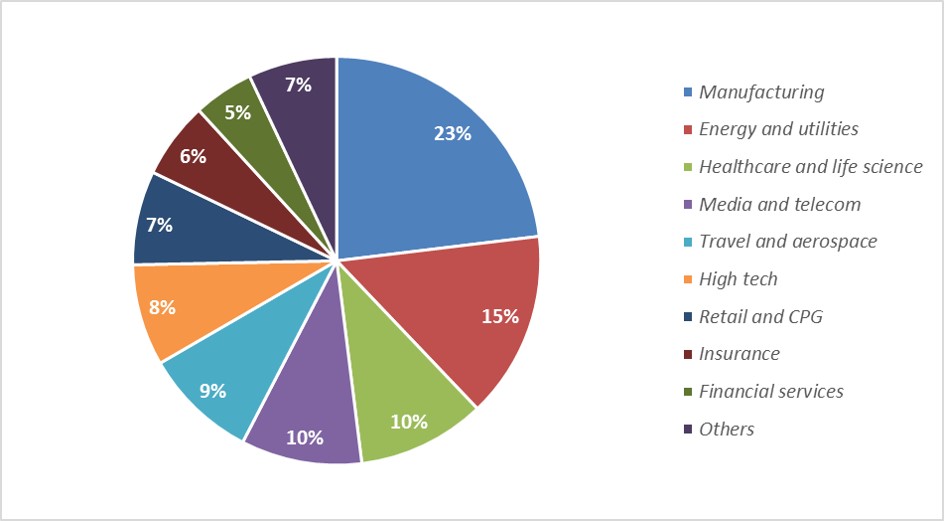
Sample size: 10,000 engagements (approximately) across 26 service providers
Source: HFS Research, 2018
What are the emerging healthcare IoT use cases? What are the benefits? What are some examples of recent initiatives? Let’s discuss!
Several emerging IoT-enabled use cases, which we outline below, are influencing the healthcare sector. The entire healthcare ecosystem including healthcare facilities, medical devices manufacturers, and pharmaceutical companies are getting influenced by these use-cases. Since IoT technology implementation demands a lot of software and embedded electronics capability that widely varies from traditional medical technologies, healthcare players are collaborating with technology companies for IoT initiatives as described in Exhibit 2.
Exhibit 2: Enhanced patient monitoring and diagnosis are the main benefits of connected healthcare applications
|
Use-case |
Stakeholders |
Typical activities |
Initiatives |
Main benefits |
|
Remote and continuous health monitoring for patients |
· Hospitals and other patient care organizations · Healthcare professionals · Pharmaceutical companies |
· Use of connected devices such as wearable devices to track different parameters like blood pressure, heart rate, and blood glucose, facilitating patients to access personalized medication · Continuous health monitoring In real-time · Leveraging the data to provide the best possible treatment to the patients |
Pfizer is partnering with IBM to develop a system of sensors, mobile devices, and machines that could deliver real-time, around-the-clock disease symptom monitoring of Parkinson’s patients to clinicians and researchers (link)
|
· Enhance patient experience · Enable healthcare decision making |
|
End-to-end visibility in hospital management |
· Healthcare facilities |
· Enabling hospitals to increase their operational efficiency (inventory control, equipment health monitoring), clinical efficiency (bed status tracking, staff monitoring for patient check-up), and customer-centricity (patient onboarding, payment facilitation) through smart IoT devices |
Philips Healthcare is leveraging Amazon AWS IoT tools to enable clinicians and hospitals to provide better healthcare services (link). |
· Increase in operational efficiency for facility management |
|
Enhanced drug management |
· Pharmaceutical companies |
· Edible IoT-enabled “smart” pills that will aid the monitoring of health issues, adherence, and medication controls · Smart pill-bottles that remind patients to take the medication in a timely manner |
Propeller Health expands digital health collaboration with GlaxoSmithKline to improve the management of asthma and chronic obstructive pulmonary disease (COPD) (link) |
· Enhance patient medication
|
|
Advanced medical devices operations |
· Medical devices organizations |
· Provides medical devices engineers with wireless sensor technology, remote and continuous monitoring, actuation tools, mobile connectivity, and 3D-printing capabilities of living tissue, enabling enhanced operations and scope to improve the device effectiveness. This field is known as the internet of things for medical devices (IoT–MD) · Remote operation is also now a reality with the application of surgical robots |
Boehringer Ingelheim and Novartis partnered with Qualcomm Life to develop a connected inhaler for COPD (link link). |
· Enhance patient monitoring |
|
Data-based digital healthcare and clinical trial model |
· Healthcare professionals · Pharmaceutical companies |
· Actionable insights from the data generated from IoT applications. Leverage AI applications for disease detection, pattern recognition in health monitoring, drug prescriptions, etc. · Helpful for clinical research, particularly for new molecule identification and methodological analysis of diseases |
Accenture and Roche collaborate to enhance digital healthcare for cancer patients (link) |
· Improve treatment outcome with lesser error |
Source: HFS Research, 2019
Factor in the following aspects while implementing IoT-based integrated healthcare system
The benefits of a connected healthcare system look promising, but enterprises need to keep in mind the following pointers to pave the way for IoT-enabled healthcare applications.
IoT is an enabler for healthcare Industry players because it generates real-time patient data that acts as a reference point for analysis. But data security and privacy are of major concerns from both patients and the regulation point of view. With the GDPR type regulations, patients will now have more control of their data, so, any mismanagement of this data can damage the organization’s reputation and restrict the future access of the patient data. So enterprises should manage the data properly by adhering to the regulatory standard and guidelines.
Register now for immediate access of HFS' research, data and forward looking trends.
Get StartedIf you don't have an account, Register here |
With the exception of our Horizons reports, most of our research is available for free on our website. Sign up for a free account and start realizing the power of insights now.
Our premium subscription gives enterprise clients access to our complete library of proprietary research, direct access to our industry analysts, and other benefits.
Contact us at [email protected] for more information on premium access.


