
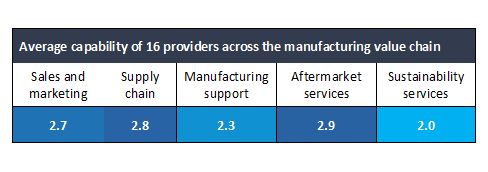
Manufacturing is undergoing a sustainable revolution. However, while HFS’ Manufacturing Services Top 10 2019 found that providers have mastered arts like supply chain management or sales and marketing support for manufacturing clients, their sustainability services lag; carbon footprint management, green supply chain management, environmental, health, and safety administration, for example. The IPCC reported that energy and industrial companies, by some distance, have the highest potential for sustainable transformation—providers should be licking their lips. But the responsibility lies with manufacturing enterprises; they must change the conversation, acknowledge the sustainability demand, and force their providers to build their expertise rapidly.
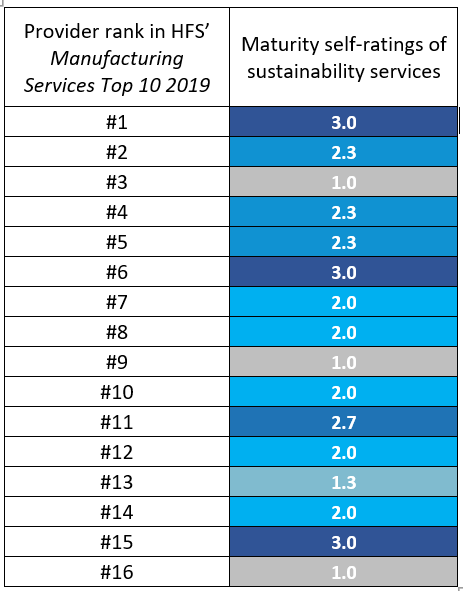
HFS also found that providers’ overall rank in our manufacturing Top 10 had no bearing on sustainability service maturity, suggesting that one, sustainability has not historically been a critical success factor, with cost dominating, and two, that providers can go a long way toward strong sustainability services by simply getting the ball rolling.
Manufacturing clients were least satisfied with their providers’ ecosystem management. Partnerships and M&As are a traditionally quickfire way for providers to build capability from nothing, but manufacturers must also build their own ecosystems for sustainable innovation; providers will soon come running to the door with their newfound prowess.
In manufacturing, sustainability is as hot as anywhere. Depending on the source and classification of sectors, it accounts for approximately 20% of global emissions.
Its popularity is not just for philanthropy; Unilever expect sustainability to generate $12 trillion per year in business value. Even though everyone knows the challenge, in many enterprises, it hasn’t filtered through to the C-suite—see our more detailed report.
But, perhaps surprisingly, it’s not just manufacturing enterprises that lag when it comes to sustainability within their industry. HFS’ Top 10 Manufacturing Service Providers 2019 report found that in manufacturing, sustainability services were the least mature out of providers’ portfolios (see Exhibit 1).
It’s hardly surprising when you trawl through providers’ responses to our surveys. When we asked providers about their strategies in manufacturing, now and in the future, sustainability did not once come up. Service providers are happy to rank their sustainability offerings as mature, emerging, or not a focus, but when it comes to actively strategizing, it seems as though there is a massive gap, with top and bottom lines still dominating the C-Suite agenda.
Exhibit 1: Sustainability services are the least mature among manufacturing providers’ portfolios.
Please rate the maturity of your manufacturing service offerings, where 1 is not a focus, 2 is emerging, and 3 is mature.
Source: HFS’ Manufacturing Services Top 10, 2019
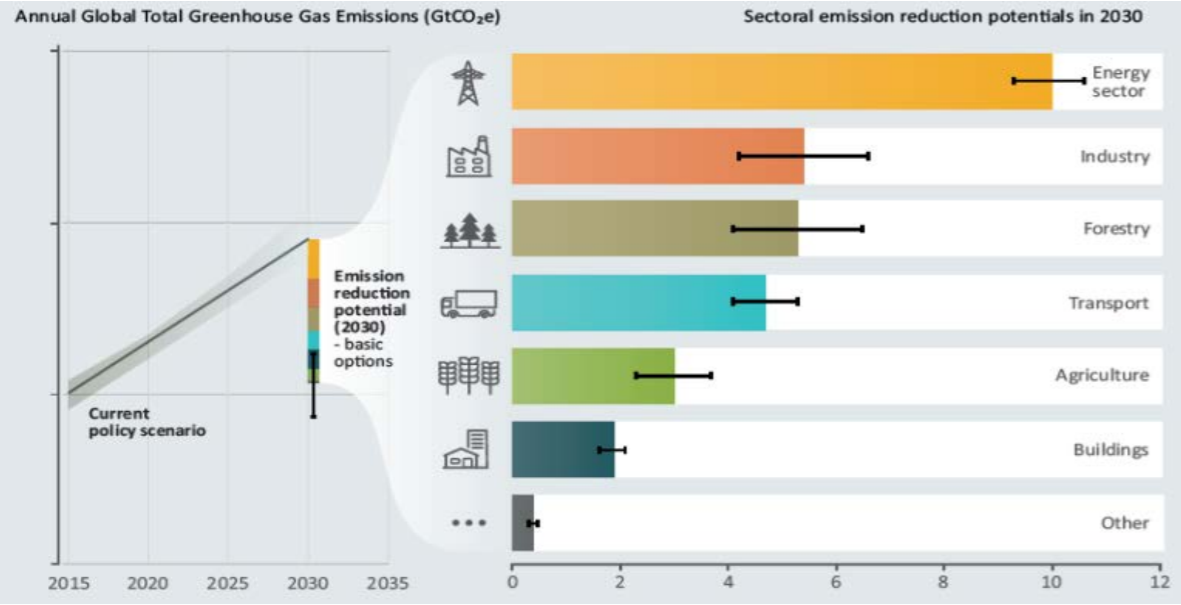
The IPCC reports how the industry and energy sectors (i.e., manufacturing and friends) have the highest potential for emissions reduction (see Exhibit 2). The same report also details how innovation with existing and new technologies is key to bridging this gap; you’d think manufacturers would be yelling “Where’s my service provider!?”
Exhibit 2: The industrial and energy sectors have the biggest potential for emission reduction—manufacturers and their service providers should be restless!
Source: IPCC, 2018
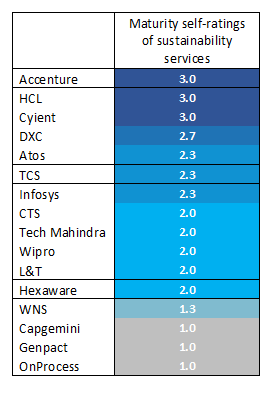
Exhibit 3: Despite the seemingly dire need for sustainable revolution in manufacturing, most providers are, self-admittedly, trying to play catch-up.
Manufacturing service providers were asked in our Top 10 to rate their own sustainability services as 3 for mature, 2 for emerging, and 1 for not a focus.
Source: HFS’ Manufacturing Services Top 10, 2019
Many providers have historically focused on cost; it’s what their manufacturing clients wanted. It’s easy to understand why sustainability services have little impact on overall rank—for now.
The reported potential of the industrial space to decarbonize, combined with an increasing acceptance of the business value of sustainability, means that poor sustainable standards will result in either a loss of competitive advantage—or worse, heavy financial penalties. We’re starting to see the latter at scale: The UK’s Southern Water was slammed with a record £126 million fine due to wastewater spills, while rapidly evolving scientific evidence is giving power to a new wave of environmental lawsuits. A group of young Americans is even attempting to sue the Trump administration over climate change.
Exhibit 4: The self-assessed maturity of providers’ sustainability services compared with their overall rank (assessed by HFS).
Source: HFS’ Manufacturing Services Top 10, 2019
The lack of a correlation between providers overall rank in our Top10, and their level of sustainability service maturity, in Exhibit 4 leads us to believe that to date, it hasn’t been a critical success factor for providers.
Traditionally, partnerships and acquisitions—building an ecosystem of expertise—is a prime way of building capability quickly.
Digital manufacturing and supply chain transformation were clients’ main desires in our Top 10, and manufacturing clients are the happiest with service providers’ relationship management capabilities.
Where providers lack, according to clients, is in managing an effective ecosystem of partnerships.
If lagging providers are to catch their leading peers when it comes to sustainability services, they must boost their partnership ecosystems with sustainability expertise in addition to acquiring and recruiting talent.
But it’s not all providers’ fault. Manufacturing clients need to drive better conversations—demonstrating and creating the demand to turn their providers into sustainability experts, either as a specialty service or tied in with their core offering as an end-to-end package. Exhibit 4 showed us that manufacturing clients clearly don’t punish providers for not having a strong sustainability angle.
Manufacturers can also take a proactive approach to building their own innovation ecosystems to drive sustainability… service providers will soon come running to their doors.
Having pressed on the lagging nature of providers’ sustainability offerings to the manufacturing sector, the onus is as much on their clients as it is on the providers themselves. Providers provide what their clients demand they provide.
Manufacturers must ensure their strategies and conversations with providers paint a clear picture that sustainability must be an integral part of service offerings. In doing so, providers will soon become the expert, whether by acquisition or feeding off new and existing ecosystems of partnerships.
Proactive manufacturers should also build their own ecosystems for sustainable innovation—it’s clear that their options among large providers are limited. Providers throughout the manufacturing space might just come running with an even better solution.
Register now for immediate access of HFS' research, data and forward looking trends.
Get StartedIf you don't have an account, Register here |
With the exception of our Horizons reports, most of our research is available for free on our website. Sign up for a free account and start realizing the power of insights now.
Our premium subscription gives enterprise clients access to our complete library of proprietary research, direct access to our industry analysts, and other benefits.
Contact us at [email protected] for more information on premium access.

