
IT and business process outsourcing has weathered plenty of worrying times: the 2008 recession, big public sector failures in the US and the UK, potential changes in VAT rules, and concerns about the availability of offshore visas come to mind. Early in August there has been another high profile insource by Birmingham City Council, a £475 million deal originally signed in 2006. And now we are seeing evidence that interest in outsourcing is waning quickly in our latest survey.
There are a few questions you need answered: Why is this happening? Is outsourcing still relevant for your business? Is it still a viable operating model as organizations look to automation, simplification, and internal resources—particularly for strategic and data–centric operations?
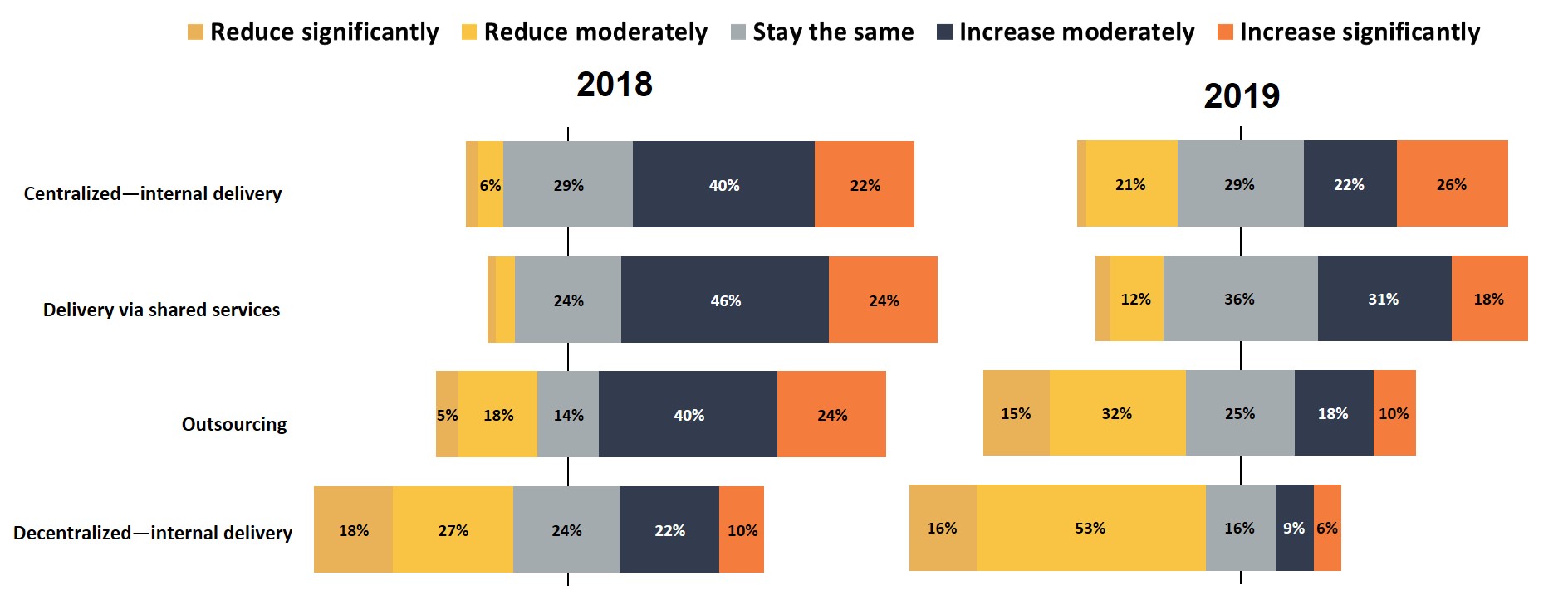
To help answer these questions, in our latest State of Operations and Outsourcing survey, we asked operational managers what they expect to do with various delivery models. Their answers, in Exhibit 1, show a steadily waning interest in outsourcing; however, it also points to a lack of enthusiasm for any of the current options on the table.
Exhibit 1: Interest wanes in outsourcing as a part of operating frameworks
Sample: Global 2000 enterprise leaders = 355
Source: HFS Research supported by KPMG, “State of Operations and Outsourcing 2019”, (and 2018)
The chart shows a big shift in spending attention away from outsourcing, even in the past year. Data going back to 2014 is even more stark, with 72% of respondents expecting to increase outsourcing spending, which dropped to 60% in 2016 and 2018 and shrank further to 28% in our 2019 survey.
Without shared risk, you can’t get into the core
Over the last 10 years, the holy grail for outsourcing was a commercial relationship based on shared risk/reward, gainshare, or, more recently, business outcomes. Even though we’ve asked this question many times, we’ve rarely seen contracts where this model was the bulk of the contract or the main deal basis. Sure, people put an element of bonus or a small amount of risk–based payment in deals, but most outsourcing and managed services deals are based on FTE or some type of transaction or volume. And if organizations aren’t confident the provider has skin in the game, how can they trust it with tasks that have strategic goals like growing revenue?
There was a window of opportunity for outsourcing to become more tied to business outcomes and get more strategic in more accounts. But it remained tarnished by its broad association with being a cost–saving method rather than being a business value driver or change agent.
The cost-saving agenda has moved on, and automation has become hype du jour as a technology and as a cost–saving method. Unless your outsourcing deal genuinely drives value or has automation embedded within it, it is time to look for an alternative deal or look internally for a way to drive it.
So what are external services budgets being spent on if not outsourcing?
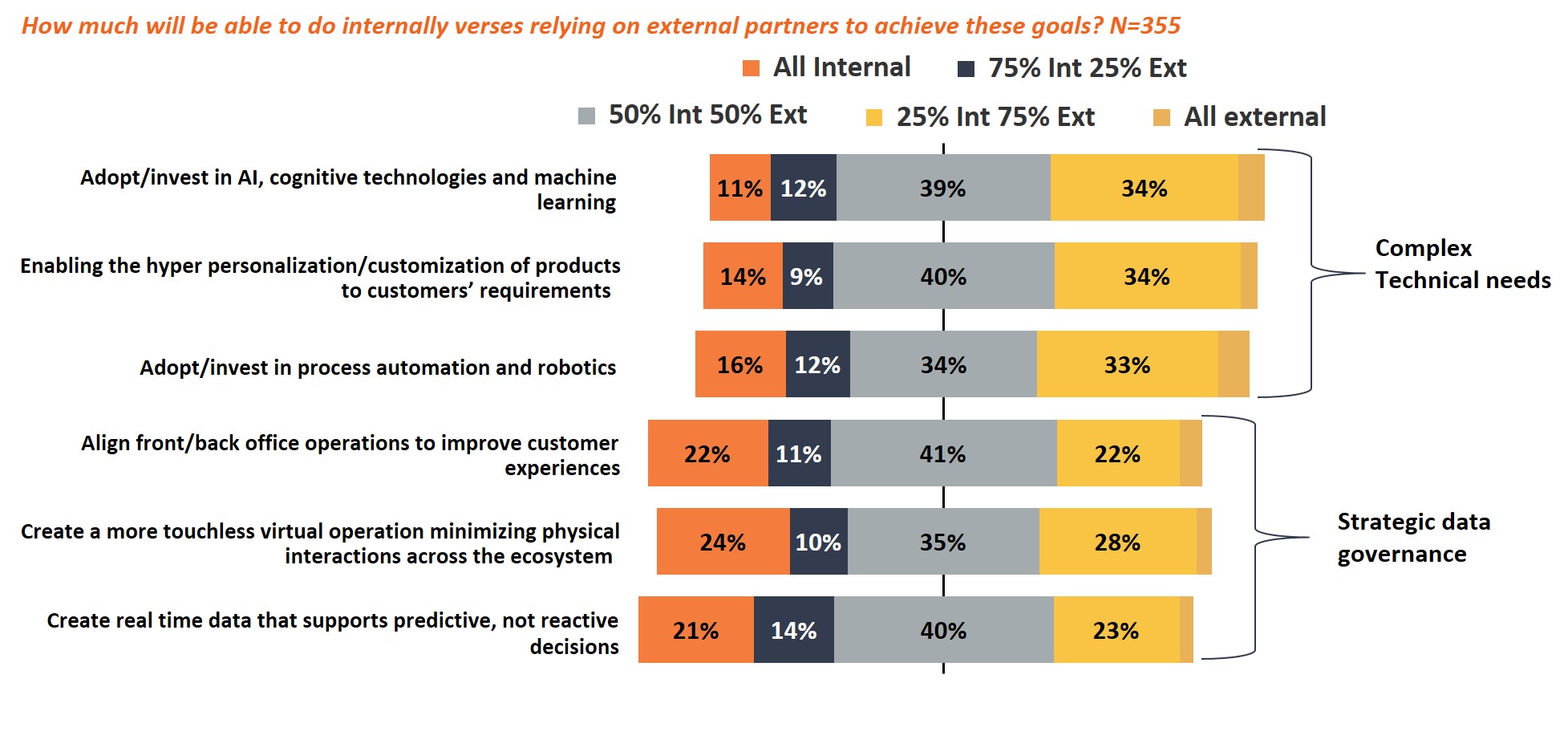
The emphasis has shifted more to project-based professional services, which is borne out if you look at any of the service providers’ revenue growth figures. Largely, consulting and implementation revenues have remained strong, and outsourcing and managed services have remained weak, except in specific areas, such as cloud. Exhibit 2 shows where organizations are using external and internal resources.
Exhibit 2: External spending bifurcates—get technical or die trying
Sample: Global 2000 Enterprise Leaders = 355
Source: HFS Research supported by KPMG, “State of Operations and Outsourcing 2019”
Broadly speaking, enterprises are using more external services for the top three categories, all of which require a degree of complex technical need. The bottom three categories expect to use fewer external services, and these are largely strategic areas where data plays a big role. We expect the role of the service providers in the bottom categories to be more focused on enabling the internal team to drive strategic goals more effectively rather than to own these operations directly. In the same survey, respondents made it very clear that they don’t want suppliers to automate to replace jobs—they want suppliers to help provide the technology to enable process transformation and to drive strategic change.
The Bottom Line: Outsourcing and managed services can shrink the core, but they won’t take over.
We believe the issue goes back to the original premise for outsourcing, which was about deciding what functions were core versus non-core. Outsourcing and operational services are still relevant for non-core, less strategic parts of an organization, as was always intended. Many organizations have outsourced or used a shared service model for most of their non-core activity, so outsourcing has nowhere to go but try to be more strategic. However, the commercial models haven’t worked well, and it’s been very hard to incentivize external service organizations to care enough to manage strategic activities. Operations leaders need to stop expecting outsourcing to fix strategic issues. This is what employees are for.
This means the emphasis of outsourcing and external services generally has to shift. Outsourcing for non-strategic work. And professional services led engagements to provide strategic levers for internal staff. Technically complicated work that gives staff the best tools to access AI, machine learning, and advanced forms of automation. The best people to drive change and drive value in an organization are its managers and employees, but they need the right information and agile operations to enable them to make better decisions and see results more quickly. Outsourcing hasn’t failed, it was pushed beyond its intended scope. Outsourcing works best when the underlying processes are standardized – it may get a new lease of life as we cycle through the current wave of automation and process simplification.
Register now for immediate access of HFS' research, data and forward looking trends.
Get StartedIf you don't have an account, Register here |
With the exception of our Horizons reports, most of our research is available for free on our website. Sign up for a free account and start realizing the power of insights now.
Our premium subscription gives enterprise clients access to our complete library of proprietary research, direct access to our industry analysts, and other benefits.
Contact us at [email protected] for more information on premium access.

