
This HFS Point of View is for pharma CIOs who want a Day-1 playbook for governing cross-border M&A integration in the first 90 days.
CIOs take note. The real value of Sun Pharma’s $11.75 billion all-cash acquisition of Organon won’t be determined by the purchase, but by the success (or not) of the first 90 days of IT integration and governance. What separates the cross-border pharma deals that captured value from those that destroyed it is whether the dominant integration risks were governed from Day 1, and four of the five that decide this deal land on the CIO. Get those four right, and $350 million in stated synergies becomes recurring value; miss them and $11.75 billion becomes a write-down.
The largest outbound deal by an Indian company to date closes Sun Pharma’s three biggest capability gaps in one move: women’s health, biosimilars, and developing commercial market reach in more than 140 markets. Its combined revenue increased to roughly $12.4 billion, placing Sun Pharma among the global top 25 pharma companies by revenue.
Executive Chairman Dilip Shanghvi publicly named Sun Pharma’s three integration priorities as “business continuity, disciplined integration, and responsible value creation,” and signaled an “open” posture toward Organon, drawing on the Taro and Ranbaxy playbooks rather than imposing Sun Pharma’s operating processes from Day 1. That posture buys time for culture and talent. It does not buy a $350 million synergy commitment.
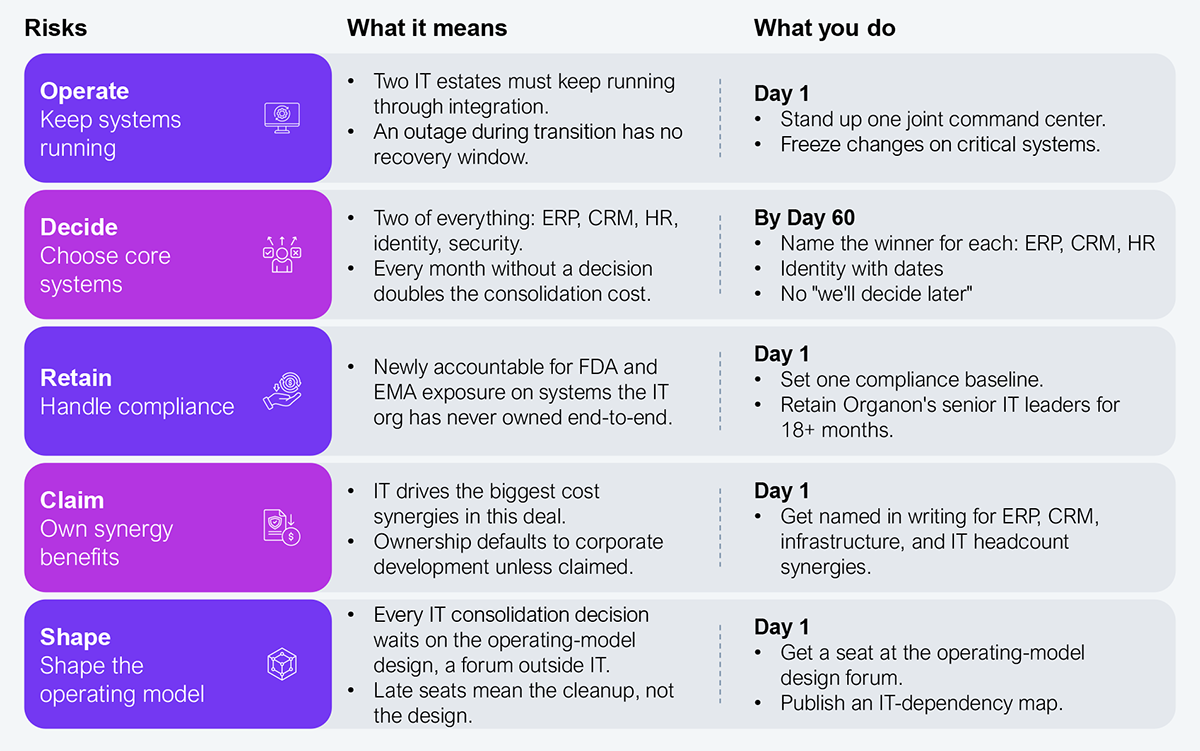
Cost synergies of that scale, across procurement, people, and supply chain, require shared systems. And four of the five dominant integration risks all land on the CIO: service continuity, system consolidation, dual-regulatory compliance, and synergy ownership. Four IT-owned risks decide whether cross-border pharma integration creates value or destroys it.
Industry estimates suggest that approximately 70% of pharma deals fail to deliver their expected objectives, and that up to 70% of value erosion occurs during integration.
Sun Pharma’s starting conditions sit close to every deal in Exhibit 1, winners and losers alike: scale, cross-border complexity, and a 47-facility manufacturing network that meets FDA (Food and Drug Administration) and EMA (European Medicines Agency) requirements simultaneously. The variable Sun Pharma controls is which playbook it runs. The pattern across the last decade of cross-border pharma deals at scale tells the story (see Exhibit 1).
The pattern is not that every failed deal failed for the same reason. It’s that value was lost when the dominant integration risk was not actively governed early enough: compliance risk in Daiichi-Ranbaxy, integration-bandwidth risk in Mylan-Meda, and litigation-tail risk in Bayer-Monsanto. In contrast, Astellas-OSI and Takeda-Shire show what happens when integration is governed around clear value-capture priorities from Day 1. Sun Pharma’s announced approach leaves four of these dominant risks under-governed at once.
Astellas acquired the Tarceva oncology platform and became a serial cross-border acquirer. Takeda delivered $2.3 billion in recurring annual cost synergies by FY2020, 64% above its original $1.4 billion target and a full fiscal year ahead of plan.
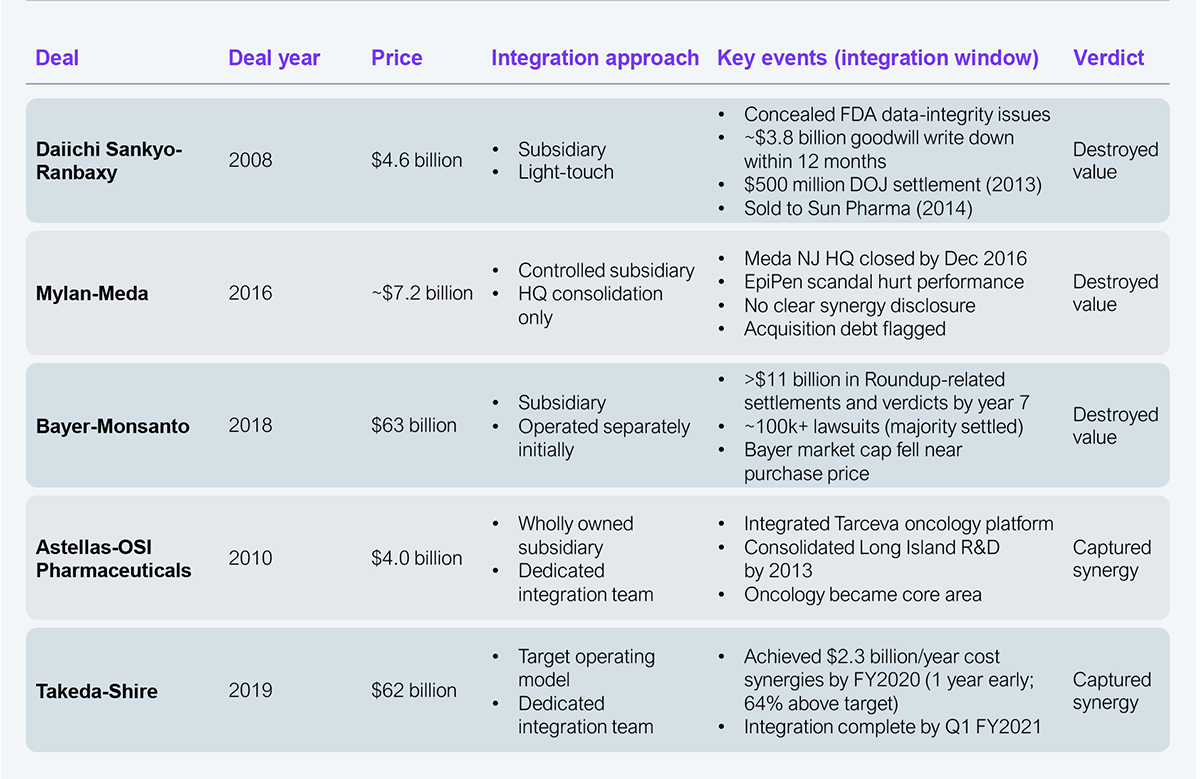
Cohort: cross-border pharma deals $4B+ (2008–2019) with publicly documented integration approach and visible 5+ year outcomes.
Source: HFS Research, public deal disclosures, 2026
Subsidiary status is a useful corporate-law construct. It is not a tech-integration get-out clause. The synergy line in the deal’s business case requires a single tech estate over time: no one runs two ERPs, two CRMs, two HR systems, and two SAP instances forever. Once the synergy commitment is in the model, every quarter of deferred consolidation compounds the cost of eventually doing it.
The CIO’s hardest political battle won’t be technology; it will be resisting the “leave it as a subsidiary, integrate later” framing that lets every other function claim more time while the IT bill accumulates interest. The longer the delay, the more brittle and bespoke the eventual consolidation becomes.
The risks Sun Pharma’s CIO has inherited map directly to the dominant-risk categories that broke past cross-border pharma deals: operational continuity, overlapping system landscape, dual-regulatory compliance, and IT-driven synergy ownership all land squarely in IT. The fifth operating-model integration is outside IT, but every IT consolidation decision waits on it (see Exhibit 2).
Source: HFS Research, 2026
Capturing synergy value in cross-border pharma integration requires the CIO to run a staged Integration Management Office (IMO)-led playbook from Day 1.
Days 1–30: Get stable
In the first 30 days, Sun Pharma will need to set up the IMO with clear goals and metrics, pause risky technology changes across both IT systems, keep supply chains running for FDA- and EMA-regulated products, and hold onto key people while staying compliant with both regulators. Other CIOs in cross-border pharma integration can do the same: Get Day-1 stability right through the IMO is the basic entry ticket.
Days 31–60: Start capturing synergies
By Day 60, Sun Pharma will need IT ready to support the merged business: pricing, shared back-office services, and sales territory maps for the combined team working in more than 140 markets. Other CIOs in this position can do the same: List every IT dependency tied to a commercial decision and flag it to the IMO before it becomes a blocker.
Days 61–90: Lock the structure
By Day 90, Sun Pharma will need to start combining the core systems (ERP, CRM, and HR), while keeping pace with R&D choices, manufacturing tech transfers, and regulatory work led by other teams. Other CIOs in this position can do the same: Align IT consolidation milestones with decisions from R&D and regulatory leads, and flag any mismatches early.
For any cross-border pharma integration to deliver value, the CIO must get four things right on
Day 1:
Astellas and Takeda didn’t win their deals by integrating harder. They won by naming their biggest risk, naming the person who owned it, and governing it from Day 1.
Sun Pharma’s chairman has publicly committed to “business continuity, disciplined integration, and responsible value creation,” commitments that map to the IT-owned risks above. Get those four right, and $350 million in stated synergies becomes recurring value; miss them, and $11.75 billion becomes a write-down. Sun has 90 days to prove the framework. Any other cross-border pharma CIO in this position faces the same test.
Register now for immediate access of HFS' research, data and forward looking trends.
Get StartedIf you don't have an account, Register here |
With the exception of our Horizons reports, most of our research is available for free on our website. Sign up for a free account and start realizing the power of insights now.
Our premium subscription gives enterprise clients access to our complete library of proprietary research, direct access to our industry analysts, and other benefits.
Contact us at [email protected] for more information on premium access.


