
Deploying machine learning at a global scale is a growing challenge for AI adoption
Our recent research into machine learning found that enterprises are bullish about AI adoption—expecting machine learning (ML) to influence many business operations in under two years. However, when it comes to execution, HFS observes a glaring chasm in implementing intelligent automation technologies. A lot of organizations have started with various automation tools—working through pilots, PoCs, and projects. However, planning and managing global deployments in production, beyond project work, is challenging.
AI and other automation technologies represent the next wave of advancing business operations for many organizations. Business leaders across all domains are increasingly seeking adaptable and intelligent predictive systems that can make better use of data and streamline operations. The move toward intelligent automation essentially provides an organization the opportunity to both fundamentally change how work is done and rethink business models with the combination of humans and emerging technologies.
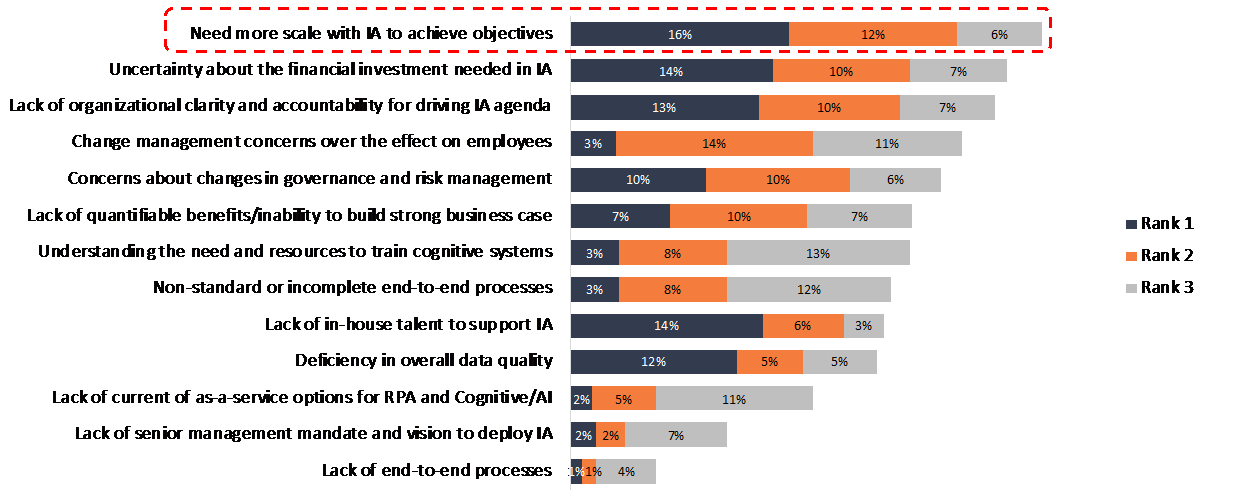
Exhibit 1: Scale is the biggest inhibitor to IA success
Question: What are the top three inhibitors that are holding you back from achieving strategic AND operational goals?
 Source: HFS Research in conjunction with KPMG, State of Intelligent Automation, 2018
Sample = 590 business leaders including 100 C-level executives
As our latest study shows (see Exhibit 1), scalability emerges as the biggest inhibitor to the widespread adoption of intelligent automation technologies. Enterprises are at a point where they need to go beyond the “why” and “what,” and get to the “how.” They’ve identified business drivers and initiated projects—now how do they scale up and get maximum business impact from the investments in emerging intelligent automation technologies?
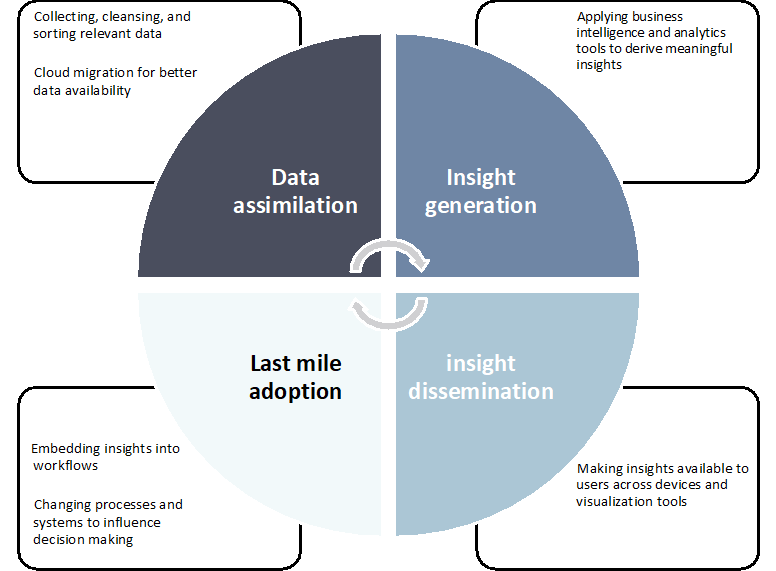
As our recent smart analytics study outlines, turning data into insight is a complex and multi-phased process for most organizations. Each stage—from the initial collection of data to the final consumption of analytical insights by business users—typically involves multiple teams and departments. Similarly, multiple technology platforms and tools need to come together to deliver on the promise of smart analytics, AI, and automation.
Exhibit 2: The smart analytics lifecycle is a complex process for most organizations
Source: HFS Research, 2018
Business and technology groups must continuously iterate over each stage and explore new ways to improve efficiency and results. The iteration is critical given that technologies are constantly evolving across data assimilation, insight generation, insight dissemination, and last-mile adoption. HFS sees a promising opportunity for enterprises to use modern automation and analytics tools to create tighter feedback loops, better self-service, and more firmly embedded insights in business workflows, processes, and systems.
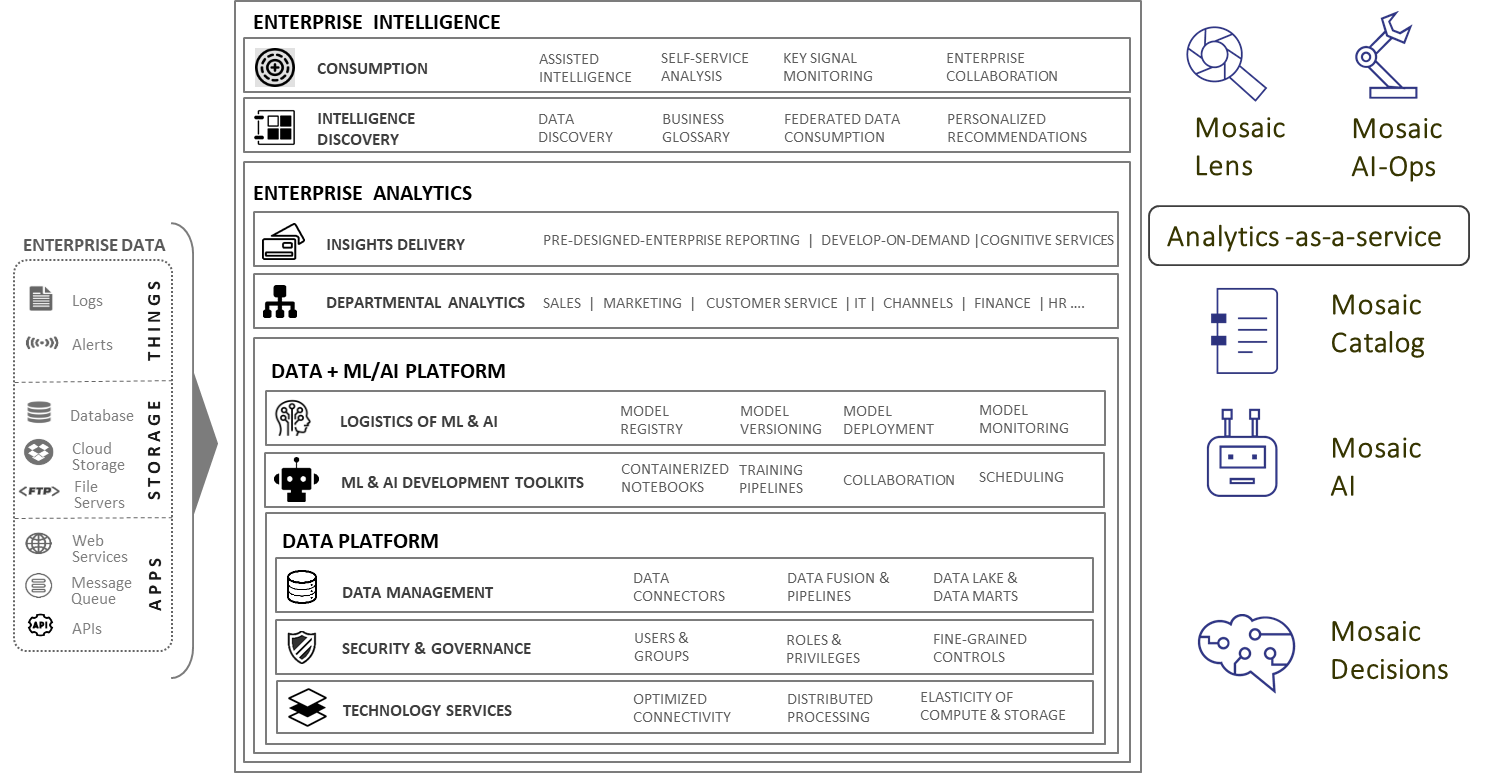
LTI, a global technology consulting and digital solutions company, has spent considerable time thinking about how best to address these challenges for its enterprise clients. During our 2017 research efforts, HFS outlined LTI’s investments in its analytics platform, Mosaic. This platform has now significantly evolved, with a conscious design that embraces the convergence of data, analytics, automation, and AI technologies. Mosaic encompasses data engineering, advanced analytics, knowledge-led automation, IoT connectivity, and AI, all wrapped up with an improved solution experience for different business and IT users.
Exhibit 3: LTI Mosaic ecosystem components have been built to solve real client needs with AI, data, and analytics
Source: LTI, 2019
LTI’s Mosaic features five key components to help enterprises with different aspects of adopting analytics, AI, and automation technologies. The central theme is to give more flexibility and ease of use to the end consumers of data and insights and simplify the data management and automation tasks for technical data, analytics, and automation teams.
LTI’s emphasis with Mosaic is to mold the use of its platform components to co-exist with and enhance each client’s existing technology stack and roadmap. Mosaic uses many open source technology elements, and LTI has built flexibility in to reduce complexities across both engineering and governance. Soumendra Mohanty, LTI’s EVP and CDAO, outlines, “Our goal is to solve our clients’ business challenges and deliver on outcomes. The Mosaic stack is an enabler; we are not going to clients with the idea that we just provide the platform for them to input data and get results.” Depending on the use case and problem, one or several Mosaic components will be suggested to clients to solve their specific challenges.
LTI has adopted an approach to lay out a strong technology foundation for each component of the Mosaic stack and then work with selected clients to bring in additional depth to each component. For example, LTI worked with a large technology product company with very advanced AI logistics requirements and developed the AI component of Mosaic. Similarly, working with a large government body with the need for a very mature consumption layer, LTI created the Lens component of Mosaic. In this way, Mosaic has evolved to solve real client needs across various parts of the intelligent automation and analytics lifecycle.
A company over 150 years old, seeking connectivity in the age of Industry 4.0
The leading elevator company in our research pioneered the vertical transportation system industry, becoming the world’s largest manufacturer of elevators, escalators, and moving walkways. The enterprise fueled the industrialization of the modern world across the globe. The company operates across 200 countries and delivers personalized service through 31,000 mechanics worldwide.
The elevator company has been undergoing a digital transformation journey for the last few years. Transformation is an inevitable reality as manufacturing, product, and service design are impacted by digital technologies—the basis of the Industry 4.0 concept. HFS sees Industry 4.0 as a seamlessly integrated network of machines, production processes, and manufacturing control systems. It is a digital manufacturing enterprise with the physical product at the core driven by information from an integrated information network among internal stakeholders as well as external entities such as customers and suppliers.
The company’s views are similar in the world of Industry 4.0; its end goal is to make products better for customers. During our research, the Senior Manager, IoT, for the elevator company described the business drivers for his work across the company’s digital transformation, IOT, advanced analytics, cloud architecture, and governance. He states, “The world is moving digital, and we had better keep up. In the elevator business, everyone is moving to automation. The industry’s service margins are squeezed, and the labor market is tight. Profitability depends on selling more or servicing more.”
While emerging markets are the prime sources of new business, developed countries have far lower growth and increased competition. Revenue growth and profitability growth are thus the key business drivers. The elevator company’s mission for digital transformation is to improve its products and how it services them. The Senior Manager explains, “We have to get better on tracking all our assets, whether they are physical, IP, or human. This journey into digital transformation helps us achieve that.”
The company sees opportunities to leverage multiple technologies, namely the Internet of Things (IoT), smart analytics and data, machine learning, and automation tools to realize its goal. The use cases are two-fold:
From a servicing perspective, the Senior Manager outlines a critical need, “Our goal is to be proactive, so we don’t wait for the customer to report issues with our products. We want to figure out any potential issues and act on them before they happen—becoming predictive, proactive, and transparent.” The company is over a hundred and fifty years old and has a wealth of data it can mine to achieve these goals. Machine learning models can mine this huge data stash to learn and predict products’ maintenance needs. Transparency is another important aspect of this use case—making sure everyone, including mechanics, helplines, supervisors, and product developers, can view a single version of the truth and act as a collective.
With the vision for a connected future in place, the elevator company worked with third-party partners to design and implement a new overall architecture. However, it was a challenge for the company to scale its predictive machine learning models. The company’s models needed a platform for data ingestion and the ability to scale hundreds of models across regions. LTI, an IT services provider, had experience with the company’s IT services group and had also recently been brought in to support the IoT infrastructure. LTI realized the client’s challenge with scaling their ML models and suggested Mosaic as a proposed solution during a subsequent RFP. The elevator company evaluated Mosaic against two other similar platforms and found it to be best suited for its needs.
“Our goal is to be proactive, so we don’t wait for the customer to report issues with our products. We want to figure out any potential issues and act on them before they happen—becoming predictive, proactive, and transparent.”
—Senior Manager, IoT, leading global elevator company
The Senior Manager recounts, “Mosaic had interesting facets to it that made it more desirable for scaling up our program. Namely, the ML workbench, the ability to combine and split data pipelines, the data validations available, and being able to call APIs on demand. These modules also made Mosaic more appealing for our broader IOT vendor program. We could use this platform to drive other programs that we knew were on the horizon.”
Starting in April 2018, the enterprise began engaging with LTI on the Mosaic implementation, primarily deploying the Mosaic Decisions component. A little over half a year later, and the platform is now running in five countries. The organization is running its predictive engines on Mosaic on the cloud through Microsoft Azure. The team is using production data and undertaking final field trials. During these trials, the LTI deployment team analyzes the results continuously and makes needed improvements. At this time, LTI has completed implementation of the platform in all three Azure zones (US, Europe, and Asia) supporting multiple countries under each zone.
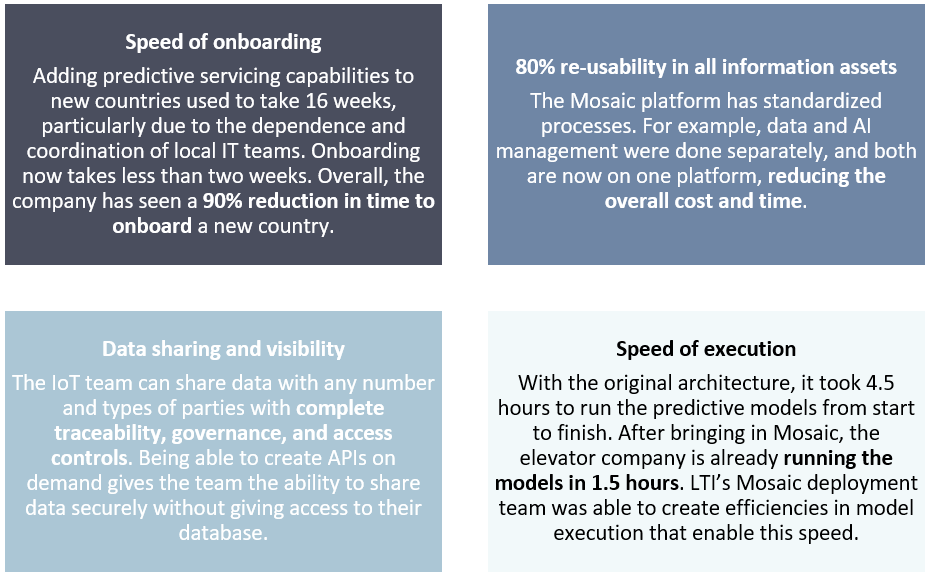
Even though the project is still underway, the organization has already started to realize multiple benefits from its Mosaic implementation. Overall, the company’s machine learning initiative is set up for global scalability through many improved features (see Exhibit 4).
Exhibit 4: Mosaic makes global scalability achievable for elevator company
Source: HFS Research, 2019
The speed of execution was one of the major bottlenecks preventing the company’s global adoption of the predictive engines. The Senior Manager explains, “4.5 hours in our world means that the supervisor gets the prediction late into the day, by which time mechanics already clock out. It’s a very personnel-based decision. Automation is all well and good, but in our industry, regulatory codes still require people to go maintain our assets. We must keep that human element in mind. If our mechanics and supervisors are not going to adopt this, this initiative will be a waste for our company.” Compressing the time required to get predictive insights greatly improved the company’s chances of success with this use case and kept the humans in the services loop, where they are needed the most.
The elevator company’s IoT team believes that while it has come a long way already, the company is at least a year away from maturity on its predictive maintenance capability (and beyond). The Senior Manager’s goals include reducing the models’ execution time even more to 45 minutes. The progressive AI logistics modules available on Mosaic are a valuable next step. The goal is that using other components of Mosaic, especially the AI logistics component, will allow the company to optimize the AI model building and deployment process and build in more flexibility for data scientists along with enterprise-level governance and scalability with production.
Ultimately, the IoT team is aiming for each country’s IT and operations leaders to build and manage their own pipelines and models. The Senior Manager opines, “Right now everything is done by my group, which is not sustainable. We operate in 160 countries, and our team doesn’t have the bandwidth for that.” Extending the skills necessary for this to several countries will require significant training using Mosaic’s persona-based access and change management to keep adoption going smooth.
Further, as the company keeps iterating and expanding on the machine learning models it is using, better model management becomes a necessity. Required improvements include being able to track history, trend performance, and scale further up when the company’s usage loads go up. The elevator company and LTI are working through scenarios for efficient scalability and model management for the company’s AI needs well into the future.
Developing the technological and process discipline for data-driven decisions is set to become an imperative for businesses in the future. With the help of LTI, the elevator company is on this journey toward industrialized AI. LTI, for its part, is taking a progressive stance with Mosaic and developing new ways to help clients with the increased convergence of automation, AI, and analytics. Both organizations are developing best practices as they go, cultivating key learnings that will inform the elevator company’s strategy on a go-forward basis.
HFS strongly believes that in a developing industry such as intelligent automation, sharing results and emerging best practices is extremely valuable to the broader community. These experiences help minimize the hype and advance the effective use of intelligent automation. The Senior Manager’s recommendations for success include:
Register now for immediate access of HFS' research, data and forward looking trends.
Get StartedIf you don't have an account, Register here |
With the exception of our Horizons reports, most of our research is available for free on our website. Sign up for a free account and start realizing the power of insights now.
Our premium subscription gives enterprise clients access to our complete library of proprietary research, direct access to our industry analysts, and other benefits.
Contact us at [email protected] for more information on premium access.

