
This Market Impact Report is for CIOs, enterprise IT leaders, and business transformation executives at Global 2000 organizations evaluating how to break free from legacy tech debt through AI-native delivery models and Services-as-Software™.
It’s 2025, and most enterprise technology leaders aren’t building the future—they’re managing the past. Despite years of digital ambition and billions in modernization budgets, the hard truth remains: technical debt has become the single biggest barrier to innovation, agility, and growth. HFS estimates the Global 2000 are carrying $1.5–2 trillion in accumulated tech debt.
This isn’t just a technology issue—it’s a structural trap. And much of the $1.5 trillion IT services industry is designed to keep enterprises in it.
For decades, organizations have turned to outsourcing, staff augmentation, and piecemeal automation to cope. But these legacy approaches have too often become part of the problem. They are incentivized to sustain complexity rather than eliminate it, resulting in normalizing stagnation with armies of offshore workers.
Now, AI presents a real escape route—not by making legacy cheaper to run, but by giving enterprises the tools to tear it down. AI can read and rewrite legacy code, automate integration and testing, and compress years of technical debt remediation into weeks.
But here’s the paradox: most organizations are still treating AI like just another tool—when it needs to be treated like a jackhammer.
This study, based on insights from more than 600 IT and business leaders across industries, reveals a growing recognition that breaking free from tech debt requires more than new technology. It demands a shift in mindset, delivery models, partner expectations, and operating architecture.
Enterprises are ready to act:

These aren’t signs of incremental change—they’re signals of a systemic shift. And they point to a new era in which outcome-aligned, AI-native delivery models will define competitive advantage.
This HFS Market Impact paper unpacks what that shift looks like—and outlines five bold moves CIOs must make to escape the trap of tech debt and build for what’s next.
If AI is the jackhammer, leadership is the ignition. The question is no longer whether to modernize—it’s whether you’re ready to break through.
Enterprises are not building for the future—they’re barely keeping the lights on.
Despite spending nearly 30% of IT budgets on modernization, only three in 10 organizations have modernized their core applications (see Exhibit 1). For the rest, transformation has become a euphemism for putting lipstick on a legacy pig.
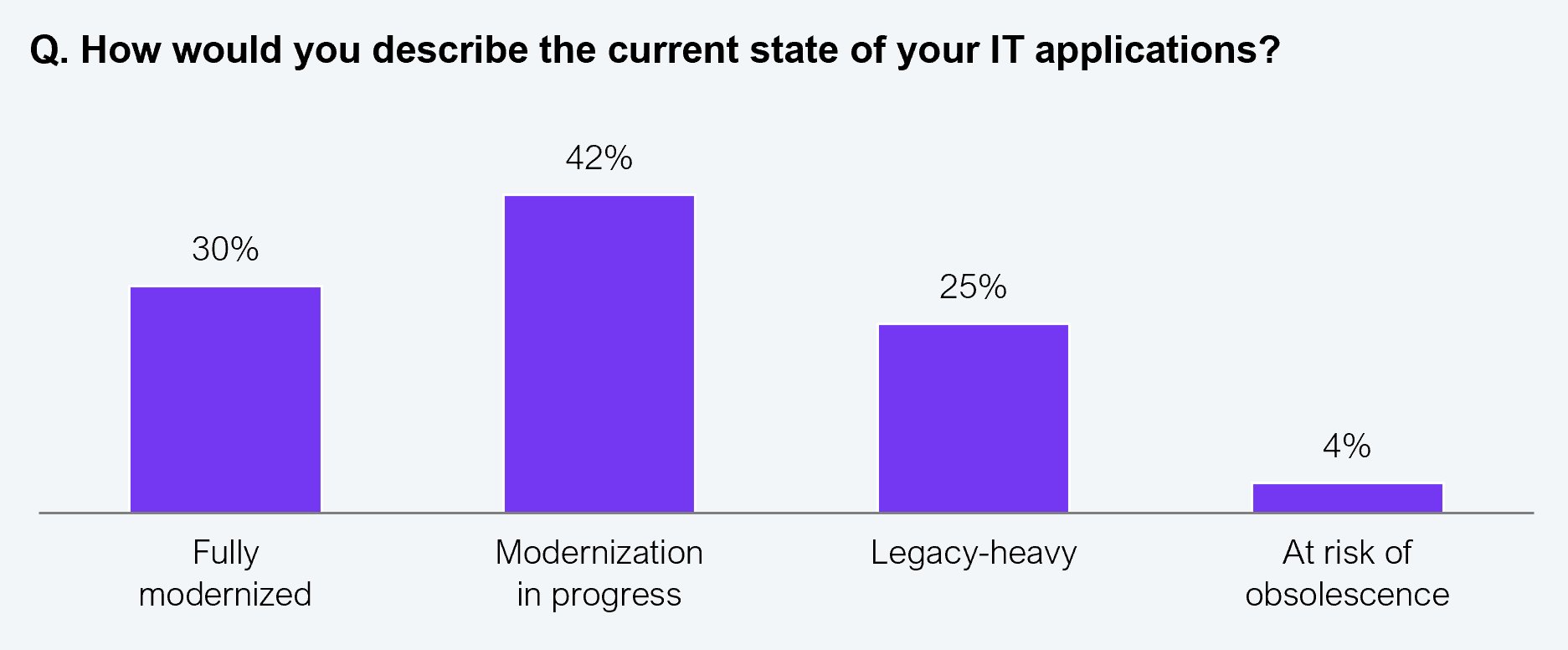
Sample: 608 IT and business leaders across Global 2000 enterprises
Source: HFS Research in partnership with Publicis Sapient, 2025
Why so little progress? Because we’ve been trying to escape a system while still following its rules.
We’re spending millions on modernization, but the problem isn’t just legacy code. It’s how we think. The decisions that led to this architecture are still being made the same way.
— Senior IT leader, healthcare enterprise
Most enterprise leaders have inherited decades of bolt-on complexity, shadow systems, and partner dependencies. Outsourcing didn’t fix the problem—it outsourced the symptoms.
You definitely don’t fix your problems by outsourcing them… You might get some wage arbitrage, but you didn’t fix any of the problems.
— IT director, banking sector
This is the cost of doing nothing differently: billions spent, talent wasted, and innovation throttled at the core.
AI promises to unlock productivity, automate complexity, and rewire enterprise processes. But here’s the rub: AI won’t fix a broken system. It will just make it run faster.
Still, there’s hope. In our study, 80% of enterprise leaders (see Exhibit 2) believe AI will improve modernization outcomes.
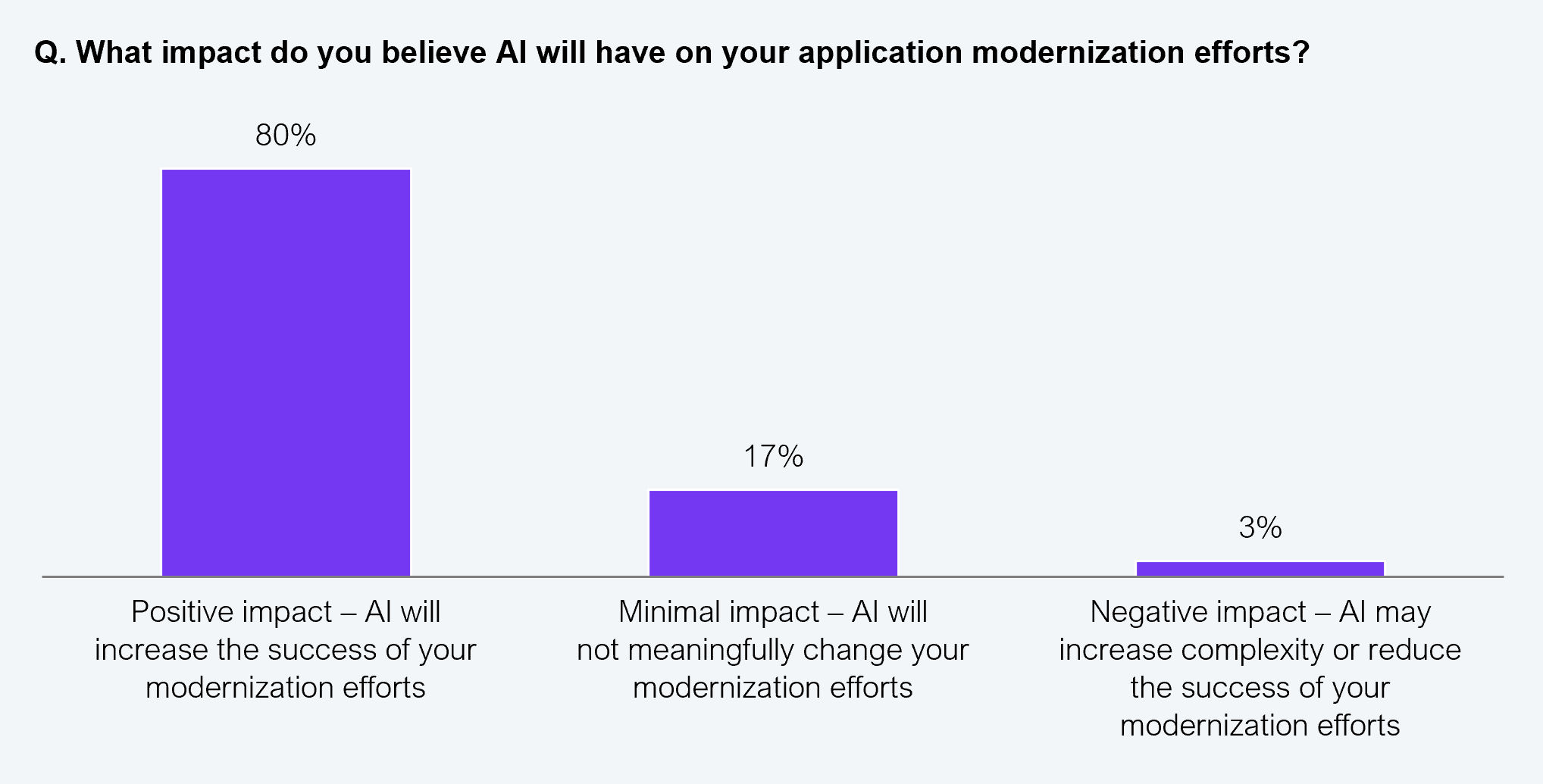
Sample: 608 IT and business leaders across Global 2000 enterprises
Source: HFS Research in partnership with Publicis Sapient, 2025
And that optimism isn’t misplaced. AI can now:
And, for the first time, leaders are seeing it do so at a cost-to-scale ratio that makes modernization viable in a fraction of the time previously required—thanks to the AI capabilities and the falling cost of both code and compute. With large context windows and the ability to reason across structured and unstructured data, AI changes what’s possible—not just how fast we move. But AI can’t be another tool in the box. It must become the foundation of how work gets done and how systems are reimagined.
I can spin up an LLM pipeline in hours. The problem isn’t the platform. It’s plugging AI into a .NET workflow from 30 years ago.
— Senior AI leader, healthcare enterprise
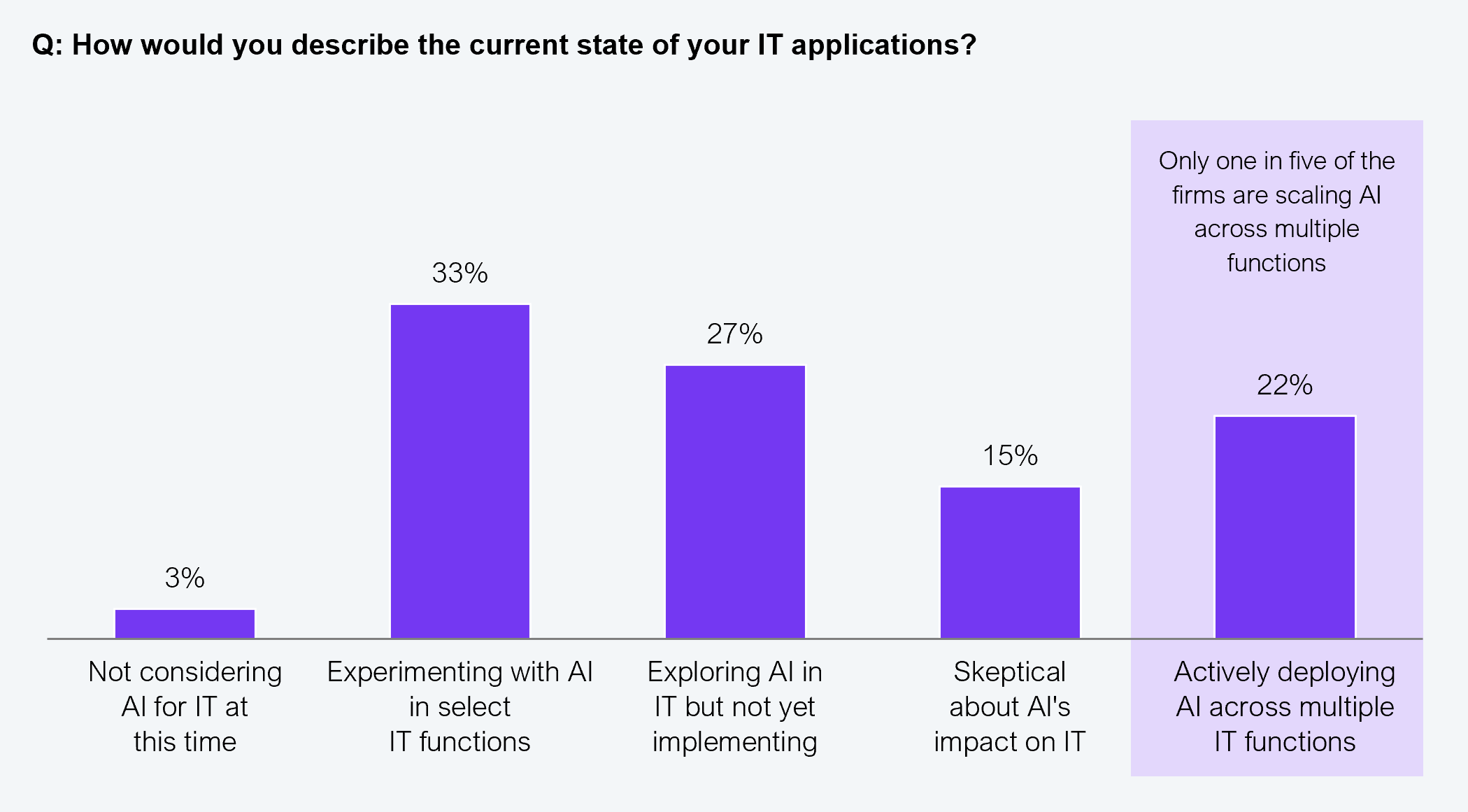
Don’t let the hype fool you. While most are bullish on AI’s role in IT, few have cracked the code. Only one in five of the firms we surveyed claim to be scaling AI across multiple functions (see Exhibit 3). A third admit to simply experimenting. This is tinkering, at best.
Sample: 608 IT and business leaders across Global 2000 enterprises
Source: HFS Research in partnership with Publicis Sapient, 2025
Even worse, 27% are simply exploring possibilities with AI, while another 15% are skeptics. So, nearly half of all the firms haven’t even started yet.
You can solve for tech. What’s harder is solving for people. We don’t have enough leaders who can usher in real change—and fewer who understand what that means in AI.
— CDO at a leading enterprise
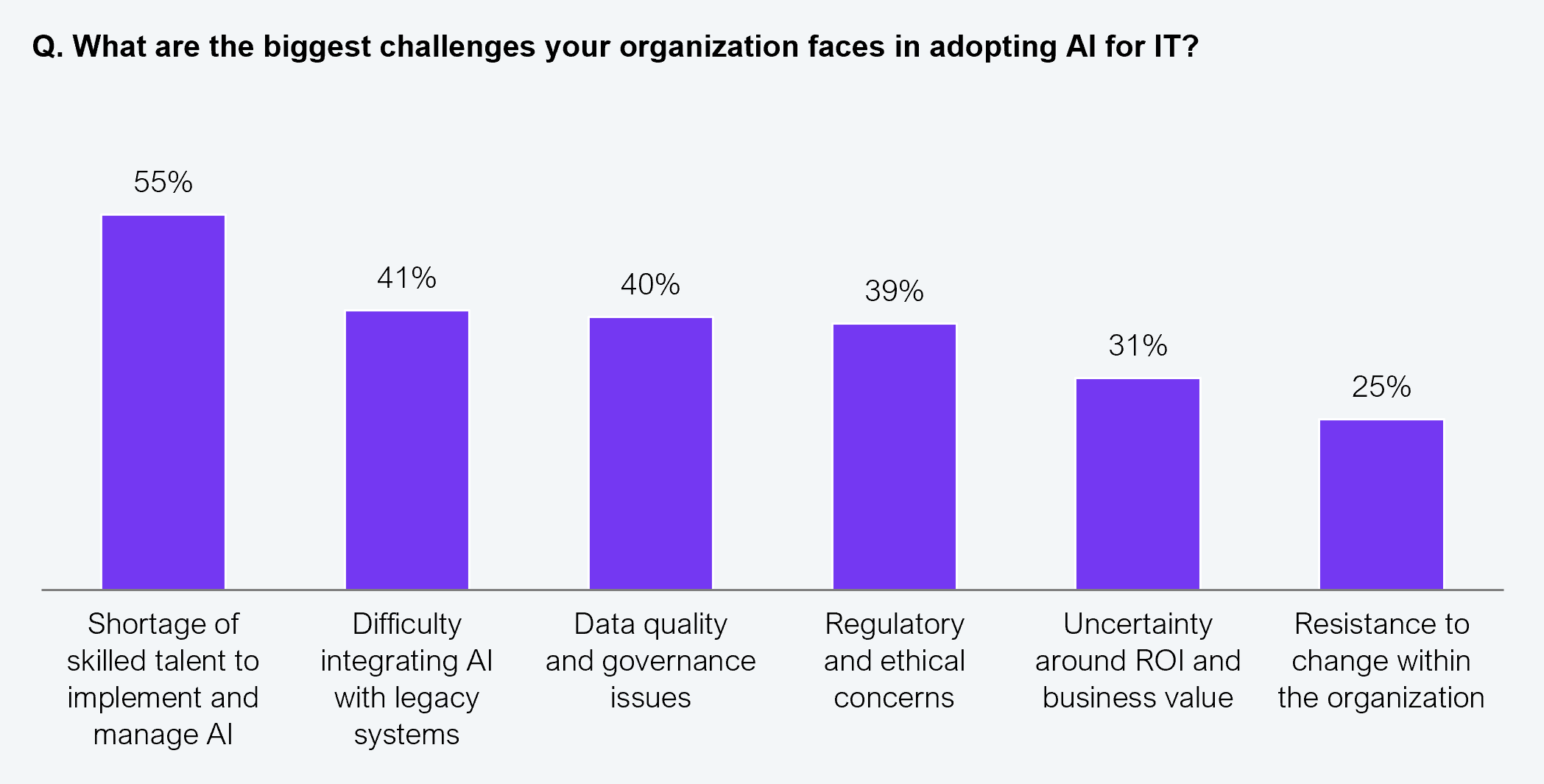
More than half of the leaders we surveyed say they lack the talent, data, or governance capabilities they need (see Exhibit 4). Ethics and compliance concerns are a priority for 39% of firms, and 41% are still struggling to integrate AI with their legacy systems.
Sample: 608 IT and business leaders across Global 2000 enterprises
Source: HFS Research in partnership with Publicis Sapient, 2025
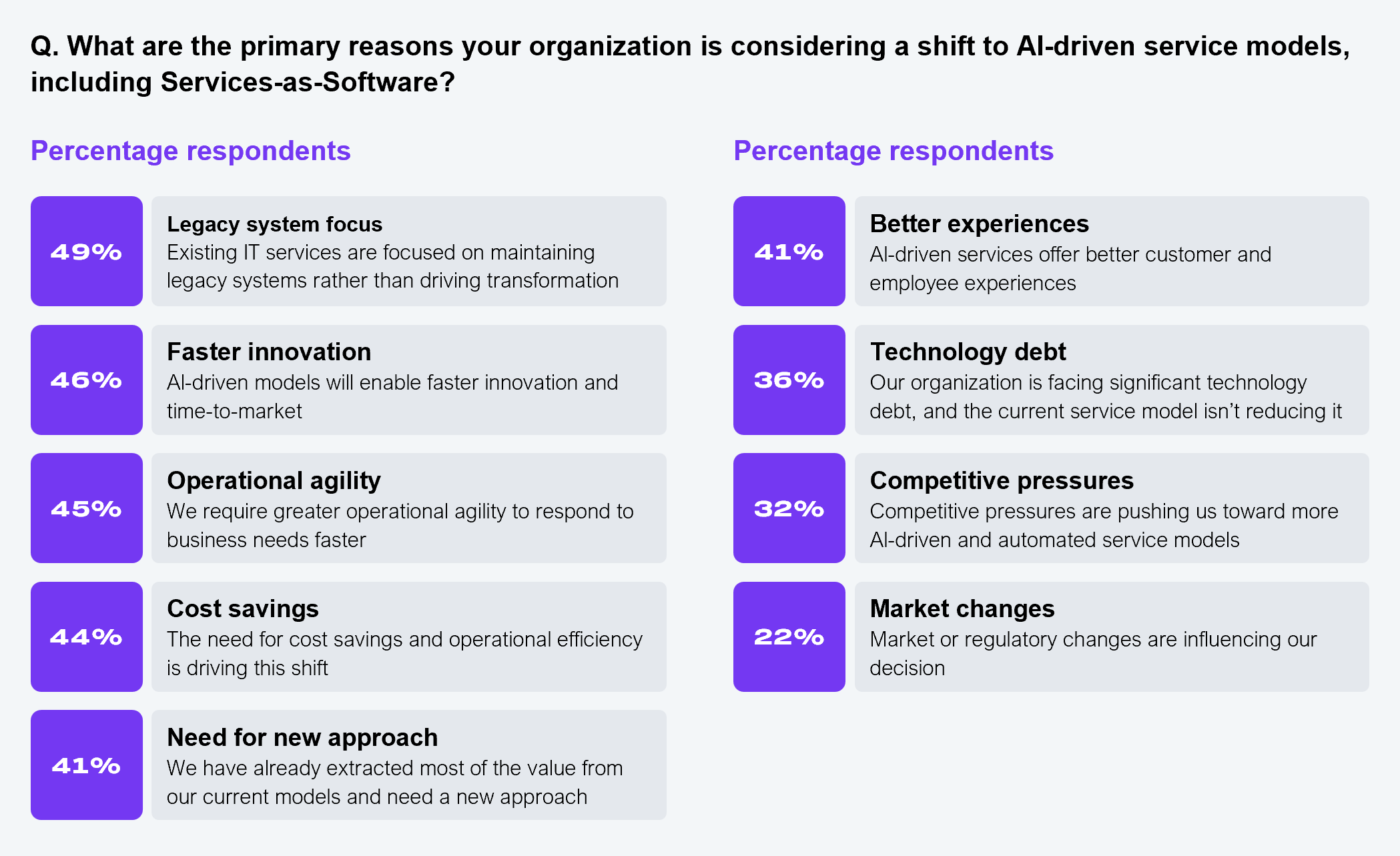
What’s driving it? Leaders are looking for an end to their stagnant status (see Exhibit 5). Almost half say legacy constraints are killing innovation, and similar numbers demand faster transformation, greater agility, and more resilience. More than a third simply want an escape from mounting technical debt.
Sample: 608 IT and business leaders across Global 2000 enterprises
Source: HFS Research in partnership with Publicis Sapient, 2025
Despite years of investment in IT services, the top reasons enterprises are shifting to AI-led service models reveal deep dissatisfaction with the status quo. Taken together, this data tells a clear story: Enterprises want models that are faster, smarter, and more aligned to business outcomes. This is not about incremental improvement; rather, a demand for new service models that act more like software.
Source: HFS Research 2025
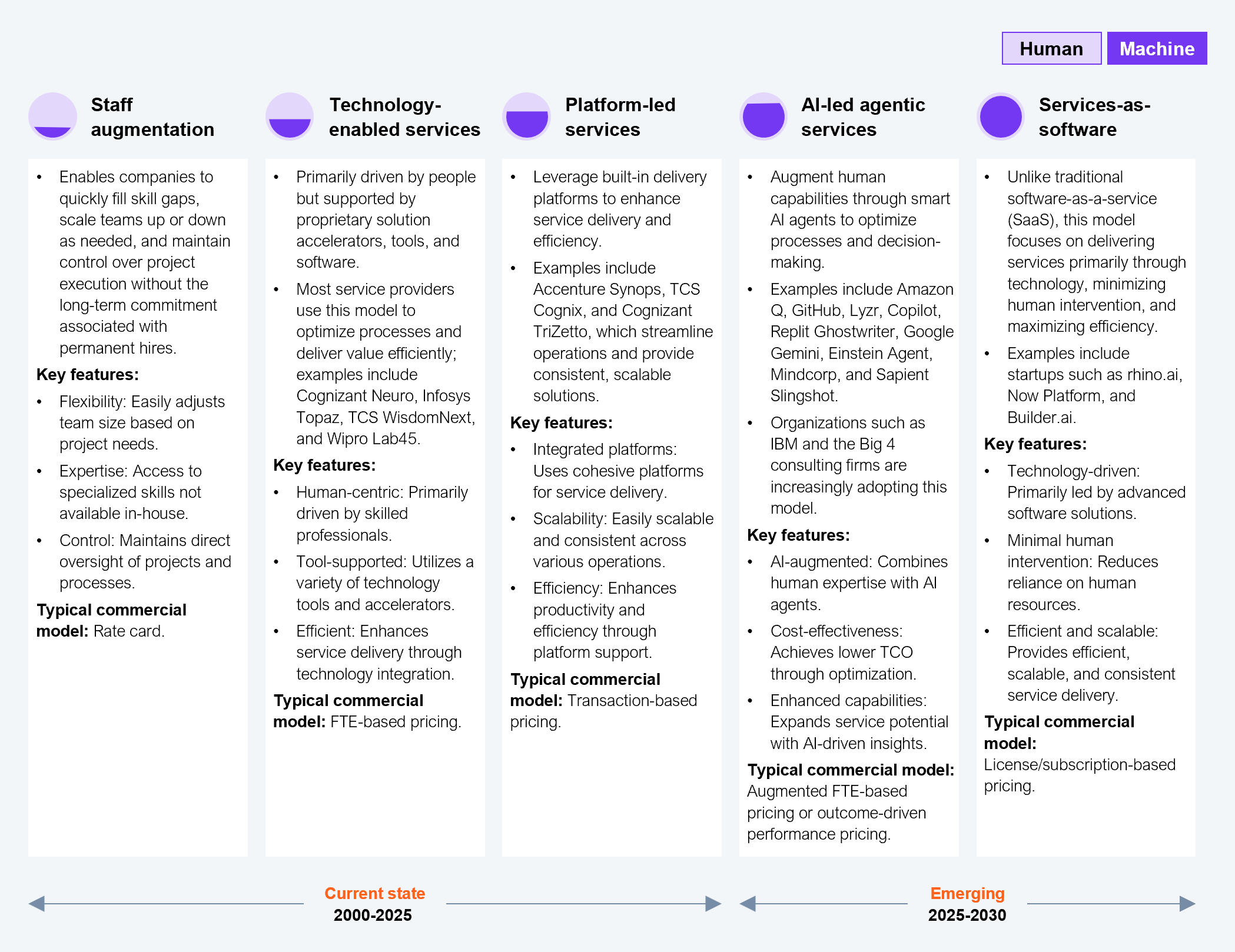
The IT services industry has long profited from enterprise inertia, sustaining itself by staffing large teams—often recent graduates from India—to maintain outdated systems under long-term contracts. This old model—outsourced labor, linear delivery, static rate cards—perpetuates tech debt and isn’t working. Emerging in its stead, and not a moment too soon, is Services-as-Software—a term coined by HFS Research to describe a shift to technology delivering services in place of labor arbitrage. This is the post-labor model for enterprise IT. This model is technology-driven, primarily led by advanced software solutions with minimal human intervention—cutting the reliance on human resources (see Exhibit 6).
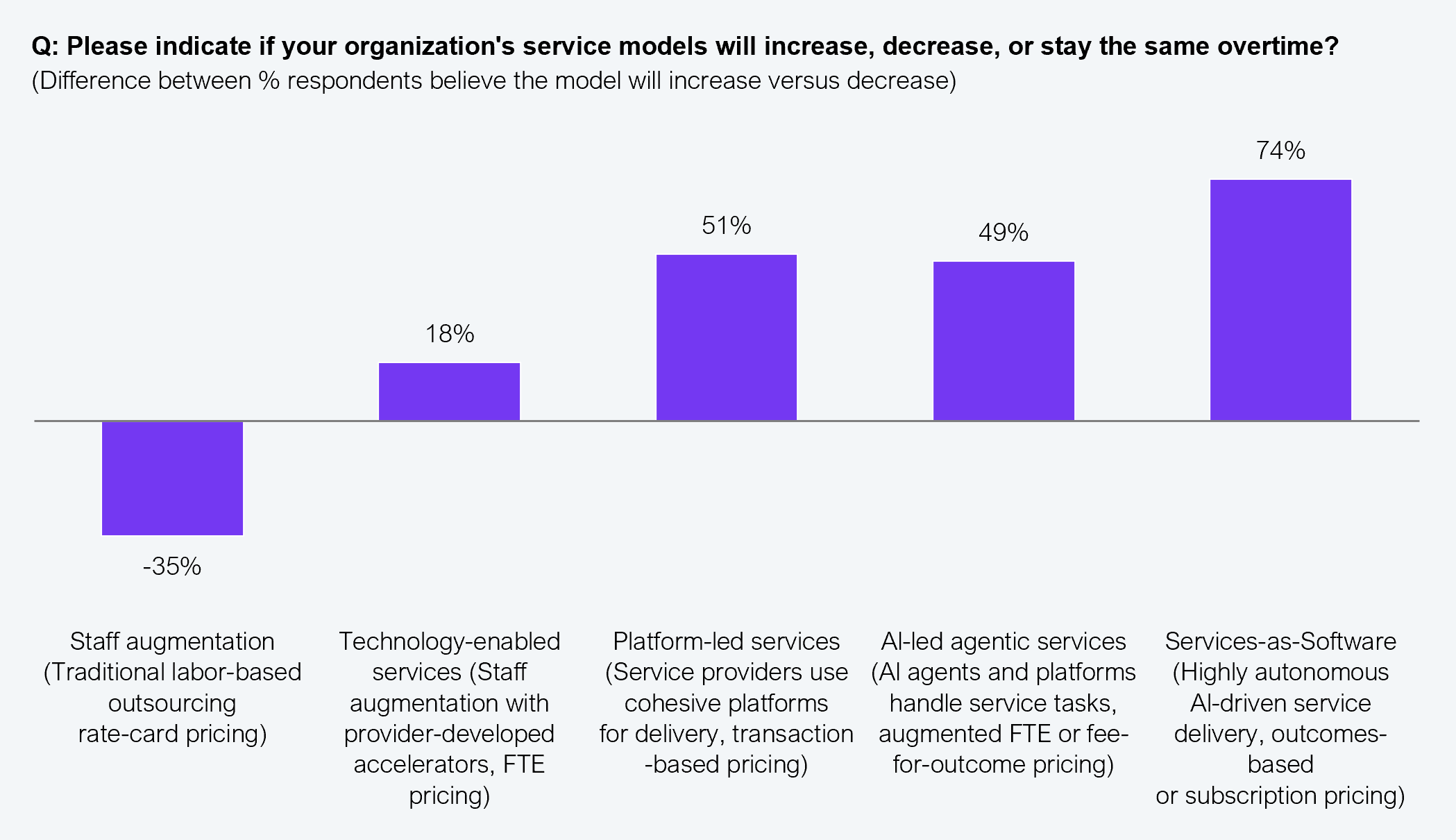
Three in four enterprise leaders now expect a pivot from staff augmentation models to Services-as-Software (see Exhibit 7).
Sample: 608 IT and business leaders across Global 2000 enterprises
Source: HFS Research in partnership with Publicis Sapient, 2025
Everyone wants to modernize. But if your provider still leads with headcount, you’re not buying transformation—you’re renting inertia.
— IT director, banking sector
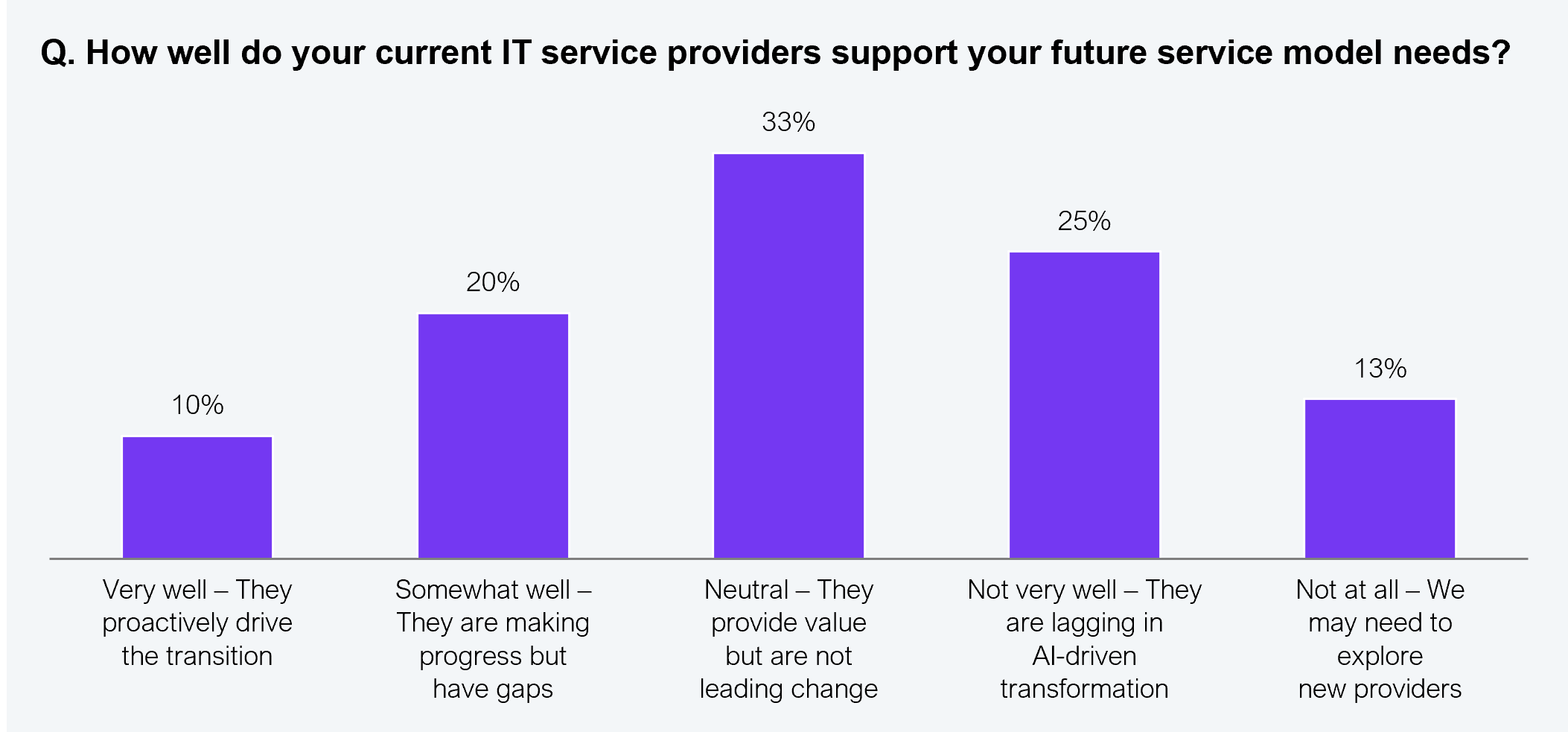
Despite the buzz, most service providers are behind the curve. Only 10% of enterprise leaders say their vendors are proactively helping them pivot to AI-powered delivery (see Exhibit 8). Most, at best, say they are being offered incremental value. Your vendors are failing to lead on the future service model you are crying out for.
There’s a lot of PowerPoint and flashy demos. But translating that into real architecture? That’s where they fall short.
— Senior IT leader, healthcare enterprise
Four in 10 leaders are actively dissatisfied with their current providers and 71% indicate they’re ready to switch providers for better AI execution and/or leadership.
Sample: 608 IT and business leaders across Global 2000 enterprises
Source: HFS Research in partnership with Publicis Sapient, 2025
The writing is on the wall: Enterprise leaders want productized capabilities, not people. They want platforms, not presentations.
As services become software, the commercial model must evolve. This must become an area of focus in every AI transformation conversation. Our data (see Exhibit 10) shows a clear demand for change. Yet examples of successful deployment of new commercial models are few and far between.
Procurement leaders worry about runaway costs in untested models. An important first step, therefore, is to test the models in small and contained experiments to provide some reassurance to the procurement department.
What is for sure is that a full-time equivalent (FTE) model cannot work when pricing for Services-as-Software. And firms should be wary of simply switching human body-shopping for agent body-shopping—we’ll be back to square one in no time if we go down that route.
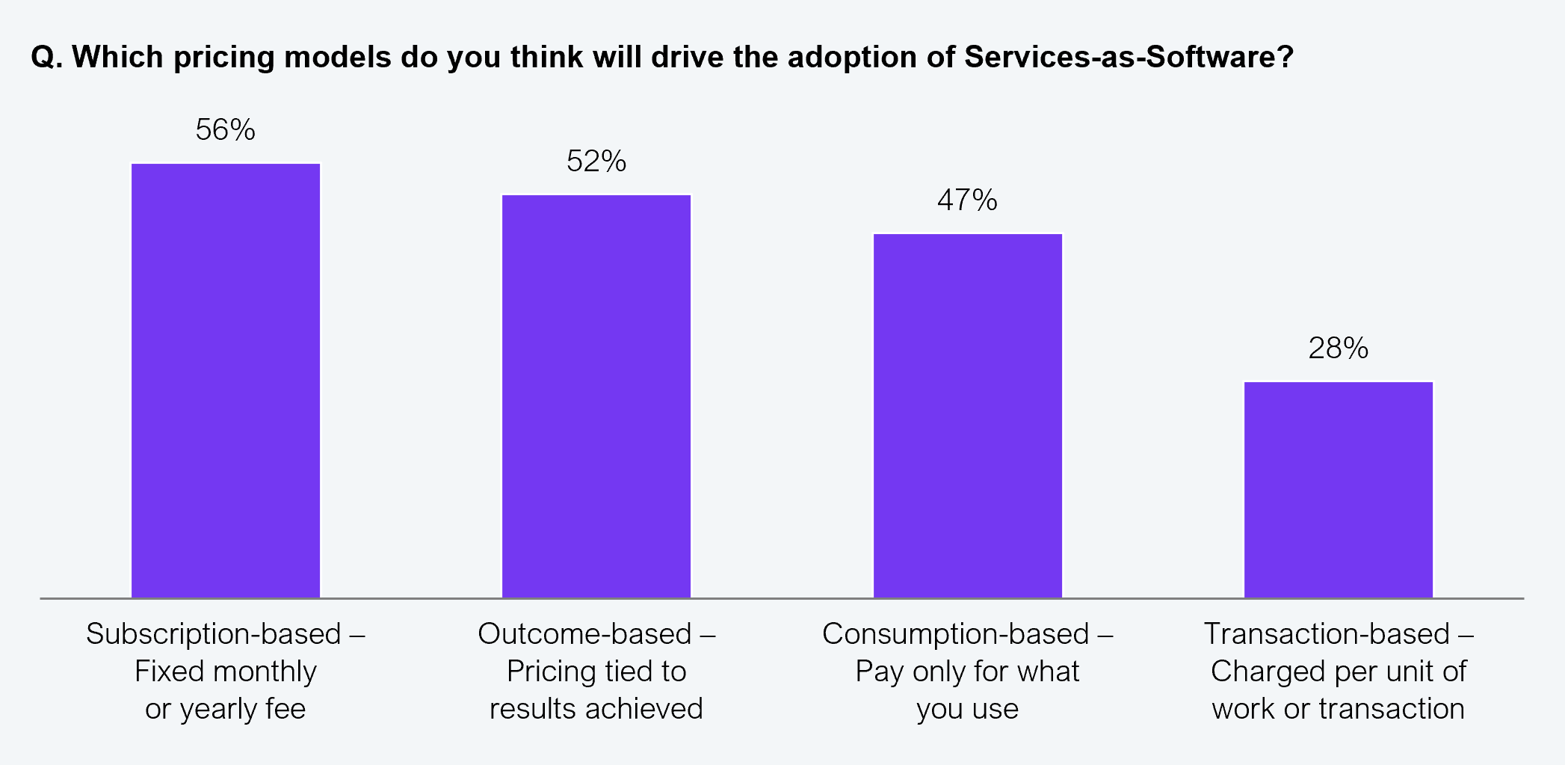
Exhibit 9 shows that the current favorites among enterprise leaders are: subscription models (56%), outcome-based pricing (52%), and consumption-based pricing (47%).
Sample: 608 IT and business leaders across Global 2000 enterprises
Source: HFS Research in partnership with Publicis Sapient, 2025
Every vendor says they have AI. But show me the value. Show me the savings. It has to be quantifiable
— Executive AI leader, North American bank
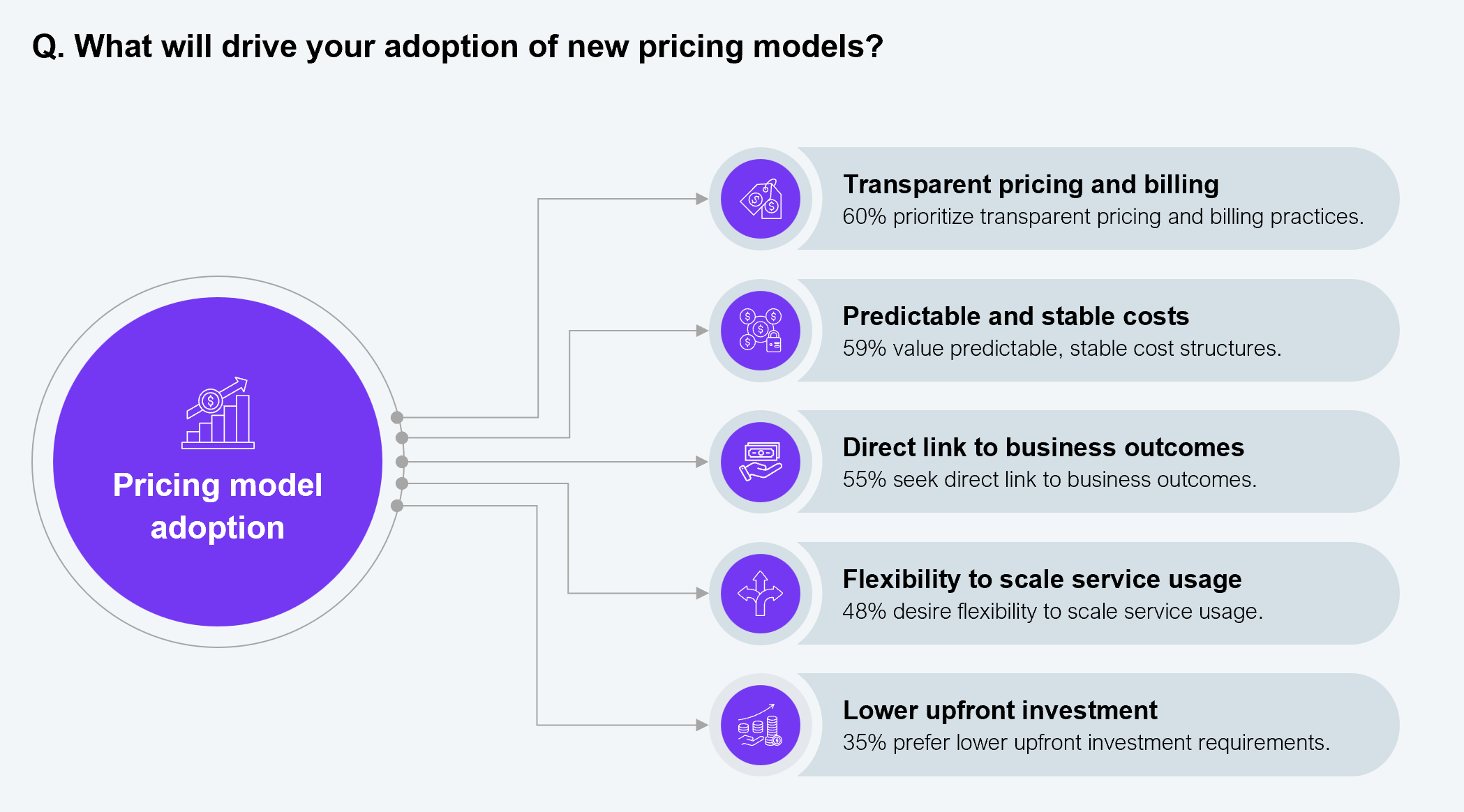
In moving to new commercial models, enterprise leaders are clear about the measures they want to see built-in (see Exhibit 10).
The model’s only valuable if you can validate it. We need analytics to prove it’s working—not just invoices that say it did.
— Director of technology at a global energy firm
Sample: 608 IT and business leaders across Global 2000 enterprises
Source: HFS Research in partnership with Publicis Sapient, 2025
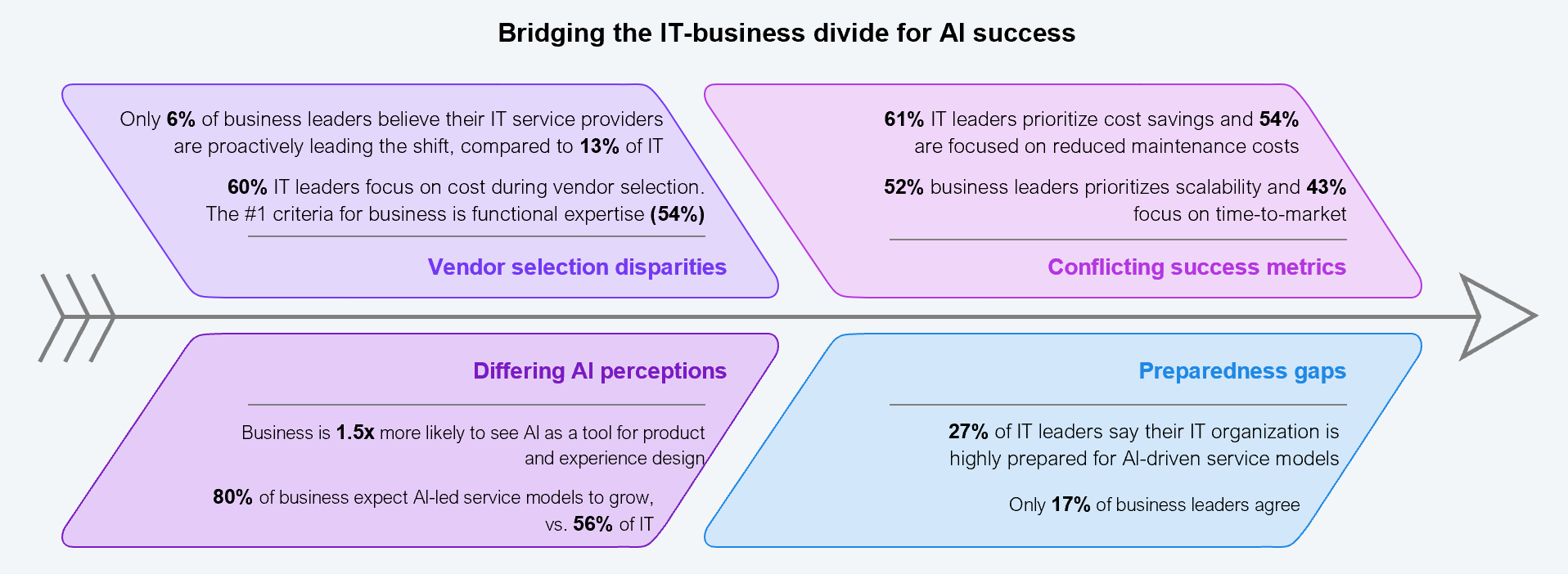
Despite strong momentum toward AI-led, software-defined services, IT and business leaders are still operating from different playbooks—and it’s undermining progress. IT sees AI as an evolution of infrastructure and cost optimization; business sees it as a lever for growth, speed, and innovation.
One of the challenges is that a lot of what gets done is driven by the business. And the business controls the budget. But no one in the business is saying ‘go spend millions changing our infrastructure.’ So the IT team ends up trying to fund transformation without clear business sponsorship
— Senior technology leader in a global insurance firm
We uncovered four critical disconnects that must be resolved for the Services-as-Software transformation to succeed (see Exhibit 11).
Sample: 608 IT and business leaders across Global 2000 enterprises
Source: HFS Research in partnership with Publicis Sapient, 2025
We need to align AI strategy with business strategy. Change management is as important as the tech. You can build something shiny— but if people don’t use it, there’s no ROI.
— Executive AI leader, North American bank
This clash isn’t just a matter of perspective; it’s a structural fault line that will stall transformation unless addressed head-on. Alignment requires a shared language of value. That means:
Ultimately, AI transformation isn’t an IT initiative—it’s a business operating model shift. And it can’t succeed unless both sides have a firm hand on the jackhammer.
If AI is the jackhammer, the operating model is the concrete slab it needs to break through. You can’t apply transformative technology with a transactional mindset. The legacy operating model—centered on labor, layered approvals, and linear workflows—wasn’t built for intelligence. And it certainly wasn’t built to help you escape tech debt.
To unlock AI’s potential, enterprises must stop grafting it onto outdated structures and start rebuilding around it. That means redesigning how work gets done, how services are delivered, and how value is measured. The future operating model is modular, intelligent, and outcome-led—and it’s incompatible with legacy scaffolding.
Here are three foundational shifts:
1. From siloed systems to seamless value chains
Think ‘connected enterprise,’ not fragmented departments. AI thrives on context—and context dies in silos. The future operating model dissolves barriers between front, middle, and back offices to create a unified flow of data, decisions, and action.
That’s the essence of the HFS OneOffice vision: real-time visibility, unified governance, and orchestration of value from customer touchpoint to fulfillment. AI can’t deliver business outcomes if it’s boxed into a single function or owned by IT alone.
Management Tactics: Invest in process mining, break down legacy ownership boundaries, and rewire teams around end-to-end outcomes—not org charts.
2. From governance bottlenecks to embedded guardrails
Traditional governance slows everything down, especially AI. Monthly steering committees won’t keep up with autonomous agents making real-time decisions. Yet the risks are real. In highly regulated industries, you don’t get to ‘move fast and break things.’
This isn’t e-commerce. You don’t get to move fast and break things. In highly regulated industries, explainability and control aren’t optional—they’re non-negotiable.
— CIO at a leading financial services institution
Instead of relying on oversight after the fact, build governance into the system from the start. That means automated controls, policy-based enforcement, and real-time monitoring—so risks are caught and contained in the moment, not in a memo weeks later.
Management Tactics: Shift from governance as review to governance as code. Empower leaders to manage policies, not people.
3. From labor management to platform stewardship
This isn’t about managing more people—it’s about managing smarter systems. In the new model, your employees aren’t just doing tasks. They’re orchestrating outcomes with AI.
You don’t need more managers—you need platform owners. HFS has already researched an example start-up in which every employee’s job description includes their role as a manager of AI agents. This isn’t some far-flung future; this is happening here and now. Read: Ops leaders must embrace agentic-by-default.
There’s no off-the-shelf AI talent. The field is evolving too fast. You build your team by mixing full-timers with flexible specialists—but that creates tension between agility and ownership.
— Technology leader based in Silicon Valley
Your teams must steward automation, calibrate agents, and continuously improve digital workflows. This requires a mindset shift from coordination and effort tracking to insight, platform product management, and business impact.
Management Tactics: Redesign roles to include AI stewardship and retrain managers to lead platforms—not projects. Reward outputs and outcomes, not effort expended.
Imagine this.
Your core platforms evolve continuously, not in quarterly sprints or annual upgrades. AI reads legacy code, replaces brittle workflows, and suggests improvements before you ask.
Your teams don’t spend cycles reconciling systems—they guide intelligent agents that stitch together decisions across functions, channels, and continents in real time.
You’re not managing project plans—you’re orchestrating outcomes. Compliance is embedded. Governance is coded. And decisions are faster because they’re grounded in more context than any human could ever hold.
Your vendors deliver products, not promises. You pay for value, not volume. And you finally have the transparency, flexibility, and control to modernize at the speed of business.
This is not a patched-up legacy stack—but a platform for continuous reinvention. AI is not a bolt-on but an operating system.
Be brave with the jackhammer. Smash through to a post-tech-debt enterprise:
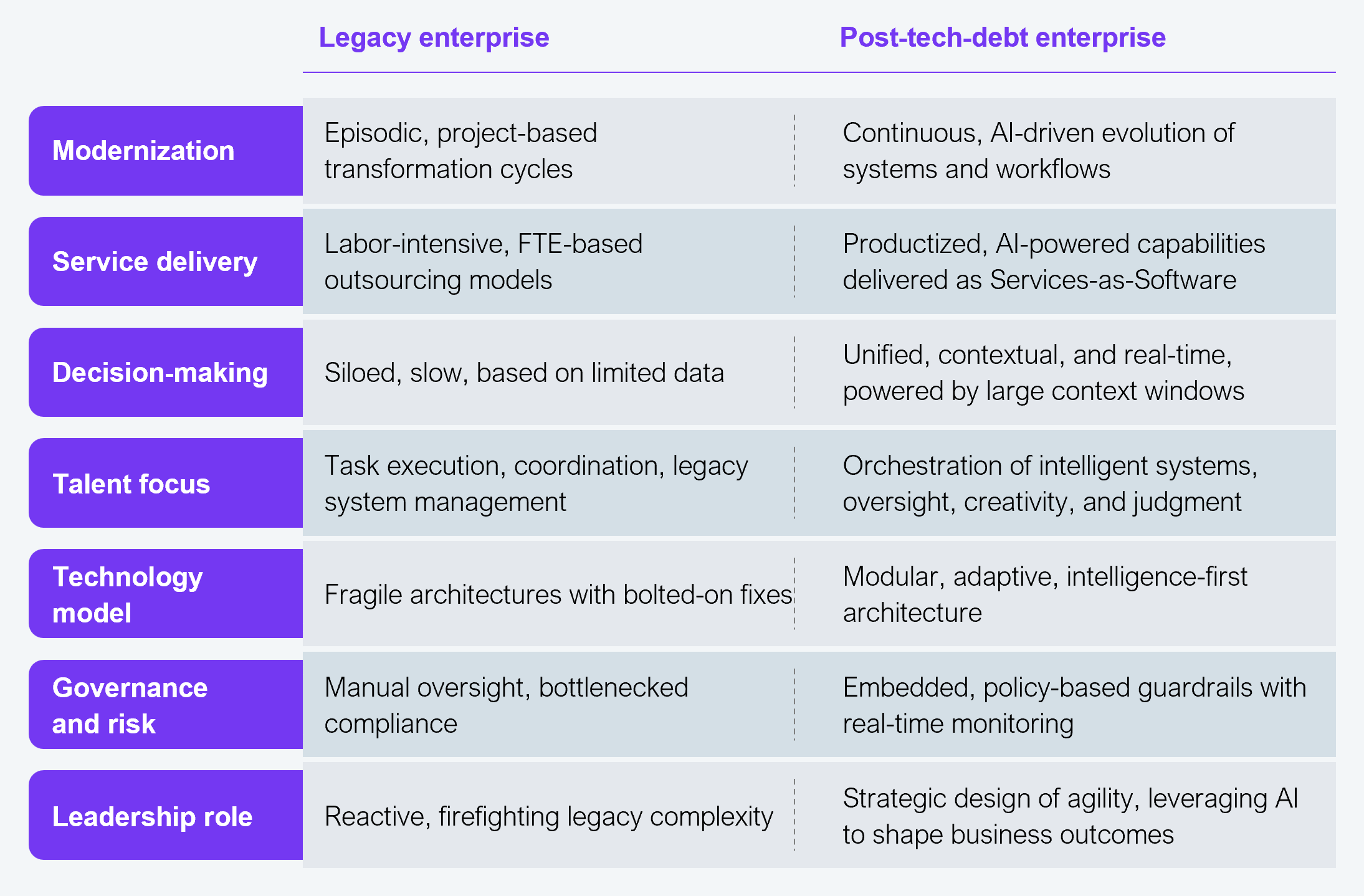
This post-tech-debt enterprise is not a fantasy. It’s what enterprise looks like after the jackhammer has done its work. AI isn’t the destination—it’s the demolition crew. What you build next determines whether you lead—or get left behind.
Tech debt isn’t just an inconvenience, it’s the enterprise anchor dragging your transformation to a crawl. AI gives you a once-in-a-generation chance to cut the cord. But doing so requires more than tooling up—it demands a decisive shift in how you build, partner, govern, and lead.
Here are the five moves that separate AI-native leaders from those automating their stagnation:


Tech debt is no longer just a technical issue. It’s a business risk. A cost drain. A competitive liability. And the longer you delay, the deeper it gets.
In a macro environment where efficiency is king, tariffs are rising, and budgets are tightening, waiting isn’t strategy—it’s surrender.
You don’t get free of tech debt by wishing it away. You get there by rewiring how your enterprise works—and who you trust to help you do it. AI is the jackhammer. The five moves above are how to use it.
Register now for immediate access of HFS' research, data and forward looking trends.
Get Started

If you don't have an account, Register here |
With the exception of our Horizons reports, most of our research is available for free on our website. Sign up for a free account and start realizing the power of insights now.
Our premium subscription gives enterprise clients access to our complete library of proprietary research, direct access to our industry analysts, and other benefits.
Contact us at [email protected] for more information on premium access.

