
Consumers’ increasing expectation for seamless shopping, whether in store or online, is challenging retailers to transform their operational models to support a true omnichannel experience. In order to stay competitive, retailers must work toward bridging experience across digital and physical touchpoints throughout the customer journey to help customers better connect with products and create loyalty to the brand.
This POV examines how one sportswear manufacturer and retailer transformed its operations across people, process, and technology to result in record performance statistics, including stock price and market capitalization. Its approach contains some valuable lessons for retailers wanting to drive holistic transformation within their enterprises and with partners, and it shows that a people–first focus for creating engaging customer experiences can result in real business results.
Retailers know that “digital” is all about creating an engaging customer experience
Retailers, more than any other industry, are keenly focused on creating new and engaging customer experiences.
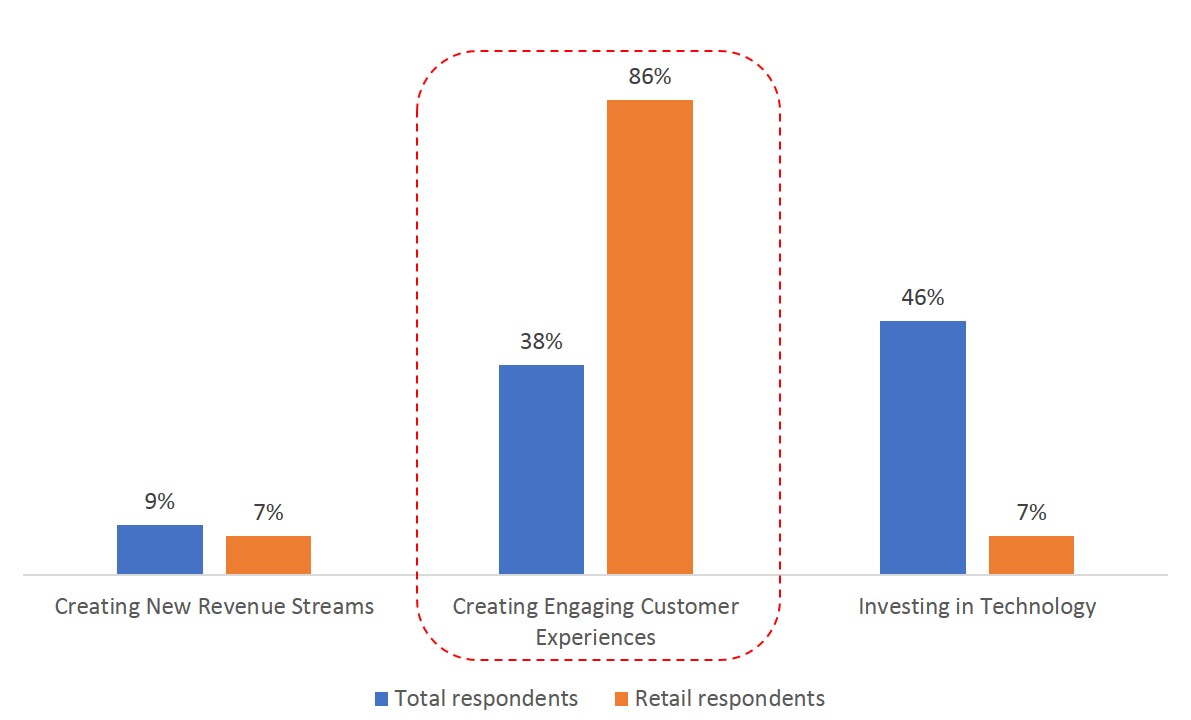
An HFS Research survey indicated that while only 38% of global enterprise respondents thought of digital’s impact as creating new customer experiences, 86% of retailers had this viewpoint (see Exhibit 1). In particular, consumer packaged goods (CPG) companies see digital as an opportunity to connect more directly with consumers and inspire brand affinity, where they’ve traditionally gone to market through retailers in a B2B2C model. While investing in technology may be part of it, this data shows that retailers view digital as it relates to customer experience as its greatest area of impact.
Exhibit 1: Retailers understand that digital’s impact is about customer experience
Which of the following statements most closely resembles your leadership’s view of the impact of digital?
Source: HFS Research, n = 395 C-Level Enterprise Executives
Transformation requires people, process, and tech: the “people problem”
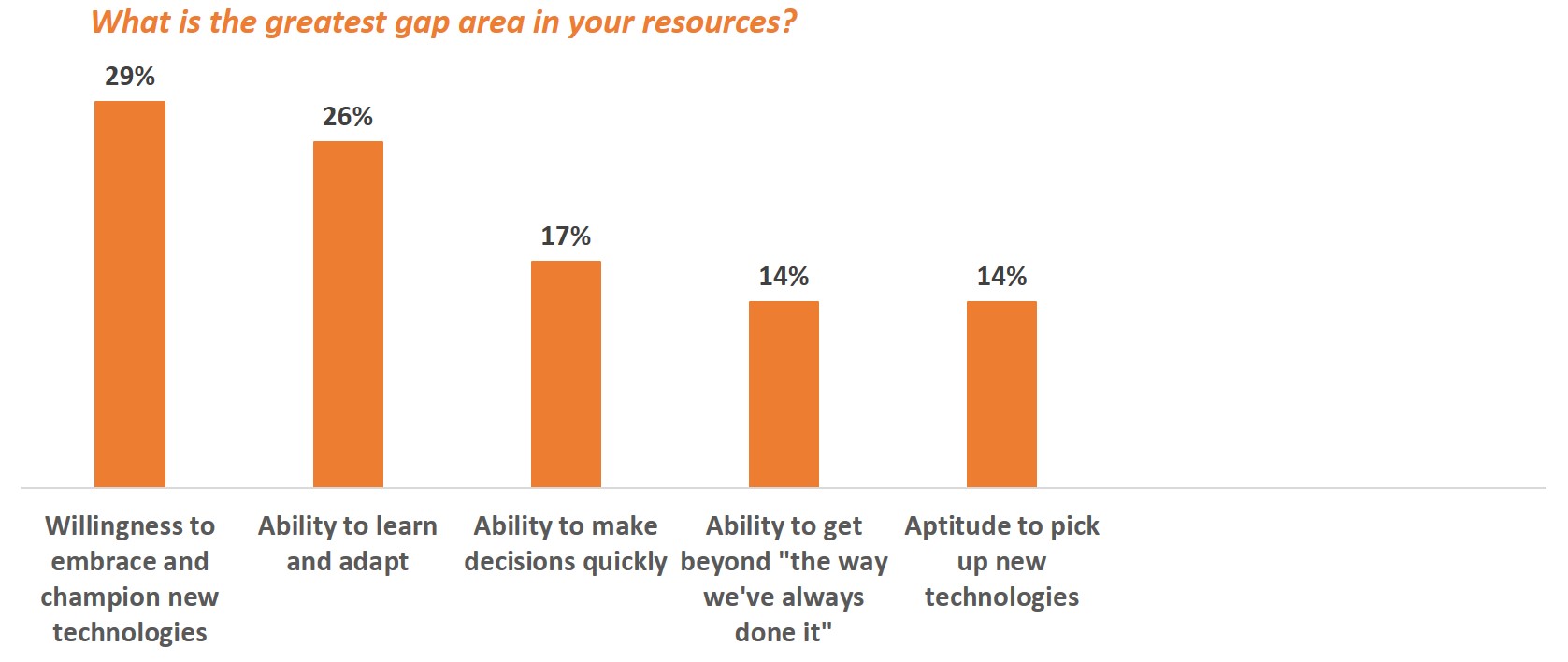
We asked retailers about their greatest resource gap, and the top response pointed to not having enough employees with a willingness to embrace and champion new technologies (see Exhibit 2). The second–largest gap pointed to not having enough people with the ability to learn and adapt. These are not skills and expertise problems; issues with a willingness and ability to learn and adapt point to a misalignment in an enterprise’s culture. When people’s expectations don’t align with embracing new technologies, it could be because the company selected the wrong technology or that it has not incentivized employees to use or value the technology.
Exhibit 2: Cultural problems are holding retailers back from transformation
Source: HFS Research, 2019, n= 42 Global 2000 retail and CPG companies
Retailers need to work with their partners to overcome the “people problem.” They also must think about whether their current partners are the right ones to work with in the future. They should be seeking partnerships that help align culture, learn, and adapt. As the omnichannel solutions lead at the retailer put it, “It all starts with the mindset of the people—getting customers and employees engaged and aligning solutions to their expectations.”
– Senior Director Global Omnichannel Solutions, major sportswear manufacturer and retailer
Case study: A leading sportswear company leveraging a partner’s speed and scale for omnichannel success
A leading sportswear company, which is largely wholesale but growing in direct–to–consumer, is on a journey to engage more directly with customers and improve customer experience. With help from its primary IT services partner Infosys, this company conceptualized what the customer experience should look like, what tools to select, and how to align talent to solutions. As the omnichannel lead described it, “Figure out first what motivates people and then develop incentives for adoption.” As a partner, Infosys aligned with this people–first approach and provided the added scale and expertise to help the retailer design the customer journey, develop ideas, and test them to get them to market quicker.
These examples show how the partnership enabled the implementation of new ideas that led to business results:
The omnichannel transformation this retailer has undertaken has enabled a very high growth of e–commerce business at the retailer growing fourfold in the last four years. The omnichannel platform has contributed to this growth by enabling faster delivery, quicker returns and refunds, and the option buy online and pick up or return in the store. The increased digital engagement has resulted in lower returns, higher sales, and increased Net Promoter Score. Beyond the customer experience, the platform has enabled more intelligent and efficient back–office processes such as better inventory turnover and single inventory view, which contribute to fewer cancellations and increased product availability via e–commerce. The retailer is using these changes to its omnichannel platform in support of its goal to capture customer loyalty and become the “best sportswear company in the world.”
The Bottom Line: Partnering with a “people-first” approach can generate better customer experience and result in improved business performance
A big part of this engagement’s success has been the setup of a change management organization to ensure that the sportswear company’s team gets enough insights, support, and training for changes in the process and systems. This team also collated feedback on the new system to improve it so that users would embrace the change. This shows that the people–first approach is critical not just in the design and setup phases of implementing new processes and systems, but also in the ongoing management and improvement of the transformation.
Register now for immediate access of HFS' research, data and forward looking trends.
Get StartedIf you don't have an account, Register here |
With the exception of our Horizons reports, most of our research is available for free on our website. Sign up for a free account and start realizing the power of insights now.
Our premium subscription gives enterprise clients access to our complete library of proprietary research, direct access to our industry analysts, and other benefits.
Contact us at [email protected] for more information on premium access.


