
If there is a subject that doesn’t need any more complexity, it is quantum computing. (See our latest guide and research on this.) We have focused our research on the main tent of quantum computing, full universal quantum, largely because it has the most disruptive potential—at least in a single bound. The reality is that despite the clamor for quantum, most enterprise leaders don’t have a clear understanding of how it works or whether the many solutions proffered by vendors are just inspired by the decades-away technology. Technology leaders must build a clear understanding of quantum, and when they do, they might find a couple of alternatives that could help with real-life problems more quickly.
To put it simply, there three different types of high-performance computers (see Exhibit 1) that fall into the quantum computer world (by the way, it is a bit more complicated than this—but it’s quantum, so it always will be).
Exhibit 1. The main types of “quantum” span cost, availability, and speed spectrums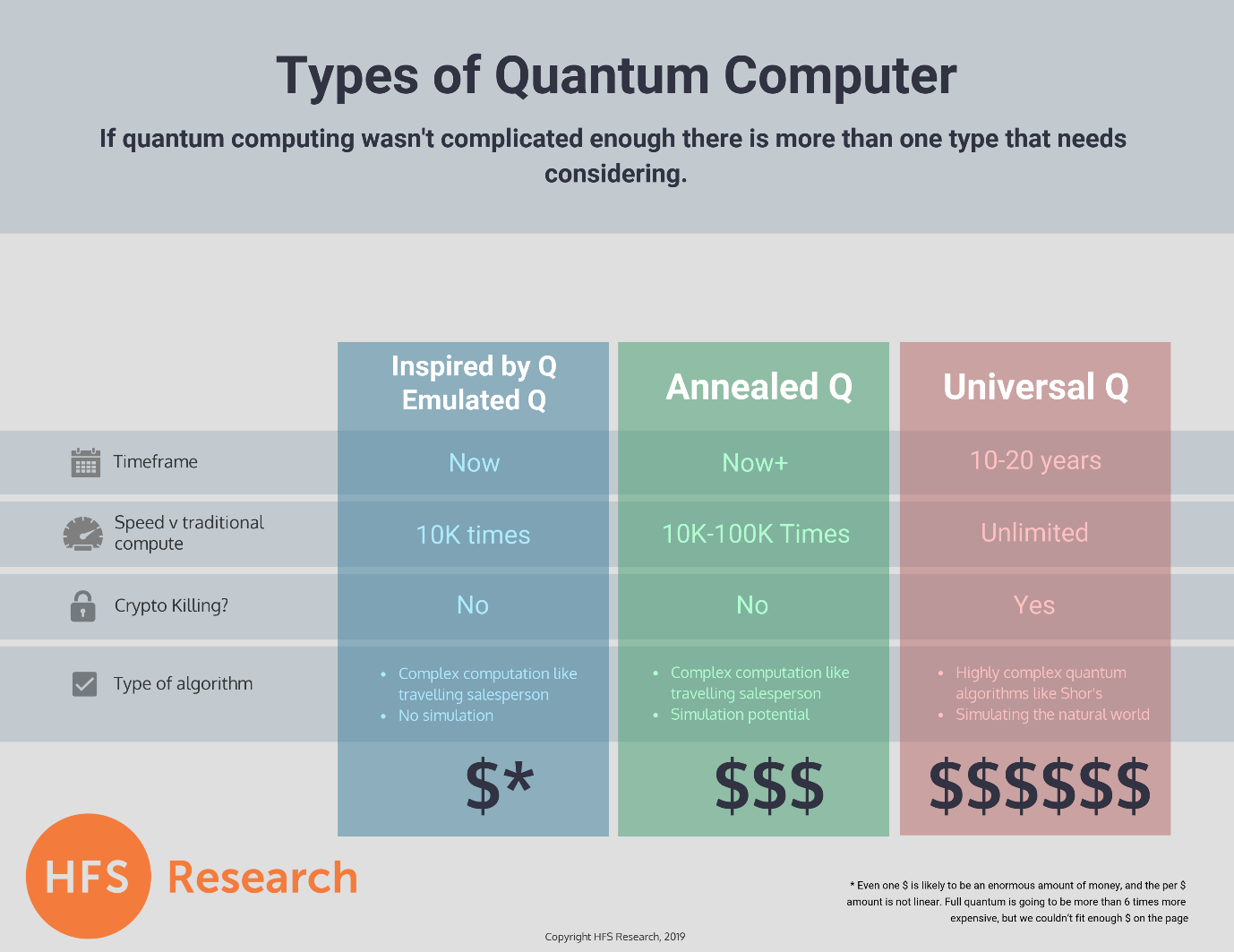
Source: HFS Research, 2019
The differences between the three categories are not trivial and reach beyond cost, availability, and speed.
Even computers inspired by quantum have the power to disrupt
Frankly, it exists. It works already, and it potentially provides a real-time solution for an existing class of complicated calculations that are traditionally executed as batch tasks, such as complex resource scheduling. When the resources are factory robots, for example, this can potentially have large implications.
The uncertainty surrounding the timeframe of full quantum computing provides opportunities to intermediate technologies, particularly as their price points are significantly lower. They will have a chance to demonstrate potential use cases for disruptive step change in complex compute problem-solving. For example, a closer-to-real-time solution for the travelling salesperson problem could change the way a transportation firm implements logistics and how a manufacturing business uses its expensive factory resources. HFS has seen some initial proof of concept work with Inspired Q, where rapid computations helped maximize efficiency of various scheduled resources including vehicle fleets and factory resources.
The Bottom Line: Quantum may be a long way off, but you can enter the quantum on-ramp with potentially disruptive high-performance computing now. Complex scheduling problems for expensive resources and other highly complex computation-intensive areas such as drug design could see disruption.
In the distant future, we may be able to apply quantum technologies to real business problems. Tech leaders must recognize that quantum technology is nowhere near practical application yet. However, there is a raft of vendors pushing “quantum inspired” solutions that mimic the successes of quantum computing theory to solve real business challenges. Entering a market filling up with hype and marketing drivel, tech leaders would do well to recognize this to ensure they aren’t blind-sided by glitzy messaging and alluring use cases.
Register now for immediate access of HFS' research, data and forward looking trends.
Get StartedIf you don't have an account, Register here |
With the exception of our Horizons reports, most of our research is available for free on our website. Sign up for a free account and start realizing the power of insights now.
Our premium subscription gives enterprise clients access to our complete library of proprietary research, direct access to our industry analysts, and other benefits.
Contact us at [email protected] for more information on premium access.

