
With the advent of the Internet of Things (IoT), billions of consumer and industrial devices are connected around the globe. Because connectivity is a critical factor to manage all these devices, telecom operators (telcos) have a bigger role to play in IoT. The global telecommunications sector is facing a financial crunch due to huge upfront investments for next-generation infrastructure and declining revenue streams. Telcos are struggling to cope with defining their next chapter and new revenue sources to replace declining core communications revenues.
IoT provides an excellent opportunity for telcos to increase both their top and bottom lines. Opportunities such as becoming integrators of connected devices and applications, offering payments, and other IoT capabilities can help them reimagine their businesses. In this PoV, we discuss the emerging IoT use cases that telcos can use as key growth levers.
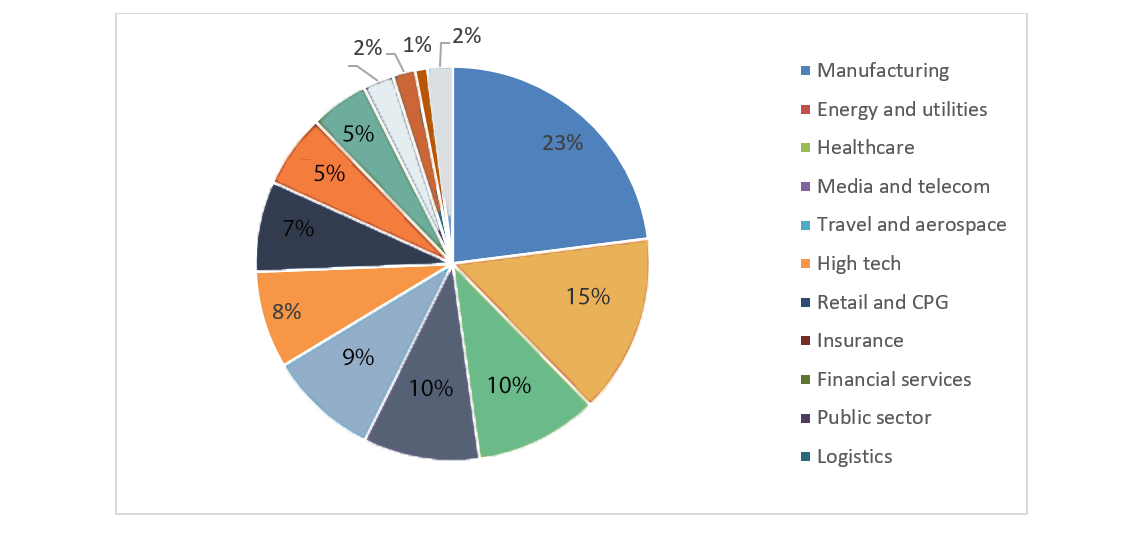
In 2018, HFS published the HFS IoT Services report in which we analyzed approximately 10,000 IoT engagements across different industries, as described in Exhibit 1. Based on our analysis, we found that the telecom sector accounts for around 10% of total IoT engagements, making it the third-largest sector for IoT engagements.
Exhibit 1: Percentage distribution of IoT engagements across industries
Source: HFS Research 2018
Infrastructure, connectivity, and point solutions are the three primary IoT use cases for telecom operators
We observed three types of client engagements:
Specialized connectivity services: Telcos primarily provide connectivity services for data and voice, but now they need to upgrade networks to provide machine to machine (M2M) services for a large volume of data and remote connections. The connectivity should be suitable for both wide area and local networks having compatibility across different network protocols. In IoT, low power connectivity (e.g., LPWAN, NB-IoT) is going to be a hot trend for telcos.
Infrastructure and platform-as-a-service models: With the advent of 5G, telcos can opt for a more flexible functional split of networks, such as differentiated services based on data volume, latency, or the criticality of applications. Telcos will be responsible for managing the connectivity infrastructure and network uptime of operational management platforms such as those for asset monitoring and supply chain track-and-trace.
End-to-end and value-added services: Telcos are in a sweet spot to provide data analytics services to third parties for customer segmentation (e.g., target audience and personalized offerings), predictive modeling (e.g., asset monitoring and maintenance reporting), and other purposes. Also, telcos have begun to provide end-to-end IoT solutions such as smart home functions (e.g., remotely controlling the electronic and electrical compliances), connected cars, and infotainment solutions.
We have observed several initiatives, acquisitions, and partnership announcements in the IoT space among the global telcos since 2018; here are some notable events:
Telcos need to integrate several technologies (e.g., SDN, NFV, AI) and industry depth to offer use-case-specific or industry-specific IoT solutions. Integrating newer technologies with IoT can help telcos create new opportunities that enable new revenue streams and improve bottom lines through network optimization. Some large operators such as Orange, AT&T, and Telefónica have adopted a model in which they charge a fee to both providers and consumers to manage and maintain connected services. Telcos need to maintain a strong focus on their target segments and need to develop a long-term strategy to build capabilities and client success stories.
Register now for immediate access of HFS' research, data and forward looking trends.
Get StartedIf you don't have an account, Register here |
With the exception of our Horizons reports, most of our research is available for free on our website. Sign up for a free account and start realizing the power of insights now.
Our premium subscription gives enterprise clients access to our complete library of proprietary research, direct access to our industry analysts, and other benefits.
Contact us at [email protected] for more information on premium access.


