
Digital twins—the virtual representation of a manufacturing environment and its physical assets, specifications, and data—has proven benefits when applied to manufacturing design, testing, and operations performance enhancement.
The concept has become a vital component for the discrete manufacturing industry, where it is being used as a digital clone of real-life production lines and products to recreate and simulate the physical design and manufacturing landscape. With their advanced 3D, AR-VR components, holograms, use of predictive analytics, and deep simulation capabilities, digital twins are promising manufacturing enterprise leaders non-linear gains not only in in optimizing production lines and operational performance but also in rapid product design, development, prototyping, and testing. Therefore, digital twins have become a mandatory solution to consider for any new-age manufacturing organization.
This report explores the advantages that the digital twin can bring to the manufacturing enterprises, the challenges of its implementation, the importance of ecosystems in the digital twin journey, and how Siemens is enabling its end-users for adopting digital twins.
In the recent past, we analyzed Industry 4.0 engagements based on different technology implementation (as shown in Exhibit 1) and found that digital twin adoption had already gained traction. Two technologies, the internet of things (IoT) and manufacturing data analysis (big data and machine learning), have played a significant part in the maturity of digital twin development. To learn more about how IoT and AI applications are shaping digital twin adoption, visit our report, Make Digital Twins Be Your Enterprise’s New Best Friend in an IoT World.
Exhibit 1: Percentage distribution of adoption of different technologies across Industry 4.0 engagements
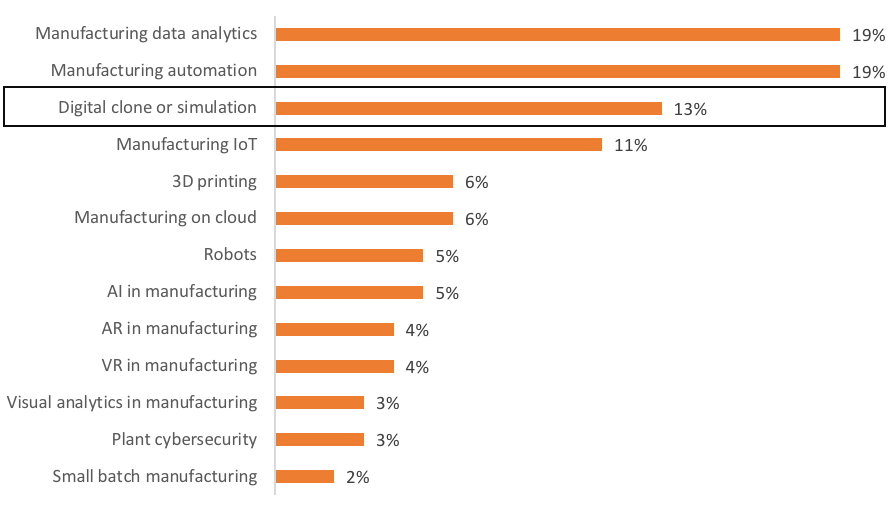
Source: 350+ Industry 4.0 engagements, The HFS Blueprint Guide to Industry 4.0 Services
The primary use cases of digital twins observed across the Industry 4.0 engagements are
The manufacturing landscape varies widely across the globe in terms of business processes, the technology used, and regulations. Overall, we have observed that the lagging manufacturing enterprises have some technology adoption challenges in common:
These challenges limit the journey of digital twin implementation for small manufacturing enterprises. Sometimes big manufacturing organizations lack digital maturity, resulting in multiple iterations for an accurate digital twin.
A robust ecosystem can expedite the journey of organizational technology maturity across two critical dimensions, technology and talent.
Manufacturing enterprises need to identify suitable technology partners for their digital twin journey. They can also collaborate with manufacturing IT service providers to enable this technology.
Siemens is focusing on building digital experience centers that will support machine tool builders, dealers, and educational institutes through knowledge sharing programs, application support, training, and similar initiatives.
In support of this need, Siemens India offers:
Manufacturing enterprises must embrace the digital twin technologies in the following steps:
Register now for immediate access of HFS' research, data and forward looking trends.
Get StartedIf you don't have an account, Register here |
With the exception of our Horizons reports, most of our research is available for free on our website. Sign up for a free account and start realizing the power of insights now.
Our premium subscription gives enterprise clients access to our complete library of proprietary research, direct access to our industry analysts, and other benefits.
Contact us at [email protected] for more information on premium access.

