
Robotic process automation (RPA) is not a panacea; it’s a software tool. It’s outstanding at automating standardized processes using structured data via screen capturing and database connections. Supporting tools and resources like SQL scripts, APIs, .Net, or cognitive capture tools extend its functionality. The market hype associated with RPA continues to be massive; however, missed objectives and lackluster returns on investment create a pall of disappointment and dissatisfaction—with many companies not even using the full functionality of RPA. But this may be a good thing. Perhaps the cold slap of mediocre results can awake us from the daze of thinking a singular magical software tool is going to transform our businesses, mass-produce bags of money, and slash headcount without any need for massive change management or process reinvention. The increasingly clear reality is that RPA is a powerful tool when enterprises use it correctly with a powerful supporting cast of complementary tools, supported by an execution approach that prioritizes solving problems, not standing up bots.
HFS with support from Blue Prism, is showcasing real enterprise journeys with robotic process automation (RPA). This report spotlights Arla Foods, a Scandinavian multinational dairy cooperative. Looking around the marketplace, Arla is one of the enterprises that is quite satisfied with its RPA program. It does not have the most bots implemented, but it has scaled RPA broadly and is reaping notable benefits. Its secret is taking a practical approach to automation – literally using the right tools for the job, ensuring enough technical expertise to know what works and what doesn’t for each business problem, and having enough backbone to pick and choose which emerging best practices work best for its enterprise.
Business automation supports Arla’s “Calcium” transformation program
 Arla Foods, founded in 1881, is a Denmark-based cooperative of dairy farmers. As the largest organic dairy producer in the world and owner of the second-largest milk pool in Europe, Arla offers a variety of dairy-based products to markets around the globe. In December 2015, Arla launched a new corporate strategy,
Good Growth 2020, designed to set its course for success for the next five years. Good Growth has primarily focused on bolstering target products and regions and creating a unified firm from its many mergers and acquisitions (M&A). To support Good Growth, in 2018, Arla launched a strategy accelerator program called Calcium. Calcium complements Good Growth and is designed to help Arla drive down costs and increase efficiencies to achieve its goal of a more than €400 million bottom-line impact by 2021. With €300 million, it will increase its milk price’s competitiveness, and it plans to reinvest €100 million into growth areas.
Arla’s business automation program emerged as a part of a mission to create a better digital company. It initially tapped RPA in 2016 to help create better processes within its finance division for SAP-enabled functions like financial controlling activities, balance sheet reconciliations, intercompany accounts, and month-end adjustments. The firm cut its RPA teeth with Redwood Robotics, which Arla selected for its out of the box connectors with SAP. While the tool itself was useful, it was the rigor of analyzing what was wrong with its processes and driving process improvement that ultimately delivered value to Arla. RPA was the means, not the end.
The success of Arla’s finance automation program helped drive further investment in RPA, with a stated objective to drive efficiencies beyond finance. Arla hired a business automation program lead, Maciej Obuchowski, in early 2017 to drive the program forward. Obuchowski had a couple of years of experience with automating business processes using RPA, .Net, VBA, and SharePoint with a computer science background. He came from WNS, but he had previously worked in Arla’s shared services center as a technical process improvement specialist. Having worked with Arla previously and having years of experience with process automation before RPA became a “hot topic” made him an ideal candidate for the job. His experience as a “citizen developer”—someone with in-depth business process knowledge and technical and programming knowledge—proved to be optimal to expand Arla’s use of RPA because it enabled him and his team to balance business needs with technical requirements to create effective solutions.
As Obuchowski built Arla’s RPA program, he wanted to ensure that he had the right tools available to his team to support a variety of automation scenarios beyond finance. He opted to bring in Blue Prism connected-RPA as a general-purpose “universal” tool to complement Redwood’s ERP focus. Obuchowski states Arla selected and continues to work with Blue Prism because it excels at automating back-office processes with robust controller features, the “best” visual studio, and an ability to extend its functionality by programming in .NET languages.
“This approach of being practical and technical allowed us to see through much of the hype around RPA and really focus on using an array of tools at hand to
drive swift and effective solutions to business problems. We would never use RPA just because we can. It’s always driven by being the best tool for the job.”
Maciej Obuchowski, Process Automation Manager, Arla Foods
Arla leveraged Accenture to get its RPA program off the ground by assisting with infrastructure, supporting a pilot program, training developers, and helping establish an RPA center of excellence (CoE). While most of the Arla team had to learn RPA from the ground up, Obuchowski prioritized using existing internal resources from the business, aligned to the citizen developer profile. After baseline training, he continued their training to broaden their technical capabilities and to ensure they were getting the most out of RPA. According to Obuchowski, “This approach of being practical and technical allowed us to see through much of the hype around RPA and really focus on using an array of tools at hand to drive swift and effective solutions to business problems. We would never use RPA just because we can. It’s always driven by being the best tool for the job.”
So what has Arla achieved with its practical and comprehensive approach to RPA? Its business automation program has been up and running for more than two years now. It has expanded broadly across the company supporting process improvement and optimization for more than 200 processes and functions in areas such as finance, IT, supply chain, logistics, legal, customer service, and marketing. Two people maintain these 200 processes with a 99.1% stability KPI (key performance indicator). Arla estimates business automation, as a significant contributor to its Calcium transformation program, has helped it save €2 million in efficiency gains thus far.
Arla is also getting some external market recognition. In 2018, it won the first RPA hackathon in Poland. In April 2019, it won the “Innovation Excellence Award: Most Innovative Use of Blue Prism” at the Blue Prism World event in London against a field of more than 100 organizations (Exhibit 1). HFS is keenly aware of the stiff competition, as our own Elena Christopher was one of the judges. It’s worth noting that HFS reviewed all entries on a blind basis. Arla’s winning innovation was the extension of Blue Prism capabilities by adding additional components to work with SAP and connecting it to Redwood. It resulted in decreased development time, in some cases by 30%, and increased process stability.
Exhibit 1: Arla Foods wins the “Innovation Excellence” award at Blue Prism World London 2019
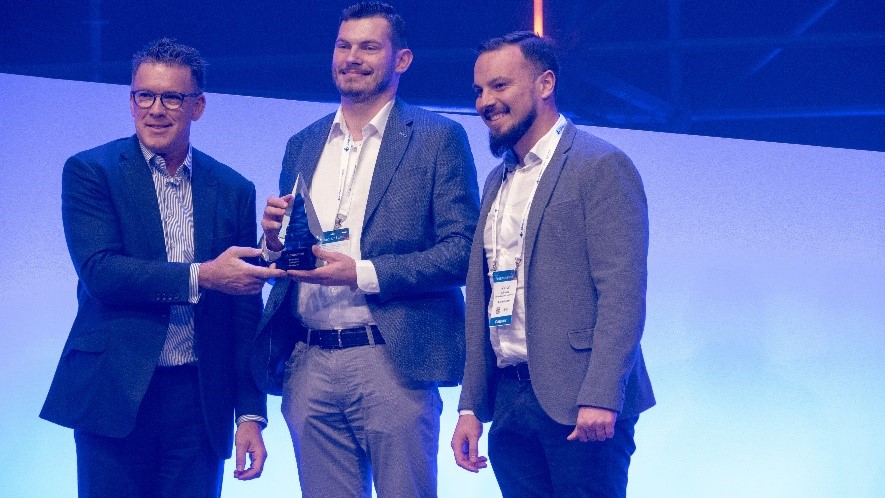
Pictured: Alastair Bathgate, CEO Blue Prism; Maciej Obuchowski, Process Automation Manager, Arla Foods; and Michał Gajkiewicz, Scrum Master, Arla Foods.
Source: Arla Foods, 2019
As enterprises continue to try and separate the hype from the real potential of RPA, HFS has observed that enterprises’ willingness to share best practices is essential. In addition to supporting this POV, Obuchowski has been very open about sharing his and Arla’s experience and innovations with RPA through various conference events, and in some cases, he has invited RPA developers from other companies for training with Arla’s team.
In keeping with the sharing theme, here are some of the key practical secrets to the success of Arla’s business automation program:
Arla Foods started its automation journey with the intent to simplify processes and solve problems. The company never viewed RPA as the panacea for solving all its woes. Arla brought RPA in to help solve certain business problems, such as creating better and more standardized processes, after years of M&A activity created silos and process inconsistencies. Arla started its RPA journey with finance and liked its functionality. It moved on to complement the SAP expertise of Redwood with the general-purpose connected-RPA functionality of Blue Prism. Arla leveraged RPA as a valuable change agent tool to help achieve its objectives. Arla’s practical use of RPA and other automation enablers, its strict focus on solving problems, and its balance of technical skills with business context have helped the company create a formidable business automation program measured in business results rather than the number of bots.
Register now for immediate access of HFS' research, data and forward looking trends.
Get StartedIf you don't have an account, Register here |
With the exception of our Horizons reports, most of our research is available for free on our website. Sign up for a free account and start realizing the power of insights now.
Our premium subscription gives enterprise clients access to our complete library of proprietary research, direct access to our industry analysts, and other benefits.
Contact us at [email protected] for more information on premium access.

