
HFS’ Industry Blueprint: Utility Operations 2018 report found that executives’ priorities are split two ways. Thirty percent see growing bottom-line profit as the key business priority, while 23% go for customer experience. Sustainability is also causing a strategy headache—The UK’s traditional energy suppliers may soon be forced to focus their efforts on either all-out cost-leadership, or green energy and good customer service; digital disruptors are bringing an existential threat to those caught in between priorities.
Energy providers in the UK built their empire (dominated by the “big six”) on customer loyalty and a reluctance to switch, before price comparison sites triggered the move towards continuously switching to the best deal currently available. Now the emergence of “auto-switchers” is changing the UK’s energy game. Auto-switching services are independent from energy suppliers—they continually move customers to the cheapest energy tariff which meets their preferences, whether the customer’s preference is solely cost, customer service, or green energy.
Despite the seemingly dominant trend of ethical consumerism, many will always look to cost. As auto-switching sweeps the UK energy market, and algorithms choose customers’ providers for them, executives must decide: Are they the big bad cost-leader? Or are they the friendly, sustainable good guy?
The UK’s traditional energy suppliers, such as British Gas, E.ON and the rest of the “big six”, built their position of strength as astronomical barriers to entry led to little competition. Times have changed. Digital platforms and demands for renewable energy are allowing small utility providers to stamp their authority on the market.
However, customers’ reluctance to stay proactive and switch provider whenever a better deal comes along remains unchanged. Despite the numerous price comparison sites available, and a post-2010 exponential boom in market entrants (see Exhibit 1) —Ofgem, the UK’s gas and electricity market regulator, found that over 60% of customers in the UK have either changed supplier only once or never at all.
Exhibit 1: The UK has been an exponential boom in the number of registered utility suppliers since 2010.
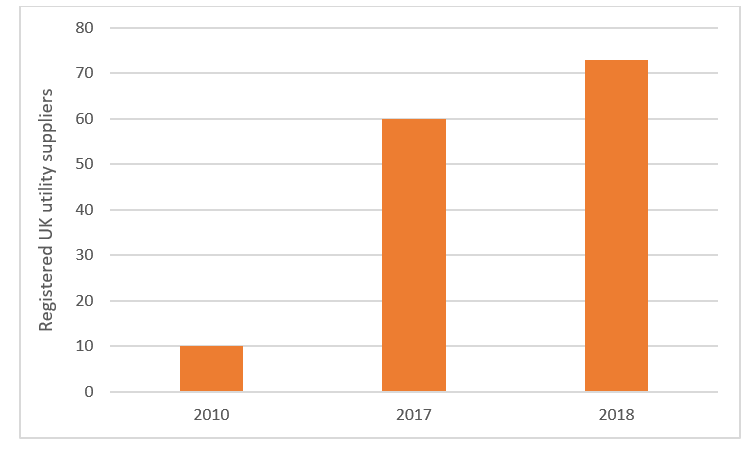
Source: Ofgem, 2018
Despite a wave of potential disruption, growing bottom-line profit remains a major imperative for utility providers, demonstrating languishing traditional executive mindsets as disruptors move in around them; HFS’ research found that 30% identify this as the key business challenge. However, not far behind, improving customer experience is at the forefront of 23% of executives’ minds.
The UK’s energy revolution started with comparison sites—where consumers could survey and choose the deal that best suited them. But this required constant vigilance to remain on the best tariffs.
We’re now seeing the emergence of “auto energy switching services” that, after signing up, will continuously move consumers onto the best available tariff among existing energy providers.
One example is Switchd, who claim that its users save on average £408 per year. Another firm is Weflip, which was spun-out by comparison site GoCompare and is totally free to use. To start, users provide some basic information and choose from a range of options, after which Weflip handles the switch. After that, if Weflip finds a saving greater than £50 per year it will switch the user automatically (should they agree). Look After My Bills and Migrate operate similarly, but they place a high focus on providing good customer service rather than the cheapest tariff.
73% of UK customers want 100% renewable energy and are increasingly unwilling to accept “why we can’t” excuses.
No one can deny the demand for clean energy. Companies like Bulb and CleanChoice Energy who offer their customers 100% renewably sourced energy are growing rapidly. Bulb saw a 1700% revenue increase in 2018 to £183 million, and it is predicted to reach the one-million customer mark in 2019—3% of the UK market share. However, these current models of sustainable energy provision still rely on the consumer actively making the change.
Switching between only renewable energy suppliers is an option on many auto-switching sites, however to-date it is not emphasized in the same way as customer experience. An auto-switcher that nails this angle, given the clear demand for green energy, might well see conscientious consumers flooding to its platforms.
But price will still win out for many. There will always be a significant proportion of the population who simply cannot afford to prioritize clean energy and a friendly phone call. There remains a large segment of the market for energy suppliers to drive down their costs—when auto-switching makes dealing with energy providers infrequent and easy, you might just find many consumers willing to ignore rudeness and a portion of non-renewable energy if it slashes their bill.
In a market where consumers want to know they’re getting the best deal with cleanly sourced energy and seamless interactions when necessary, auto-switchers will give the people what they want, even if they don’t fully know what that is yet.
In a future UK where energy providers are automatically allocated by algorithms based on customer preference, traditional providers must ensure that they know exactly where they stand and where they want to go: Do they drive down costs as far as they can through automation, analytics, efficiencies, and technology? Or do they revamp their customer experience and sustainable energy initiatives to stand out from the crowd?
Register now for immediate access of HFS' research, data and forward looking trends.
Get StartedIf you don't have an account, Register here |
With the exception of our Horizons reports, most of our research is available for free on our website. Sign up for a free account and start realizing the power of insights now.
Our premium subscription gives enterprise clients access to our complete library of proprietary research, direct access to our industry analysts, and other benefits.
Contact us at [email protected] for more information on premium access.

