
Utility executives must ensure that customer experience (CX) isn’t just a token “focus”—it’s largely ignored in HFS’ most recent data against a greater desire to cut costs and improve both top and bottom lines. Utility industry firms must engrain its constantly evolving CX into strategy and then act on it, whether that’s by acquiring nimble startups or digital disruptors, partnering throughout the utility value chain, or making sure they have the right service provider and a consortium of partners to stay competitive and avoid being ousted. ENGIE’s recent partnership with Accenture, Salesforce, and Vlocity is but one recent example of a shifting utilities industry with both customer and employee digital experience at its heart.
Traditional utility giants are becoming increasingly wary of disruption, and, as a result, many are racing to rethink and shore up their priorities and strategies. Utilities’ business models are striving to match customers’ evolving needs—digital transformation means we all expect seamless, personalized services, whatever the industry or offering.
The battleground to reinvent the utilities CX covers a wide range as utilities such as electricity, gas, and water move away from being a traditional commodity:
Our Business and IT Industry survey for 2019 laid bare the priorities keeping utilities execs awake at night: They’re simultaneously looking to their top lines, bottom lines, and customer experiences (see Exhibit 1).
Exhibit 1: Customer experience is competing for utilities execs’ attention with top lines and bottom lines
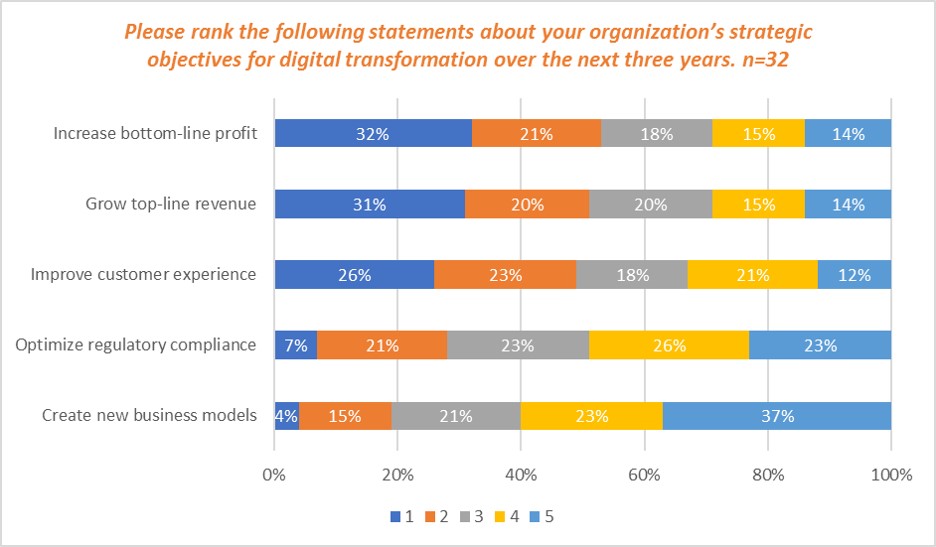
Source: HFS Research, Business and IT Industry survey, 2019, n = 32
Utility execs must make sure that CX doesn’t get lost in the cost focus and that clear strategies not only distinguish it from cost initiatives but also acknowledge the effect that CX transformation must have when considering new business models, revenue streams, and, ultimately, the bottom line.
Separately, HFS’ 2019 State of Industry survey also found, perhaps more starkly, that driving down costs is the prime initiative for utilities execs (Exhibit 2), despite also citing a fear of disruption and a need to reinvent their CX.
Most, but not all, of the surveyed execs were seemingly satisfied with this stance, hoping to rely on their longstanding business models and price competitiveness. Many feel that their current business models are effective in meeting their goals… but this certainly wasn’t the view of everyone, painting the picture of split priorities in the industry. They don’t know whether to go all-in on cost, all-in on CX, or balance the two.
Exhibit 2: Operating costs seems to dominate many execs’ initiatives
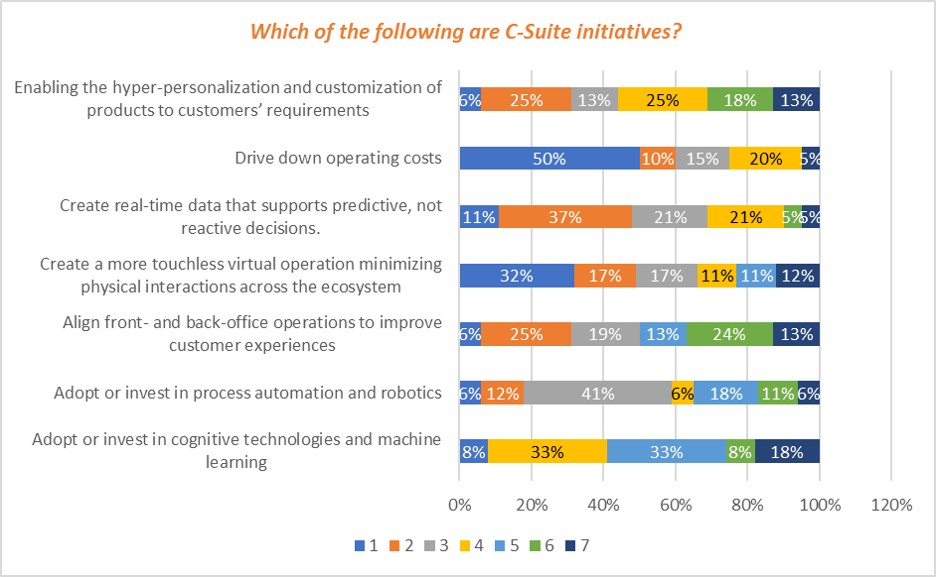
Source: HFS Research, State of Industry survey 2019, n=22
Pressure on business models and a need to hyper-personalize customer offerings as a result of new, nimbler players entering the utilities game means incumbents are rethinking what their customers want. Our State of Industry survey showed a utilities industry throwing lots of investment into customer experience design, with 77% claiming some or significant investment and focus. Digital workplace technologies are also seeing this apparent investment (69% claim as much) to stay relevant and competitive with not only customers but also employees.
ENGIE provides a recent example mirroring our data’s view that utility giants are investing and prioritizing both CX and digital workplace initiatives in tandem.
ENGIE, a 160,000-employee “provider of low-carbon energy and services” (transitioning in 2016 from simply a “utility” company), recently teamed up with Accenture, Salesforce, and Vlocity to transform how it engaged with customers. The partnership will deploy a global CRM platform centered around its customers, with strong links to employees that will allow the company to drive customer success across B2B and B2C channels. Accenture is providing the strategy and implementation, while Vlocity is providing the industry-specific solutions on Salesforce’s platform. Salesforce will allow ENGIE an integrated view of its B2B and B2C businesses and hope to provide personalized recommendations, collaborate with customers on solutions, improve the immediacy and transparency of services, simplify maintenance and installations, and proactively manage relationships to reduce energy consumption over the coming decades.
Consortia like the ENGIE partnership are just one of the ways incumbent utility firms can respond to a shifting industry with growing pressure on both cost and CX. They can acquire the nimble startups or digital disruptors that threaten their market position or be more cooperative in partnering throughout the utility value chain. Less directly, they can make sure they have the right service provider and a consortium of partners in place—like ENGIE has shown—to stay competitive and avoid being ousted.
To figure out the best route forward, internal business and IT cooperation is essential—one of the continuing challenges we hear across the enterprise landscape. Breaking down the proverbial “silos” of communication and data will enable incumbent legacy providers to engage with their providers and partners better and ultimately leverage the change agents that are allowing newer players to disrupt business models that have stood firm for decades.
Register now for immediate access of HFS' research, data and forward looking trends.
Get StartedIf you don't have an account, Register here |
With the exception of our Horizons reports, most of our research is available for free on our website. Sign up for a free account and start realizing the power of insights now.
Our premium subscription gives enterprise clients access to our complete library of proprietary research, direct access to our industry analysts, and other benefits.
Contact us at [email protected] for more information on premium access.

