
While GenAI has been making headlines, it’s not the job killer many feared. Instead, it’s become a powerful tool that enhances productivity without replacing human roles. The real disruptor lurking on the horizon is agentic AI.
Unlike GenAI and many traditional AI systems, which require human oversight and struggle with complex reasoning, agentic AI is poised to autonomously handle multiple levels of decision-making tasks that were once the exclusive domain of seasoned executives and skilled knowledge workers.
While GenAI and other AI systems are making strides, many still operate in isolation from human expertise, failing to establish a true partnership between artificial and human intelligence. This integration gap manifests in several ways:
This evolution is not only about enhancing productivity but also enabling AI systems to take on more complex and autonomous roles within enterprises (see Exhibit 1). A key subset of this evolution to “Purposeful AI” is agentic AI, which is specifically designed to operate autonomously while adhering to human-defined boundaries. Unlike traditional AI systems that require ongoing human supervision, agentic AI can make high-level decisions, manage multi-faceted business functions, and execute tasks independently while continuously learning from its environment and interactions.
In contrast to earlier AI systems that often operated in isolation from human expertise, agentic AI can bring enhanced contextual understanding, enabling it to make decisions that align with an organization’s long-term objectives.
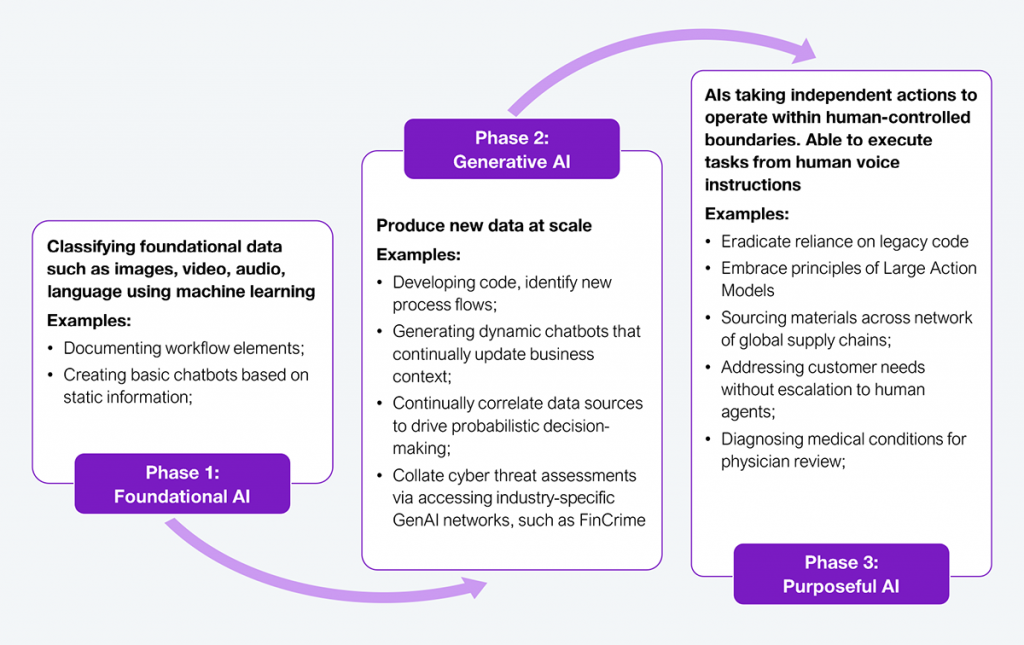
Source: HFS Research, 2024
Agentic AI can potentially disrupt the workforce and the enterprise software landscape, creating significant cost-saving opportunities and posing direct threats. For the workforce, roles that humans traditionally handle are now at risk as AI can autonomously analyze data, make high-level decisions, and execute tasks. Additionally, in other cognitive-heavy domains such as strategic planning, AI has the potential to autonomously analyze data, simulate scenarios, optimize operations, and make decisions in real time more effectively than human-driven processes.
On the software front, agentic AI can potentially consolidate multiple functions that typically require a suite of enterprise tools. This integration of capabilities—from financial planning and supply chain optimization to customer service automation—eliminates the need for separate, costly software systems. Enterprises will no longer require multiple licenses or maintenance contracts, threatening the revenue streams of many specialized software providers as companies shift toward a single AI-driven platform. The result is a significant reduction in both software and staffing costs.
Both large enterprises and startups are pushing the boundaries of AI-driven autonomy and decision-making, transforming how businesses operate.
Established players:
Startups:
As this landscape continues to evolve with more major players launching agentic solutions, startups such as Mindcorp.ai, rhino.ai, and Lyzr must differentiate by offering unique capabilities, ensuring cross-platform compatibility, and demonstrating cost-saving benefits to appeal to enterprise clients.
Enterprises must adapt quickly to this shift as agentic AI can autonomously handle complex decision-making tasks. This will impact both workforce roles and the enterprise software landscape, reducing the need for repetitive, decision-heavy positions and consolidating software functions under AI-driven platforms.
Register now for immediate access of HFS' research, data and forward looking trends.
Get Started


If you don't have an account, Register here |
With the exception of our Horizons reports, most of our research is available for free on our website. Sign up for a free account and start realizing the power of insights now.
Our premium subscription gives enterprise clients access to our complete library of proprietary research, direct access to our industry analysts, and other benefits.
Contact us at [email protected] for more information on premium access.

