
This Challengers’ Code report is for CIOs and enterprise sourcing leaders evaluating alternatives to Tier-1 application management services providers and assessing how a Services-as-Software delivery model can improve throughput, cost predictability, and operational reliability.
Traditional application management services (AMS) are people heavy, slow to diagnose, opaque across vendors, and too expensive to flex as run, change, and build demands spike. If CIOs redesigned their AMS around outcomes instead of effort, they would provision an engine with more transparent accountability, faster problem resolution, and a delivery model that adapts as the business changes. In HFS research, Quinnox emerged as a pragmatic challenger for enterprises seeking AI-mediated operations, measurable throughput gains, and flexible run–change–build economics without multi-year reinvention programs. The appeal here is not the technology but the operating model shift it enables.
As systems become more interconnected and incident volumes outpace headcount, CIOs seek models that deliver speed, reliability, and transparency without escalating personnel costs. In the end, service delivery is becoming increasingly software mediated, sending strong signals to service providers to productize their services portfolio to insulate themselves from the impending convulsions of a brutally competitive landscape.
Quinnox’s leadership was betting on this transition long before AI agents became ubiquitous. Quinnox occupies a distinctive position in the rapidly evolving Services-as-Software (SaS) market. It is not a Tier-1 transformation partner (Tier-1 partners have annual revenue exceeding $3 billion and more than 50,000 multi-regional employees), nor does it aim to replicate the scale-first, labor-intensive delivery model. Its core working principle is that enterprises will only break free from legacy constraints when services themselves behave more like technology platforms. This is the philosophical backbone behind Quinnox’s SaS approach.
Instead of scaling people against problems, the firm is codifying decision flows, diagnostic logic, and integration patterns into programmable, reusable assets. The overarching vision is to package managed services as platform-led, agentic workflows that emphasize throughput, predictability, and fungible capacity across run, change, and build. Its Qinfinite platform for application life cycle management (with other platforms, including Qyrus for quality engineering and QoCreate for all cloud and AI-native programs) underpins this mechanism with agentic routing, knowledge graphs, and automated software development life cycle (SDLC) scaffolding.
This stance resonates most with mid-market and upper mid-market enterprises that want operational predictability without the overhead and lock-ins of Tier-1 providers.
Quinnox’s approach is grounded in two decades of engineering-first work across manufacturing, consumer packaged goods (CPG), and financial services. These industries punish downtime and reward precision. Quinnox performs exceptionally well where enterprises value platform-led AMS, cross-vendor transparency, embedded intelligence across the SDLC, and commercial models built around units rather than headcount. The firm’s long client tenures, averaging more than nine years, reflect its reputation, going head-to-head with much larger players.
We compete almost exclusively with every top 10 global services player. We challenge the status quo. We win by giving clients what they are not getting from their current providers. It is value-driven and outcome-focused.
— Amit Nagar, CEO, Quinnox
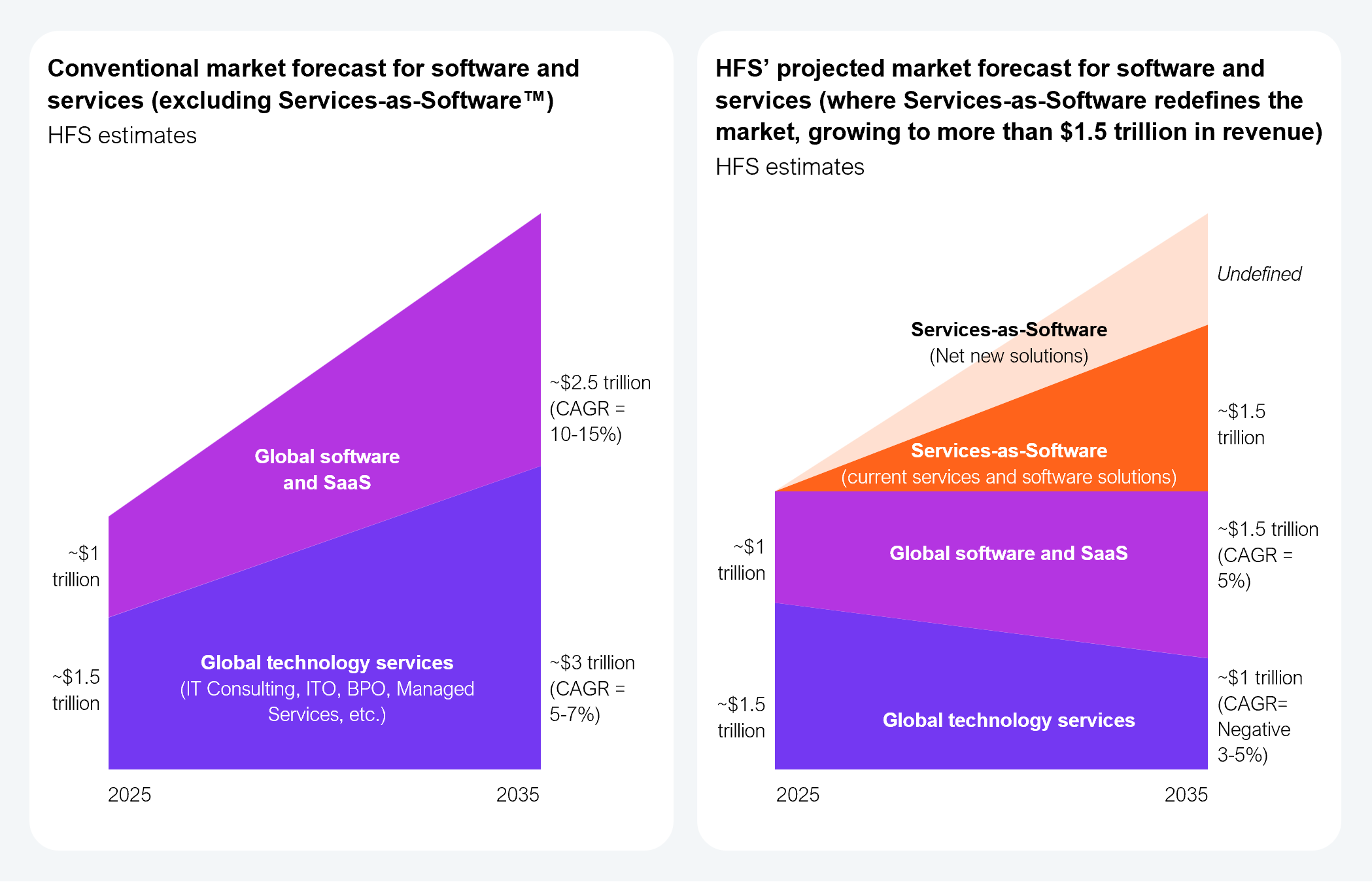
Enterprises are reaching the limits of traditional managed services. Costly, people-intensive delivery models cannot keep pace with the increasing complexity of digital ecosystems, the pressure to reduce operational overhead, and the need for faster, more predictable outcomes. HFS sees a generational shift from services-led to software-led IT services. HFS expects this new market, which it calls Services-as-Software, to exceed $1.5 trillion in revenue by 2035 (Exhibit 1).
Source: HFS Research, 2026
Against this backdrop, Quinnox stands out as a provider that has already operationalized many of the principles shaping the next decade of service delivery. Its relevance is tied to what enterprises are demanding today: more automation, predictability, and fundamental redesign. Quinnox stands out on several fronts:
We are the company—the challenger—that gives alternatives to global enterprises that need more than a slow-turning aircraft carrier in their sourcing arsenal, much more than what a Tier-1 supplier can promise and deliver.
— Amit Nagar, CEO, Quinnox
Quinnox has built its growth in sectors such as CPG and retail, manufacturing, BFSI (banking, financial services, and insurance), and logistics, where operational reliability is non-negotiable. These industries rely heavily on fast-moving, interconnected applications and integrations, which amplify the cost of slow incident resolution, recurring issues, and opaque vendor models. Quinnox’s client base today is dominated by Fortune 1000 and large mid-market enterprises across North America and Europe, with a growing presence in Asia.
For enterprises evaluating their AMS and integration landscape, Quinnox’s positioning is particularly relevant where the mandate is for shortening MTTR, reducing repetitive work, and modernizing integration-heavy environments.
Quinnox’s SaS philosophy is not an overlay on traditional managed services but a fundamental rethink of how work moves through the IT value chain. Instead of scaling labor, Quinnox codifies human judgment. This creates a programmable system of work that brings software-like precision to service delivery.
We became our own first platform-driven, digitally virtualized enterprise—fully traceable and auditable. That journey turned Quinnox itself into a living case study. Practice what we preach!
— Amit Nagar, CEO, Quinnox
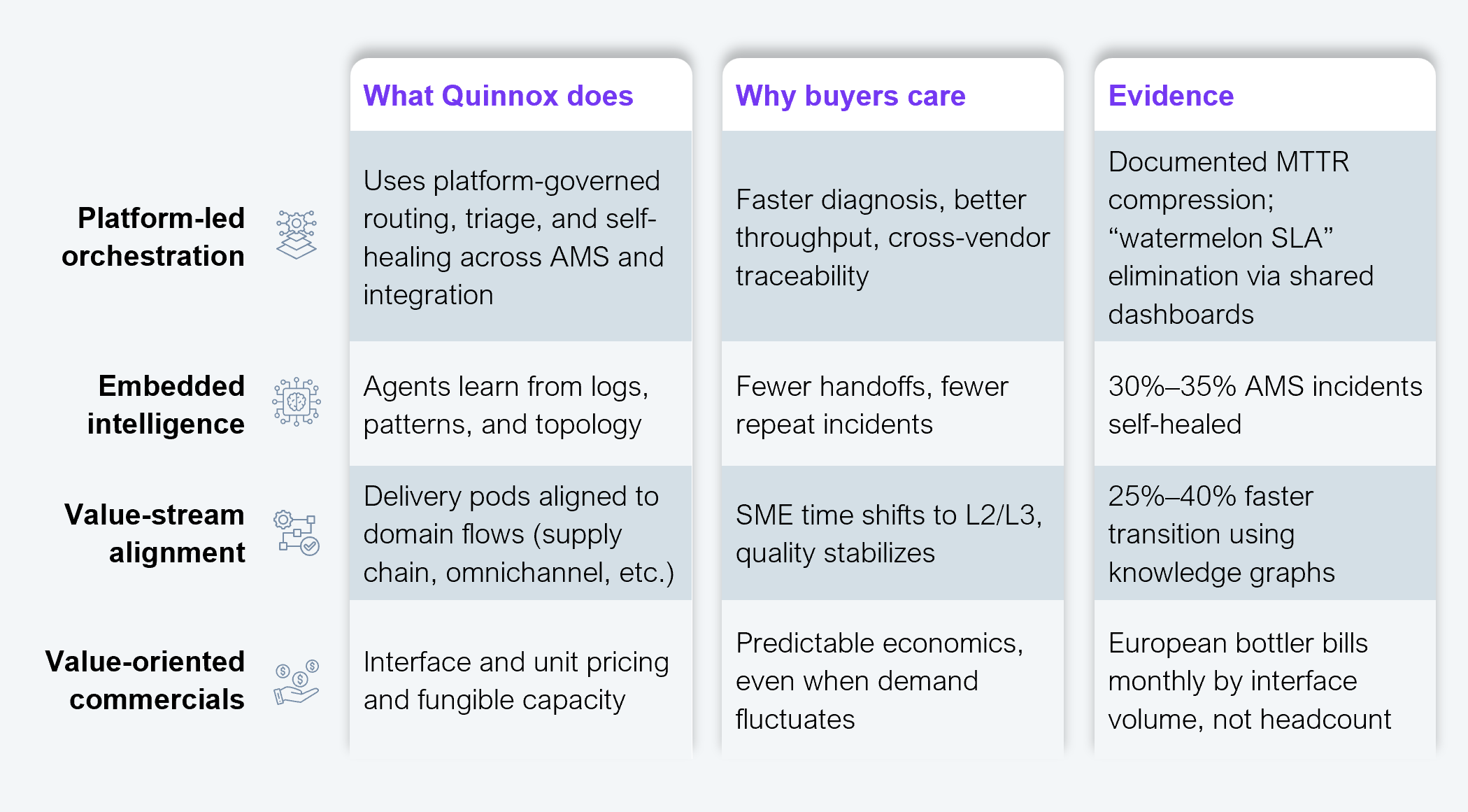
Where Quinnox differs from traditional providers is not just in its platform stack but in the way delivery, governance, talent, and commercials work together as a unified operating system.
Source: HFS Research, 2026
Over the last decade, we have built a culture of tinkering and inventiveness, so our people felt they were joining a technology company, where innovation, disruption, and experimentation are recognized and promoted. Status quo is boring.
— Amit Nagar, CEO, Quinnox
Quinnox’s commercial value proposition centers on tangible operational improvements that enterprises can measure in real time. Across client engagements, HFS observed a consistent impact:
Customers don’t go looking for ‘Services-as-Software’—they look for predictability, control, automation, and reduced human dependency. That’s what we give them and call it ‘Services-as-Software’.
— Amit Nagar, CEO, Quinnox
Organizations in some of the most integration-heavy and operationally complex landscapes within the CPG, retail, and manufacturing sectors have applied Quinnox’s SaS model. What stands out is the consistency of outcomes, including faster resolution cycles, more precise delivery flow, reduced subject matter expert (SME) dependency, and predictable economics. Below, we present two exemplary cases that epitomize the caliber and consistency of Quinnox’s client work over the years.
Following a major merger, the client faced a fragmented SAP and non-SAP environment, featuring multiple iPaaS platforms and a growing backlog of interfaces. Traditional delivery models struggled to cope with the complexity and volume.
Quinnox implemented a platform-led integration factory that standardized estimation, pattern reuse, test-data generation, and deployment checks. A T-shirt–sizing commercial model created predictability and reduced volatility in integration demand.
The results included multi-million–dollar savings over three years and significant effort reductions across every stage of the integration life cycle: 40% in design, 50% in build, and up to 70% in code review.
A senior technology leader told HFS that the most significant shift was predictability. The client could finally “buy integrations” with clarity on cost, flow, and quality. The leader also highlighted Quinnox’s flexibility and direct leadership engagement as meaningful differentiators compared to Tier-1 providers, noting that Quinnox must continue to strengthen its cross-domain maturity as it scales.
Why does this case matter?
Integration is traditionally the least automatable area of IT operations. Quinnox’s ability to introduce structure and measurable throughput in a heterogeneous, multi-vendor environment demonstrates genuine SaS maturity.
This enterprise struggled with SME-heavy Oracle environments, version sprawl, weak observability, and mission-critical manufacturing interfaces. Instability and recurring incidents created a high operational burden.
Quinnox utilized Qinfinite to automatically discover the estate, build a knowledge graph, and automate high-frequency incidents. End-to-end monitoring improved visibility, and repeatable work was routed to autonomous execution.
The impact was substantial: faster transitions, dramatically reduced reliance on SMEs, a 95% improvement in resolution time for automated cases, and a 30% uplift in overall support efficiency.
The client CIO applauded Quinnox’s AI-driven, SaS model for minimizing manual dependency, strengthening system reliability, and setting a new benchmark for scalable, outcome-driven IT operations.
Partnering with Quinnox has transformed how we manage IT operations. Their AI-driven, Services-as-Software model seamlessly blends automation, intelligence, and delivery excellence, and resulted in a 50% reduction in analysis and solution efforts and a 95% improvement in resolution time for automated use cases. We have seen a 30% improvement in support efficiency. What’s even more impactful is how the solution has minimized our dependence on manual interventions and SMEs while giving us real-time visibility across our Oracle and non-Oracle environments.
The Qinfinite platform has enhanced visibility, reduced manual dependencies, and strengthened system reliability. Quinnox’s delivery-led, software-enabled approach truly sets a new benchmark for how modern enterprises should run intelligent, scalable, and outcome-driven IT operations.
— CIO, leading home fragrance and specialty retailer
Why does this case matter?
This case study shows that SaS can stabilize complex, legacy-heavy estates, offering a practical path to modernization.
Net-net, these client stories demonstrate that Quinnox’s Services-as-Software model consistently improves throughput, transparency, and operational reliability. However, enterprises must be prepared to work differently to fully capture the benefits of platform-mediated service delivery.
Enterprises considering a SaS-driven operating model should focus on five readiness areas that consistently separate high-performing transformations from stalled ones.
1. Recognize that SaS takes more than a new challenger partner
Build a clear view of work that can be codified by identifying high-volume, high-touch service requests, incident clusters, and integration patterns. The goal is to identify where decisions are repeated and where automation can meaningfully reduce cycle time. Enterprises that come prepared with structured workflows can dramatically accelerate value capture.
2. Turn processes into reusable service blueprints
Standardize service definitions before you automate. Codify processes into reusable blueprints, whether it’s for incidents or build cycles. This is where enterprises shift from “people describe how work is done” to “services encapsulate how work is done.”
3. Give AI agents the data they need (safely)
Enable AI-mediated execution with responsible data access. SaS models rely on contextual signals, such as ticket metadata. Start with synthetic or segmented data and expand access gradually with tight scoping.
4. Measure flow, not just tickets
Reset measurement frameworks from SLAs to flow-level accountability. Traditional ticket-based SLAs rarely reflect customer experience. SaS models perform best when enterprises demand stage-level metrics, reuse rates, test coverage growth, and visibility across vendors. This is how you eliminate “watermelon SLAs” where green reports mask red experiences.
5. Treat SaS as a change program
Prepare for change management across business and technical teams. AI-driven routing, automated triage, and pattern-based decisions can be perceived as disruptive. Transparent dashboards, explainable recommendations, and human-in-the-loop controls help build trust.
Quinnox’s SaS model represents this fundamental shift. It recasts AMS and integration work as software-led, platform-delivered flows rather than incremental automation.
It is likely to be most relevant for enterprises ready to adopt a more AI-native, software-like operating model and less suited to organizations that primarily want large advisory footprints or contractor-led scale.
Register now for immediate access of HFS' research, data and forward looking trends.
Get Started

If you don't have an account, Register here |
With the exception of our Horizons reports, most of our research is available for free on our website. Sign up for a free account and start realizing the power of insights now.
Our premium subscription gives enterprise clients access to our complete library of proprietary research, direct access to our industry analysts, and other benefits.
Contact us at [email protected] for more information on premium access.

