This Market Impact Report is for senior telecommunications service provider leaders evaluating how to move agentic AI from isolated pilots to enterprise-wide orchestration that drives measurable business outcomes.
HFS Research, in partnership with Amdocs, surveyed 90 Tier-1 telecom executives across Europe, Australia, and North America and conducted multiple in-depth interviews across customer experience (CX), BSS, OSS, IT, and financial operations. Our research identifies where telcos are investing in agentic AI, how it is (or isn’t yet) delivering value, what outcomes they are seeking to measure, and where operating-model shifts are required to move from incremental pilots to scalable impacts.
This paper is for senior leaders in telecommunications service provider firms under pressure to identify, invest in, and improve operations and business impact by becoming an agentic AI telco. This study examines the current state and the impact of future investments and provides a playbook based on insights from leaders in OSS, BSS, CX, and more who are seeing entirely new outcomes emerge from the use of agentic AI.

Our research revealed five areas where executive leadership can drive fundamental business change with agentic AI.


While our research finds telcos are making meaningful progress with agentic AI within individual domains, the most complex challenge is moving from experimentation to enterprise coordination. Agentic AI is not a technology bet; it’s an operating-model decision. The opportunity is not to deploy more AI, but to better execute across domains through governance, KPI resets, and sequenced autonomy. Telcos that treat agentic AI as an enterprise execution model and not a set of tools are positioned to protect revenue, improve customer health, and increase resilience in structurally flat growth markets.
Telcos continue to invest heavily in fixed broadband, 5G, and fiber infrastructure. Yet average revenue per user (ARPU) at major telecom operators has either stayed flat or declined, even as subscriber counts and usage rise. Tier-1 operators still must invest to stay competitive and compliant, but each investment cycle, whether 5G, fiber, or platform modernization, adds more tool, interface, and process complexity systemwide.
Complexity is costly, but it’s not the core issue. Rather, the challenge lies in a lack of coordination across processes and functional domains. Handoffs, data inconsistencies, and fragmented accountability too often constrain end-to-end processes. Siloed KPIs reinforce legacy execution, keeping line-of-business leadership’s focus on line-specific productivity or efficiency gains.
The biggest problem here is decision making because we cannot just go in silos and look at them one by one; some of the work needs to happen in near real time.
— Wireless network strategy leader, North American wireless provider
Agentic AI can serve as an orchestration layer, building on existing domain-level automation efforts and enabling closed-loop execution across systems with appropriate governance and oversight. But as shown in Exhibit 1, this isn’t a technology shift; rather, it is a shift in the telco operating model. The strategic question for telecom leadership isn’t “How do we deploy more AI?” but “How can AI connect data and workflows across domains to turn capital investments into better service outcomes while reducing manual intervention and improving service continuity?”
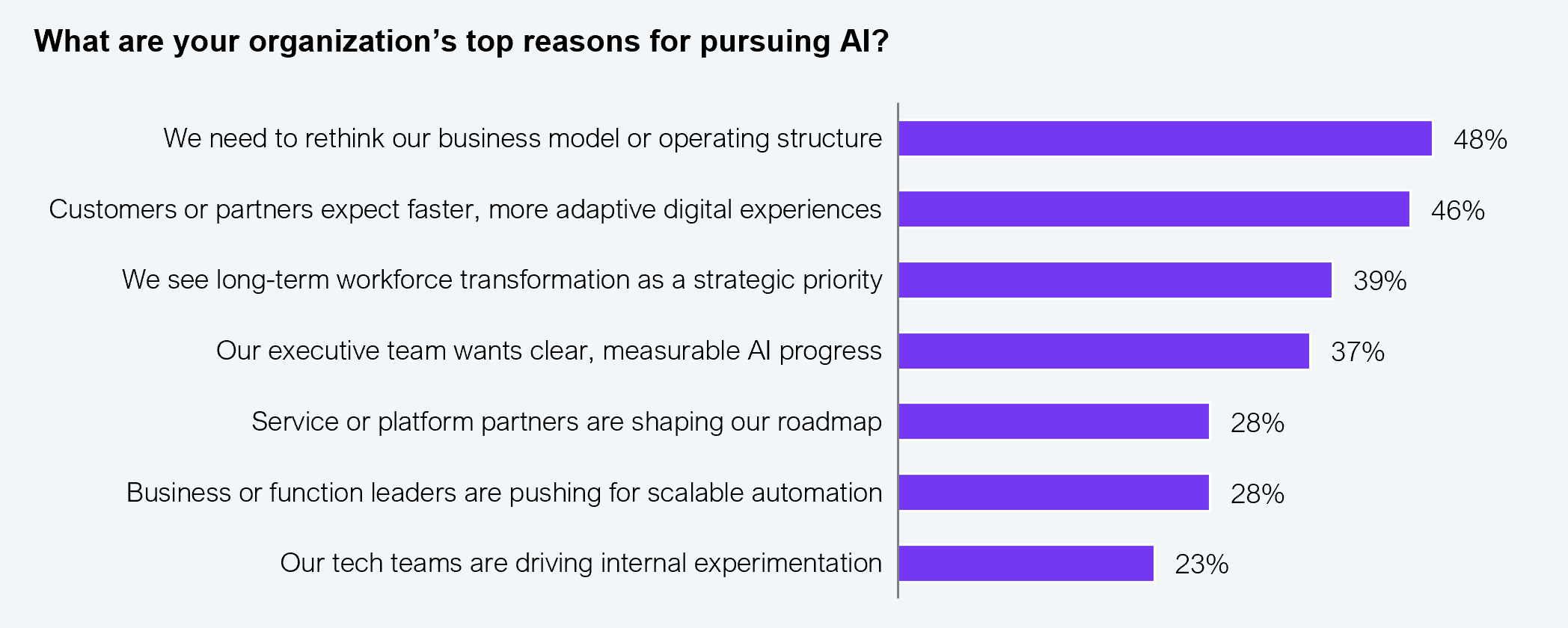
Sample: N=30 C-level telco leaders
Source: HFS Research, 2026
Many telcos are entering a period where the limits of the traditional operating model are increasingly visible. Growth remains constrained, while operating margins remain under pressure. The result is a disconnect between investment and outcomes, with rising complexity and cost-to-serve limiting operating leverage and shareholder returns.
If agentic AI is to help close this gap, it is important to know how far along telcos are in embedding it into their operations. Our study respondents reported that their AI efforts remain overwhelmingly in early stages. Half of all respondents categorized their agentic AI initiatives as “Emerging,” and 20% categorized them as “Pioneering,” with solutions embedded in their operations, as shown in Exhibit 2.
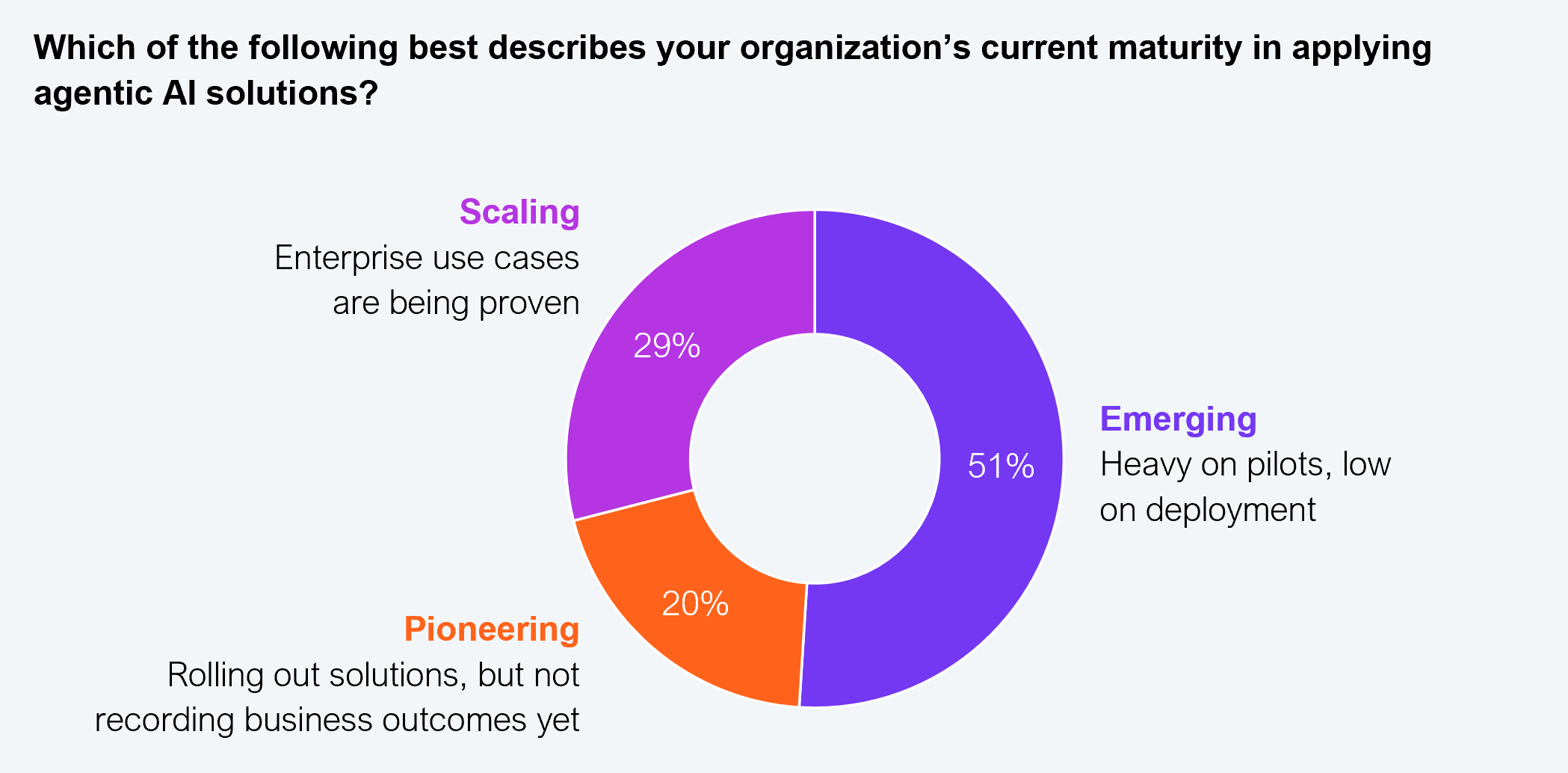
Sample: 90 telecom enterprise executives
Source: HFS Research, 2026
Moving from the emerging stage to pioneering requires more than additional pilots; it requires telco leadership to decompartmentalize data, processes, and nuanced performance metrics. This maturation is more than putting old wine in a new bottle; it is where agentic AI can truly change how the firm operates. When cross-system orchestration is enabled, agentic AI connects signals, workflows, and decisions that were previously fragmented, allowing cross-functional execution to scale and drive embedded growth in the flow of information across people, processes, and functions.
Business leaders in the telecom industry have never lacked insight into operational challenges. Revenue assurance gaps, customer churn triggers, service delivery breakdowns, and escalating cost-to-serve are all well-documented. Instead, the constraint has been the ability to execute consistently across operational domains, namely, because teams in different operational domains are held to different success metrics. AI orchestration requires breaking down operational silos, and operators must adopt new AI-centric KPIs. These KPIs should align with governance mechanisms that go beyond incremental automation and productivity gains.
AI will allow us to move away from purely FTE-based metrics. Our goal is for agentic AI to allow us to set new business outcome metrics tied to the speed at which we can discover, address, and resolve any issue in a predictable manner, with or without human intervention.
— General Manager, Strategy, large European telco firm
Implementing agentic AI necessitates KPIs that align with measuring outcomes, enabling control over services, delivering resiliency and trust, and doing so at scale. In an environment where systems may increasingly act autonomously, measurement becomes more than reporting; it should be based on real-time factors.
However, as Exhibit 3 illustrates, current agentic AI initiatives still focus on productivity and task efficiency. While this is a natural starting point, productivity gains alone are unlikely to produce the operating-model shifts required to scale agentic AI safely and deliver enterprise outcomes.
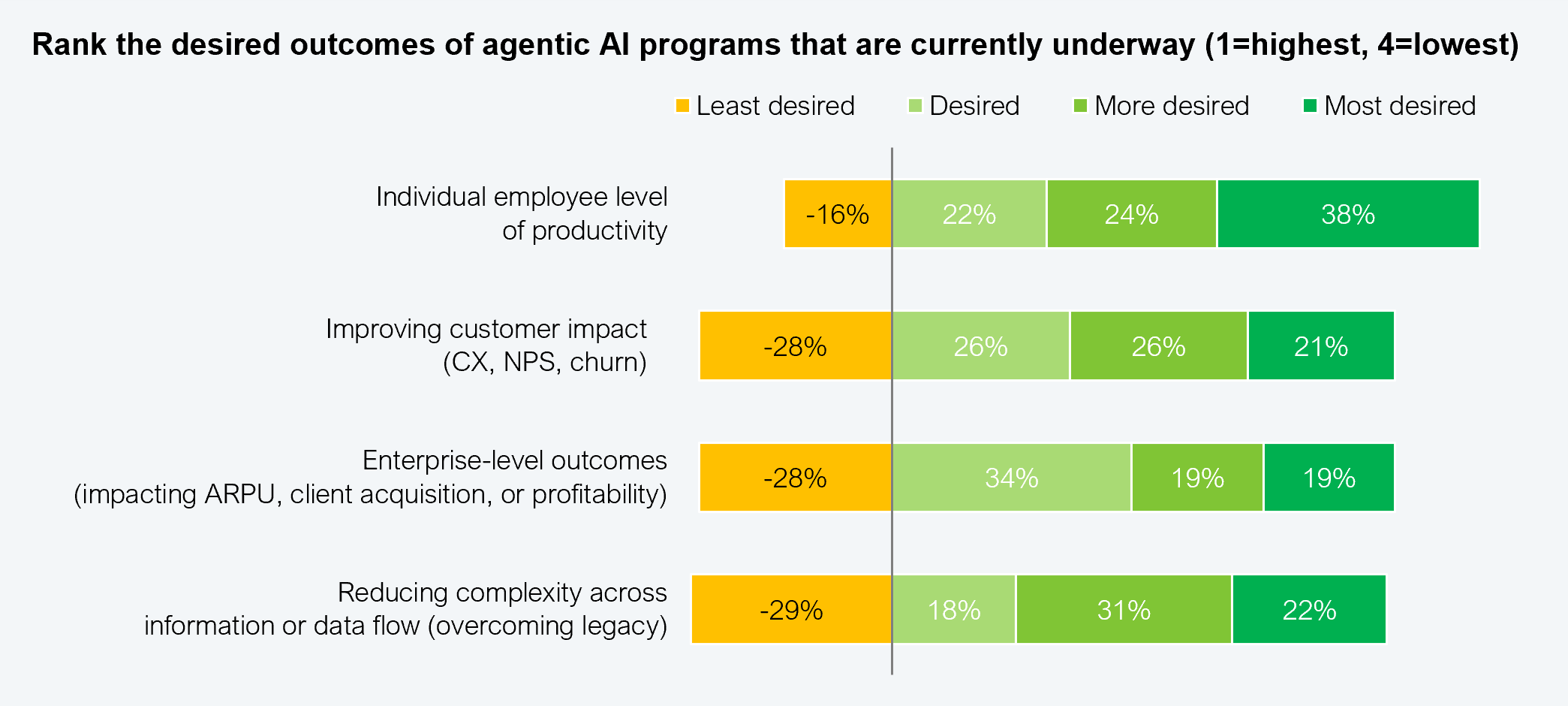
Sample: 90 telecom enterprise executives
Source: HFS Research, 2026
The evolution toward agentic becomes clearer when we see how leaders expect their measures of success to change, as shown in Exhibit 4. The relative importance of traditional measures such as labor reduction and cost efficiency decreases, while the importance of revenue integrity, churn reduction, monetization effectiveness, predictive accuracy, and resolution quality increases. These priority shifts are most pronounced in processes that agentic AI can orchestrate across multiple operational silos, resolution effectiveness,
and ARPU.
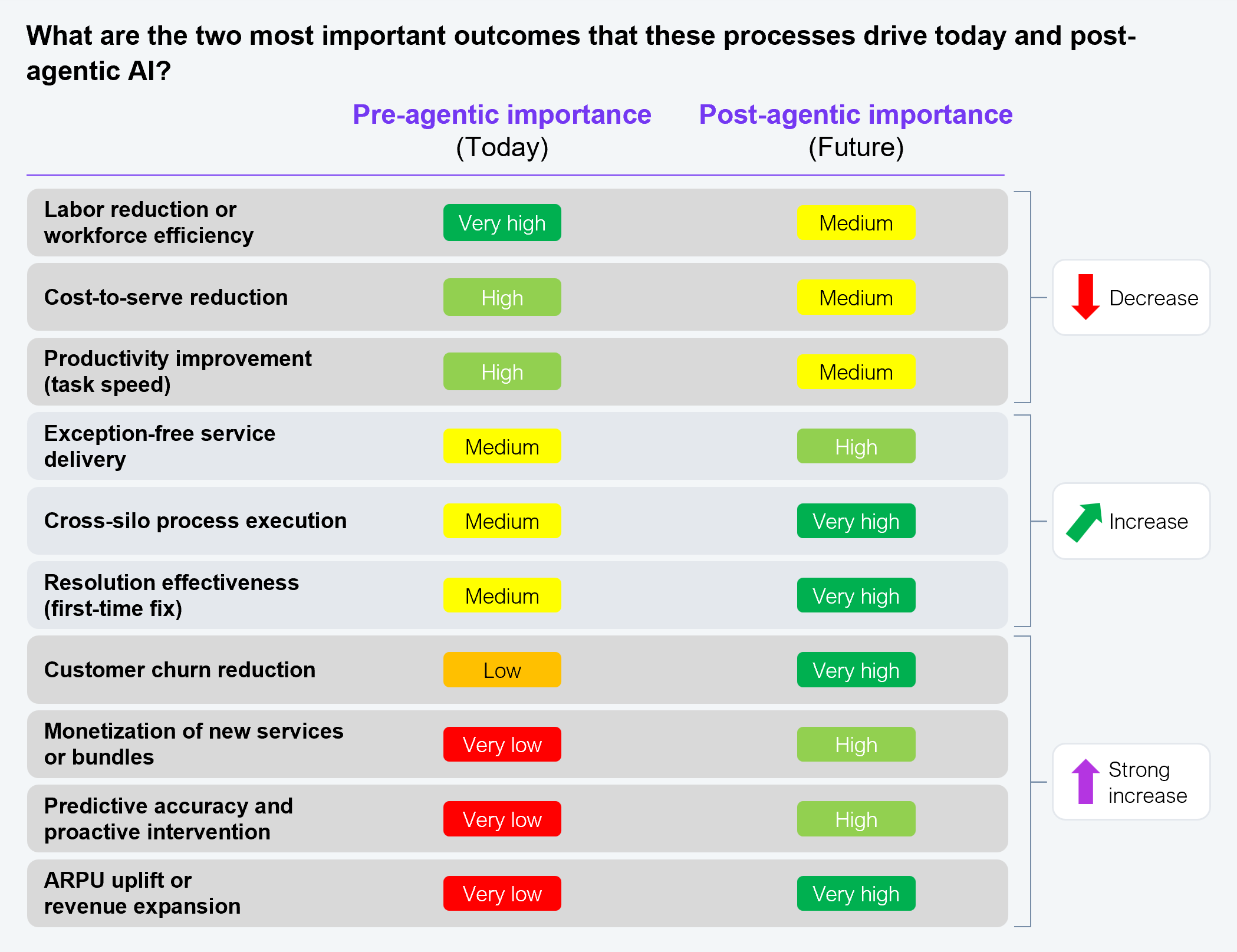
Sample: 90 telecom enterprise executives
Source: HFS Research, 2026
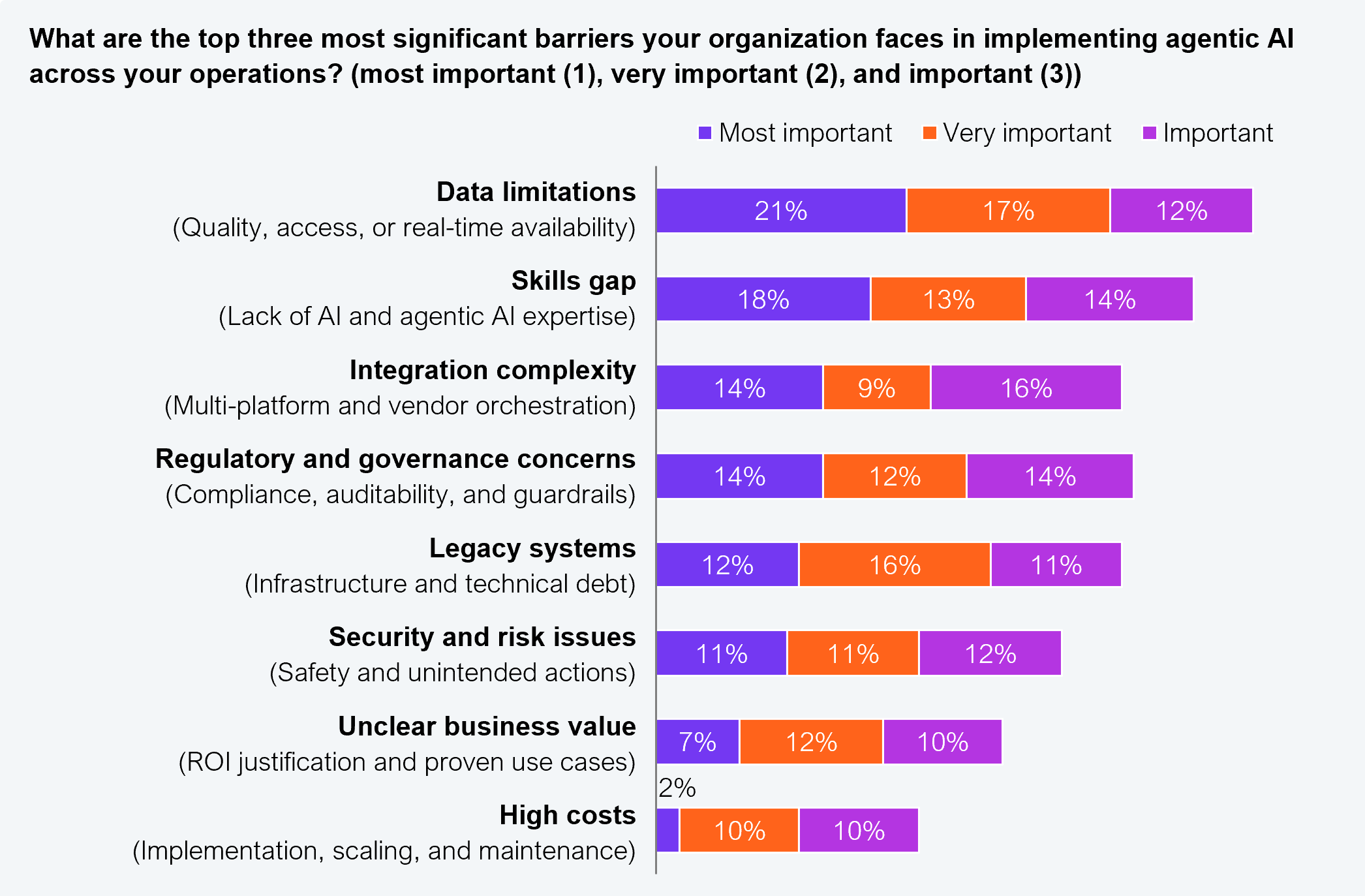
Telco leaders view agentic AI as a way to overcome entrenched complexity across systems, processes, and workflows. Yet the very constraints they seek to resolve, such as data fragmentation, integration overhead, and legacy architectures, also represent the primary barriers to scaling it, as shown in Exhibit 5.
Sample: 90 telecom enterprise executives
Source: HFS Research, 2026
These constraints are compounded by the realities of operating across deeply interconnected stacks. Data fragmentation, integration complexity, and legacy system constraints remain significant barriers to scaling agentic AI, as shown in Exhibit 6. While experimentation can occur in contained pilots, enterprise impact requires agents to function across heterogeneous systems, inconsistent data environments, and fragmented accountability models—conditions that traditional operating structures weren’t designed to support.
Integration complexity is what kills us. If AI agents can manage the orchestration between our dozens of systems, that would be huge.
— European wireless provider
Sample: 90 telecom enterprise executives
Source: HFS Research, 2026
Across many processes, regardless of function or time horizon, the KPIs that predominate in an agentic future are revenue and prediction driven. As telcos look ahead, a new class of agentic AI-focused measures is taking hold, most prominently predictive accuracy, alongside multi-agent collaboration and autonomy-related indicators. These new KPIs are a shift from functional KPIs toward
shared-outcome-oriented KPIs.
This shift reflects a profound truth: Agentic AI cannot succeed under the same measurement frameworks that governed earlier waves of automation. Traditional telco KPIs were built for human-led execution—optimizing task efficiency, throughput, and cost control within functional boundaries. But as autonomy increases, these metrics become insufficient. Agentic systems require new ways to govern behavior, ensure trust, and monitor whether agents are learning, coordinating, and acting appropriately across domains. In this context, measurement becomes more than reporting; it becomes the control mechanism that determines whether autonomy can scale.
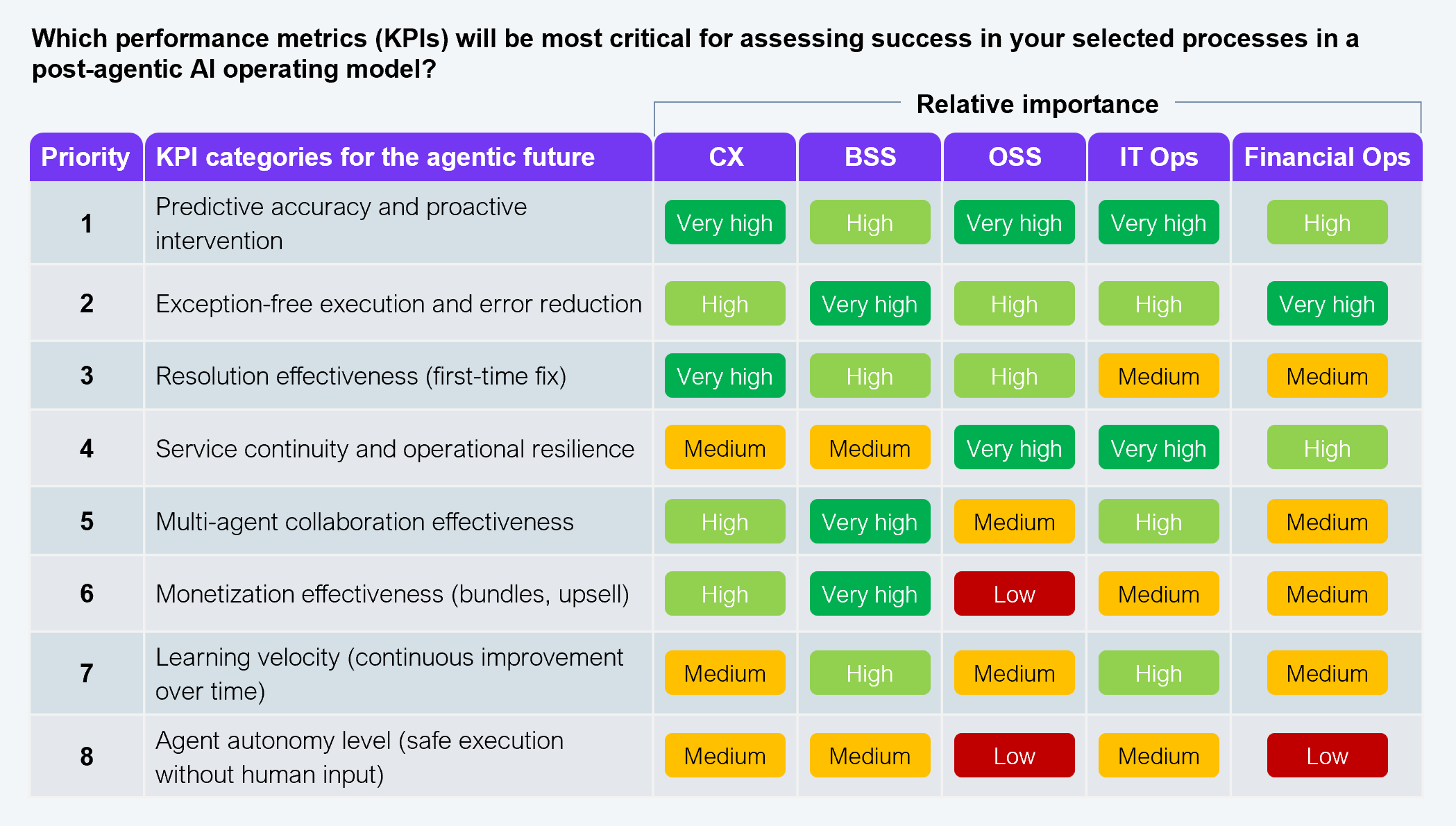
In Exhibit 7, we capture how leaders expect agentic AI to reprioritize KPIs. Topping the list is agentic AI’s ability to support proactive intervention and accurate predictions by connecting the dots across multiple systems, factors, and data points. Enabling leaders to use AI to predict outcomes across many touch points was crucial.
Sample: 90 telecom enterprise executives
Source: HFS Research, 2026
An overall conclusion may be that agentic AI is pushing telcos from “automation ROI = labor takeout” to “autonomy ROI = revenue protection + customer health + governed execution.” It forces a measurement upgrade; agentic-native KPIs become the control system for scaling autonomy and include an autonomy index, predictive accuracy, learning velocity, multi-agent collaboration, experience consistency, and proactive issue resolution.
The survey data makes this evolution clear. Exhibit 7 shows that telcos consistently prioritize predictive accuracy and revenue-related KPIs across functions as crucial agentic AI outcomes, signaling that agentic AI is expected to underpin business-focused outcomes rather than efficiency gains. Agent-native metrics such as collaboration effectiveness, autonomy levels, and learning velocity are also gaining prominence, reflecting the need to manage not just performance but also system behavior over time.
We can see an example of agentic AI in configure, price, and quote (CPQ) workflows. Currently, many telcos follow a complex manual process: create a customer quote, determine service locations, add products, configure products, confirm serviceability, generate contracts, and last, generate an order.
Without agentic AI, this process can require multiple people accessing multiple systems, interpreting multiple data points, and triggering multiple independent workflows. The resulting inefficiencies cost time and resources, and they don’t guarantee a positive customer experience.
With properly applied agentic, the benefits extend beyond just process automation. It connects the data from all these systems, databases, and data warehouses and quickly assembles a configuration-to-quote solution in near real time. This is value, and this is where linking the business’s desired outcomes to technology and AI investments represents an operational step change.
BSS transformation projects always take two years. AI agents could help us get value from our existing systems while we modernize…bridging old and new, automating the glue work.
— North American telco operator
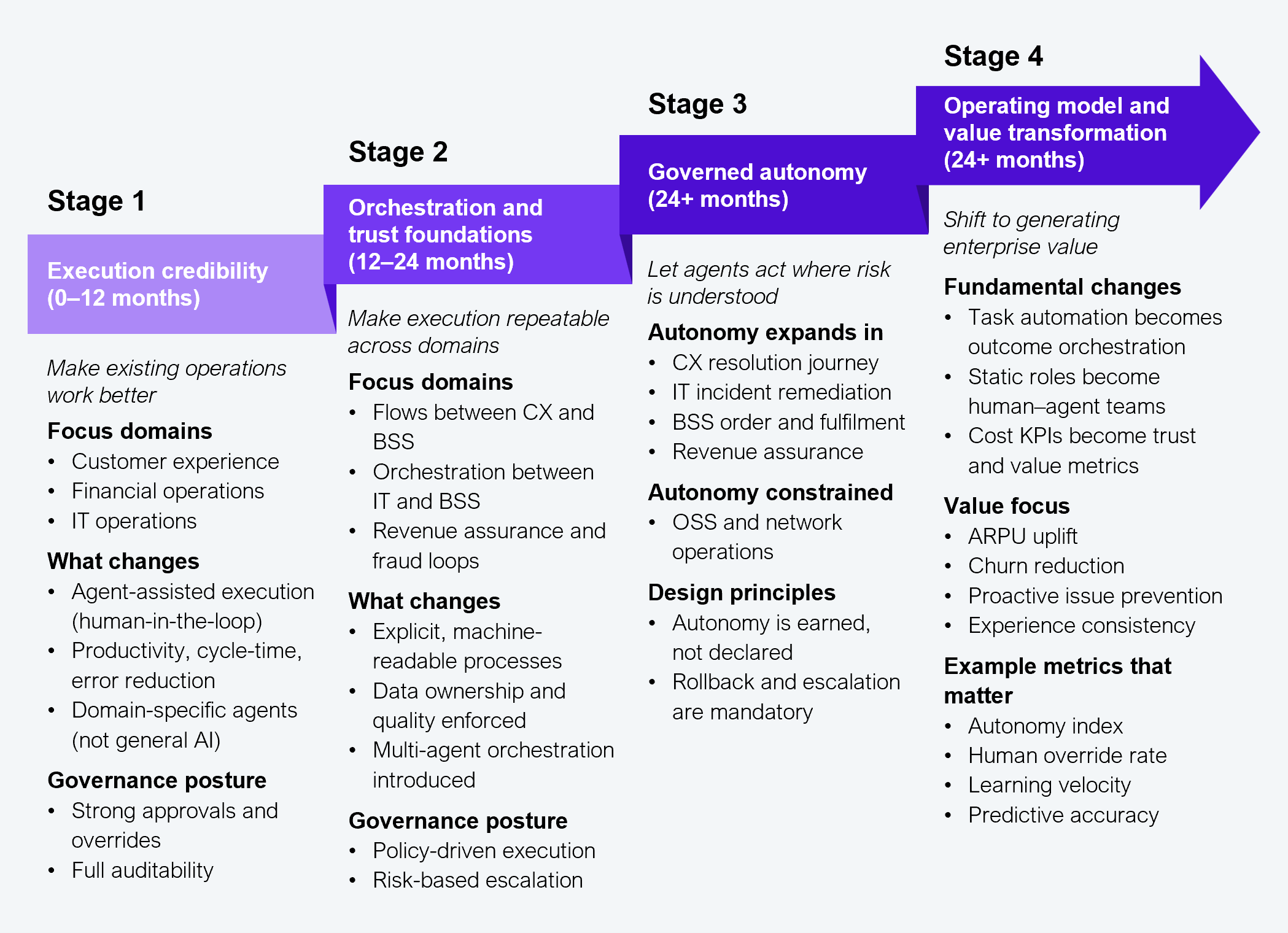
To support successful scaling, we developed the high-level playbook in Exhibit 8 based on our research findings. It outlines a staged rollout co-led by business and IT that sequences cross-system orchestration. Start where value is measurable, then expand autonomy as governance and trust mature.
Source: HFS Research, 2026
The key is to break down processes into subcomponents…It’s too hard to start from a total end-to-end perspective.
— BSS leader, North American provider
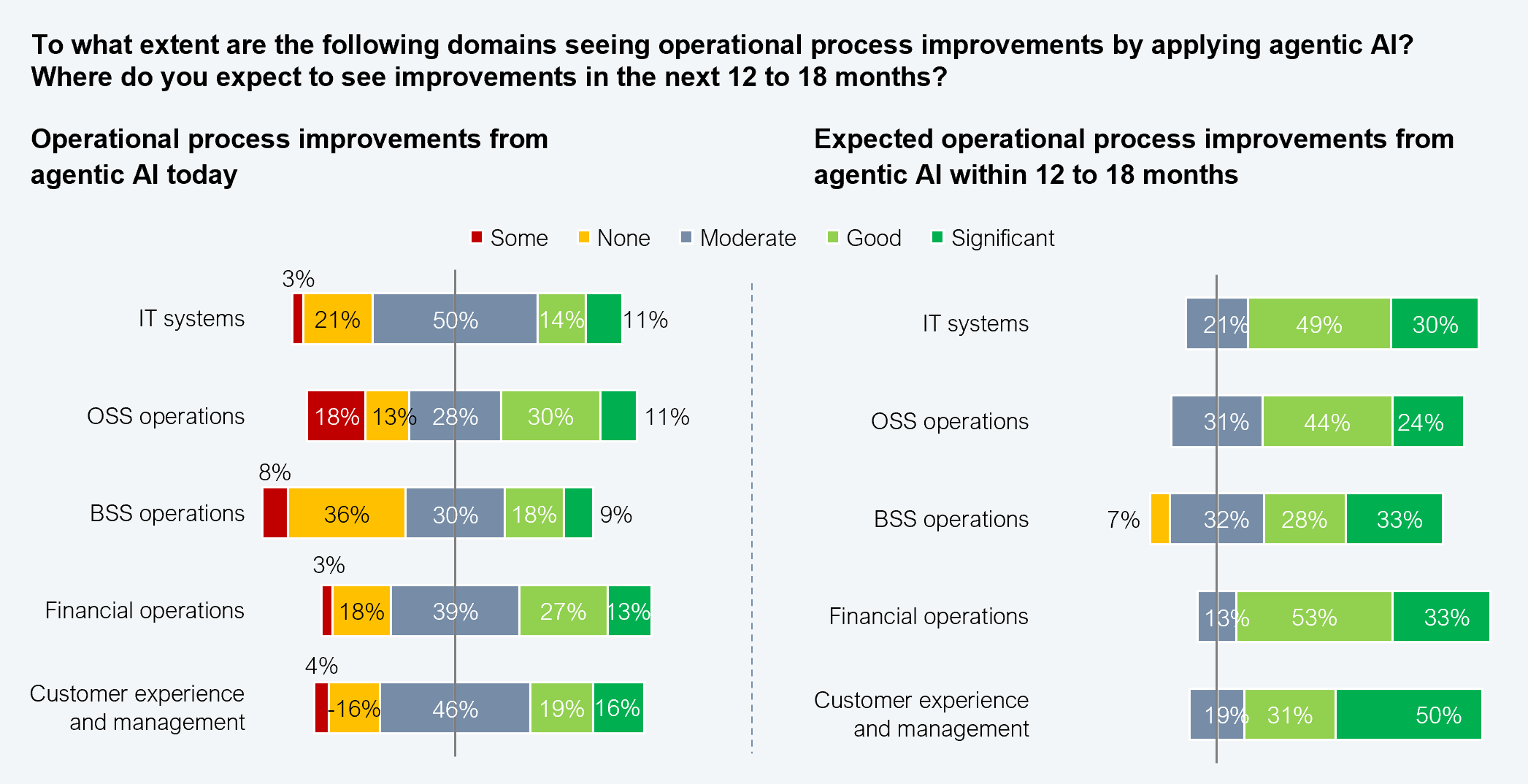
The survey data reinforces this staged approach. Research in Exhibit 9 shows that customer experience and financial operations lead in terms of realized operational improvements. These domains sit closest to revenue, churn, and cost-to-serve outcomes, and they offer clearer feedback loops: errors can often be corrected quickly; interventions are measurable, and early wins build organizational confidence.
Sample: 90 telecom enterprise executives
Source: HFS Research, 2026
Looking ahead 12 to 18 months, expectations broaden significantly. IT systems and BSS show the largest projected uplift due to agentic AI, signaling that telcos anticipate moving from contained improvements toward more complex cross-functional orchestration. These domains require agents to coordinate across fragmented stacks (e.g., order management, service assurance, billing journeys, and incident response); therefore, they tend to scale only once foundational governance and integration capabilities are in place.
A breakthrough for us would be how agentic AI can support real-time network optimization without human bottlenecks. Our engineers spend too much time on routine tasks that AI agents could handle.
— European telco operator
OSS is also impacted and improves over time due to agentic AI, but at a more measured pace. This is not a lack of ambition, but a reflection of perceived risk-reward ratio. Network-facing environments have the highest blast radius. Autonomous actions in OSS can cascade rapidly, disrupting service continuity and affecting large customer populations. As a result, telcos are approaching OSS autonomy more conservatively, prioritizing controlled execution, rollback capability, and human oversight before allowing deeper levels of agent-led action.
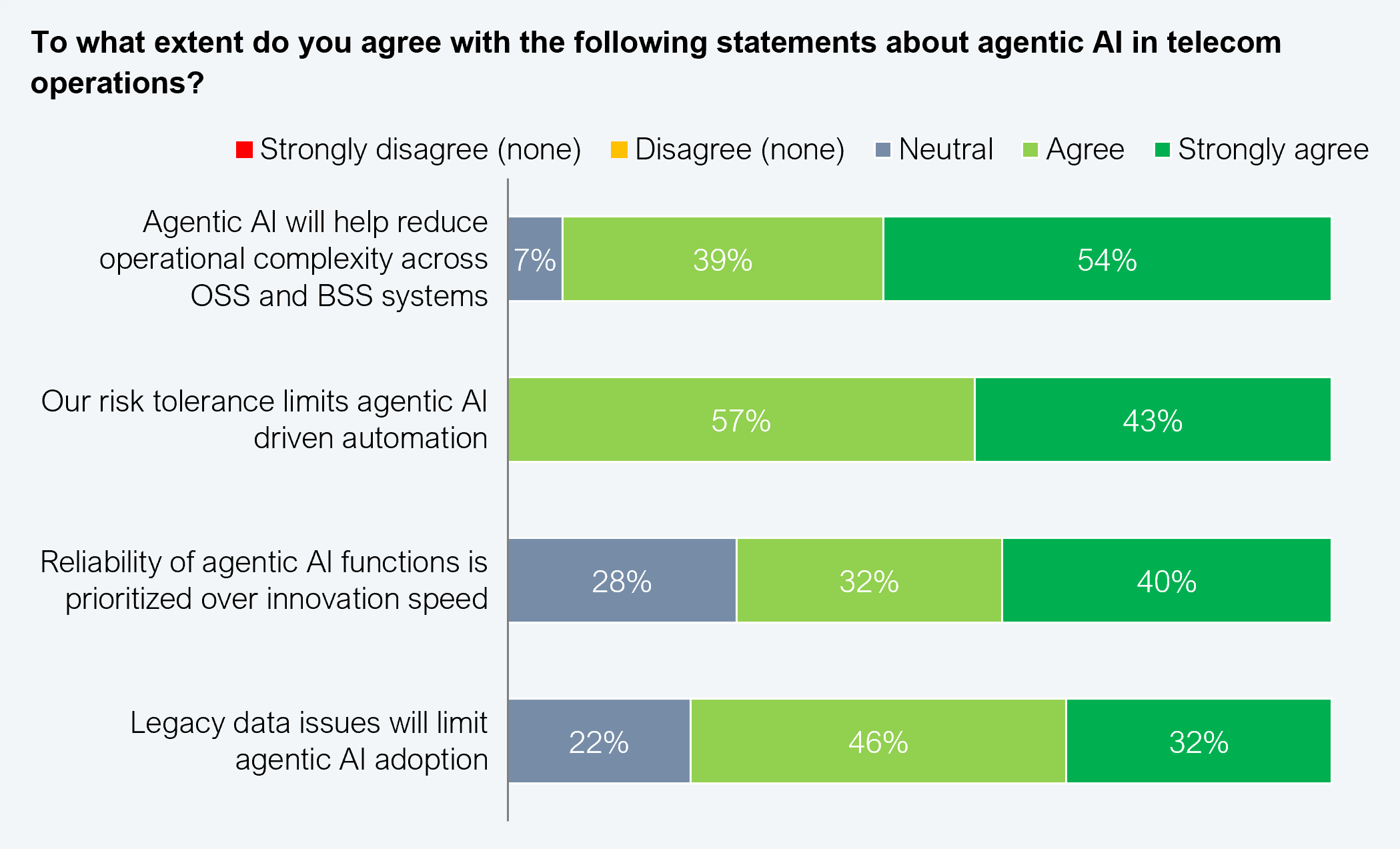
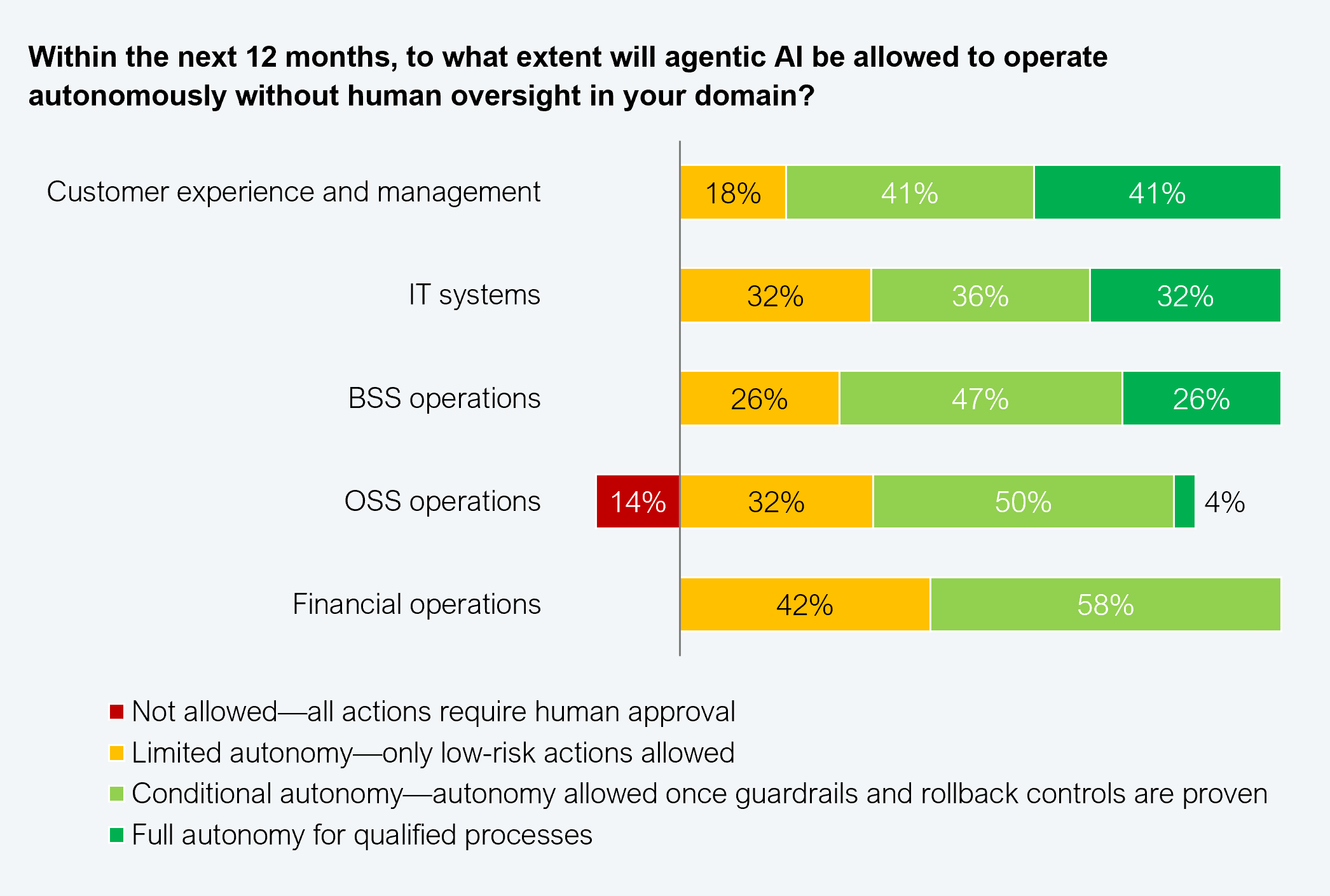
Underlying this domain-level roadmap is a clear autonomy acceptance curve. As shown in Exhibit 10, telcos are most comfortable allowing higher levels of autonomous action in customer experience, followed by IT and BSS. OSS shows significantly lower tolerance for full autonomy, with some respondents indicating that autonomous action is currently not permitted. Sequencing is fundamentally about risk management: autonomy expands fastest where failures are reversible and slowest where failures can cascade.
Sample: IT systems: 22, OSS operations: 28, BSS operations: 34, financial operations: 24, customer experience and management: 34
Source: HFS Research, 2026
Telcos must leverage playbooks to deploy agentic AI sequentially. As many interviews illustrated to HFS, early successes in deploying agents and AI workflows across CX, financial operations, and IT build operational confidence, refine governance, and strengthen orchestration capabilities. Getting clear, measurable early wins before extending agentic AI deeper into the network and service layers will drive adoption.
The opportunity is not to deploy more AI, but to execute better across domains through governance, KPI resets, and sequenced autonomy. Telcos that treat agentic AI as an enterprise execution model, not a set of tools, are positioned to protect revenue, improve customer health, and increase resilience in structurally flat growth markets.
Becoming an agentic telco is about changing how you operate and how you measure success. KPIs will shift from being human-operator-centric to business-impact-oriented. As one executive nicely sums it up, “[we] are seeing a shift from reactive, constrained work to predictive operations. We’ve talked about it for years, but agentic AI may actually deliver what we’ve desired all along.”
Register now for immediate access of HFS' research, data and forward looking trends.
Get StartedIf you don't have an account, Register here |
With the exception of our Horizons reports, most of our research is available for free on our website. Sign up for a free account and start realizing the power of insights now.
Our premium subscription gives enterprise clients access to our complete library of proprietary research, direct access to our industry analysts, and other benefits.
Contact us at [email protected] for more information on premium access.