
This Market Impact Report is for CIOs, chief AI officers, enterprise transformation leaders, and operations executives assessing how to move agentic AI from bounded pilots into enterprise-wide autonomous execution.
Agentic AI marks a transition from tools that assist work to systems that participate in it. In 2026, enterprises are no longer experimenting at the edges; they are embedding intelligence into execution itself. The question is no longer whether agents can act, but whether organizations are prepared for what it means when they do.
This HFS study, conducted in partnership with Infosys and informed by more than 500 Global 2000 enterprise decision makers, examines how enterprises are deploying agentic AI, where it is delivering value, what is constraining autonomy, and what separates isolated pilots from enterprise-wide scale.
The findings show that progress is real but uneven. Adoption is accelerating, yet autonomy remains constrained by how work is structured, governed, and trusted. Most enterprises are building agent capability faster than they are reshaping the systems those agents must operate within.


Agentic AI is no longer a feature upgrade. It is a structural change in how decisions are made, how work flows, and how responsibility is assigned between humans and machines. The enterprises that navigate this shift well will do so by designing for coordination, trust, and adaptability, not by adding more intelligence to systems built for control.
For enterprise leaders scaling AI across operations and governance, Agentic AI adoption is accelerating, and deployment is expanding across tasks, teams, and workflows. But a familiar pattern is emerging with implementation moving faster than enterprise redesign. Agents are being embedded into execution, yet decision rights, accountability, and governance remain largely unchanged. Without structural shifts in how authority and ownership are defined, organizations are increasing activity within existing models rather than enabling true autonomy.
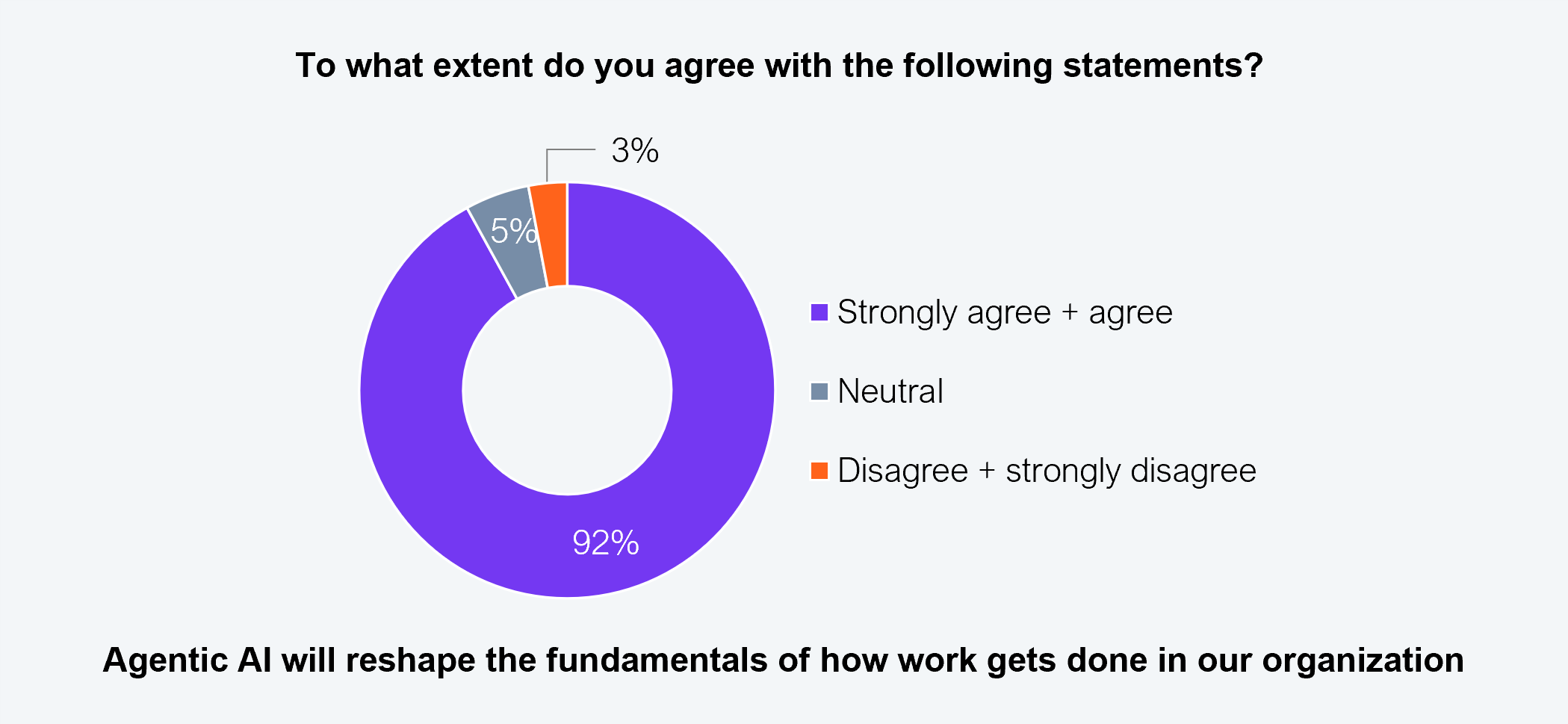
Agentic AI has already won the belief battle. Ninety-two percent (92%) of executives say it will reshape the fundamentals of how work gets done (see Exhibit 1). The momentum is real, but the next question is the one most enterprises are now running into: What does “ready” actually look like when agents move from demos into day-to-day execution?
Sample: 505 Global 2000 enterprise decision makers
Source: HFS Research, 2026
That is where agentic maturity matters. It is not a measure of how many agents an enterprise has deployed. It is a measure of whether agents can expand beyond isolated tasks into real workflows, with clear ownership, governed behavior, trusted data access, and defined human intervention when things break. When those conditions are missing, adoption still happens, but it stays contained.
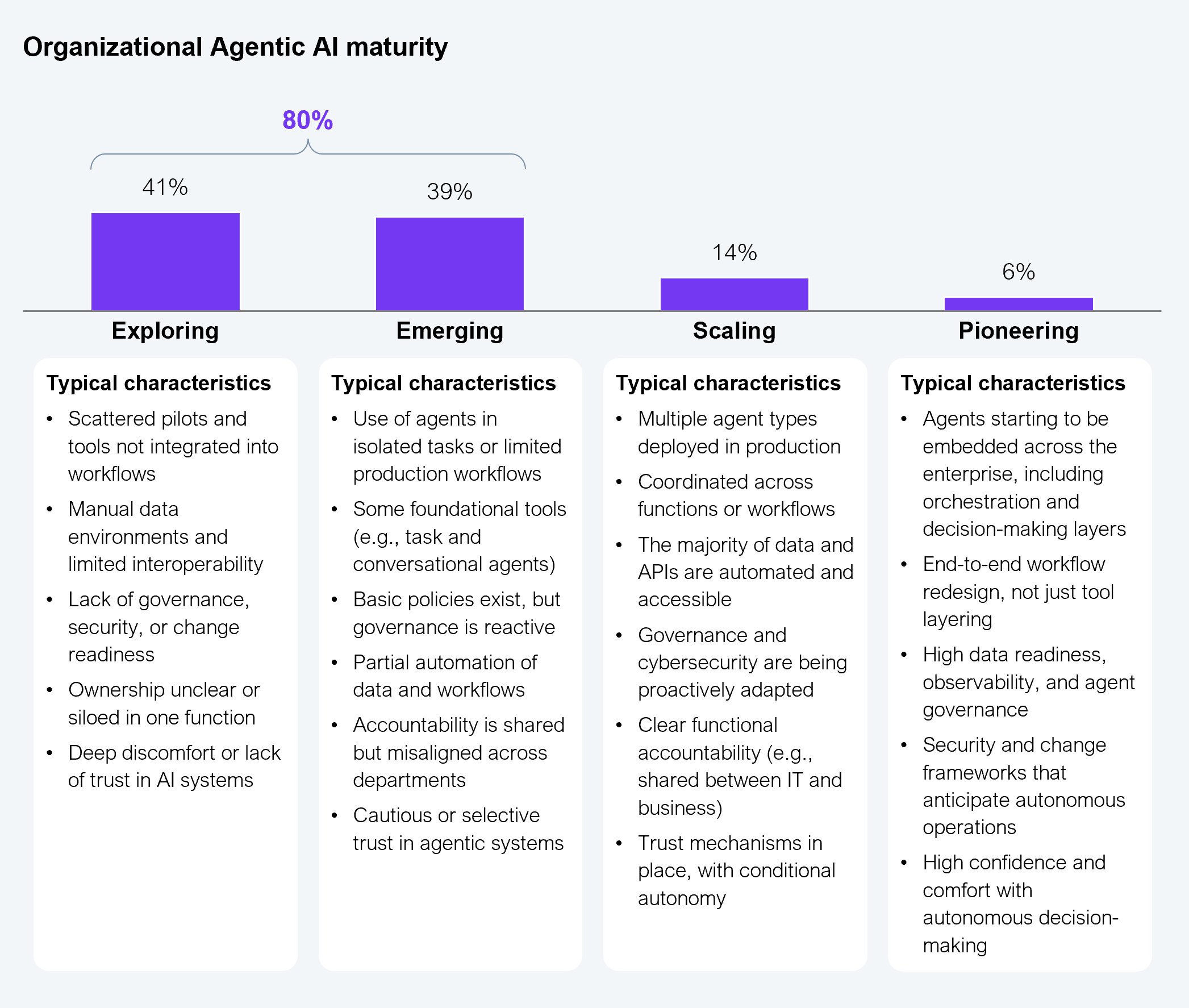
The maturity distribution makes that containment visible. Enterprises cluster into four stages: Exploring (41%), Emerging (39%), Scaling (14%), and Pioneering (6%). Eighty percent (80%) remain in the first two stages, where progress is still concentrated in bounded use cases and value is measured primarily through efficiency gains rather than enterprise-wide execution change (see Exhibit 2).
Sample: 505 Global 2000 enterprise decision makers
Source: HFS Research, 2026
This maturity did not appear overnight. The pioneers are also the enterprises that were already ahead on GenAI maturity. They are more than 20 times more likely to have GenAI embedded across core workflows and decision making than organizations still exploring, consistent with last year’s HFS–Infosys AI maturity research. The message is simple: agentic progress compounds. Enterprises that never moved GenAI beyond pilots are now discovering that scaling agents is easy, but scaling workflows, ownership, and trust is the real work.
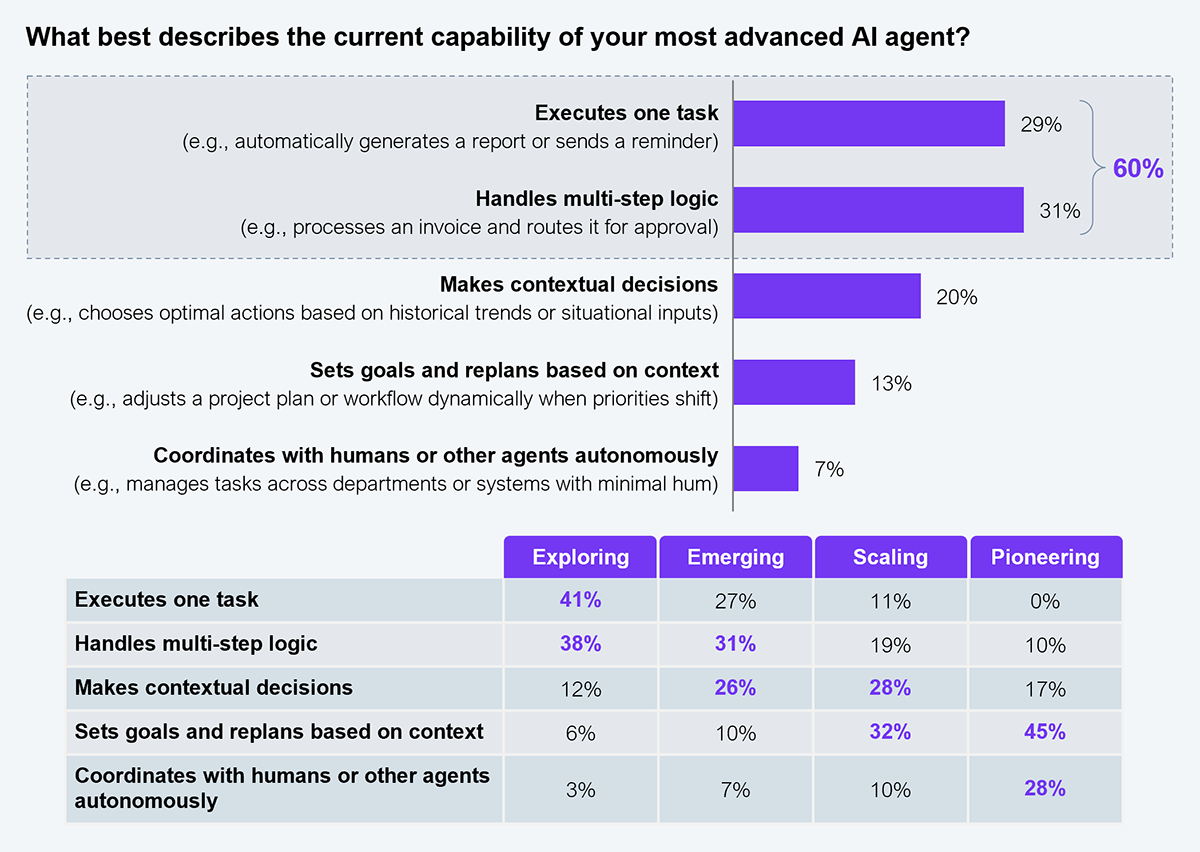
Enterprises are choosing reliability over reach, and the data makes that choice visible. Sixty percent (60%) say their most advanced agents are still rules-based and focused on bounded tasks like summarization, ticket handling, and transaction processing (see Exhibit 3). That is not a weak starting point; it is a predictable one. It keeps risk low, value measurable, and failure containable.
But it also exposes what maturity really demands. Task automation is not autonomy; it is permissioned execution. The maturity jump shows up when agents move from executing instructions to handling multi-step logic, making contextual decisions, and coordinating across humans and systems. These capabilities concentrate in the Scaling and Pioneering cohorts (see Exhibit 3). The message is simple: Autonomy does not arrive when agents get smarter. It arrives when enterprises change what agents are allowed to do and build the governance, data access, and accountability to let them do it.
Sample: 505 Global 2000 enterprise decision makers
Source: HFS Research, 2026
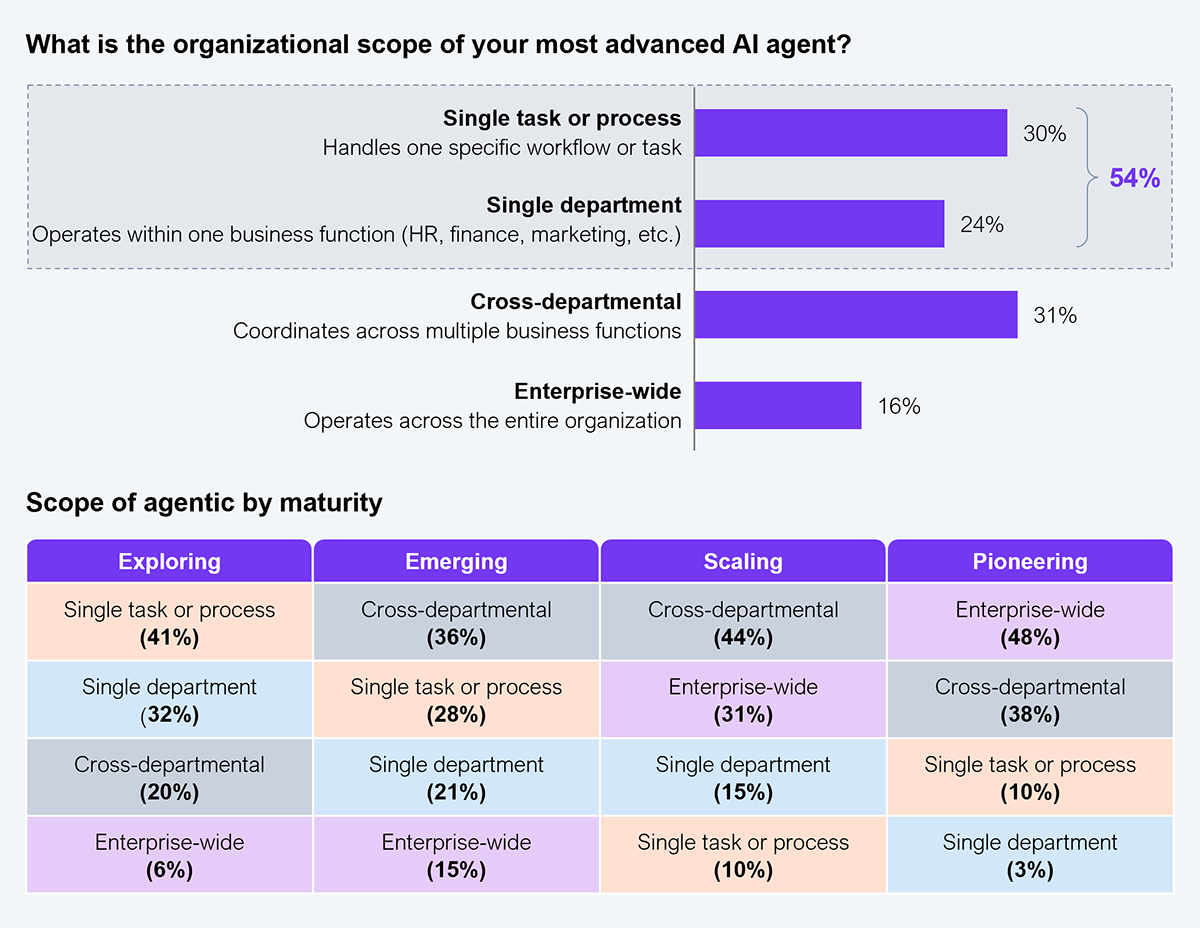
If you want one clean maturity signal, it is scope. Only 16% report enterprise-wide deployment today (see Exhibit 4). Most deployments remain confined to tasks, processes, or single functions, which limits coordination and keeps value localized.
This is not a model capability problem. It is a delegation problem. Expanding scope forces decisions about decision rights, escalation, auditability, and shared accountability. Enterprises that cannot answer those questions will keep agents contained, even when adoption looks broad.
Sample: 505 Global 2000 enterprise decision makers
Source: HFS Research, 2026
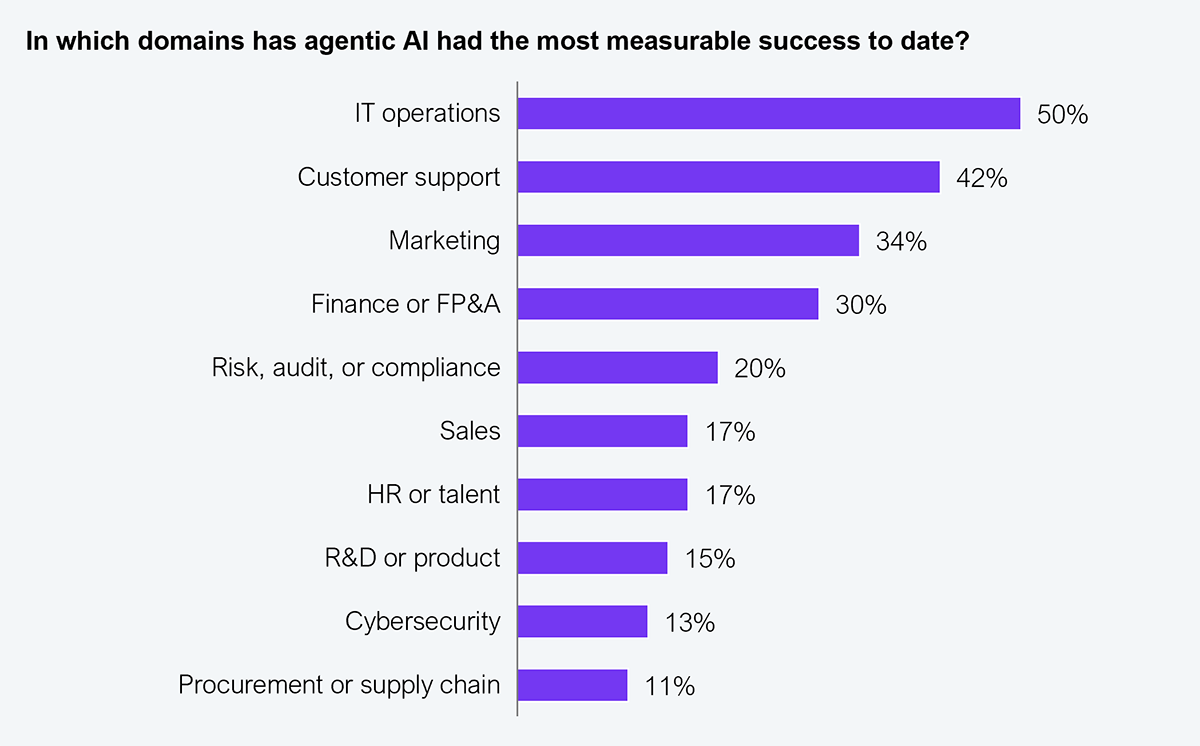
Agentic AI gains traction fastest where workflows are already structured, data is abundant, and outcomes are measurable. IT operations and customer support lead adoption, cited by 50% and 42% of enterprises, respectively (see Exhibit 5). These are domains where escalation paths are clear, risk is bounded, and governance can be operationalized.
The drop-off in areas like risk management, product development, and supply chain orchestration is equally instructive. These environments are exception-rich, judgment-heavy, and cross-functional by nature, which makes it harder to formalize ownership and decision rights. The constraint is not that agents cannot add value there. It is that most enterprises have not yet redesigned execution logic for work where trade-offs dominate and accountability is shared.
Sample: 505 Global 2000 enterprise decision makers
Source: HFS Research, 2026
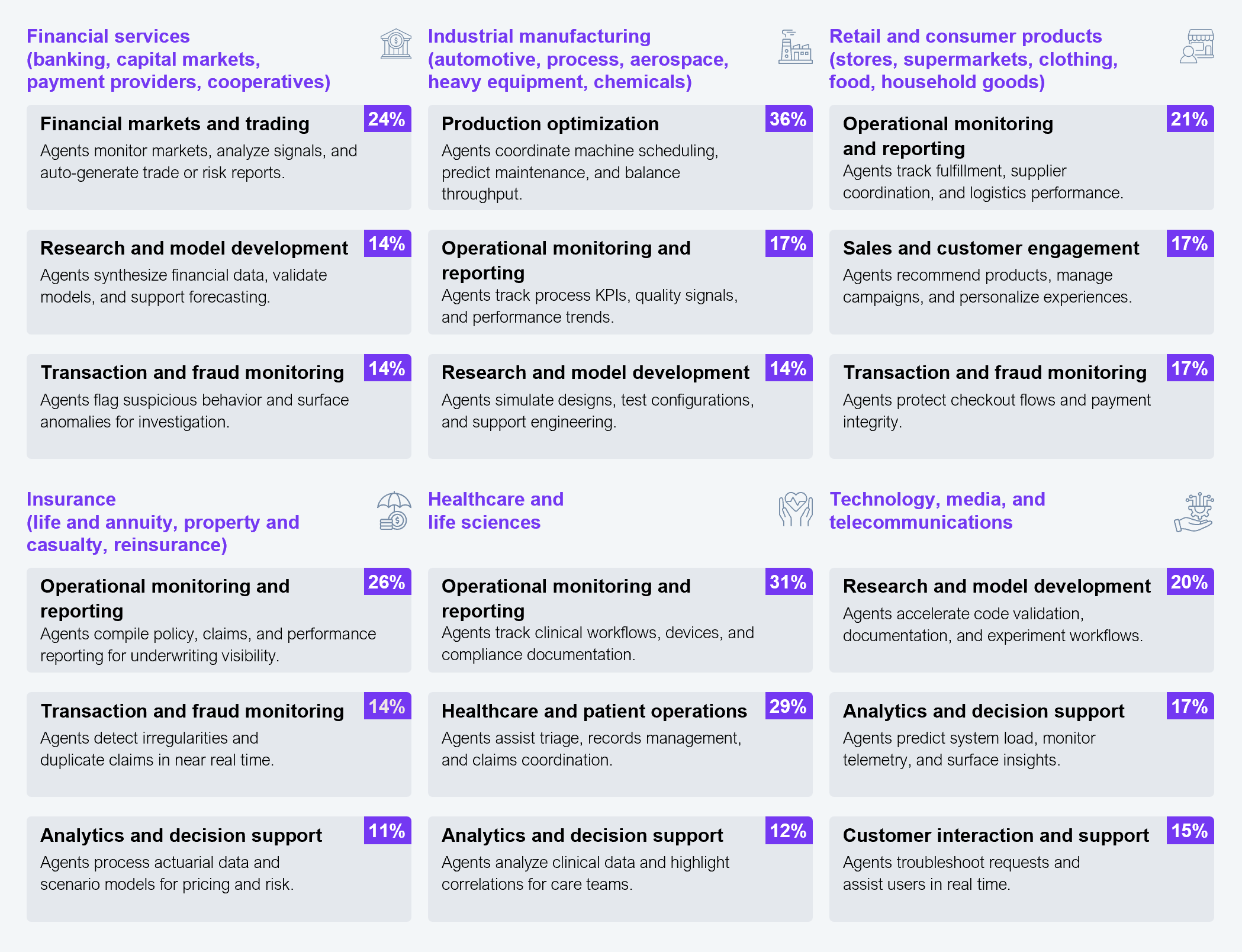
Industries are not converging on agentic AI at the same pace because they do not share the same risk thresholds. Financial services skews toward risk and compliance, healthcare and manufacturing emphasize safety and reliability, retail leans into customer engagement, and technology firms tend to experiment more broadly. Across sectors, adoption is still concentrated in bounded use cases like research, monitoring, and analytics, work that improves speed and insight without requiring broad delegated authority (see Exhibit 6).
Sample: 505 Global 2000 enterprise decision makers
Source: HFS Research, 2026
Most enterprises are proving that agents can work within clear boundaries. Far fewer are proving that the enterprise can work with agents across workflows, functions, and accountability lines. The maturity test is not adoption volume; it is whether agentic systems can expand scope safely, with defined decision rights, real-time data access, auditability, and escalation rules that make accountability explicit.
Enterprises are aiming high with agentic AI. Many are explicitly framing it as a way to rethink how the business operates, not just how tasks get done. But the data shows a growing disconnect between strategic intent and structural readiness. Organizations are running toward autonomy without agreeing on who is steering.
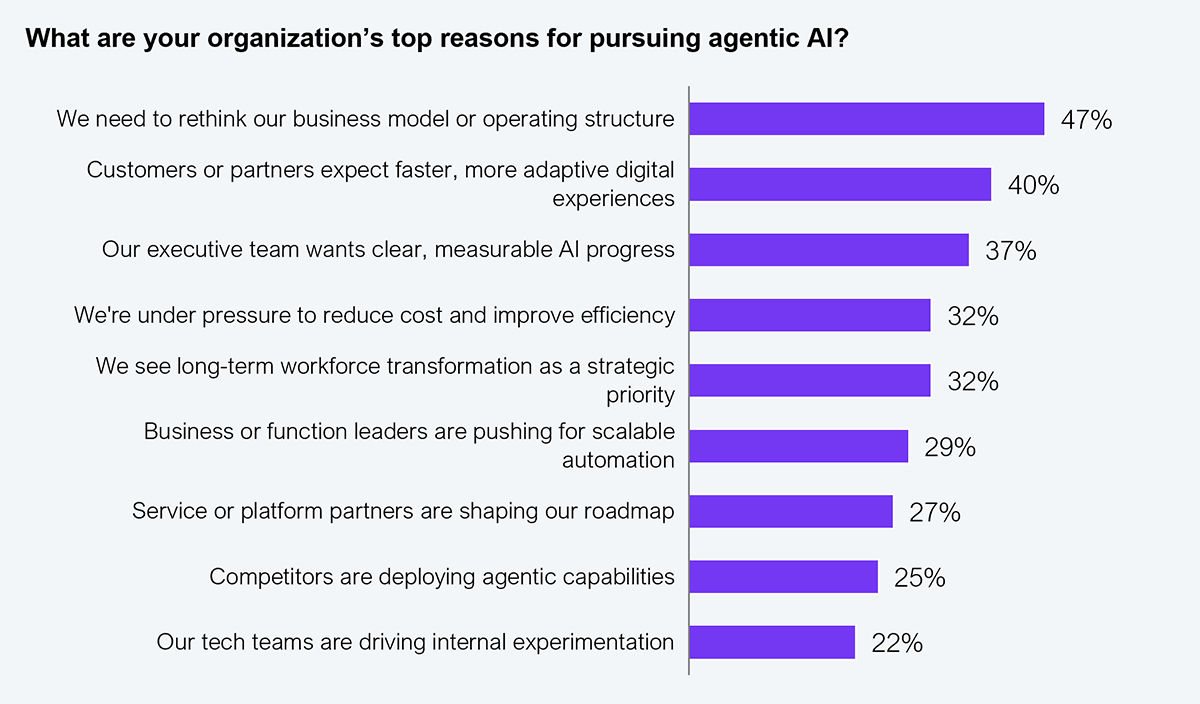
The intent behind agentic AI is not incremental. Forty-seven percent (47%) say they are pursuing it to rethink business models or operating structures, and another 40% are aiming to meet rising expectations for adaptive digital experiences (see Exhibit 7). These are not efficiency plays. They signal recognition that competitiveness increasingly depends on enterprises that can sense, decide, and act dynamically.
Yet the operating reality does not match the ambition. Many organizations are attempting enterprise reinvention without a coordinating layer that aligns agents, humans, and accountability across workflows. Strategy is being set at the top, while execution authority remains fragmented at the edges.
Sample: 505 Global 2000 enterprise decision makers
Source: HFS Research, 2026
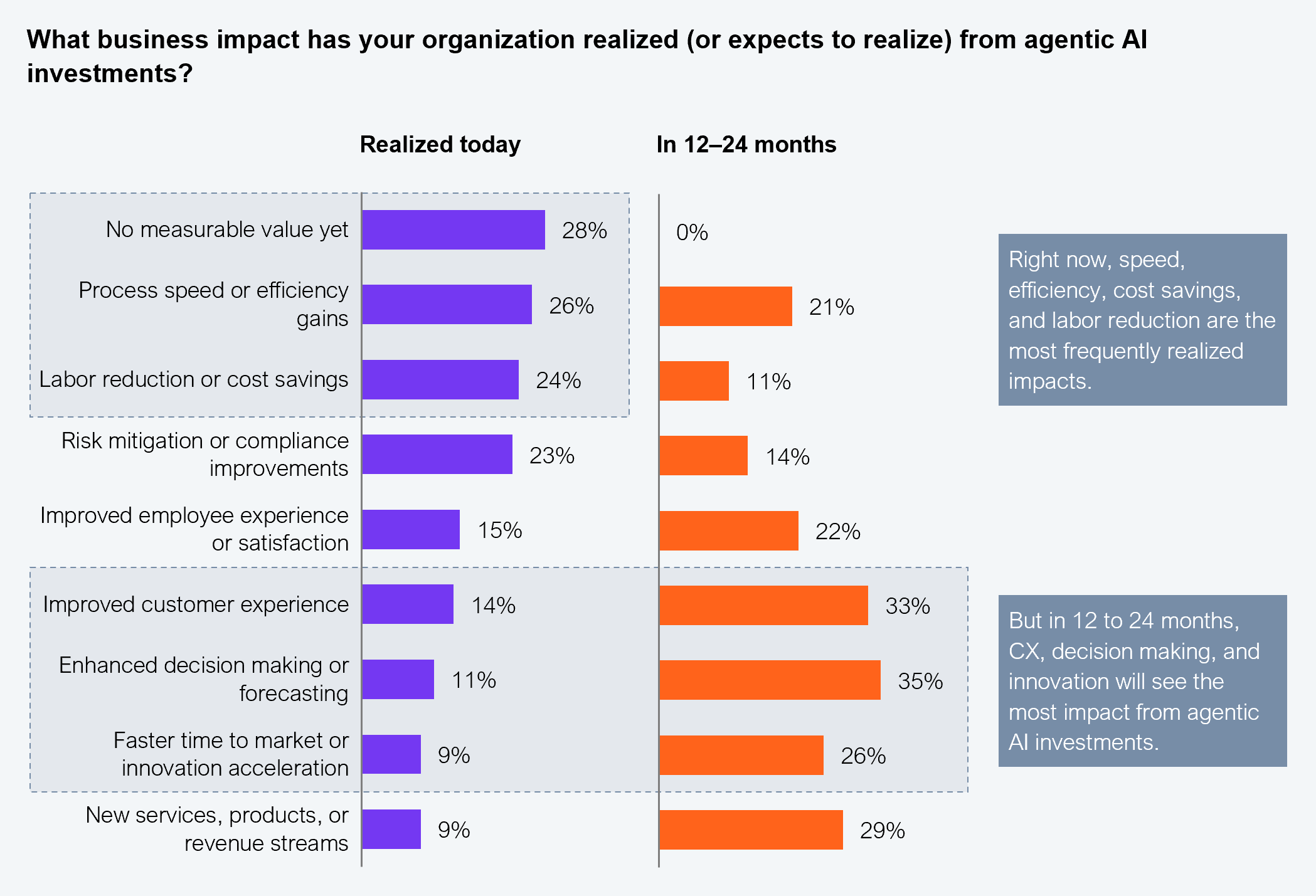
The outcomes realized so far reflect this imbalance. Enterprises report gains in process efficiency (26%) and cost reduction (24%), but far fewer see impact in decision quality, innovation, or customer experience, the areas where agentic systems should ultimately matter most (see Exhibit 8). Nearly one in three reports no measurable value yet.
This does not mean agentic AI is underperforming. It means it is being applied where a structure already exists. Efficiency improves first because it fits inside existing accountability models. Decision advantage lags because it requires new ones.
Leaders expect this to change over the next 12 to 24 months, with greater impact anticipated in forecasting, decision intelligence, and innovation. That expectation assumes a structural shift, not just better models.
Sample: 505 Global 2000 enterprise decision makers
Source: HFS Research, 2026
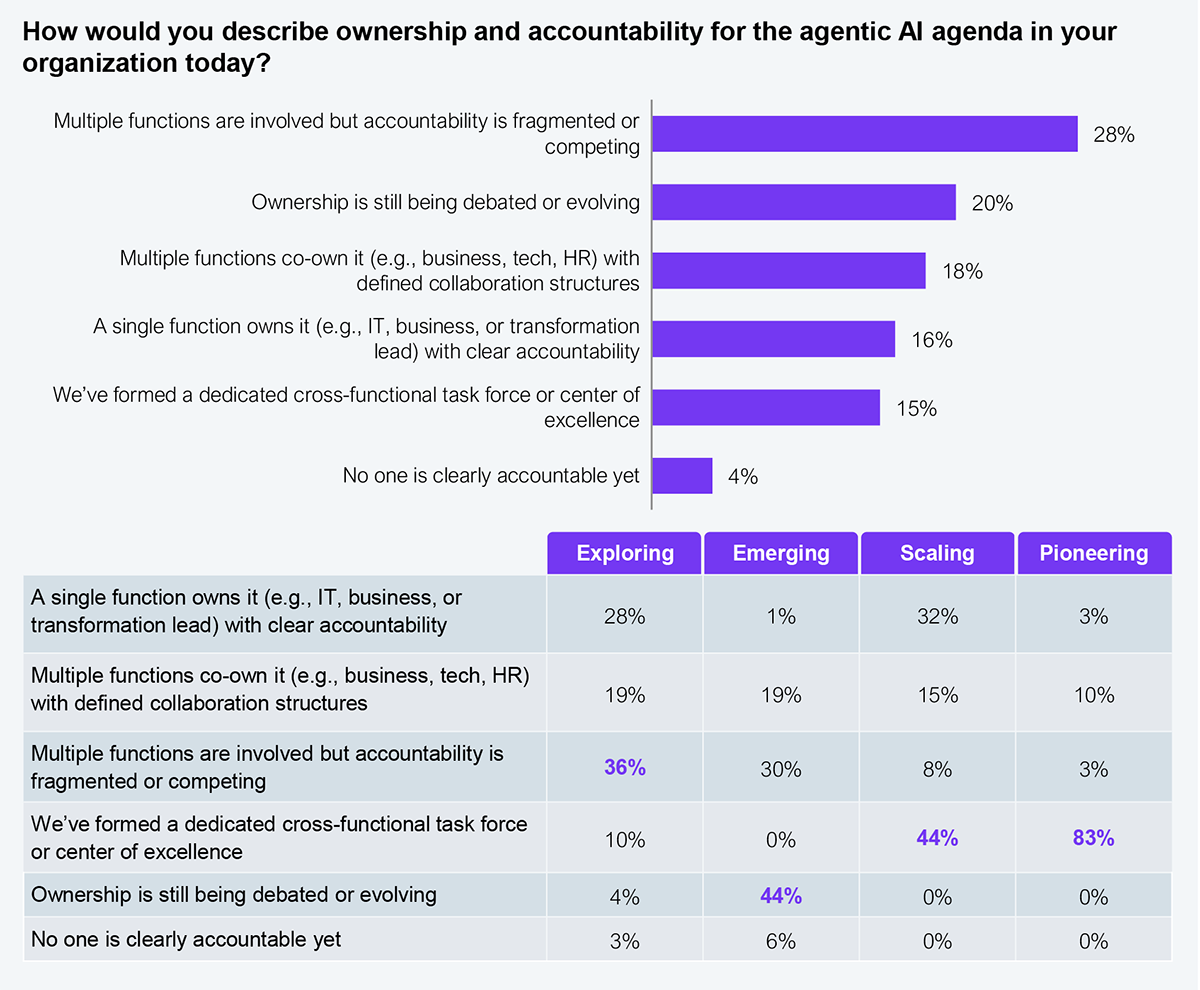
Autonomy cannot scale without clarity on who owns outcomes. Yet ownership remains unresolved across much of the enterprise. Twenty-eight percent (28%) report that multiple functions are involved with fragmented or competing mandates, and another 20% say ownership is still being debated (see Exhibit 9). Only a minority reports clear, centralized accountability.
The maturity signal here is stark. In early-stage organizations, ownership is diffuse or absent. In pioneering ones, cross-functional ownership models, often through dedicated centers of excellence, are the norm. This mirrors earlier digital transformations, but with higher stakes. Agentic systems do not just execute faster; they act independently within defined bounds. Ambiguity at this layer becomes risk, not flexibility.
Sample: 505 Global 2000 enterprise decision makers
Source: HFS Research, 2026
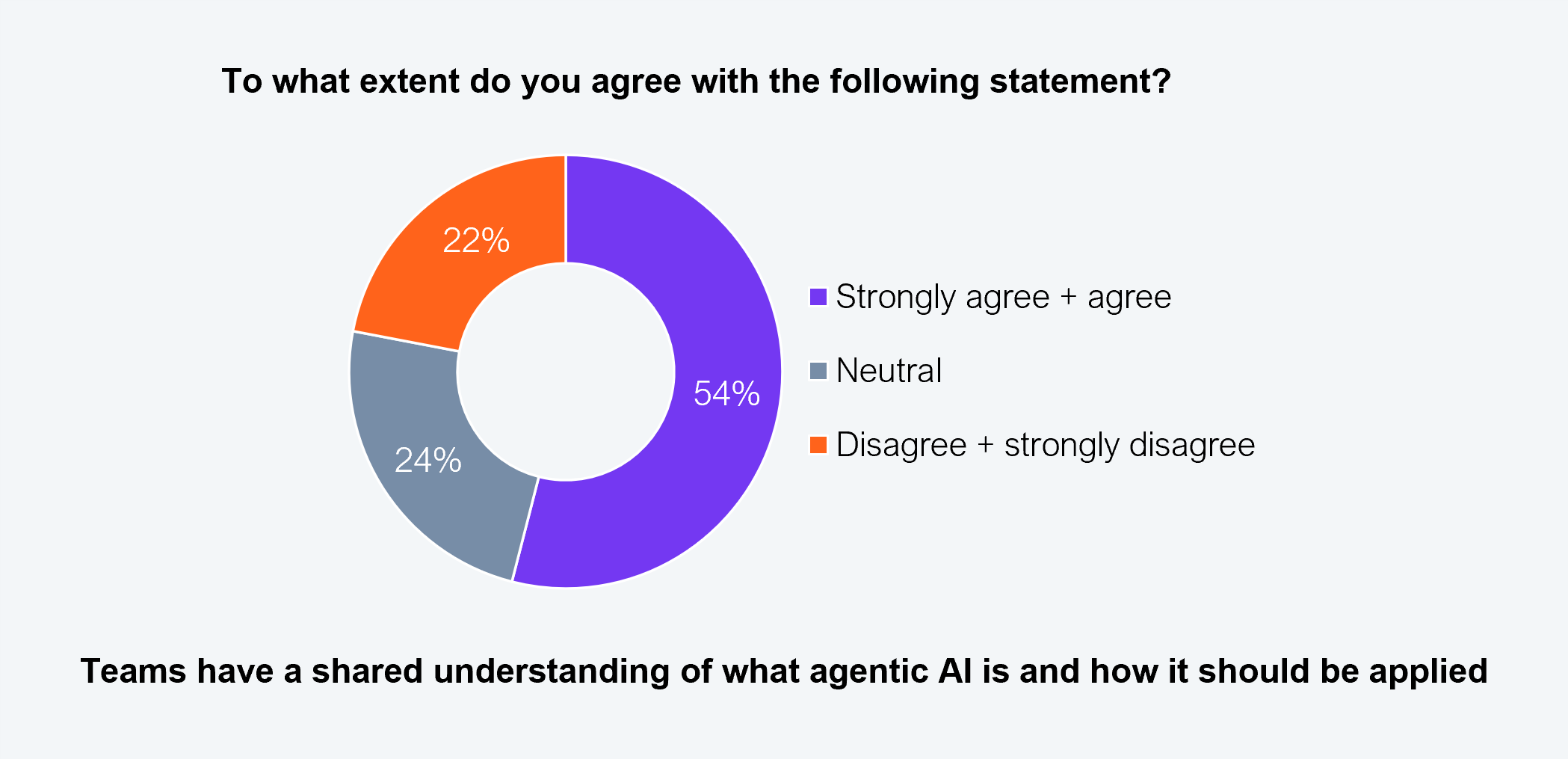
Structural misalignment is reinforced by conceptual fragmentation. Just over half of leaders say their teams share a common understanding of what agentic AI is and how it should be applied, while nearly half remain uncertain or divided (see Exhibit 10). Without a shared definition, governance becomes reactive and trust remains fragile.
Autonomy means different things to different groups. To some, it is automation with reasoning. To others, it is delegated decision making. Until enterprises align on where human judgment ends and agentic authority begins, they will continue to design for containment rather than scale.
Sample: 505 Global 2000 enterprise decision makers
Source: HFS Research, 2026
Agentic transformation cannot be driven from strategy decks or isolated innovation teams. The gap is no longer intent. It is integration. Leadership conviction is high, but ownership is fragmented, definitions are inconsistent, and decision rights are unclear.
Agentic AI exposes what enterprises have quietly worked around for years. Intelligence can reason, plan, and adapt, but it cannot operate reliably on data that arrives late, systems that do not interoperate, or controls designed for static workflows. As autonomy expands, foundational weaknesses stop being a technical inconvenience and become an execution risk.
This is not a tooling problem. It is an operating environment problem. The data shows that enterprises are pushing agentic systems toward greater responsibility before the foundations needed to support delegated action are in place.
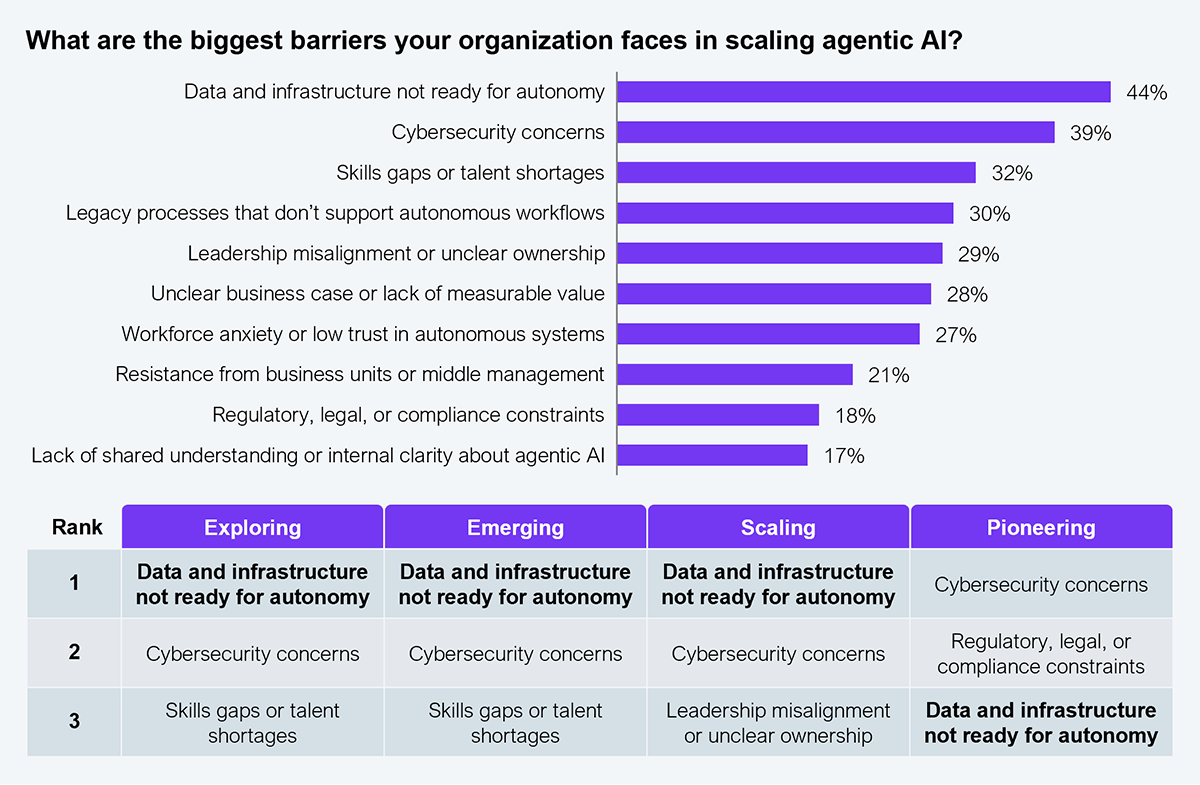
Autonomy depends on timely, contextual access to data. Yet 44% of enterprises say their data and infrastructure are not ready to support agentic AI at scale (see Exhibit 11). Only a small minority report real-time data availability across workflows, which sharply limits how much authority agents can safely be given.
This explains why so many deployments remain assistive rather than autonomous. When data is fragmented, delayed, or siloed, agents can recommend and execute tasks, but they cannot own decisions. Infrastructure reinforces this constraint. Many environments are still optimized for batch processing, human checkpoints, and sequential handoffs, not continuous execution.
Sample: 505 Global 2000 enterprise decision makers
Source: HFS Research, 2026
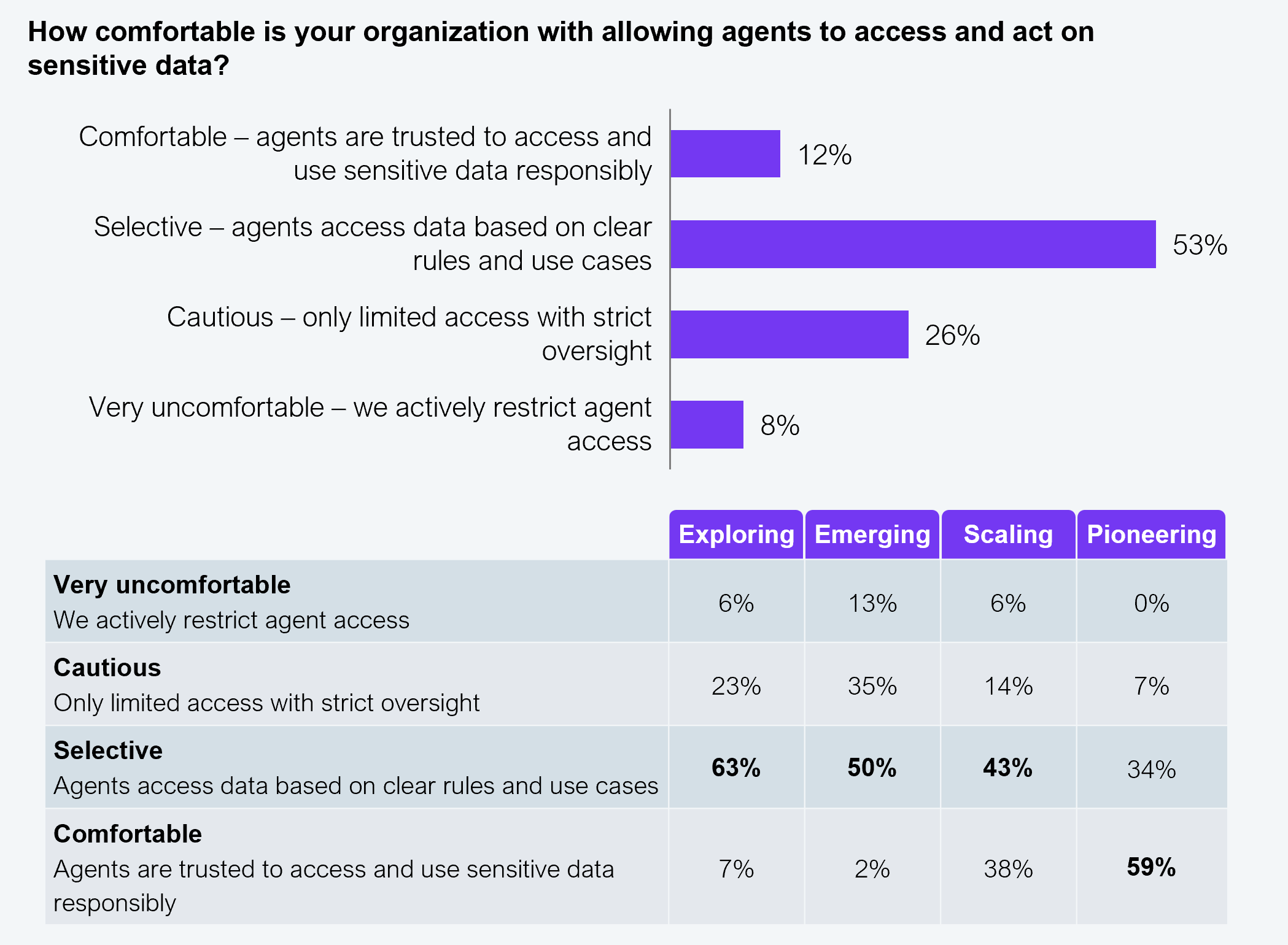
Even where data exists, trust remains tightly rationed. Only 53% allow agents access to sensitive data only in predefined use cases, while just 12% are comfortable granting broad access (see Exhibit 12).
This is guarded autonomy. Agents may be capable of reasoning across contexts, but permissions keep them operating inside narrow corridors. The maturity signal is consistent: early-stage organizations are still connecting and cleaning data, scaling organizations are adding controls, and pioneers are embedding governance directly into data and execution architectures.
Sample: 505 Global 2000 enterprise decision makers
Source: HFS Research, 2026
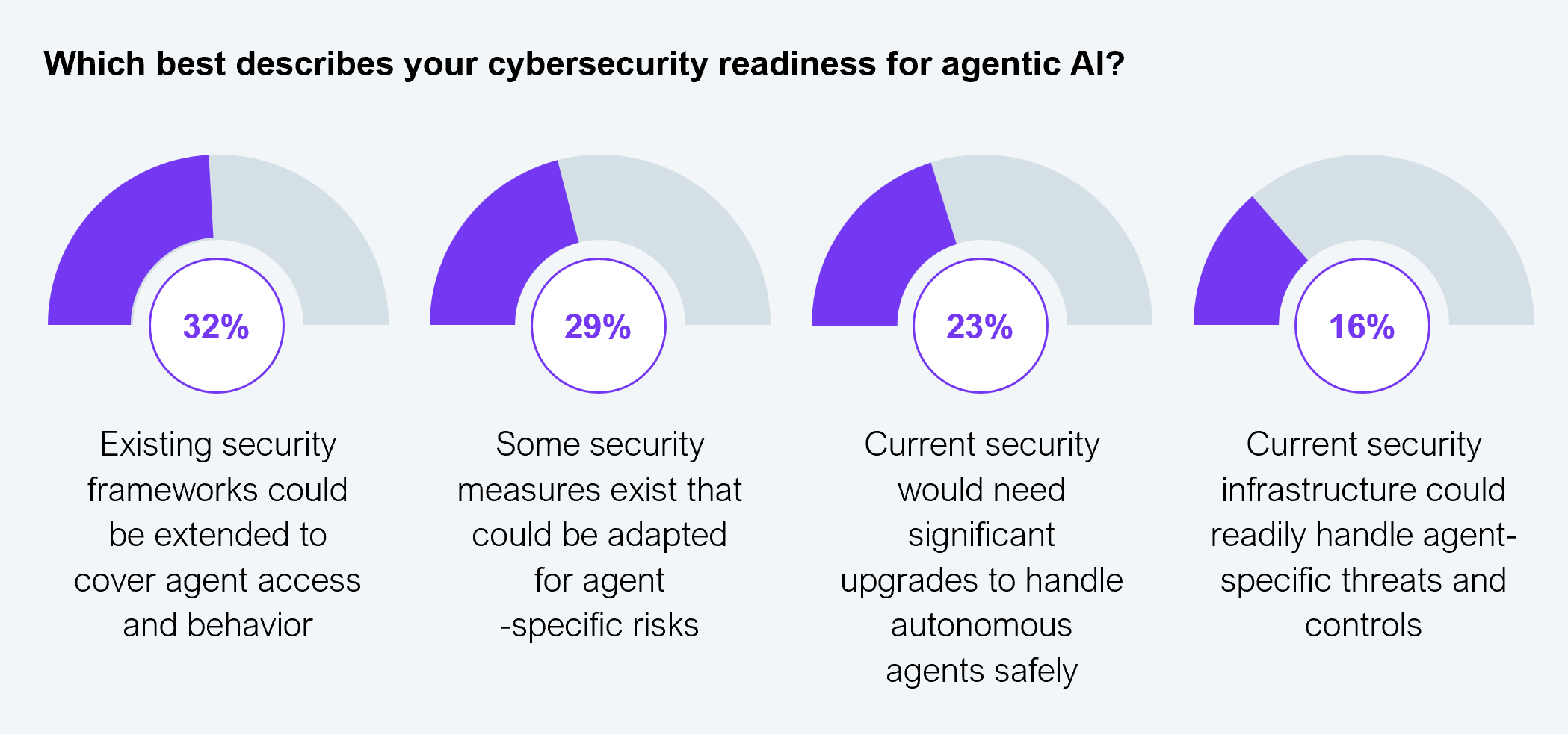
Agentic AI introduces a different risk profile than traditional automation. Only 16% of enterprises say their cybersecurity frameworks are ready to address agent-specific threats, while more than half acknowledge that a major redesign is required (see Exhibit 13). Static security models assume predictable behavior. Agentic systems operate through dynamic decision chains that cross systems and adapt in real time.
Most enterprises are responding by layering new controls onto old frameworks. That approach maintains compliance, but it does not create resilience. As autonomy grows, security must evolve from perimeter protection to continuous monitoring, identity-aware execution, and behavior-based controls.
Sample: 505 Global 2000 enterprise decision makers
Source: HFS Research, 2026
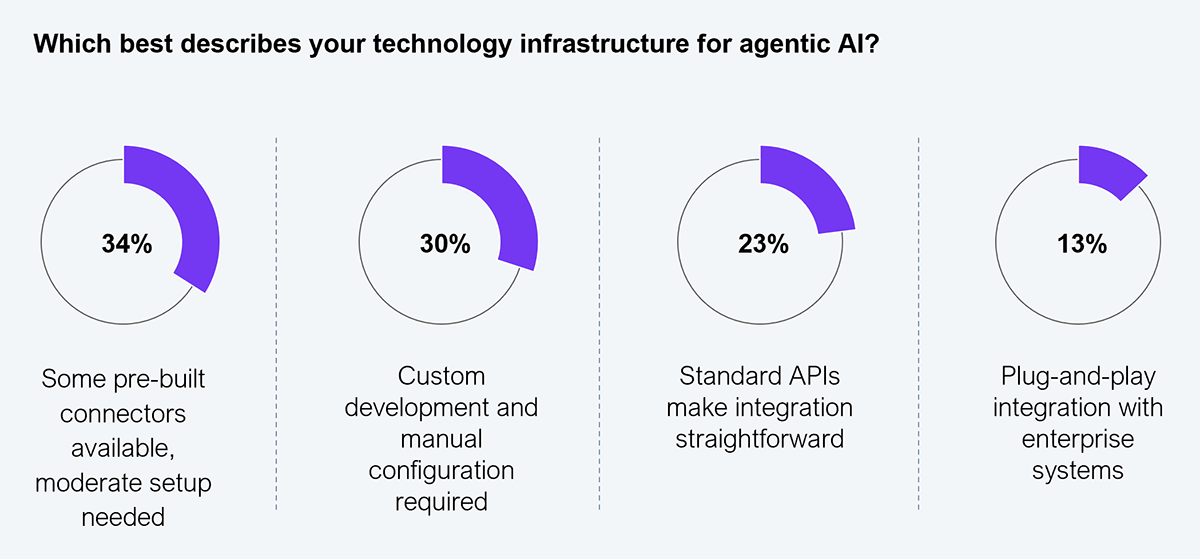
Even when data and security progress, orchestration remains a bottleneck. Sixty-four percent (64%) of enterprises rely on pre-built connectors or manual configuration to integrate agents, and only 13% report seamless integration with core enterprise systems (see Exhibit 14). Every brittle integration limits coordination, increases latency, and constrains cross-workflow execution.
What emerges is architectural fragmentation that mirrors organizational fragmentation. Enterprises assemble intelligent components without the connective tissue required for autonomy. The most advanced organizations are beginning to address this by building agent orchestration layers that govern communication, authentication, and logic across agents and systems.
Sample: 505 Global 2000 enterprise decision makers
Source: HFS Research, 2026
The data converges on one conclusion: Enterprises are layering intelligence onto foundations still optimized for stability and control. Until leaders rebuild around real-time data, governed access, resilient security, and interoperable orchestration, they will scale complexity faster than capability.
As agentic systems gain autonomy, the limiting factor shifts decisively from technology to how humans and organizations are structured around it. The data does not point to mass resistance or fear of AI. It points to something more subtle and more consequential: Enterprises have not yet redesigned how authority, accountability, and trust work when machines begin to act.
Culture is not blocking progress. It is signaling unresolved design choices. Where boundaries are unclear, confidence erodes. Where accountability is ambiguous, autonomy stalls.
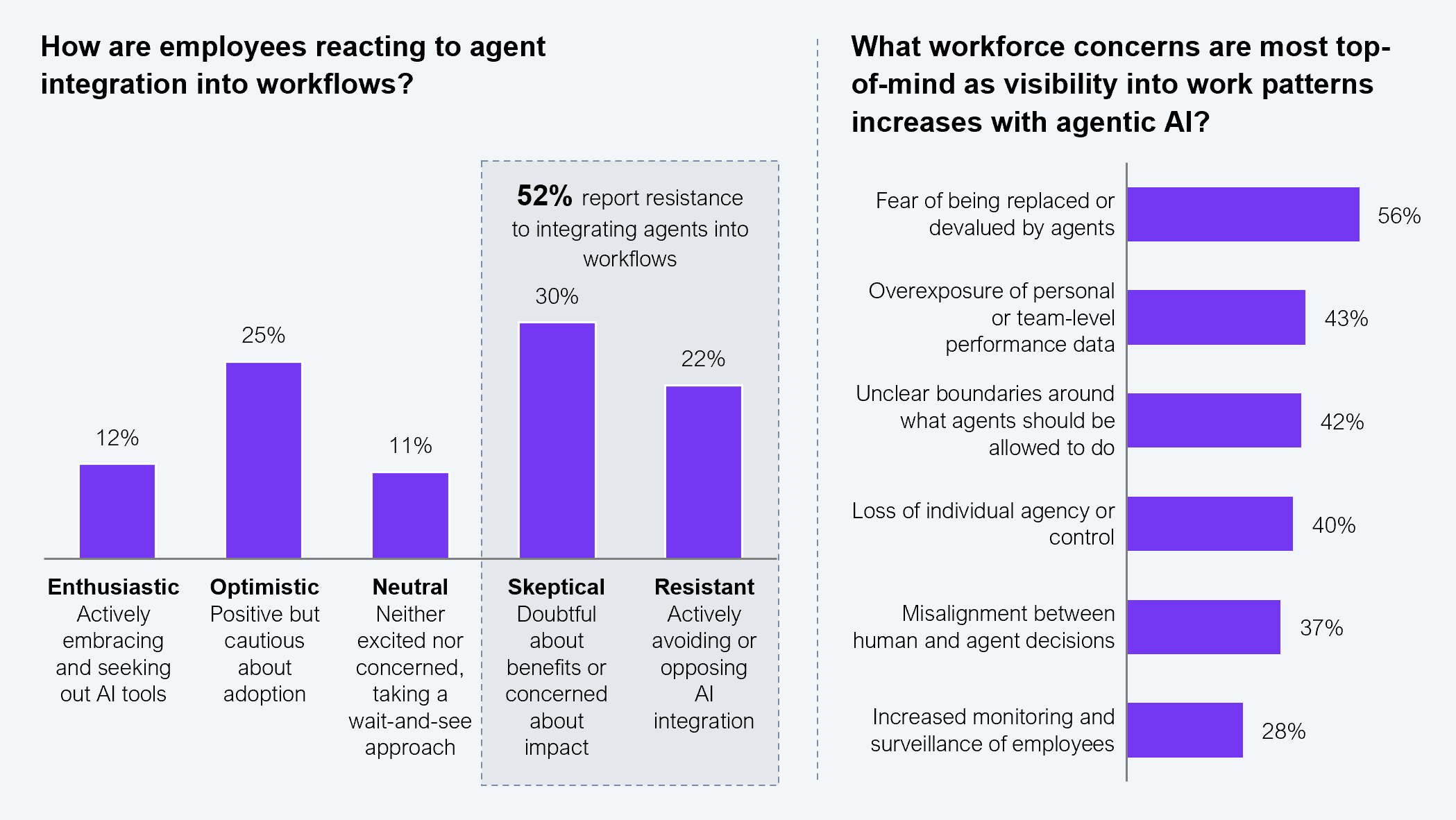
Workforce hesitation is real, but it is not ideological. Fifty-two percent (52%) report resistance to integrating agents into workflows (see Exhibit 15), yet this resistance aligns closely with earlier signals around fragmented ownership, unclear governance, and limited delegation. Employees are not rejecting agents. They are questioning how responsibility is shared when outcomes are produced jointly by humans and systems.
This distinction matters. Resistance is not a change-management problem to be solved with messaging. It is a design problem rooted in unclear escalation paths, poorly defined roles, and uncertainty about how decisions will be judged.
Sample: 505 Global 2000 enterprise decision makers
Source: HFS Research, 2026
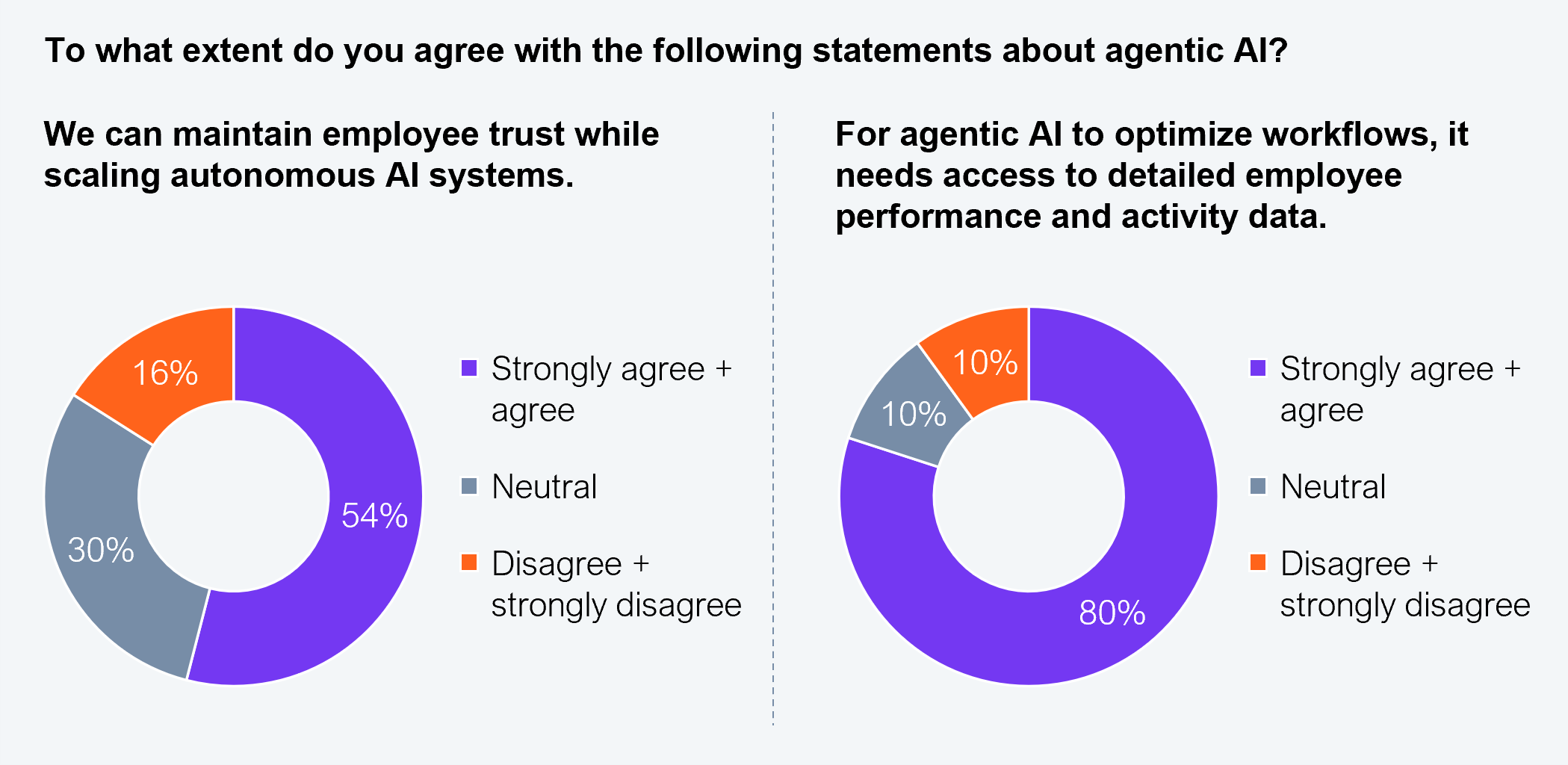
Leaders express confidence that trust can be maintained as agentic AI scales. At the same time, 80% agree that agents need access to detailed employee performance and activity data to optimize workflows (see Exhibit 16). These two signals coexist, but they create a cultural tension that enterprises have not fully resolved.
Autonomy requires visibility. Trust requires legitimacy. When employees do not understand how data is used, who sees it, or how it influences decisions, visibility feels like surveillance. Culture is shaped not by the presence of data, but by whether its use is transparent, bounded, and defensible.
Sample: 505 Global 2000 enterprise decision makers
Source: HFS Research, 2026
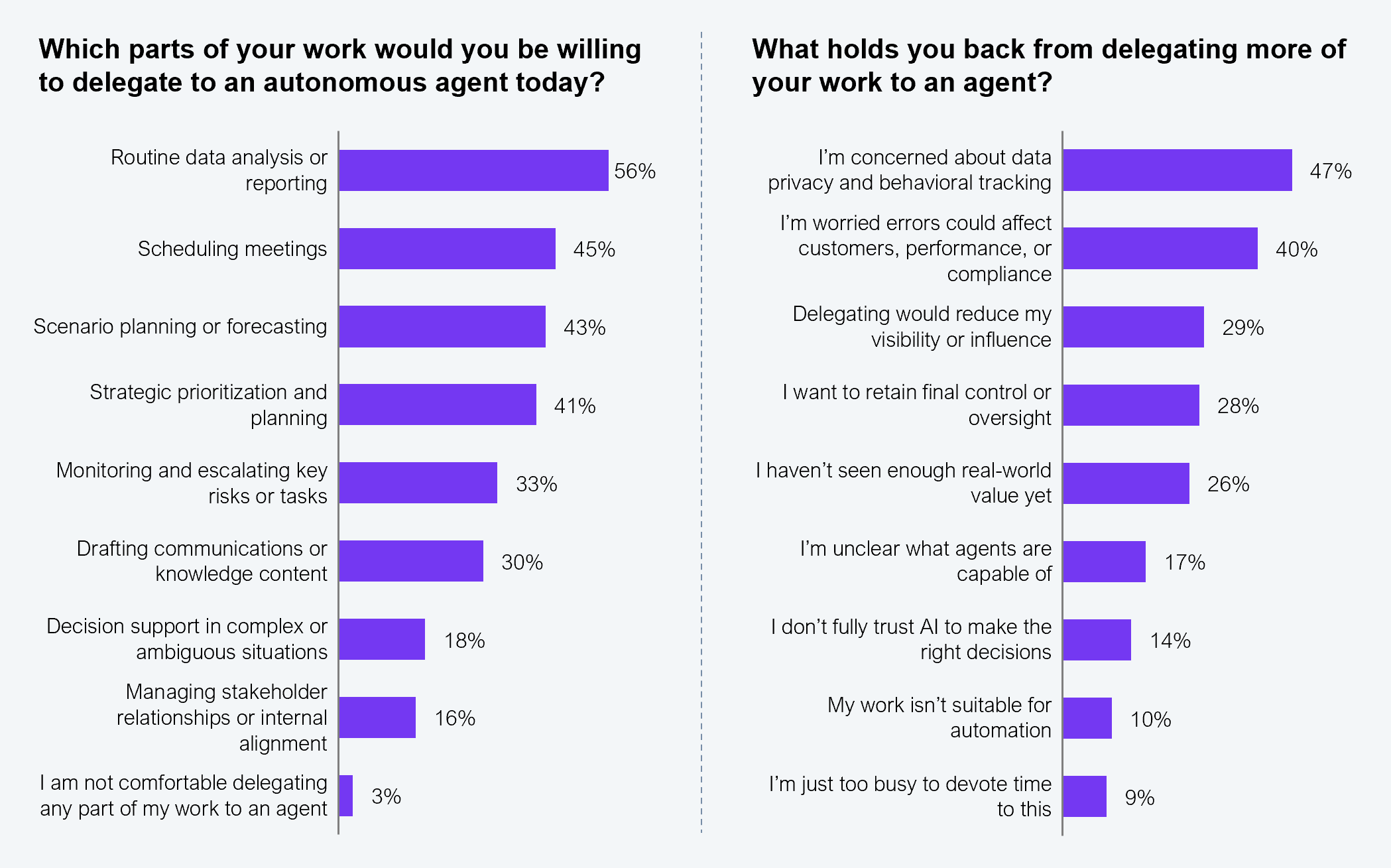
Enterprises often frame hesitation as a workforce issue, but leadership caution plays an equal role. Executives remain reluctant to delegate complex or high-consequence decisions to agents (see Exhibit 17). This matters because autonomy is learned through use. If leaders design systems that require constant human override, they reinforce containment even as adoption expands.
Autonomy cannot mature in an environment where authority is never fully granted. The result is a paradox: agents are deployed, but responsibility never truly shifts. Over time, this undermines confidence on both sides of the human-agent relationship.
Sample: 505 Global 2000 enterprise decision makers
Source: HFS Research, 2026
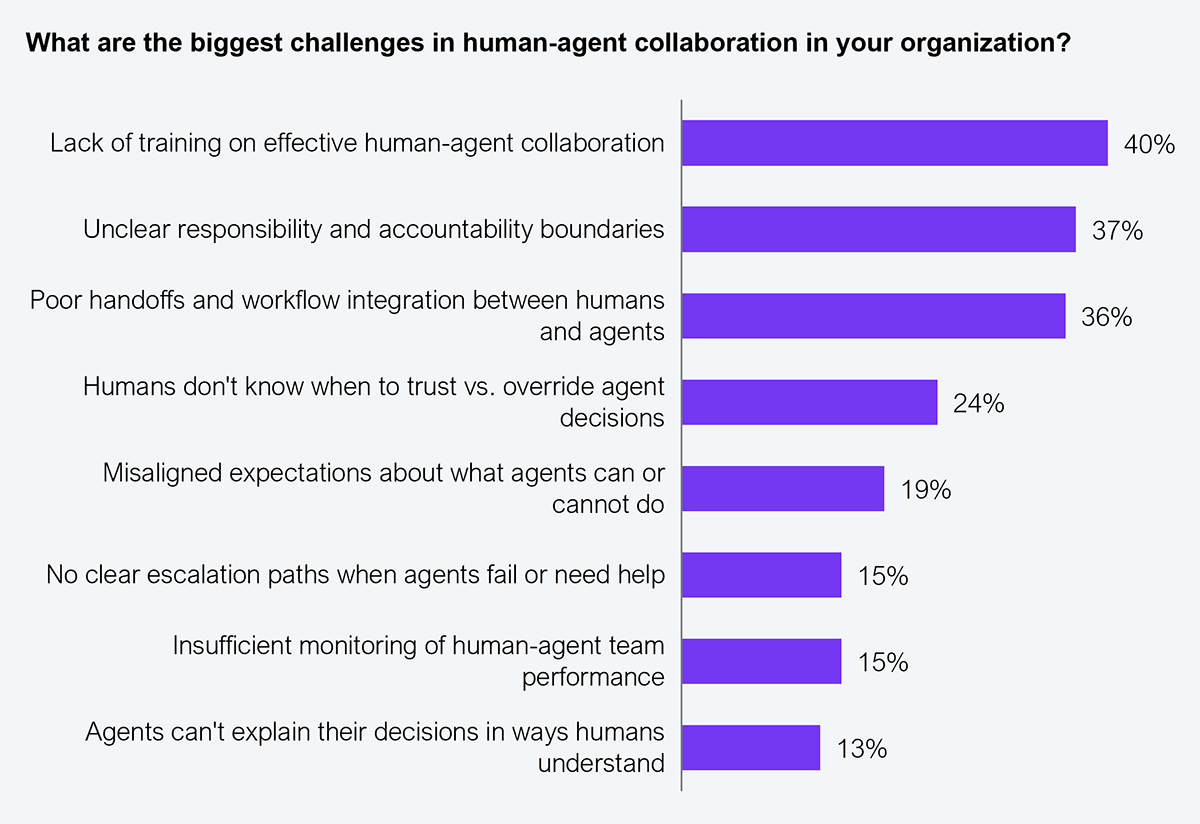
Cultural readiness shows up in operational basics. Forty percent (40%) report having no formal training or guidelines for human-agent collaboration, and 37% say role boundaries are unclear (see Exhibit 18). Without explicit handoffs, escalation rules, and accountability frameworks, collaboration becomes inefficient and fragile.
This is how trust erodes in practice, not through a dramatic failure, but through repeated moments of uncertainty about who owns the outcome when something goes wrong.
Sample: 505 Global 2000 enterprise decision makers
Source: HFS Research, 2026
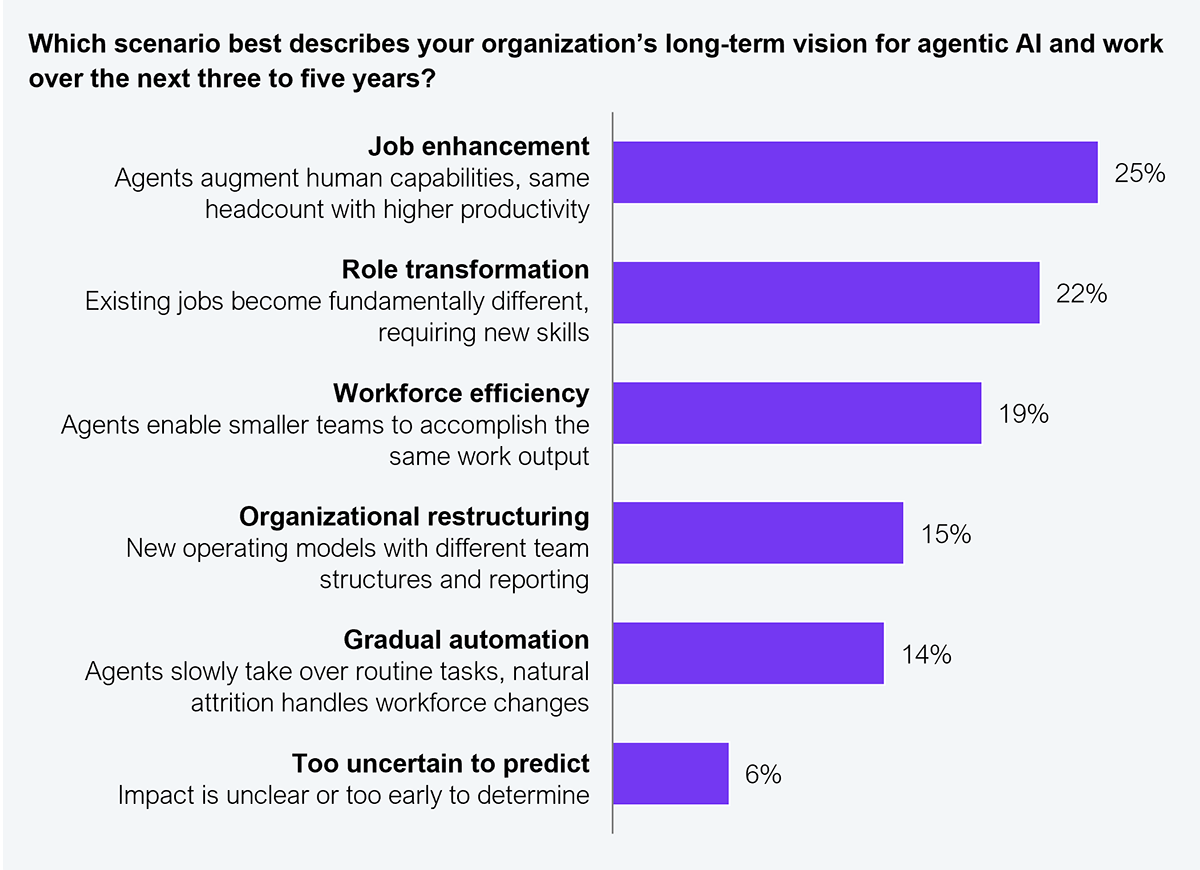
Most enterprises still describe their approach to agentic AI as job enhancement rather than workforce redesign (see Exhibit 19). This framing lowers anxiety, but it also constrains ambition. When the goal is to preserve existing roles, organizations avoid rethinking how work should be decomposed, reassigned, and governed in an autonomous environment.
More mature organizations are beginning to treat agents as a way to shift humans toward judgment, synthesis, and exception handling. That shift requires intentional role design, not reassurance.
Sample: 505 Global 2000 enterprise decision makers
Source: HFS Research, 2026
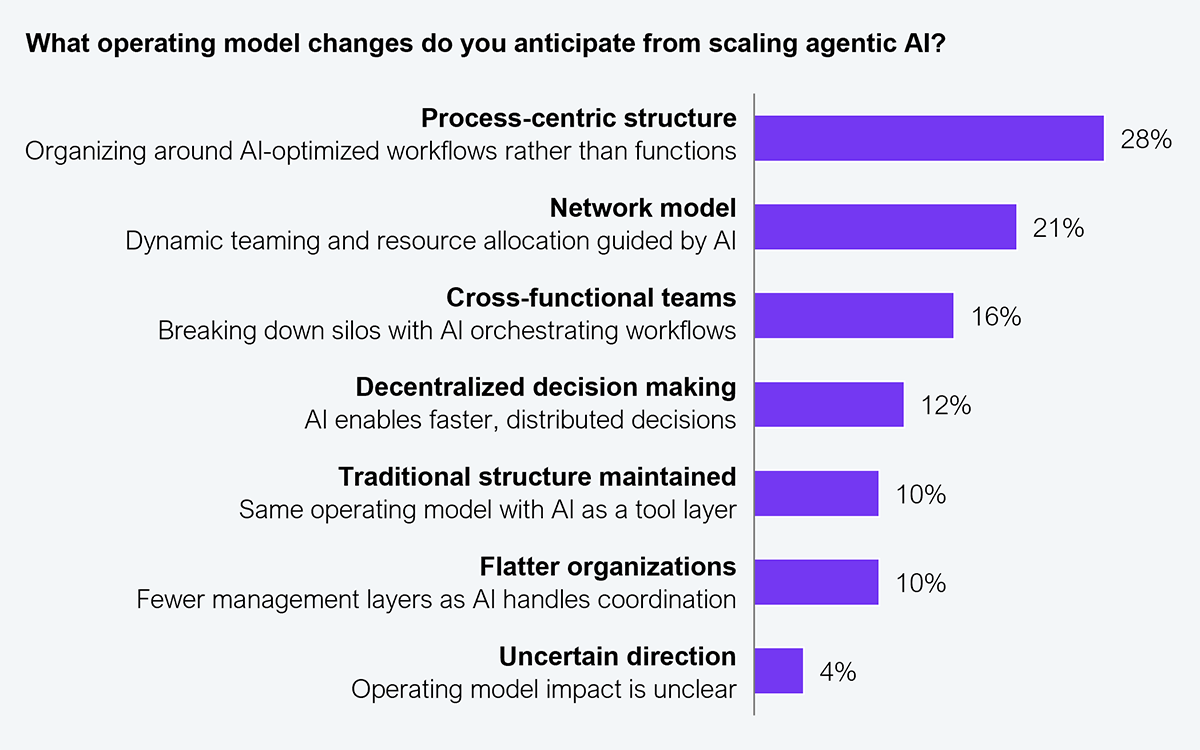
Even with today’s caution, leaders anticipate structural change. Nearly one in three expect to move toward process-centric operating models, and 21% envision network-based models where AI orchestrates talent and resources dynamically (see Exhibit 20). These expectations signal an emerging recognition that autonomy ultimately reshapes structure, not just tasks.
As intelligence becomes embedded in execution, the enterprise will be defined less by hierarchy and more by how work flows and decisions escalate.
Sample: 505 Global 2000 enterprise decision makers
Source: HFS Research, 2026
Technology is ready to move faster than organizations are comfortable with. The real constraint on agentic scale is not compute or model sophistication. It is whether enterprises can establish a credible human operating model for autonomy, one with clear boundaries, explicit accountability, and trust that is earned through design, not assumed.
The next leap in enterprise performance will not come from deploying more agents. It will come from redesigning how work moves. Intelligence cannot reach its potential inside operating models built for supervision, manual handoffs, and exception-heavy workarounds. Autonomy emerges when workflows themselves are reengineered to support coordinated action.
What separates incremental progress from real autonomy is not the sophistication of models, but whether enterprises are willing to redesign execution around intelligence rather than retrofit intelligence into legacy processes.
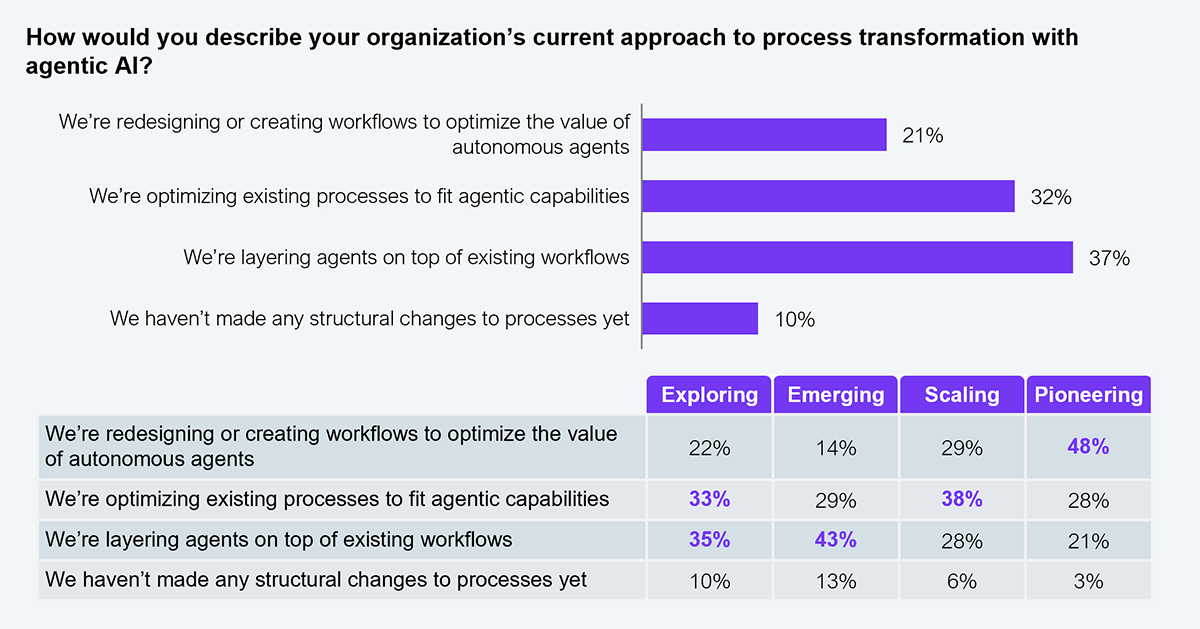
The dominant deployment pattern mirrors earlier automation waves. Thirty-seven percent (37%) are layering agents onto existing workflows, and another 32% are making limited process optimizations to accommodate new capabilities (see Exhibit 21). Only one in five is redesigning workflows explicitly for autonomy.
This approach produces quick wins but shallow change. Agents improve speed and consistency inside old structures, but the underlying logic of execution remains unchanged. Work still flows through fragmented systems, unclear decision rights, and human-centric escalation paths.
Sample: 505 Global 2000 enterprise decision makers
Source: HFS Research, 2026
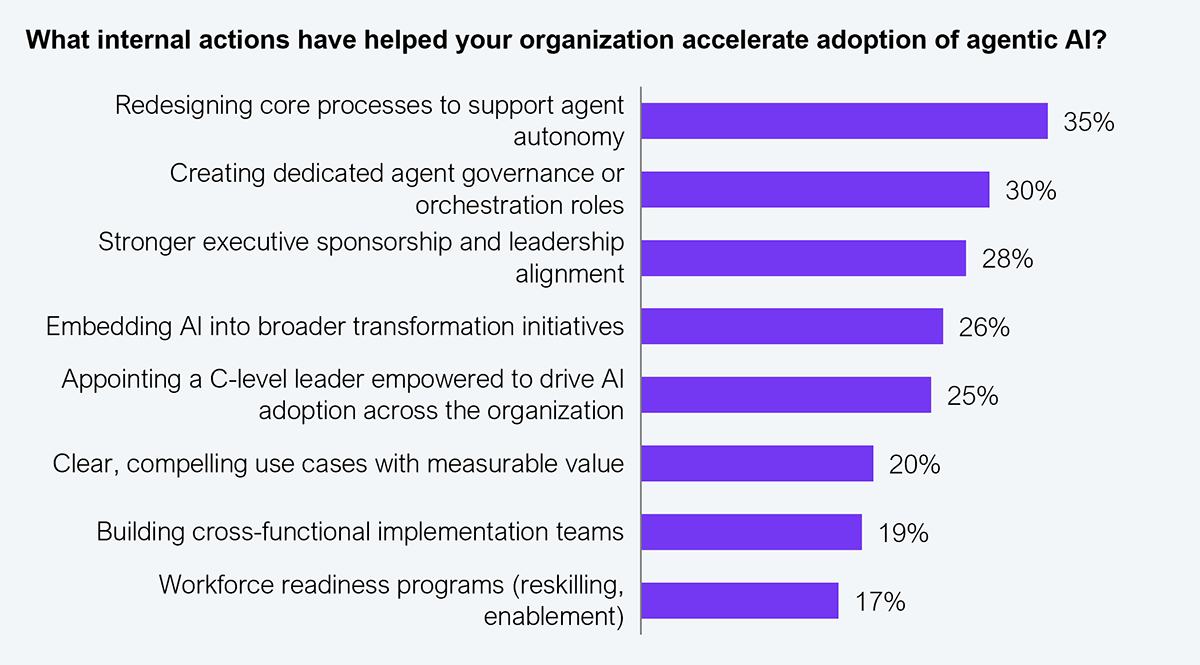
The data is clear on what actually moves the needle. Thirty-five percent (35%) cite redesigning core processes to support agent autonomy as the single most effective accelerator of adoption, followed by creating orchestration roles (30%) and embedding AI into broader transformation programs (26%) (see Exhibit 22). These are not technology upgrades. They are operating model decisions.
Enterprises that move fastest are treating workflows as living systems, instrumented, governed, and continuously improved. Orchestration becomes the connective tissue that allows agents and humans to coordinate across systems and functions without constant supervision.
Sample: 505 Global 2000 enterprise decision makers
Source: HFS Research, 2026
As autonomy expands, traditional systems of record lose primacy. What matters most is not where data is stored, but how decisions are sequenced, escalated, and audited across workflows. Process becomes the system of record that defines who can act, when intervention is required, and how accountability is enforced.
This is the quiet but profound shift underway. Enterprises cannot automate their way to autonomy. They must redesign execution itself.
Agentic AI is already moving from experimentation to real execution, but most enterprises are trying to scale it inside operating models built for control, approvals, and fragmented accountability. That is why progress stalls at a contained scope, even when capability improves.
This research points to a clear dividing line. The 6% that are scaling enterprise-wide scope are not just deploying more agents. They are redesigning how work gets done, who owns outcomes, how decisions escalate, and how leaders maintain confidence through visibility and evidence. The rest are scaling activity, not autonomy.
In 90 days, you should be able to point to one workflow that is redesigned for delegated execution, with named outcome ownership, defined escalation rules, runtime visibility (audit trails and monitoring), and metrics showing scope expansion and decision performance. This is the report’s maturity test in practice, because scope is the constraint, and only a minority reports enterprise-wide deployment today.
The 90-day test
If you cannot redesign and run one delegated workflow with clear ownership, defined escalation paths, runtime visibility, and outcome-based measures within 90 days, the constraint is not the agent technology. It is operating model inertia.
Joining the 6% is not about ambition. It is about making autonomy legible, accountable, and scalable through an operating model reset.
The enterprises that get this right will not just deploy smarter systems; they will redesign how intelligence actually moves through the organization. Agentic maturity is defined less by the number of agents deployed and more by how clearly authority, escalation, and accountability are structured. Enterprises that institutionalize that design principle will convert experimentation into enterprise-wide execution change.
Register now for immediate access of HFS' research, data and forward looking trends.
Get Started


If you don't have an account, Register here |
With the exception of our Horizons reports, most of our research is available for free on our website. Sign up for a free account and start realizing the power of insights now.
Our premium subscription gives enterprise clients access to our complete library of proprietary research, direct access to our industry analysts, and other benefits.
Contact us at [email protected] for more information on premium access.

