At FOCUS 2026, Genpact signaled a deliberate move beyond point automation. Expanding from accounts payable into record-to-report, insurance pre-bind, financial services transaction monitoring, and procurement, it is packaging agentic execution as a repeatable, production-ready capability embedded in core enterprise workflows. The shift reframes digital operations to “agentic operations,” grounded in a machine-processed, human-validated model. The strategic signal is structural: Genpact is moving from AI-enabled services to productized execution embedded inside core operations, reinforcing a broader Services-as-Software™ model.
For enterprise buyers, the implication is direct: autonomy is moving into the control layer, where working capital, compliance, and audit outcomes are determined. Enterprises that treat this as incremental automation risk constraining scalability, while those that redesign operating models around agentic execution are better positioned for efficiency and resilience gains.
Accounts payable, record-to-report, financial crime monitoring, underwriting support, and sourcing are control-heavy processes that shape financial integrity and regulatory exposure. Embedding agentic execution here raises the stakes considerably compared to edge automation. Performance can no longer be measured in productivity terms alone. Straight-through rates, exception thresholds, cycle-time compression, and control effectiveness at scale become the indicators that matter.
That’s why process depth is the differentiator, not agent capability. Genpact’s advantage lies in embedding decades of domain and industry logic into its agentic product suite, making the autonomy layer auditable, scalable, and operationally defensible in the processes where it actually counts.
The most consequential theme was “machine-processed, human-validated” as the execution standard. This requires enterprises to redistribute responsibility between systems and people. As agentic scales, systems handle repeatable processing and bounded decisions, while humans shift toward oversight and optimization.
Layering automation onto legacy workflows preserves complexity. Genpact’s model embeds execution logic and escalation thresholds directly into workflows. For CxOs, the opportunity lies in aligning operating models with this structure and investing in process ownership, data discipline, and integration architecture. When applied consistently and adapted to industry context, it enables simplification of legacy processes and supports scalable, AI-first performance.
Enterprise debt is the accumulation of unresolved inefficiencies across process, data, technology, and talent that develops when a company prioritizes quick fixes or short-term wins over sustainable long-term solutions. It appears as rework, inconsistent variants, fragmented data, duplicate systems, and unclear ownership. HFS estimates that Global 2000 enterprises carry close to $10 trillion in combined debt across process, data, people, and technology (see Exhibit 1). When agentic is embedded into legacy workflows, those weaknesses surface as exception spikes and governance friction. Autonomy rewards discipline.
That was the consistent lesson from Genpact’s client examples: scaled impact followed foundational cleanup. Data quality, process standardization, and systems rationalization were prerequisites, not afterthoughts. A global energy leader described how fragmented processes and weak data governance constrained progress until the organization rebuilt its digital foundation first, gradually scaling with agentic AI only after doing so. As the executive noted, “There is no artificial intelligence without process intelligence.” Organizations that pair agentic deployment with structured debt reduction will move faster. Those that ignore it will hit scaling limits early.
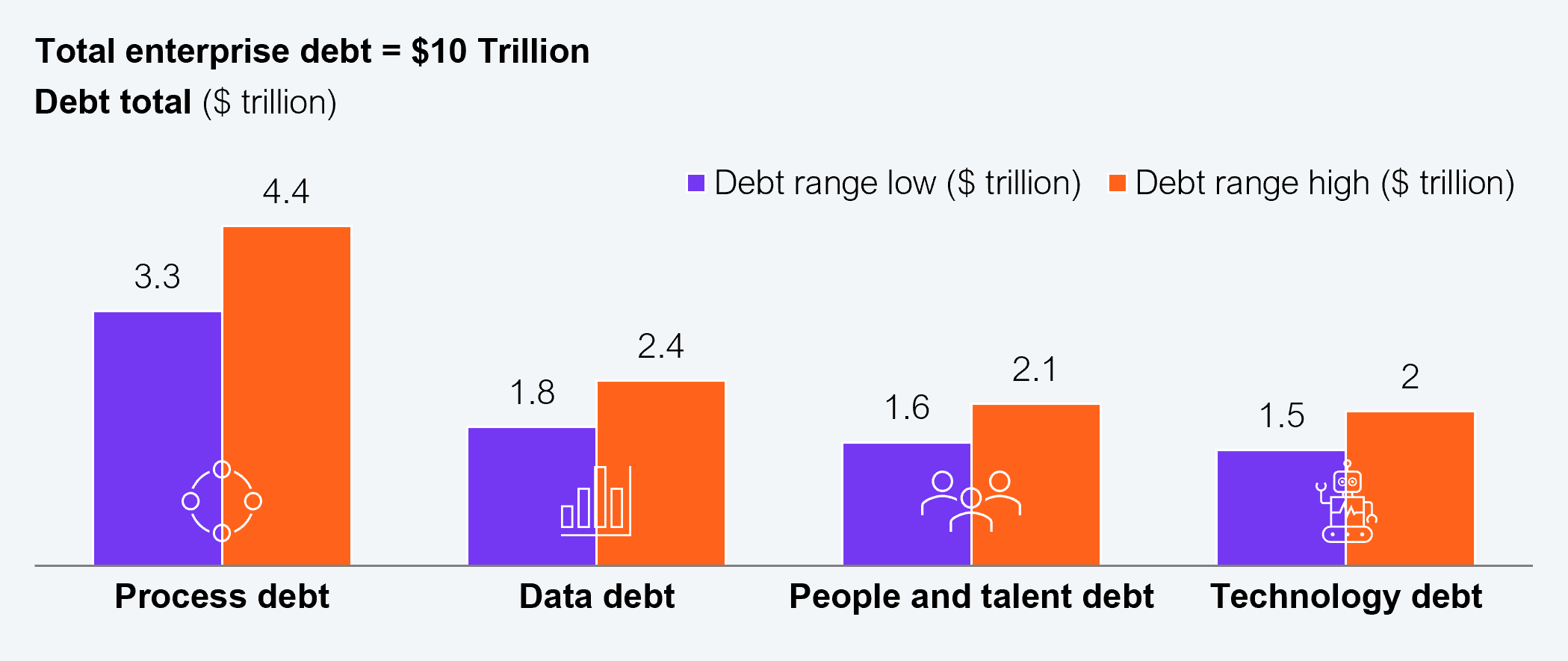
Sample: 305 major enterprise decision makers, various external data sources
Source: HFS Research, 2026
Genpact’s direction also reflects a broader move toward Services-as-Software, where elements of delivery are productized and embedded directly into enterprise workflows. This shifts the sourcing conversation. A global consumer goods VP of Global Services emphasized that enterprises are already recalibrating partner models in response to this shift, noting, “The focus is not just the transaction, but partnering with organizations evolving into an agentic-led operating model, with deep process, technical muscle, and delivery credibility.”
For enterprises, this changes how partners should be evaluated and how contracts should be structured. When execution is embedded in productized layers, commercial models anchored solely in effort become increasingly misaligned. Enterprises should anchor sourcing decisions in AI-enabled performance metrics such as cycle-time compression, exception reduction, compliance accuracy, and working capital impact.
Genpact is baking agentic AI deep into business operations execution to enable AI-first outcomes. Realizing its value requires an operating model transformation. CxOs must align autonomy with governance clarity, process simplification, and structured enterprise debt reduction so that scale occurs within well-defined controls rather than around them.
Agentic AI embedded in the operational backbone raises the standard for consistency and measurable performance. Enterprises willing to redesign decision rights and outcome metrics in parallel will be best positioned to extract durable value as agentic operations mature.
Register now for immediate access of HFS' research, data and forward looking trends.
Get StartedIf you don't have an account, Register here |
With the exception of our Horizons reports, most of our research is available for free on our website. Sign up for a free account and start realizing the power of insights now.
Our premium subscription gives enterprise clients access to our complete library of proprietary research, direct access to our industry analysts, and other benefits.
Contact us at [email protected] for more information on premium access.