Commerce is quietly shifting from people buying products to systems getting things done. If commerce leaders keep treating this as a UI refresh or another platform reimplementation, they’ll lose margins, loyalty, and differentiation.
To address this, HFS Research has introduced the “Delegated Commerce” framework (see Exhibit 1), capturing the shift where intent moves upstream, delegation becomes the new decision surface, orchestration becomes the real battleground, and execution turns into a modular network of capacity. The core issue is whether enterprises and their service partners will redesign their operations fast enough to compete when the buyer is no longer a human at a keyboard, but an agent acting on their behalf.
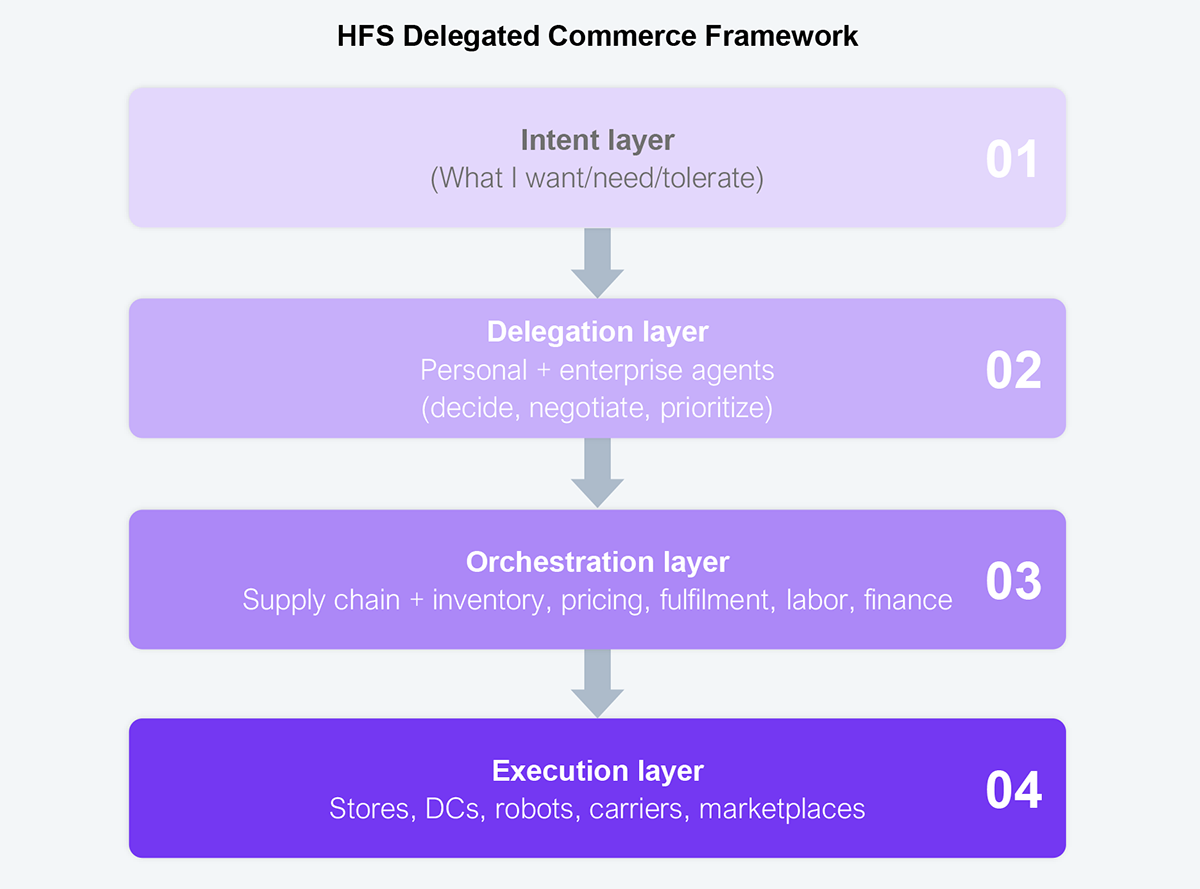
Source: HFS Research, 2026
Commerce teams have spent years refining their ability to support purchase decisions through better ads, smarter recommendations, and smoother checkouts. But people are now overwhelmed by the endless choices, subscriptions, policies, and steps, and the buying process keeps expanding. Friction is no longer confined to the UI. It’s in the operational complexity underneath, inventory accuracy, dynamic pricing, entitlement rules, delivery constraints, returns, compliance, and cross-border requirements. Traditional automation has helped with repeatable steps but never eliminated exceptions because they are structural in commerce and amplified by ecosystems.
Delegated Commerce emerges as the solution: the intent is expressed simply, lets agents negotiate and decide within constraints, enables orchestration to reconcile the messy middle, and enables execution across a flexible network.
For example, Amazon’s Rufus chatbot lets shoppers delegate price watching to the assistant, informs the user when it hits the desired price, and automatically completes the purchase once the price drops below the set threshold. Similarly, Amazon Interests (in beta version) helps shoppers describe what they’re looking for in plain language and continuously tracks the catalog to show matching products, including new arrivals, restocks, and deals. Visa has similar plans for AI agents to help with weekly groceries or buy a ticket for the customer within their budget.
The intent layer, where customers and employees spell out their needs and preferences, becomes the most important part of the system. That’s because once intent is captured in a structured way, it can be reused consistently across journeys and channels, and agents can act on it using explicit rules for risk, budget, quality, urgency, and compliance. If those rules are vague or incomplete, the system can become dangerous, with faster and more frequent decisions and limited human review. When that small error is repeated across thousands of decisions, it can quickly turn into a big problem.
Enterprises should treat intent as a governed asset: a profile of constraints, preferences, and non-negotiables. They should turn this into repeatable capabilities covering intent capture, normalization, policy mapping, and continuous learning. The idea is to translate human ambiguity into machine-operable commitments without breaking trust.
The delegation layer is where personal shopping agents and enterprise buying agents decide, negotiate, and prioritize, becoming either a margin flywheel or a compliance nightmare. It’s where decision rights move from a shopper to an agent using clear rules, permissions, and accountability so the agent can reliably act on someone’s behalf. That means the agent is choosing where to buy, which substitutions are acceptable, which promotions to apply, and which fulfilment promise to trust. It also influences which brands win the basket by scoring products on reliability, total cost, service levels, and as per customer constraints. The agent also handles prioritization and negotiation while evaluating trade-offs such as speed versus cost and escalating edge cases to humans when confidence is low or rules are violated, while maintaining an auditable trail.
Retailers must treat the delegation layer as a governed decision system that defines the decision rights, encodes policies, builds trust controls, redesigns exception handling, and modernizes orchestration, allowing agents to act without creating volatility. Brand affinity matters less when an agent optimizes on intent rather than persuasion.
The orchestration layer, which includes supply chain, inventory, pricing, fulfilment, labor, and finance, is where delegated commerce either becomes real or stays a demo. Everyone wants sleek agent experiences, but only a few want to fix the messy middle that determines whether agents can actually deliver. The hard work is operational and architectural, improving inventory integrity, modernizing pricing and promotion logic, integrating master data, instrumenting fulfilment performance, embedding finance and risk controls, and building exception pathways that scale. Delegated Commerce rewards orchestration maturity the same way cloud rewards infrastructure maturity: firms that can turn complexity into a service become the default choice.
Retailers, including B2B sellers, shouldn’t just bolt on AI shopping assistants and connect a few systems. They need a strong orchestration operating model and a repeatable, governed way to coordinate people + systems + partners, turning a shopper’s intent into a reliable order and then into an outcome every time while remaining auditable and cost-efficient.
Stores, distribution centers, robots, carriers, and marketplaces will stop being backstage and become competitive products. Through Delegated Commerce, demand will flow to whoever can prove they deliver best, not whoever markets best. When agents are doing the buying, performance becomes legible and comparable through measurable outcomes: on-time delivery, fewer defects, lower returns, higher warranty satisfaction, better sustainability, safer handling, and clearer provenance. When they start evaluating those signals, execution turns into a competitive application programming interface.
This drives a shift from selling products to selling outcomes, backed by verified service levels such as next-day delivery with 98% promise accuracy or lowest returns in the category. Enterprises should treat execution capacity, owned or partnered, as a strategic lever that unifies robotics, labor planning, carrier performance, marketplace rules, and exception management into an agent-readable promise.
Delegated Commerce is a new operating system for demand, decisioning, and fulfillment. Retailers must invest less in persuading humans during purchase and more in earning the trust of machines acting on behalf of humans. This requires governed intent models, explicit delegation boundaries, verifiable service levels, negotiable terms, transparent exception handling, and auditable controls.
The framework raises the value of ecosystems that can coordinate trust across platforms, providers, and operators. Leaders who move first will define the standards for intent, delegation, and proof-of-performance for others to follow. Strategically, the imaginative shift is to design for a world where commerce feels like outcomes, not transactions. The most successful will be those that treat commerce as a layered stack, comprising intent, delegation, orchestration, and execution, creating systems with machines as the main purchasers in mind.
Register now for immediate access of HFS' research, data and forward looking trends.
Get StartedIf you don't have an account, Register here |
With the exception of our Horizons reports, most of our research is available for free on our website. Sign up for a free account and start realizing the power of insights now.
Our premium subscription gives enterprise clients access to our complete library of proprietary research, direct access to our industry analysts, and other benefits.
Contact us at [email protected] for more information on premium access.