Mobile World Congress (MWC) 2026, held in Barcelona this March, highlighted a clear shift in telcos’ priorities. Rising sovereignty expectations and geopolitical pressure are now colliding with the push to scale agentic AI and find new monetization paths. Three themes dominated the strategy conversations: control of digital infrastructure, the roadmap to scale agentic AI, and the next wave of intelligence moving into telecom networks (AI-RAN).
For telco strategy leaders, differentiation will come from deciding where data and AI reside, orchestrating agents across silos, and proving measurable business outcomes beyond productivity gains.
Digital sovereignty was a recurring theme across operator conversations, service provider messaging, and booth exhibits at MWC. With geopolitical tensions and regulatory pressure rising, operators are positioning themselves as credible providers of sovereign digital infrastructure, citing proximity to data, experience in regulated environments, and their role as a national digital backbone.
However, there is no universal definition of digital sovereignty. For some stakeholders, sovereignty is primarily about data residency and jurisdictional control. For others, it extends to where data is processed as well as technology supply chains, infrastructure ownership, and control of AI ecosystems. Many “sovereign” claims still rely on global cloud and hardware stacks, raising questions about what sovereignty actually guarantees. This ambiguity gives operators, hyperscalers, and vendors an opportunity to shape sovereignty around their own strategic positioning, making like-for-like comparisons difficult.
For telco strategists, sovereignty is no longer a question of relevance, but what it means operationally. This means deciding whether it is a compliance posture, a differentiated hosting proposition, or a broader assurance model spanning data, infrastructure, and AI platforms, with clear controls and metrics for each. This is exactly why agentic AI is now at the center of the sovereignty debate; scaling agents turns “control” from a narrative into an operating model choice.
Agentic AI was omnipresent in every booth, conversation, and product showcase at MWC. Cut the noise, and the challenge facing telcos is about how to scale it effectively.
In collaboration with Amdocs, HFS Research launched an agentic AI playbook for telcos addressing just that (see Exhibit 1). To move beyond experimentation, telcos should adopt a staged adoption playbook. The most successful operators sequence adoption rather than attempting enterprise-wide rollout, starting with domains where feedback loops are strong and risk is bounded (for e.g., customer experience, financial operations, and IT workflows). As governance and trust mature, orchestration expands into BSS and OSS environments where the operational stakes are higher.
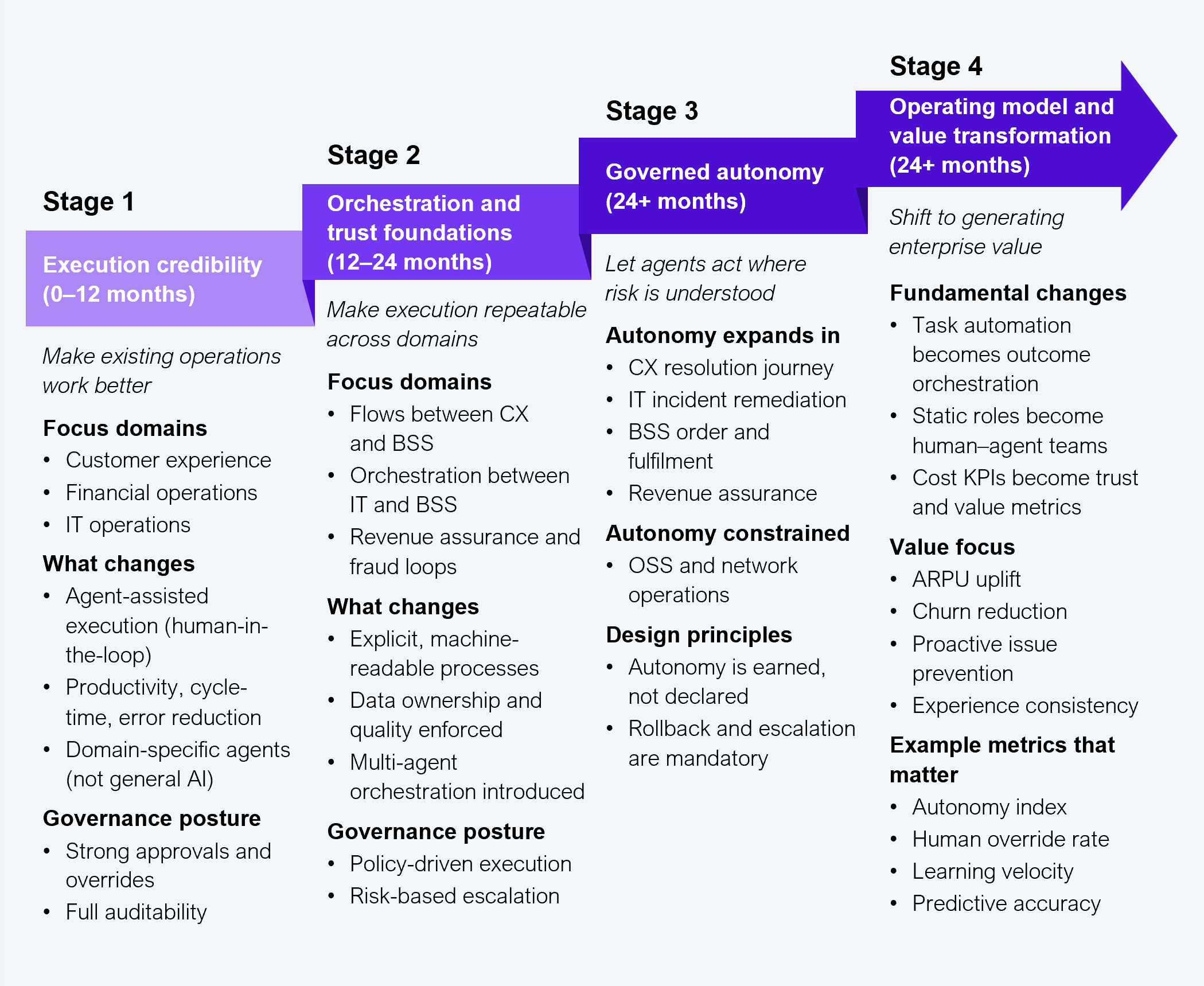
Source: HFS Research, 2026
Telcos are typically built in silos and operate across multiple systems such as SAP and Salesforce. Everyone is coming up with their own agentic solution. The real opportunity is not in deploying more agents, but in orchestrating decisions across systems and domains to deliver measurable business outcomes. The orchestration layer will be a key area of focus as telcos look to scale and drive cross-functional outcomes.
This shift to agentic also demands a change in how success is measured. As agentic AI coordinates actions across workflows, KPIs must move beyond productivity metrics toward predictive accuracy, resolution effectiveness, service resilience, and revenue impact (see Exhibit 2).
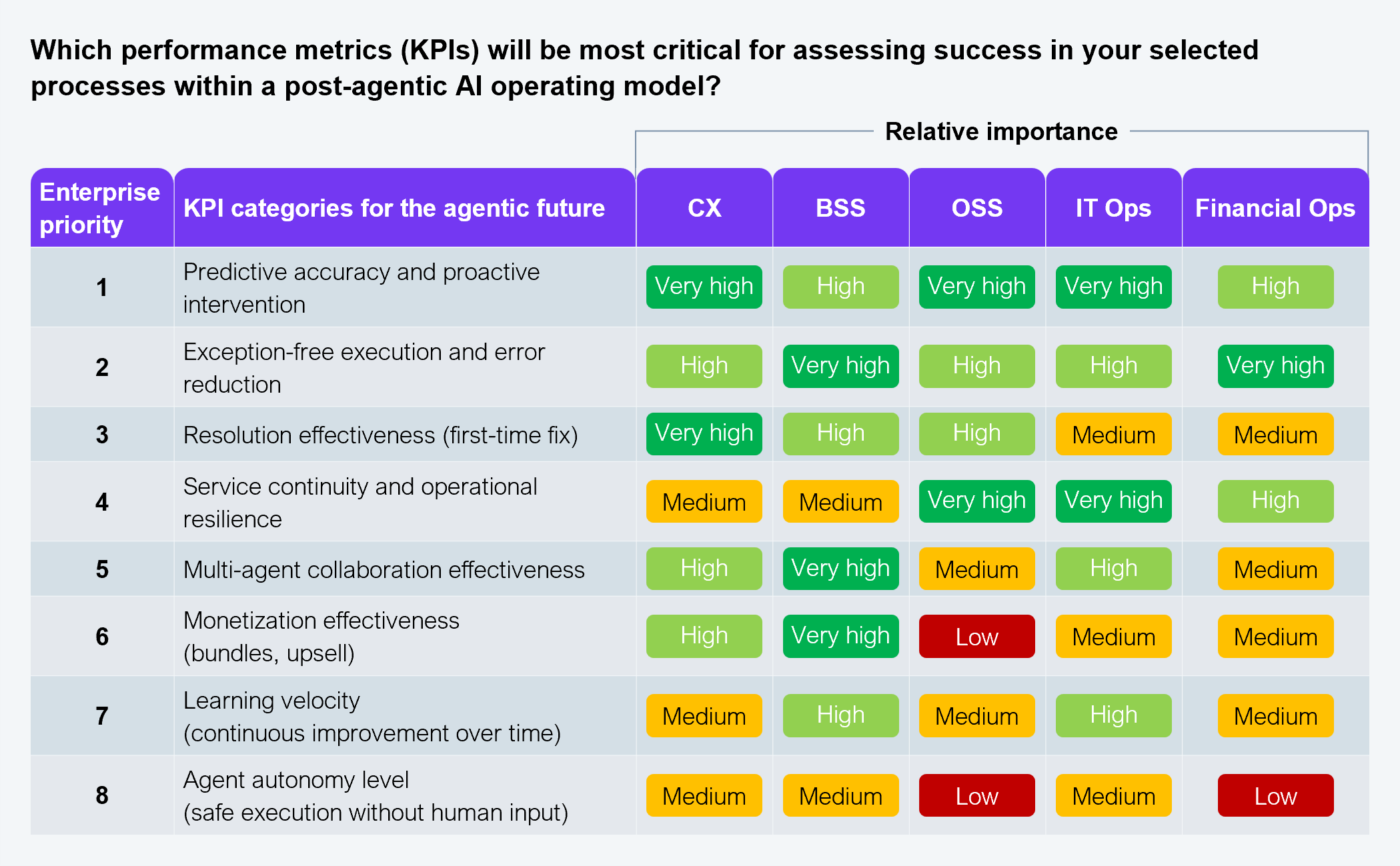
Sample: 90 telecom enterprise executives
Source: HFS Research, 2026
Operators and vendors are working to embed AI directly into radio access networks (AI-RAN) to deliver better adaptive network performance, higher energy efficiency, and automated radio optimization, particularly as AI-heavy applications place greater demands on mobile infrastructure.
The commercial ambition is broader than efficiency alone. Vendors at MWC also linked AI-RAN to new monetization opportunities, from enabling differentiated connectivity for AI-native devices to using shared accelerated infrastructure to support both network functions and AI workloads.
For telco strategy executives, the significance is that AI-RAN could make AI native to the network layer itself, not just to analytics or operations. If that shift holds, it could change how networks are designed, operated, and monetized. This will be especially important as operators start casting an eye at 6G, which promises to be a truly AI-native network.
Every telco, software company, and partner showed off its latest AI solutions, capabilities, and models at MWC. These were tied to people, process, and technology throughout the telco value chain across OSS, BSS, IT, and customer experience. However, major gaps remain: the orchestration required to scale, a clear sequence of adoption across business lines and operating silos, and the people skills and confidence needed to work with AI.
This matters because the future won’t be about the “autonomous telco,” but about offering fundamentally new products and services aligned with business outcomes and top-line growth. Those who decide where AI resides, how it connects across domains, and what business outcomes it delivers will be the real winners.
Register now for immediate access of HFS' research, data and forward looking trends.
Get StartedIf you don't have an account, Register here |
With the exception of our Horizons reports, most of our research is available for free on our website. Sign up for a free account and start realizing the power of insights now.
Our premium subscription gives enterprise clients access to our complete library of proprietary research, direct access to our industry analysts, and other benefits.
Contact us at [email protected] for more information on premium access.