
If you are a CXO shortlisting AI transformation partners right now, Accenture just made three moves you need to scrutinize. The integrations of Faculty (AI strategy and data science), Ookla (network intelligence and connectivity analytics), and DLB Associates (AI data center engineering and consulting) are not isolated deals. Together, they signal a deliberate pivot: from services-led delivery to intelligence-led products supported by forward-deployed expertise at scale.
Dr. Marc Warner, the new Accenture CTO who also founded Faculty before its acquisition, has framed the ambition directly: building the “Bloomberg of network intelligence.” That is not consultant-speak. It is a product vision. Bloomberg did not win by selling analysis. It won by owning the data layer that everyone else depended on. Warner is mapping the same logic to enterprise network and data center infrastructure.
The question is not whether the ambition is real, but if the seams hold when it matters in your environment. Faculty AI brings decision intelligence, AI safety tooling, and a CTO appointment that places AI-native leadership at Accenture’s apex. DLB Associates fills the infrastructure gap with data center engineering, site selection, and commissioning expertise, while Ookla provides the network speed and scalability for effective measurable AI performance at scale.
In short, the urgency is real. More than one-third of enterprises are stuck in pilot purgatory, with only 8% achieving organization-wide GenAI integration (see Exhibit 1). The gap between AI ambition and AI impact is widening, and siloed pilots are missing the synergistic benefits that CIOs banked on during the strategy phase. Firms that close this gap share one trait: choosing a partner that owns the “how,” from intelligence to infrastructure. That is exactly the gap Accenture is now trying to own.
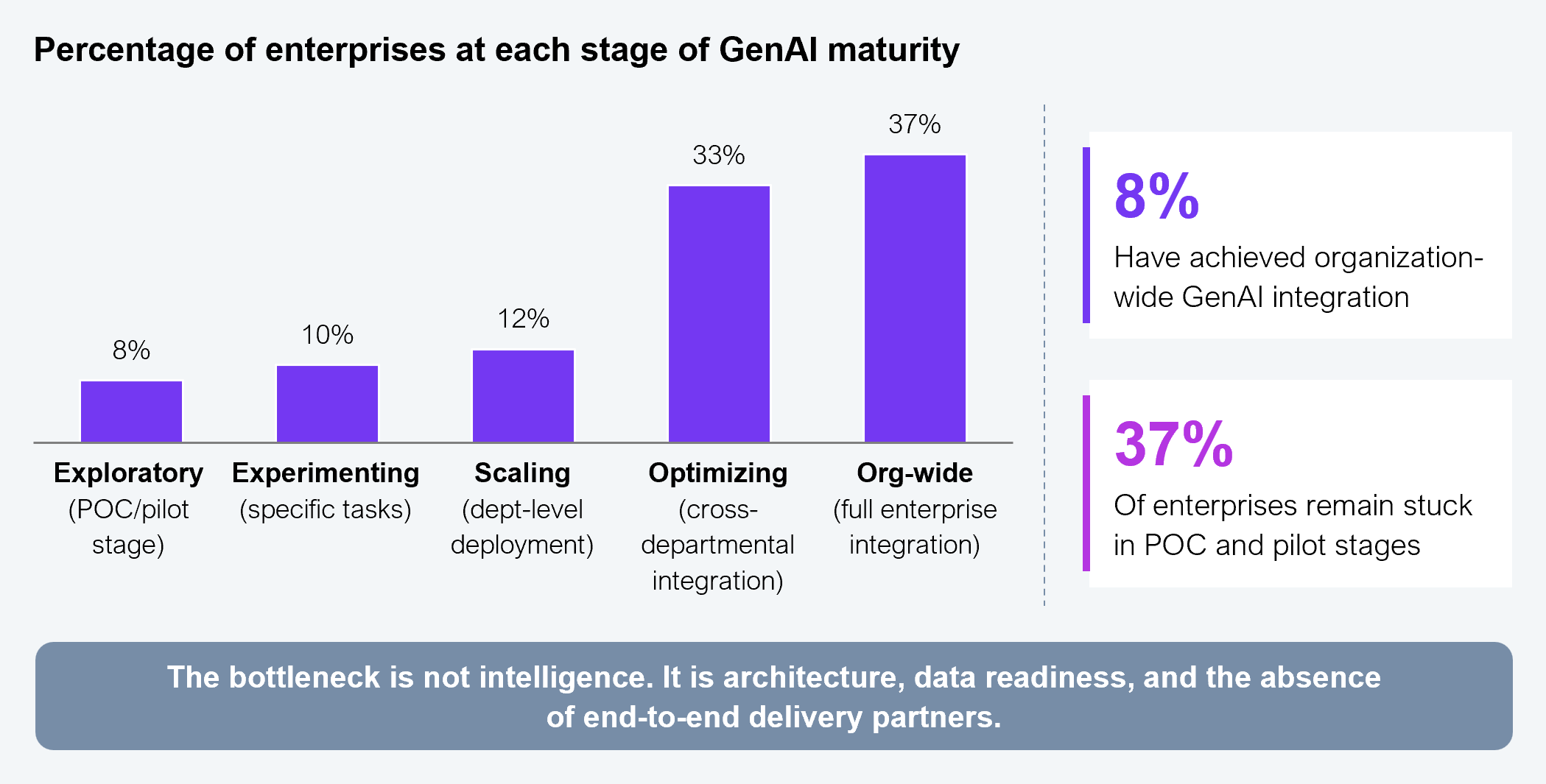
Sample: N=553 G2000 decision makers
Source: HFS Research in partnership with Infosys, 2026
Accenture has attempted to bridge this AI ambition-to-impact gap with these acquisitions. These are not routine capability bolt-ons.
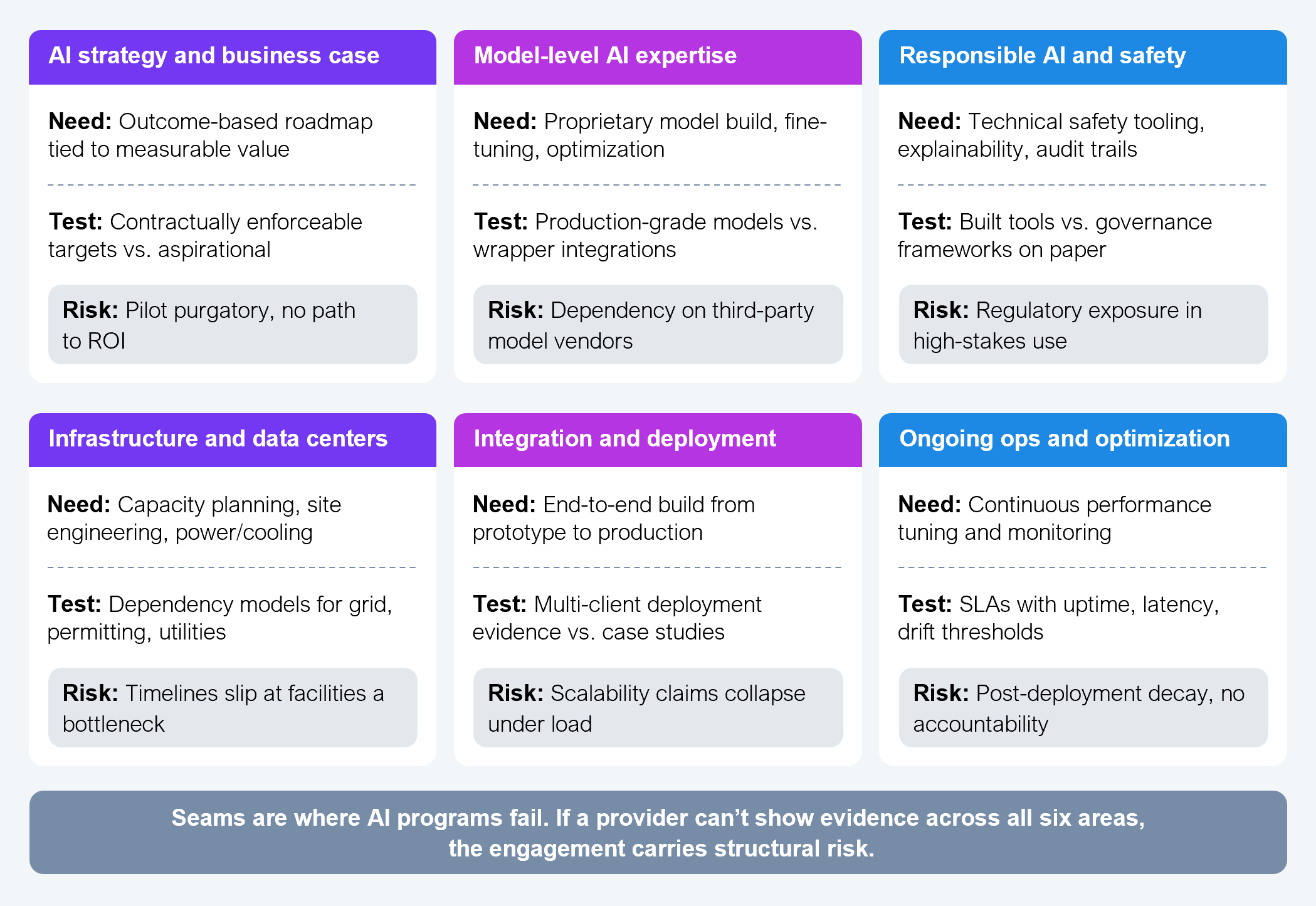
The emergence of outcome-based contracting places the burden of delivery on the shoulders of the AI partner, which is why owning the “how” across the lifecycle is becoming the decisive test of AI partnership. As a result, enterprises increasingly expect service providers to prove their strength in six areas: strategy and business case design, functional AI and ML capabilities, technical architecture, safety and ethics, mission-critical deployment, and talent development.
Yet most providers have established their credibility in only two or three. That is why enterprises must apply a structured diligence framework across all six capability areas where lifecycle seams break (see Exhibit 2).
Source: HFS Research, 2026
If a provider can’t show verifiable evidence in even one, the engagement carries structural risk that no commercial wrapper can fix. Strategy houses lack engineering depth, systems integrators depend on third-party model vendors, and infrastructure specialists sit too far from the intelligence layer. Accenture’s acquisition pattern is an attempt to close these gaps across four pillars of enterprise AI delivery (see Exhibit 3), with Faculty addressing intelligence and talent and DLB Associates filling the infrastructure layer that most providers treat as an external problem.
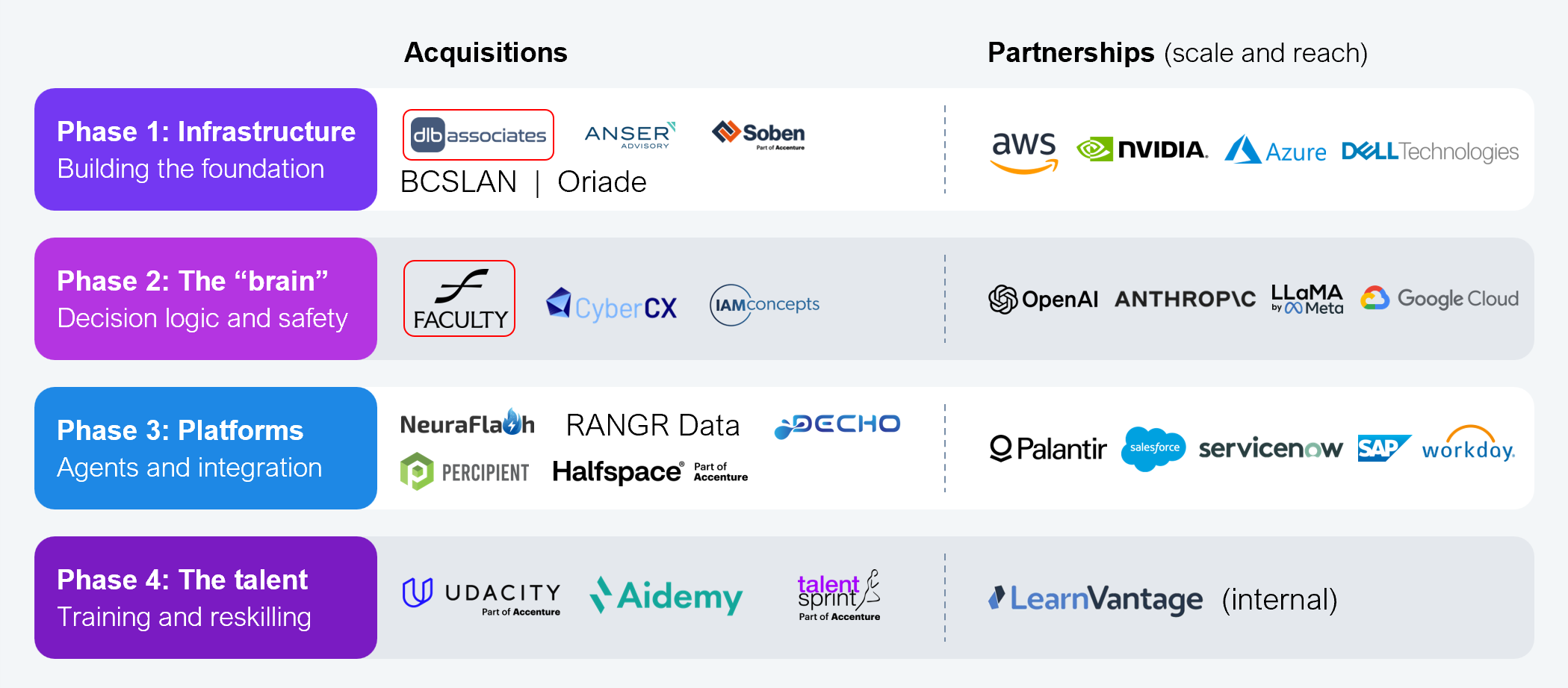
Source: HFS Research, 2026
All this reinforces that the acquisition move is clearly structural: an effort to own the “how,” starting from intelligence to infrastructure. However, enterprise buyers should stress-test whether the seams between those pieces actually hold. And there’s also a governance trap: when one partner owns all four pieces, they lose the natural checks and balances of a multi-vendor model, making independent benchmarking of cost and design assumptions critical.
Faculty and DLB Associates bring more than 400 and 600 AI specialists, respectively, representing just roughly 0.1% of Accenture’s 800,000-plus workforce. The cultural gap between a startup and a global consultancy is vast, and history shows that specialist acquisitions frequently dilute acquired culture within months. By onboarding Faculty CEO Marc Warner as the chief technology officer, Accenture is signaling that its AI delivery model is undergoing a structural change.
Also, the expanding value of the AI portfolio will depend less on the individual capabilities it acquires and more on how effectively those capabilities are orchestrated into a unified operating layer. The real test now is whether Faculty AI’s and DLB Associates’ engineers collaborate at the right points in the entire Accenture AI value chain to generate synergistic value.
Moreover, to truly deliver enterprise-scale value, Accenture should showcase an end-to-end AI orchestration fabric. Large enterprises require AI systems where data pipelines, models, agents, and business workflows interact seamlessly across complex technology estates. Accenture has already started moving in this direction with platforms such as AI Refinery, intended to coordinate AI assets and operational systems.
Accenture is making a smart structural move toward a part of the market that now gates enterprise scale. But enterprises must treat the acquisition narrative as a hypothesis, not a conclusion, and investigate for deployment evidence across the AI implementation lifecycle.
The true signal to track is no longer simply AI value chain completeness, but the firm’s ability to orchestrate these disparate capabilities into a unified operating layer. Partners that can’t prove the “how to AI” end-to-end through a mature orchestration fabric should not be on the shortlist. Enterprise buyers, on the other hand, should press for clarity in their specific engagements and monitor whether it leads to meaningful multi-client deployment over the next 12–18 months.
Register now for immediate access of HFS' research, data and forward looking trends.
Get Started


If you don't have an account, Register here |
With the exception of our Horizons reports, most of our research is available for free on our website. Sign up for a free account and start realizing the power of insights now.
Our premium subscription gives enterprise clients access to our complete library of proprietary research, direct access to our industry analysts, and other benefits.
Contact us at [email protected] for more information on premium access.

