This Point of View is for CIOs and CTOs rethinking how their global capability centers (GCCs) turn recurring work into reusable Services-as-Software™ instead of scaling headcount.
CIOs and CTOs expect more from global capability centers (GCCs) without hiring more or creating smaller greenfield GCCs with larger mandates. The question is, how does the center keep creating value every time demand rises? Enterprises have pushed their GCCs beyond execution toward reinvention, innovation, and redesigned lower FTEs delivering new KPIs. A model heavily dependent on people may add capacity, but will often struggle when the enterprise expects reuse, consistency, faster turnaround, and the ability to adjust as conditions change. The answer is Services-as-Software™.
New-age LLMs have created the opportunity to merge services into software. Over time, GCCs must transform repetitive work into capabilities that software can manage, including reusable workflows, data products, agentic services, and governed platforms. The reusable assets should be scalable and can accommodate the rising demands from enterprise leaders.
According to the HFS GCC case studies suite, 62% of GCCs already use AI (see Exhibit 1). They run it in production or embed it into operations beyond pilots. The technologies in use include generative AI, intelligent automation, machine learning, and a growing set of agentic AI deployments.
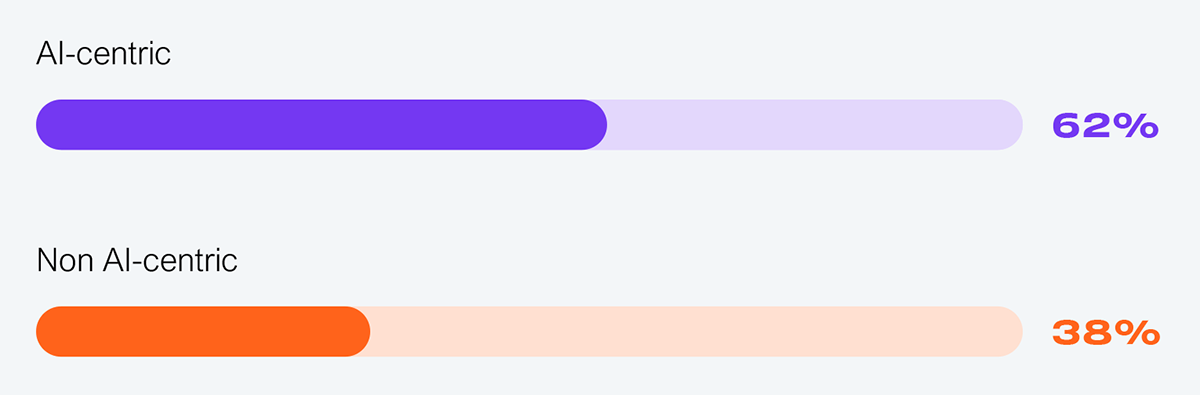
Sample: 174 GCC case studies, June 2026
Source: HFS Research, 2026
The case studies revealed that a few enterprises are already moving toward a Services-as-Software model, with credible outcomes in terms of agent and bot performance and cost savings. Here are a few GCC examples transforming the workflows to AI-centric:
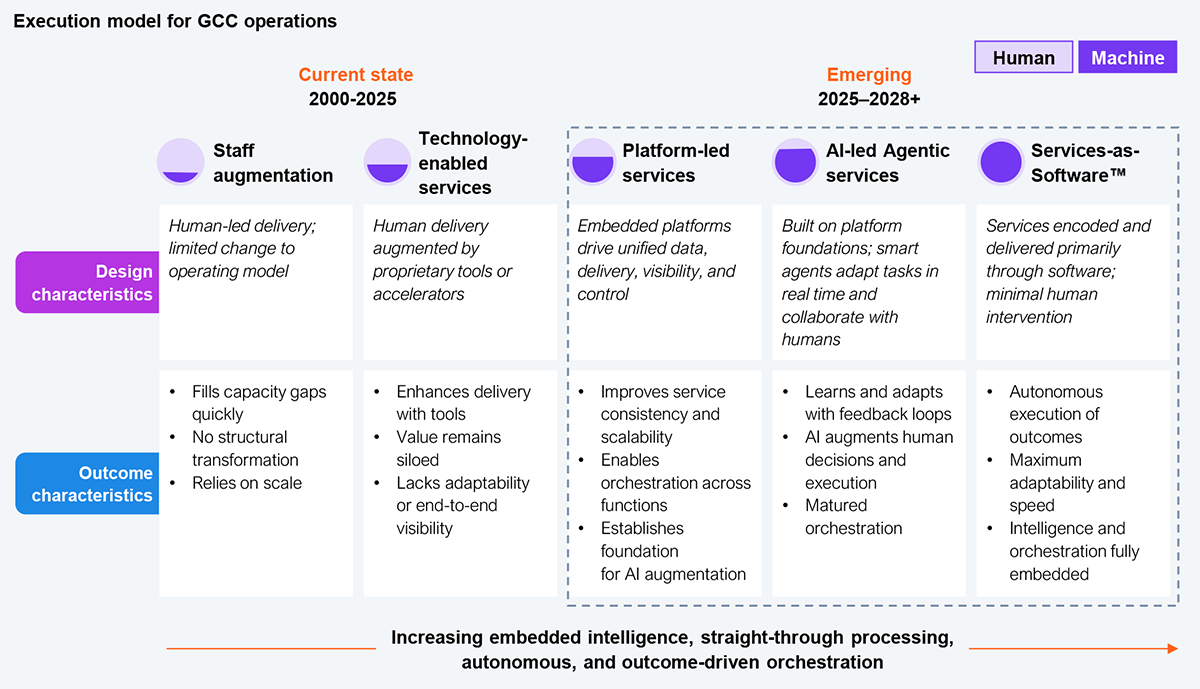
The first-gen GCC was to reduce costs, improve control, and access talent. The current approach requires a different way of executing the work. As a center moves from staff augmentation toward Services-as-Software (see Exhibit 2), the source of value shifts from people to collaborations between people and tools, and finally to work coded in software and used as a reusable capability.
Source: HFS Research, 2026
Under Services-as-Software, rising demand should drive reuse instead of hiring. In a more traditional setup, rising demand usually means more intake, more projects, more tickets, additional teams, and a heavier management burden. With a Services-as-Software approach, the same rise in demand should lead to greater reuse.
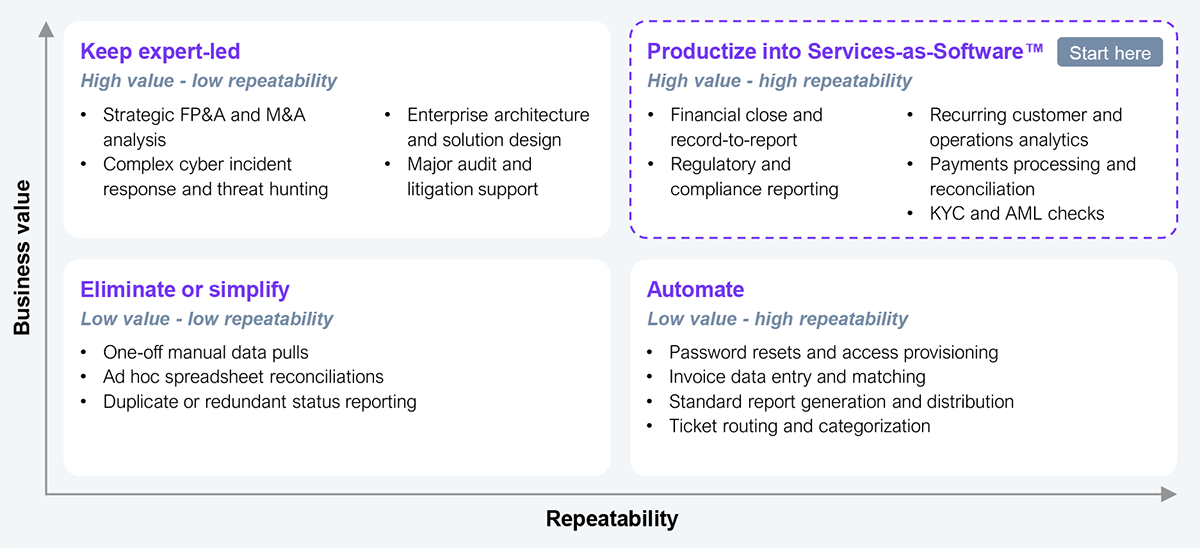
A finance close can become a workflow product, a regulatory reporting cycle can turn into a governed data and process asset, a request for customer analytics can evolve into a reusable data product, and a method for responding to cyber incidents can transform into an intelligent operating layer. It also changes the leader’s job: rather than only managing the work flowing through the center, they determine which work to eliminate, which to keep expert-led, which to automate, and which to develop into a reusable capability for the enterprise.
Providers are creating tools that help GCCs make this shift, turning their offerings into reusable software that a center can adopt rather than rebuild by request. For example, Infosys productized the EdgeVerve AI platform and Topaz, Wipro is pushing software-led services through its Fusion proposition, and Genpact transforms process expertise into agentic operations for a GCC through AI Gigafactory and AI Maestro.
Enterprises do not need to productize every service at once. A sensible starting point is the work that occurs frequently, depends on rules and data, and is important to the business. A simple matrix keeps the discussion focused on the design of the work rather than on tool selection. Sample activities in the upper-right quadrant, where high repetition meets high value, would be a great place to start (see Exhibit 3).
Source: HFS Research, 2026
Most GCCs already have tech infrastructure; what they often lack is true product ownership. A center pursuing Services-as-Software benefits from product roadmaps instead of a steady flow of project intake from product owners. It also needs investment models that support reusable capability rather than just annual capacity, along with a commitment to managing workflows across functions, since software-led services rarely stay within organizational boundaries.
Recurring work compounds. If you send it back into a queue, you will eventually hand the asset over to a provider’s platform or an automation vendor. If you encode it as governed, reusable software, the GCC becomes something the business builds around instead of optimizing away.
Register now for immediate access of HFS' research, data and forward looking trends.
Get StartedIf you don't have an account, Register here |
With the exception of our Horizons reports, most of our research is available for free on our website. Sign up for a free account and start realizing the power of insights now.
Our premium subscription gives enterprise clients access to our complete library of proprietary research, direct access to our industry analysts, and other benefits.
Contact us at [email protected] for more information on premium access.