This HFS Highlight is for operations, business process transformation, and enterprise automation leaders looking to move beyond document extraction and win back cost, cycle time, and margin in the document operations layer.
If you run operations, business process transformation, or enterprise automation, you probably spent years trying to fix how documents move through the business. You bought optical character recognition (OCR), workflow tools, intelligent document processing, and lately, AI. Yet the work still snags on manual reviews and exception queues.
The harder truth is that reading the documents was never the real problem. The value and the cost reside in everything that happens after, and most of that drag traces to a fragmented legacy stack: capture in one system, workflow in another, exception handling stitched together by hand in between. The fix is not fewer people touching the work, but fewer disconnected tools and more collaboration among the people and systems still in the loop.
The value gap is where too many organizations stop. They treat a working document process as the finish line: data is extracted, routed into a system, and stamped “automated.” The real prize lies past extraction, in the workflows, decisions, and outcomes those documents are supposed to drive. That is the layer KnowledgeLake targets with its Document OS software, built to run everything after extraction. In practice, that means three things: fast setup on each new job, operational efficiency once a job is live, and volume growth without headcount growing at the same rate.
The document processing market has matured over the past decade. Work that once tied up large teams keying in information now happens fast and accurately. AI classifies documents, extracts relevant fields, and routes the data downstream with a fraction of the old effort. Then the gains flatten out; pulling data off a document is only one step in a bigger process.
An invoice gets captured automatically, but the exceptions still land on someone’s desk. A claim gets classified correctly, but it still needs human validation before anyone can act. Capacity stays locked in clearing exceptions, and cycle time drag quietly erodes margins while faster rivals pull ahead. That’s why many initiatives never deliver their promised return.
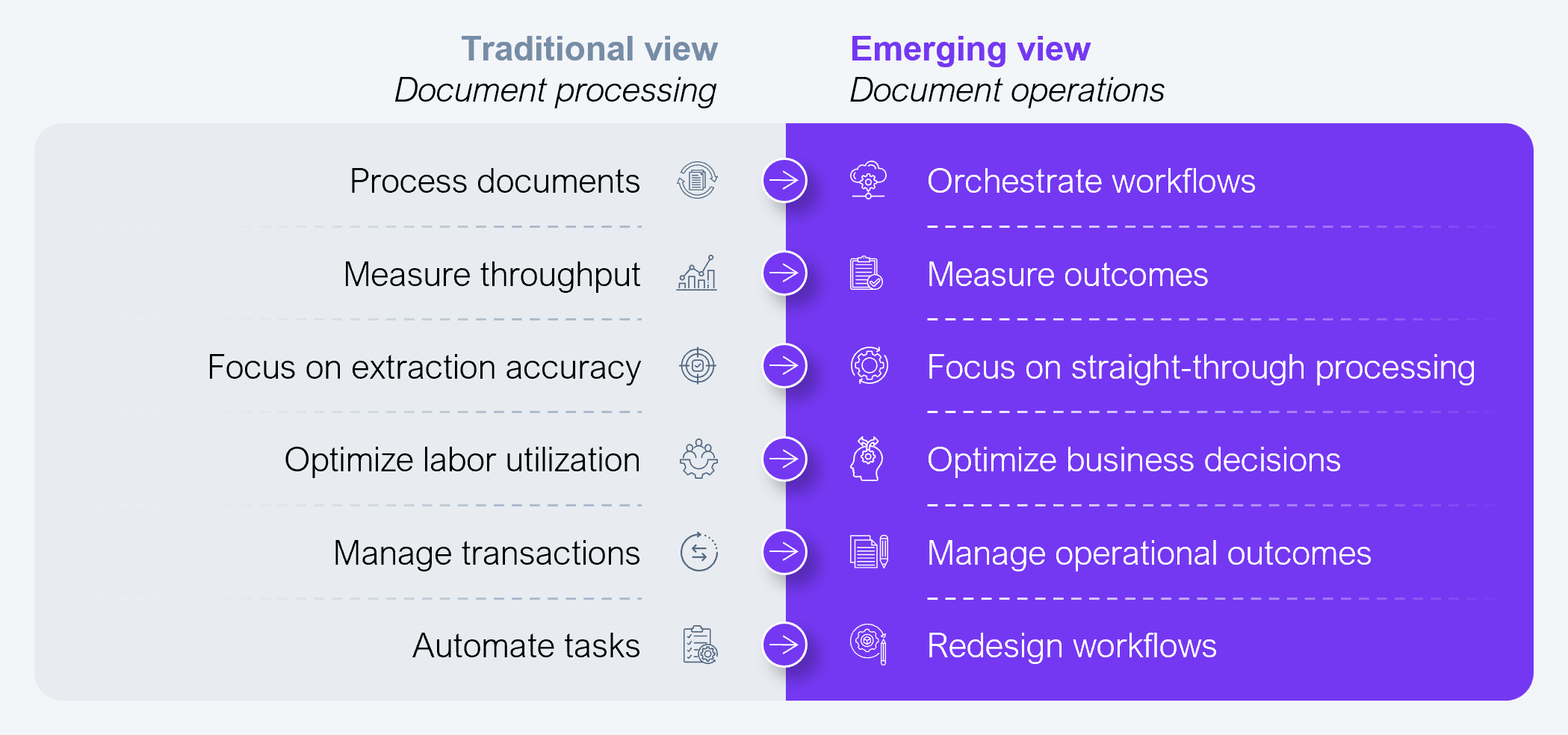
Consistency breaks down here, too. At large BPOs, margin performance varies job by job on the same technology, because each job carries its own exception patterns, client rules, and QC overhead. What operators want, as one BPO customer’s CEO put it, is auditable consistency on every job and one pane of glass across the whole operation, not a dashboard per job. Behind that demand, the scoreboard is shifting from activity to outcomes, and that strains traditional operating models. Organizations need to see how information moves through a process and, more to the point, where it stops moving. The change from document processing to document operations captures this shift (see Exhibit 1), and it is not cosmetic: Document operations are where cost and risk are decided and cycle time is won or lost.
Source: HFS Research, 2026
The work most vendors underplay is everything that comes next, and that is what KnowledgeLake’s Document OS is built to run. It puts document intelligence to work after the read: orchestrating workflows and managing exceptions up front, then handling the governance and quality checks that keep straight-through rates climbing. It serves enterprises and government teams managing their own records, as well as the BPOs that process documents at scale.
Stepping back, this is the shift HFS calls the Services-as-Software™ era, an emerging $1.5 trillion opportunity: work once delivered by people and billed by the hour is moving to AI software billed on outcomes. Document operations is one of its clearest proving grounds, where a labor-heavy service becomes a software-led capability that the business buys for the result, not the headcount behind it.
KnowledgeLake says the results bear that out. On a county land-records program, one of its largest current outsourcing engagements, it now pushes 40%–50% of documents straight through with no human review, up from a fully manual workflow when the engagement began, worth more than $300,000 on a single job. An invoice operation for a global energy firm cut roughly 700 hours of manual work and about $400,000 a year. Net revenue retention running 120%–130% is the clearest sign that customers keep buying because the platform delivers.
If you are on this journey, the playbook is not another extraction pilot. Three moves matter most:
Register now for immediate access of HFS' research, data and forward looking trends.
Get StartedIf you don't have an account, Register here |
With the exception of our Horizons reports, most of our research is available for free on our website. Sign up for a free account and start realizing the power of insights now.
Our premium subscription gives enterprise clients access to our complete library of proprietary research, direct access to our industry analysts, and other benefits.
Contact us at [email protected] for more information on premium access.