
Enterprise leaders can no longer treat services and software as distinct buying categories. Earlier this year, HFS sized the Software-as-Services (SaS) market as a $1.5 trillion opportunity. This convergence, where services are being codified as software and software is absorbing services, is triggering a collision between traditional service providers and software firms. Both are racing to embed intelligence, codify IP, and take ownership of business outcomes through scalable, subscription-led models.
Enterprises increasingly view SaS as a future-proof model. Two-thirds plan to replace significant human-led services and processes with AI-led solutions within the next three years. This shift is fueled by the urgency for agility, resilience, and speed amid volatile macro conditions and rapid tech advancement.
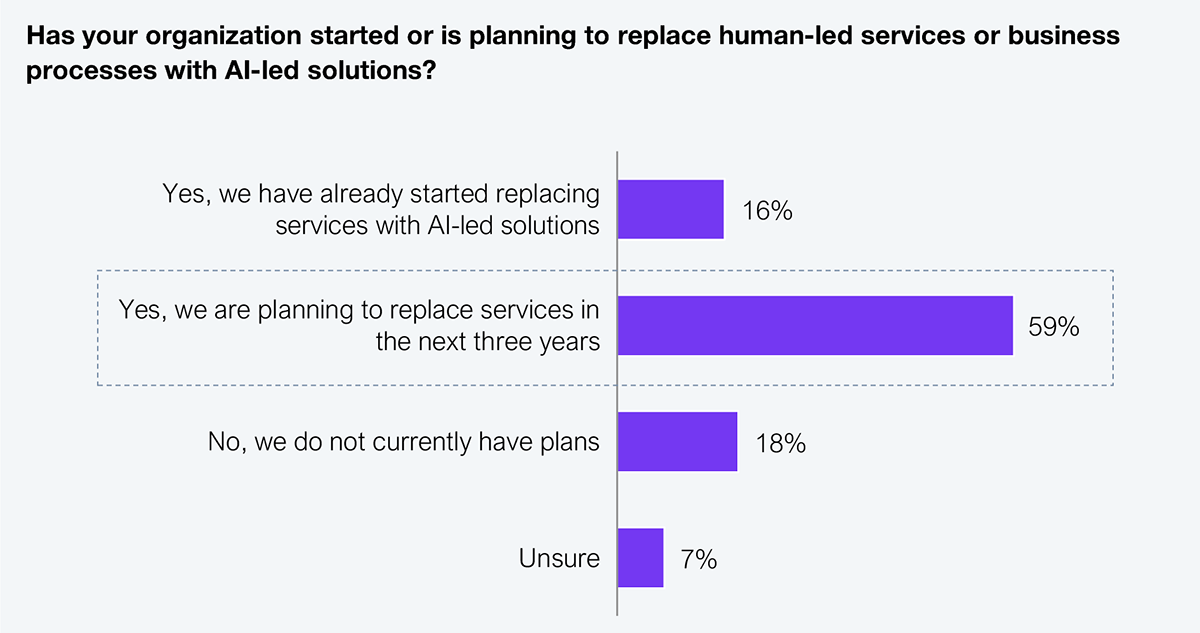
Sample: 305 major enterprise decision makers
Source: HFS Research Pulse, 2025
SaS is already starting to find its feet in the enterprise world:
The maturation of cloud-native AI, telemetry-rich platforms, and scalable IP codification is accelerating SaS adoption across three emerging pathways.
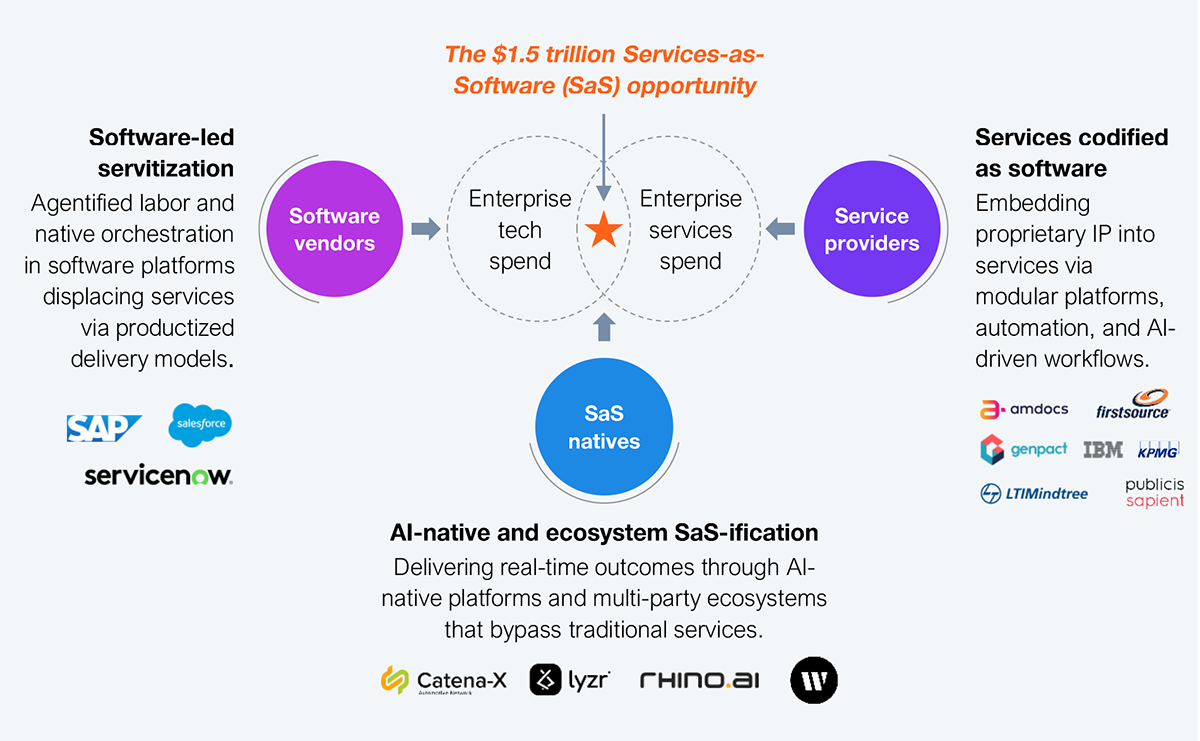
Source: HFS’ analysis of the evolving SaS market, 2025
1. Services codified as software
Traditional services in areas such as finance, ERP support, and IT operations are being broken down into repeatable workflows, bots, and AI agents. Providers are transforming delivery into modular, platform-enabled, subscription-based offerings.
Enterprise leaders must demand more than automation. They should look for platform-enabled services with observable performance, modular pricing, and continuous delivery upgrades.
Buyer lens on providers:
2. Software-led servitization
In this category, established SaaS platforms embed orchestration, automation, and AI into core products to absorb service functions. The goal is to deliver packaged modules that not only enable extensibility but also produce KPIs as a productized outcome. This approach increasingly displaces external service providers by delivering embedded services.
This is where software cannibalizes services. Enterprise leaders must evaluate SaaS platforms not just on features but on their ability to replace legacy services with embedded execution.
What to watch out for:
3. AI-native and ecosystem SaS-ification
A new wave of platforms is bypassing traditional service delivery to deliver real-time, adaptive business outcomes. These offerings are AI-native, cloud-first, and designed for autonomous decision-making, continuous optimization, and contextual recommendations.
AI-native examples include:
At the same time, ecosystem-scale platforms are emerging to facilitate collaboration, orchestration, and shared data environments across industries.
Examples of ecosystem platforms:
These platforms bypass legacy service models altogether. They deliver autonomous decision-making, continuous optimization, and cross-industry collaboration. By doing so, they are shifting the buying center away from both traditional services and legacy software vendors.
As the SaS market evolves, success will not be defined by automation alone. It will depend on a provider’s ability to link codified delivery to measurable business outcomes. Providers must go beyond delivering platforms or process automation and show tangible improvements in decision-making, transparency, and operational performance.
To lead this new model, providers must shift from task execution to demand shaping and outcome enablement. This includes making service performance observable, aligning operations with business KPIs, and embedding intelligence throughout delivery workflows.
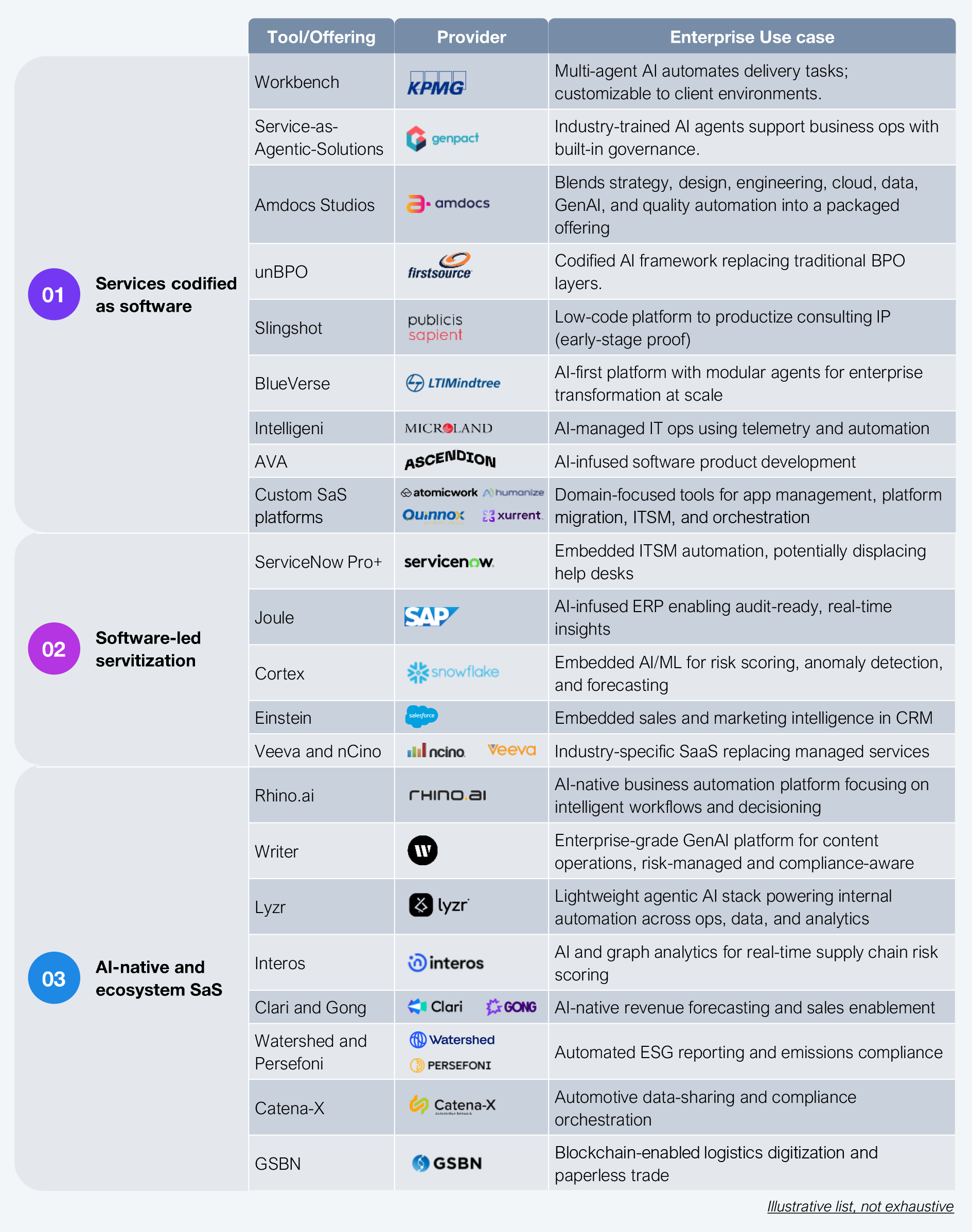
Source: HFS’ analysis of promising SaS offerings, 2025
For enterprises, codifying services is not the endgame. Embedding intelligence and receiving measurable business value is.
Enterprise leaders must:
Enterprise leaders must now lead the shift:
The $1.5 trillion SaS opportunity won’t be captured by those that cling to legacy contracts and comfort zones. Ultimately, SaS will require a new buying and selling playbook: one that rewrites the rules around pricing, governance, IP ownership, talent, and partnership structures.
At HFS, we are actively unpacking these shifts. Watch this space for deeper dives into the economics, architectures, and operating models that will define the future of SaS.
Register now for immediate access of HFS' research, data and forward looking trends.
Get Started

If you don't have an account, Register here |
With the exception of our Horizons reports, most of our research is available for free on our website. Sign up for a free account and start realizing the power of insights now.
Our premium subscription gives enterprise clients access to our complete library of proprietary research, direct access to our industry analysts, and other benefits.
Contact us at [email protected] for more information on premium access.

