Point of View

TWILTCH growth returns, but an AI monetization gap is opening across the cohort

This HFS Point of View is for CIOs, sourcing leaders, and enterprise technology buyers assessing how the TWILTCH IT services providers monetize AI value across the next growth cycle.

A new competitive dynamic is emerging in IT services: providers are making fundamentally different choices about how AI value is monetized, which will shape the next growth cycle. We looked beyond AI announcements and examined the earnings of TWILTCH (TCS, Wipro, Infosys, LTM, Tech Mahindra, Cognizant, and HCLTech). The financial results of India’s leading heritage IT and business services providers are often used as an indicator of how enterprise technology budgets are evolving globally, which is why enterprise leaders should pay careful attention.

Across the TWILTCH providers, revenue growth is improving, average cohort growth reached 5% YoY in Q1 2026, up from 2.6% in Q1 2025 and -0.6% in Q1 CY2024 (see Exhibit 1), supported by strong bookings, vendor consolidation in financial services, and a partial recovery in Europe.
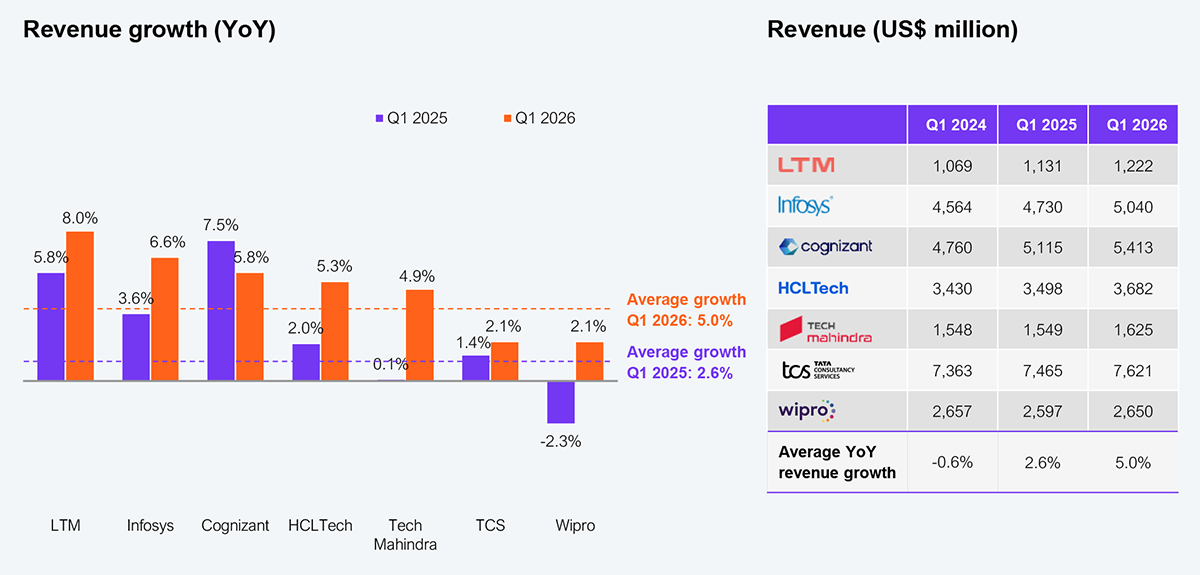
Exhibit 1: Average TWILTCH growth reached 5% YoY in Q1 CY2026, with LTM, Infosys, Cognizant, and HCLTech leading the cohort

Combined grouped bar chart and data table comparing year-on-year revenue growth for the seven TWILTCH providers. The bar chart plots year-on-year revenue growth (YoY) with purple bars for Q1 2025 and orange bars for Q1 2026: LTM 5.8% then 8.0%, Infosys 3.6% then 6.6%, Cognizant 7.5% then 5.8%, HCLTech 2.0% then 5.3%, Tech Mahindra -0.1% then 4.9%, TCS 1.4% then 2.1%, and Wipro -2.3% then 2.1%. Two dashed reference lines mark average cohort growth of 5.0% for Q1 2026 and 2.6% for Q1 2025. The accompanying table lists revenue in US$ million for Q1 2024, Q1 2025, and Q1 2026: LTIMindtree 1,069, 1,131, 1,222; Infosys 4,564, 4,730, 5,040; Cognizant 4,760, 5,115, 5,413; HCLTech 3,430, 3,498, 3,682; Tech Mahindra 1,548, 1,549, 1,625; TCS 7,363, 7,465, 7,621; and Wipro 2,657, 2,597, 2,650. Average YoY revenue growth was -0.6% in Q1 2024, 2.6% in Q1 2025, and 5.0% in Q1 2026. Note: revenue and growth data represents HFS estimates based on analysis of publicly available information; all data is in CY. Source: HFS Research and earnings reports of leading service providers, 2026.

*Note: Revenue and growth data represents HFS estimates based on analysis of publicly available information. Year-on-year (YoY) growth compares a quarter with the same quarter of the previous year. All data is in CY.

Source: HFS Research and earnings reports of leading service providers, 2026

AI and unsettled geopolitical backdrop continue to affect TWILTCH performance

Beneath the headline, some providers are using AI productivity to reduce client costs and win market share, while others are redesigning pricing models to retain AI-created value within their own economics. Early signs suggest that these different approaches to AI monetization could become an increasingly important source of differentiation over the next cycle.

The divergence is part structural and part cyclical. AI commercial-model choices, sector mix, and capital-allocation positioning point to durable differentiation, while client-specific ramp-downs, one-off contract completions, inorganic contributions at the growth leaders, and an unsettled macroeconomic and geopolitical backdrop continue to shape the cohort performance. The current gap will likely narrow, as recently signed deals scale to full revenue and one-off effects fade from the comparable base. The persistent pipeline-to-revenue lag at slower-growing firms reflects longer ramp cycles on consolidation deals and pricing concessions secured by enterprise buyers.

AI productivity is no longer a delivery question, but a commercial-model decision

Infosys, TCS, and LTM are passing a measured share of AI productivity back to clients, as indicated by Infosys and TCS at the FY27 guidance level and LTM at the contract level in its top BFSI account. Cognizant and Tech Mahindra are retooling commercial models, including tokenized, role-tier pricing at Cognizant and outcome-based vector-squad engagements at Tech Mahindra, to retain AI productivity inside provider economics. Wipro and HCLTech are building productized AI offerings: Wipro through the new AI-Native Business and Platforms Unit pivoting to a software-like model, and HCLTech through its $620 million advanced AI revenue line and AI factory engagements. HCLTech also segments the market into AI-disrupted, AI-amplified, and AI-native categories and has aligned its FY27 growth aspiration around the resulting mix shift.

Delving into the Q1 CY2026 earnings of each TWILTCH provider
  • TCS grew 2.1% YoY, driven by energy, resources and utilities, manufacturing, and tech and services. However, its India revenue fell sharply as a multi-year public-sector contract concluded. The company continues to position AI as both a delivery and infrastructure opportunity through its HyperVault subsidiary, an OpenAI partnership with a 100 MW initial capacity (with an option to scale to 1 GW), and an AMD Helios co-development of rack-scale AI infrastructure. The approach signals a willingness to embed AI productivity into client engagements while building longer-term sovereign AI infrastructure capability.
  • Wipro grew 2.1% YoY. The standouts were its largest-ever buyback of INR 150 billion and the launch of its AI-Native Business and Platforms unit that consolidates Wipro’s AI assets (Wipro Intelligence, WEGA, WINGS, and the industry-specific solutions) into a productized portfolio. This reflects a shift toward the Services-as-Software™ model, allowing the company to monetize AI capabilities through recurring, software-like commercial structures rather than traditional labor-based pricing.
  • Infosys grew 6.6% YoY, led by life sciences and communications and Europe outperforming on mega-deals. It closed the Stratus acquisition (insurance technology consulting, Guidewire-focused), contributing approximately 25bps to this year’s revenue guidance. Among the TWILTCH providers, Infosys shared solid examples of AI productivity being incorporated into client delivery and pricing models, suggesting a strategy focused on using AI efficiency gains to strengthen client value propositions and support growth.
  • LTM was the fastest-growing provider in the cohort, with revenue up 8.1% YoY. Management highlighted productivity-led pricing resets within its largest BFSI account, signaling a willingness to pass AI productivity to clients at the contract level. At the same time, its Lakshya 31 strategy (a five-year aspiration to double revenue through AI-led transformation and sovereign-capability M&A) indicates that the company is placing AI commercialization at the centre of its long-term growth ambition.
  • Tech Mahindra grew 4.9% YoY, with an operating margin of 13.7% (a tenth consecutive quarter of expansion) and an FY27 aspiration of 15%. Beyond the financial performance, the company stood out for introducing service-token and vector-squad commercial models, reflecting a broader move toward outcome-oriented AI-enabled engagements from traditional effort-based pricing.
  • Cognizant grew 5.8% YoY, with financial services growing 12.4% YoY on healthy discretionary spending and sustained large-deal momentum in North American banking and insurance. The recent acquisitions of Astreya (~$600 million; global IT managed services, AI infrastructure buildout, data-centre and digital-workplace services) and 3Cloud (Microsoft Azure data and AI specialist) are expected to contribute approximately 150bps to full-year revenue growth. The company is increasingly experimenting with AI-linked commercial models, including tokenized and role-tier pricing structures, to retain a greater share of AI-created productivity gains within provider economics.
  • HCLTech grew 5.3% YoY and reported $620 million in annualized advanced AI revenue, which are clear indicators of AI commercialization in the cohort. Its AI Factory engagements (including USD$100 million-plus signed deal with two clients in build) and the Wobby acquisition (allocated to the HCL Software segment for agentic AI data analyst capability) reinforce a strategy focused on creating monetizable AI-led offerings. The company segments the addressable market into AI-disrupted (40%), AI-amplified (55%), and AI-native (5%) categories, with FY27 growth aspiration aligned to the resulting mix shift.
The Bottom Line: Providers commercializing AI are likely to shape the next cycle, while those still focused on announcements risk falling behind. For enterprises, the critical question is no longer who has AI capabilities but know how to translate them into commercial value.

While every provider can now demonstrate AI investments, platforms, and partnerships, the AI conversation is beginning to shift from capability to economics. Early signs from Q1 CY2026 suggest that providers are taking different approaches to pricing, packaging, and monetization, which may become an increasingly important source of differentiation over the years. Enterprises looking to deploy AI must evaluate service providers on both evolving commercial models and how those align with their business models.

Sign in to view or download this research.

Login

Register

Insight. Inspiration. Impact.

Register now for immediate access of HFS' research, data and forward looking trends.

Get Started

Download Research

    Sign In

    Sign up for a free
    research account

    With the exception of our Horizons reports, most of our research is available for free on our website. Sign up for a free account and start realizing the power of insights now.

    By registering you agree to our privacy policy.

    I hereby consent that HFS Research can process my personal data.

    Digests/Newsletters: Overviews of the latest news, insight, and research by HFS.

    HFS Events: Exclusive invitations to HFS webinars, roundtables, and summits, bringing together key industry stakeholders focused on major innovations impacting business operations.

    Premium Access

    Our premium subscription gives enterprise clients access to our complete library of proprietary research, direct access to our industry analysts, and other benefits.

    Contact us at [email protected] for more information on premium access.

      Contact Ask HFS AI Support