This HFS–Genpact Point of View is for chief supply chain officers, operations leaders, and digital and data executives building an always-on supply chain that senses, decides, and acts without waiting for a human.
Five in six supply chain organizations are now buying AI, and almost none are running on it. Our AI in Supply Chain 2026 research finds that 83% of organizations are investing in AI in some form, yet only 13% have completed deployment in even one supply chain area (see Exhibit 1). The technology is not the constraint; the operating model is. Chief supply chain officers and other supply chain leaders, who keep funding pilots without rewiring the network, the accountability model, and the incentives, are simply buying capabilities that every other competitor can buy too.
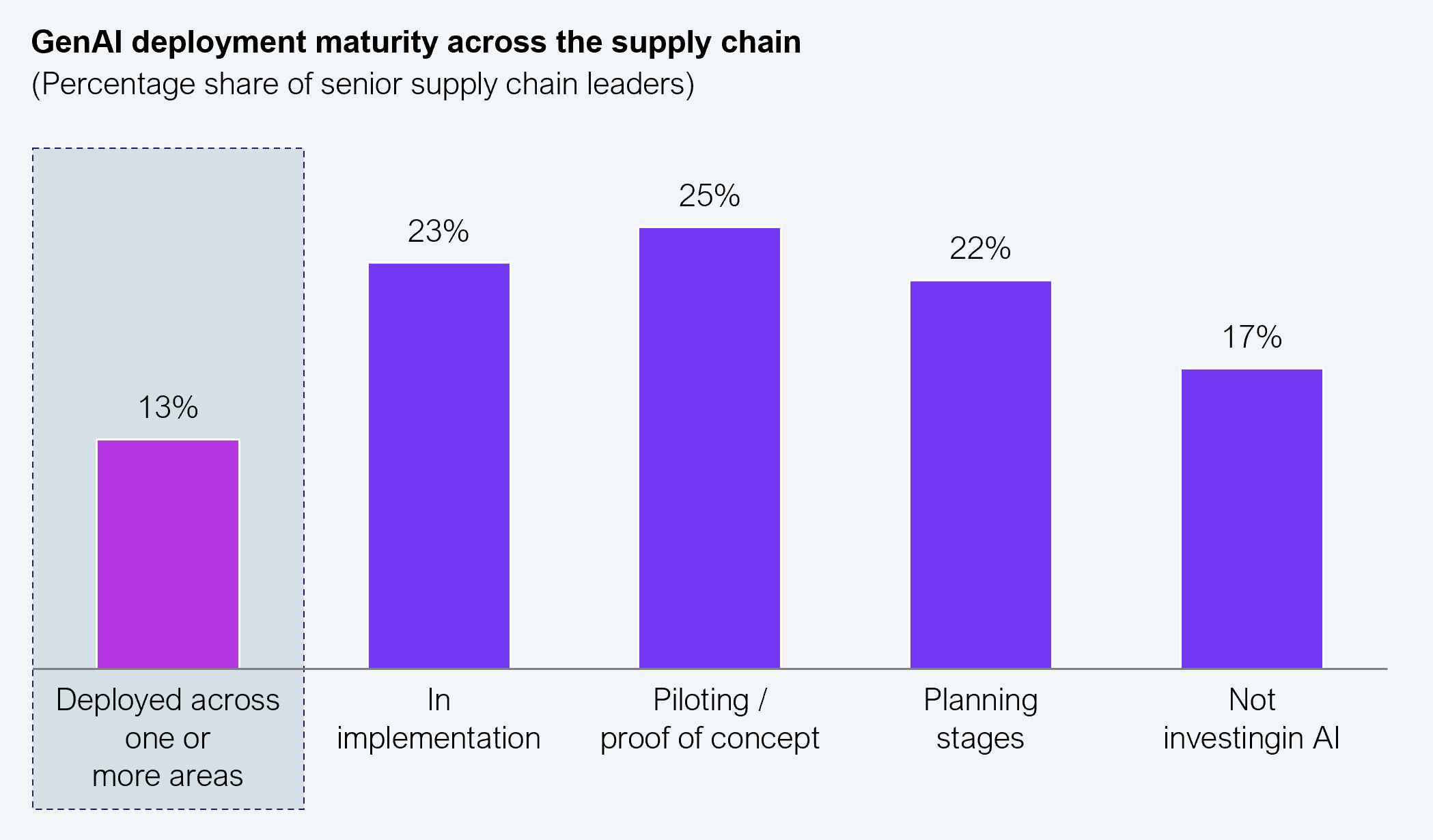
Sample size: n=242 senior supply chain leaders screened; 201 qualified
Source: HFS AI in Supply Chain 2026 study
We pressure-tested the survey’s conclusion face to face with a separate group of more than 30 senior supply chain, operations, digital, and data leaders at two HFS–Genpact executive roundtables, one in New York (April 2026) and the other in London (July 2026) (see Exhibit 2), spanning pharma, medical devices, specialty chemicals, animal health, consumer products, food retail, quick-service restaurants, luxury retail, mining equipment, oil and gas, ports and logistics, customs brokerage, defense and aerospace, and academic medical centers.
The findings were measured against “always-on,” the HFS benchmark for a supply network that senses, decides, and acts continuously. Built on a connected ecosystem working from a single source of truth, it enables end-to-end visibility across material, money, and information flows, and autonomous and self-adjusting behavior. Separated by an ocean and three months, both rooms reached the same conclusion: almost nobody could name a part of their supply chain that senses, decides, and acts without a human.
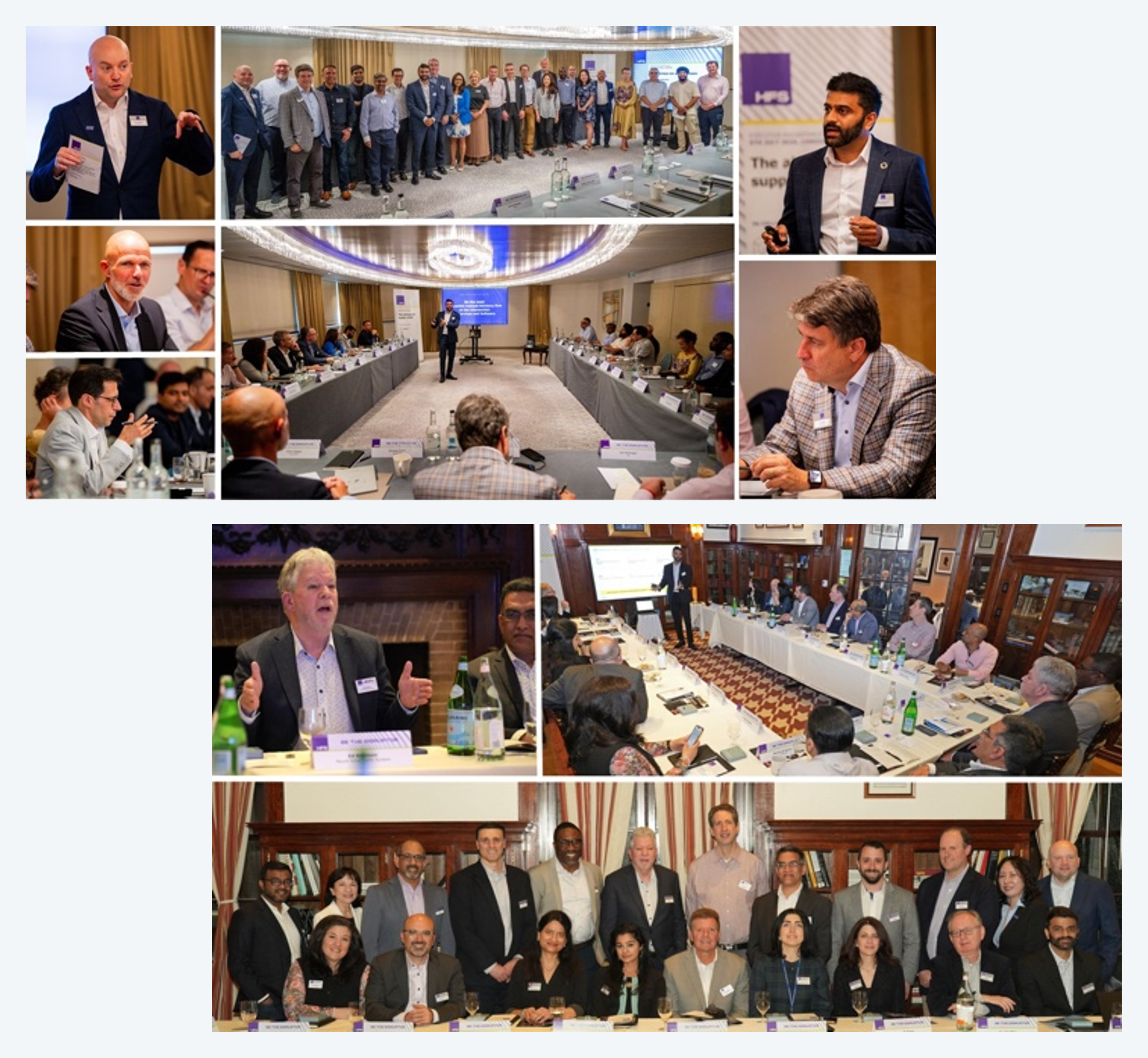
Source: HFS Research, 2026
Most enterprises measure AI programs on milestones. The more important metric is replanning latency, the time between a signal reaching the network and the network acting on it. On that metric, the market is failing. Leaders in New York reported roughly six weeks to systemize a tariff response and two to three months to validate a demand trend. In London, a private-label ice cream manufacturer that processes 60% of annual volume in two months explained that its sales and operations planning (S&OP) cycle must compress from monthly to near-daily across thousands of SKUs but cannot. The reasons in every case were identical: process flows stitched across ERP and spreadsheets and partner systems with no enterprise-grade orchestration.
The technology ceiling is far higher than the operational floor. An automotive major running 50 agentic use cases showed us a flow where a dealer-level agent detects a seat-heating malfunction cluster, production quarantines work in progress and auto-generates rework orders, fulfillment re-slots inventory and resets customer promises, and supply planning rebalances safety stock across ecosystem partners. A cycle that took 21 days now takes three hours. The same enterprises that cannot respond to a tariff within six weeks are buying the same class of technology. The difference is not the model; one redesigned the decision flow, and the others digitized their calendar. Layering AI on weekly or monthly planning cycles automates the wait.
Both rooms agreed that autonomy exists only in slivers: ERP three-way matching, carrier selection, and predictive maintenance. Even the single leader who, in our pre-event polls, claimed to have an autonomous function conceded that the machine senses and flags, while humans continue to decide and act.
The automotive flow in the previous section is not a contradiction. It shows what the same class of technology delivers when one bounded decision flow is engineered for autonomy up front, with context and decision rights designed in. Wherever engineering has not happened, sensing is as far as autonomy gets. The blocker is that decisions carry context the models were never given. A data leader at a global pet care and confectionery business described an AI that reliably flags an order it cannot fulfill 15 days out but cannot touch the production plan either because the plan encodes strategic-partner commitments that live in planners’ heads. Enterprises that skip digitizing this tribal knowledge will see their recommendation engines dismissed for missing what everyone in the room knows. A dashboard tells you the container is stuck; that is the easy part. The real work is the orchestration after: rerouting it, replanning everything downstream, and doing it without waiting for someone to notice. That is the line between showing and doing.
The right design question is not whether to keep a human in the loop but where, and the answer is determined by the consequence of failure rather than comfort. If a wrong autonomous call adds $50 per air-freight kilo, let the machine act; waiting seven hours for a human to log in and approve the reroute costs more than the error would. If the consequence is clinical, keep the human. Ed Robinson, Chief Resource Officer at Mount Sinai Health System, made the stakes clear in New York: in a healthcare supply chain, an out-of-stock is a clinical event. In London, a global logistics operator noted that a dropped container of cancer vaccines is measured in lives.
Always-on works only when this line is drawn deliberately. Use guardrails to define the limits within which agents act and thresholds to specify when service levels require a human. With EU AI Act obligations arriving in August, provable human oversight is becoming a compliance artifact. Enterprises that design it now will convert a regulatory burden into an operating asset. The planner does not disappear. They get the exceptions and the judgment calls, and the routine volume runs on its own.
The most persistent blocker we heard had nothing to do with technology. Leaders still demand individual approvals on routine decisions, so agentic systems are installed as just recommenders. Planners, rewarded for being indispensable rather than for automating the work, protect their irreplaceability with complex spreadsheets. At a global quick-service restaurant, market managers, bonused for meeting their targets, sandbagged their forecasts. The result was a global campaign product that sold out two days into a four-week promotion.
A consumer health integrated operations program was the strongest transformation case we examined. The leader’s honest verdict was that change management, not the model, was the failure. Markets were not brought into the business case early enough. The program hit its numbers, but later than planned, because adoption had to be won market by market. The lesson from both cases is the same: incentives decide whether the technology gets used. Enterprises that fund AI and leave forecast bonuses, approval hoarding, and spreadsheet fiefdoms untouched are financing their own resistance.
Three patterns separate the organizations getting AI into production, and all three are structural.
The buying model is now the binding constraint. Enterprises purchase supply chain transformation as multi-year programs measured in milestones, while the operational need is continuous improvement on replanning latency, fill rates, and supplier variance. We heard that ERP transformations are scheduled to finish in 2032, obsolete on arrival, and watched a chief procurement officer reject an outcome-based pricing proposal mid-session in favor of input-based rates. Providers cannot be held to business outcomes they only partially control, and enterprises cannot keep paying for effort. The resolution is a three-tier shared accountability model connected by a Supply Chain Guardian (see Exhibit 3). It is an orchestrator that owns the end-to-end value stream, credits provider contribution to value-level outcomes, monitors process flow across the 15-plus systems most enterprises run, and drives simplification, asking why a 40-step procurement process should not be 22.
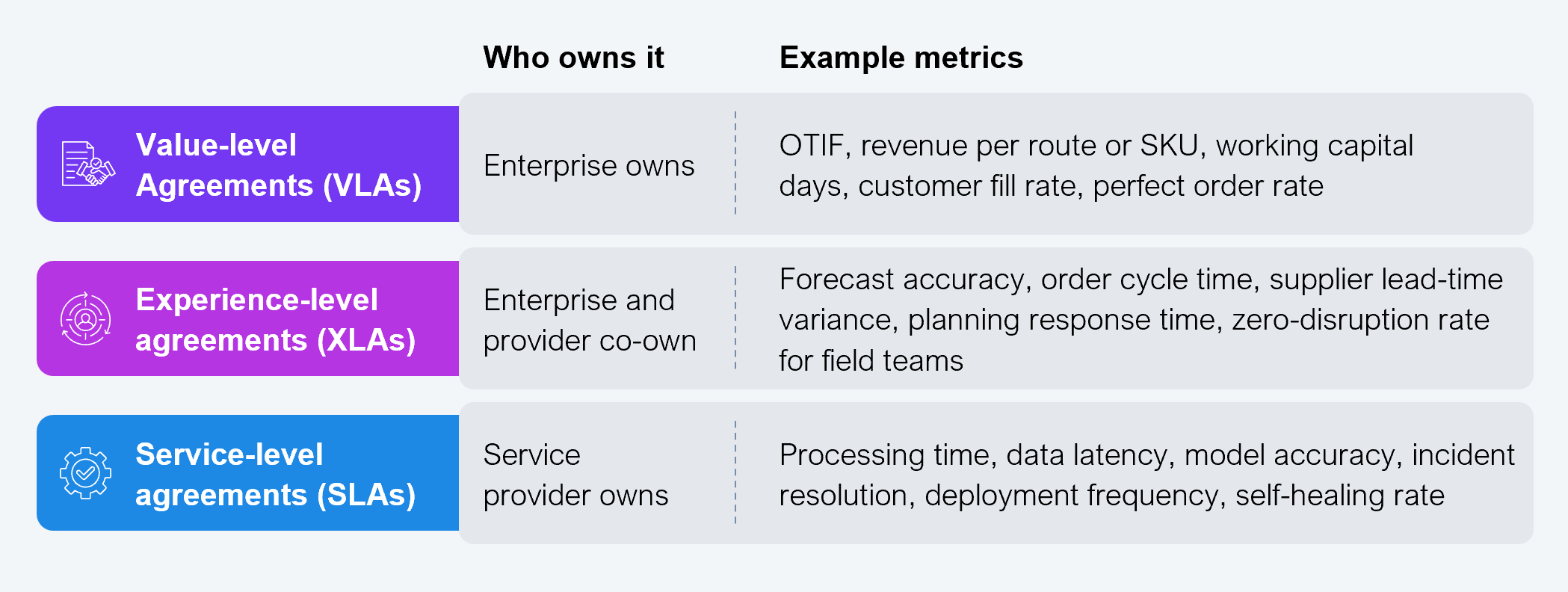
Source: HFS Research, 2026
Every blocker we cataloged across two continents was structural: fragmented ownership, undigitized judgment, incentives that reward sandbagging, procurement that buys projects when the need is products, and no owner for the end-to-end value stream. All those are solvable through design and authority rather than better models. Every supply chain AI investment now faces three questions. Does it shorten replanning latency? Does it broaden shared accountability across the enterprise and its providers? And does it move the organization up the AI Trust Curve from behavioral trust toward decision reliance? If the answer is no on all three, you are buying a faster route to the same six-week answer.
Register now for immediate access of HFS' research, data and forward looking trends.
Get StartedIf you don't have an account, Register here |
With the exception of our Horizons reports, most of our research is available for free on our website. Sign up for a free account and start realizing the power of insights now.
Our premium subscription gives enterprise clients access to our complete library of proprietary research, direct access to our industry analysts, and other benefits.
Contact us at [email protected] for more information on premium access.