This HFS Point of View, “CIOs, stop limiting AI to what your enterprise can type,” is for CIOs and enterprise technology leaders deciding where to capture and govern spoken context for enterprise AI.
Enterprise AI has learned to read what your organization writes, but most of what your organization knows never gets written down. It gets exchanged in conversation and then disappears. Most AI still depends on employees translating what they know into prompts, documents, fields, and clicks. Voice intelligence makes that context available to enterprise AI.
Voice AI enables machines to listen and speak. Voice intelligence turns what people say into context that can be interpreted, connected to what the enterprise knows, and used to shape what happens next. As real-time speech processing and agentic AI converge, voice intelligence is becoming a layer in the enterprise AI stack.
For decades, computing has required humans to translate themselves for machines. We fill in fields, click through workflows, write documents, and record decisions in systems of record. Generative AI made the task of translating ourselves more natural, but we still communicate through our fingertips.
Typing speed is the smaller cost. Writing and speaking do not carry the same information. Writing is edited and compressed. Conversation unfolds through questions, corrections, hesitation, and challenge. By the time an interaction becomes a CRM entry, contract, or meeting summary, much of that context has been stripped away.
Consider a supplier negotiation. The procurement platform captures the final price and terms. An email may capture the agreed position. But the conversation reveals why the team pushed on one term and conceded another, what the supplier resisted, and which trade-offs shaped the deal. The same gap opens in a hospital shift handover, a field engineer talking a technician through a repair, and a deal desk call where an exception gets approved. In each case, the system holds the outcome, and the conversation holds the judgment.
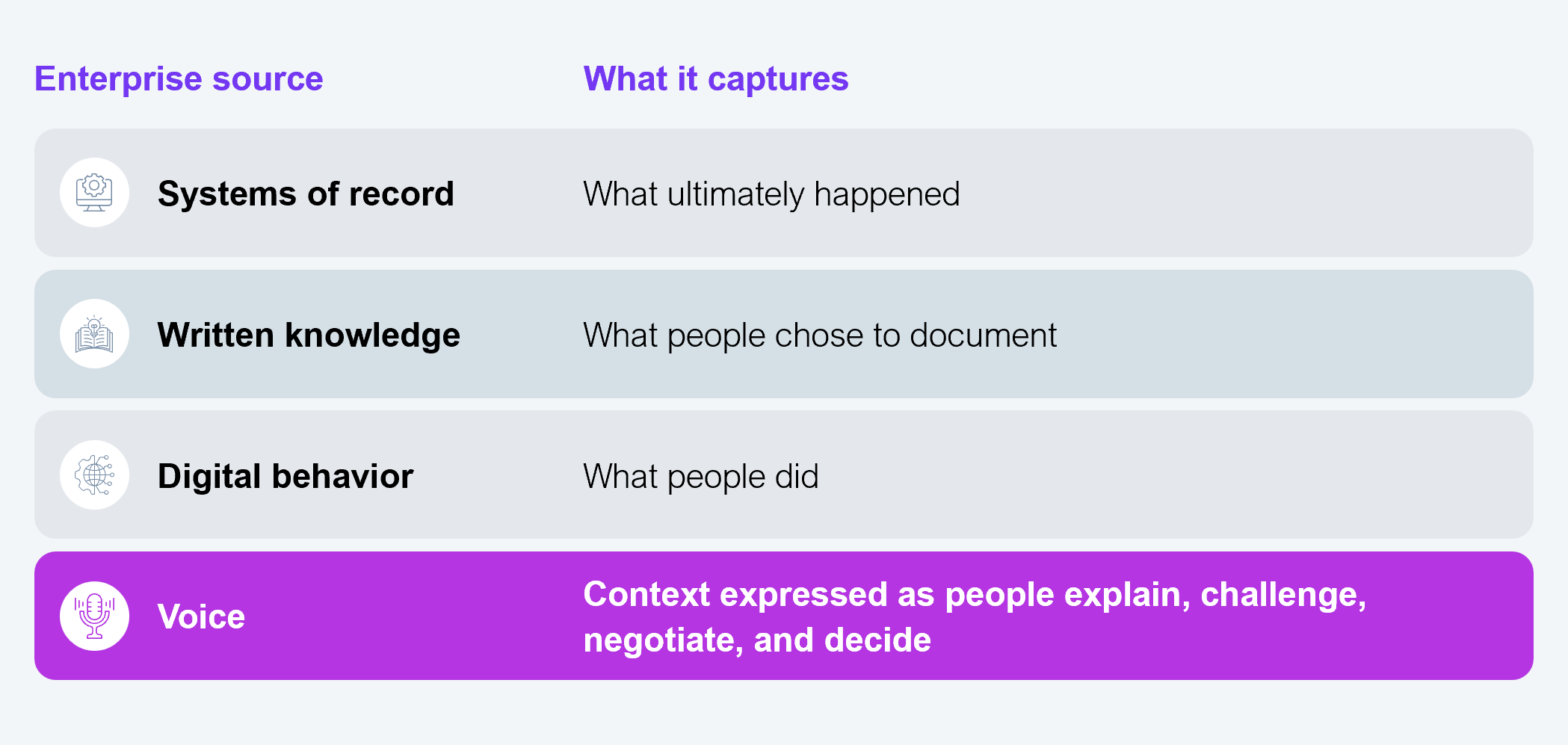
Most of that context never reaches an enterprise system, and not because AI reads the record badly. The record never held it. Documenting the reasoning depends on someone choosing to, remembering to, and having the time. Each layer of the enterprise stack captures a thinner slice of what actually happened, and voice is the only one that holds the reasoning (see Exhibit 1).
Source: HFS Research, 2026
The contact center became the natural home for voice intelligence because it was one of the few places enterprises routinely recorded conversations at scale. The technology that grew there focused on transcription, quality assurance, and customer experience analytics.
Three shifts in the underlying technology are now pulling voice out of the contact center.
Real-time speech processing can interpret a conversation while it is still happening. Ambient AI is making meetings and other interactions machine-readable. Agentic AI means the system listening to a conversation can retrieve information, recommend a response, or trigger a workflow. Together, ambient and agentic AI change how voice gets used, from a channel for talking to customers into an input layer for the enterprise. Those shifts give voice three roles it did not have before:
The market is not waiting for voice intelligence to become a formal category. Companies already sitting on enterprise conversations are expanding as value shifts from processing speech to owning the resulting context and action. Each of these four could own that layer, and each starts from a different position.

Krisp sits at the point of capture, between human speech and the systems consuming it. As it expands from audio quality into transcription, meeting intelligence, analytics, and agent assist, that position lets it turn conversations into an enterprise data asset.

Deepgram is competing to become infrastructure for the voice-native enterprise. Its real-time speech and agent capabilities let applications listen, interpret conversational turns, and respond, making voice a native input for enterprise AI.

Gong demonstrates the compounding value of conversational data. Years of customer interactions gain value when connected to account history, CRM data, and outcomes. Its advantage is context built from conversations over time, which AI can reuse.

Parloa shows where the economics ultimately move, from insight to execution. Its agents use conversational and enterprise context inside live customer interactions, completing the interaction instead of analyzing it afterward.
As voice becomes a richer source of organizational intelligence, enterprises must be deliberate about where AI is allowed to listen.
CIOs should start with three moves:
Aim at the handful of interactions where spoken context matters most, and leave the rest of the workplace alone.
The next generation of organizational intelligence cannot be limited to what employees have time to type. Pick the two or three workflows where spoken context would change decisions, then design the data, agents, and governance around them. The tooling is already arriving without you. Meeting assistants, contact center platforms, and sales tools are recording conversations across your enterprise now, and every quarter you wait lets someone else set your retention, inference, and access defaults by procurement accident.
Register now for immediate access of HFS' research, data and forward looking trends.
Get StartedIf you don't have an account, Register here |
With the exception of our Horizons reports, most of our research is available for free on our website. Sign up for a free account and start realizing the power of insights now.
Our premium subscription gives enterprise clients access to our complete library of proprietary research, direct access to our industry analysts, and other benefits.
Contact us at [email protected] for more information on premium access.