This HFS-Hexaware Point of View is for CIOs, application development leaders, and sourcing executives choosing a software modernization partner built for the AI era.
For the past couple of years, vendors have told CIOs to point AI at their software lifecycle and expect fast, cheap, and nearly effortless modernization. The promise of AI in revolutionizing how businesses can create everything from automation to new applications is compelling, but it’s dangerous to try to do it alone.
It’s clear that AI is reshaping how developers write and run software, but the enterprises that succeed will not be those that blindly leap into AI as the answer to software development. Success will require an application strategy that treats an enterprise team’s capability, AI tooling, and services partners as mutually reinforcing. HFS believes the CIO’s challenge is to align AI efforts across the software estate with a partner whose vision for AI starts with activating technology and ends with measurable business outcomes.
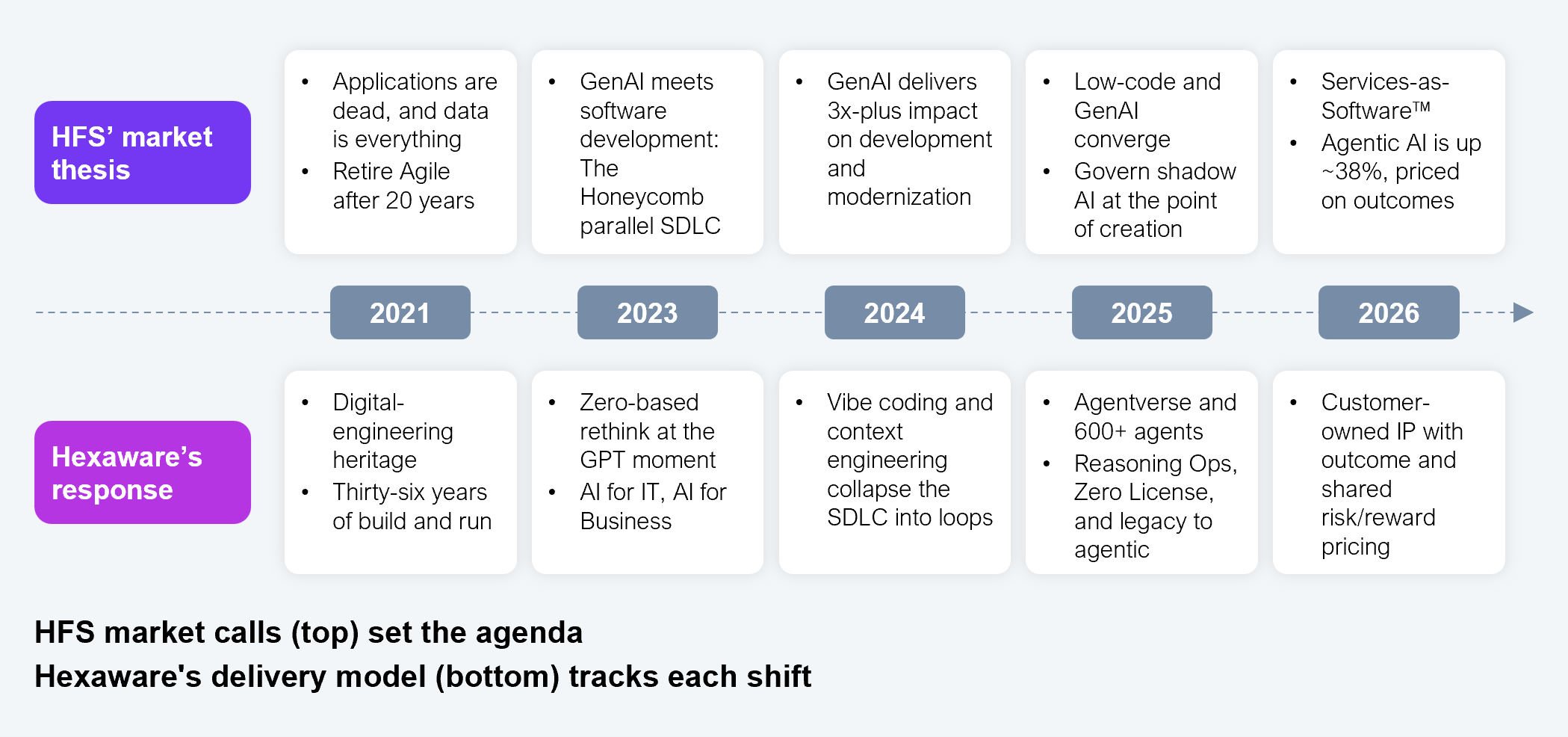
For CIOs to succeed and scale, we argue that the shift has been emerging for years and that the market did not turn on the day ChatGPT launched. Rather, HFS has been charting this reinvention since 2021 while tracking providers worth hiring and whose own evolution has mirrored this shift all along.
The through-line started with a deliberately provocative claim: applications are dead, and data is everything. The argument was that enterprises were over-rotating on moving and modernizing applications without addressing the data underneath, and that the North Star of any cloud-native journey must be data, not the application layer.
We then turned the same lens on methods, arguing that after twenty years, it was time to retire Agile. The data was unsentimental; 42% of large enterprises were still running Waterfall, and another 30% were running a Waterfall-Agile hybrid model. The same study found that 61% had no formal co-development programs at all. Agile was conceived in 2001, before microservices, containers, serverless, AI, automation, or low-code existed. It was a necessary stage, not the destination. Companion research showed that legacy development cultures were drowning even Agile inside DevOps.
Source: HFS Research and Hexaware, 2026
This progression has been consistently moving toward today’s AI-first methodologies. In 2023, HFS argued that the sequential, handoff-driven model itself had to break. It called for a move away from the linear development models that Agile enforced, toward a parallel and intertwined “Honeycomb” approach in which business-led requirements, co-design, and testing run simultaneously with engineering.
The same year, HFS called the arrival of generative coding, and, by 2024, quantified it, estimating over a threefold impact on development and modernization. An EY case study showed that converting 4,000 lines of code achieved over 85% accuracy and 80% less effort.
By 2025, HFS had documented the convergence: 93% of IT leaders saw GenAI as a boost to new and legacy work, while only 19% used it to replace developers outright. The rest used it to document, convert, generate, and refactor code. Across five years, the pattern holds. The lifecycle itself is being replaced, and data and intent are the design anchors.
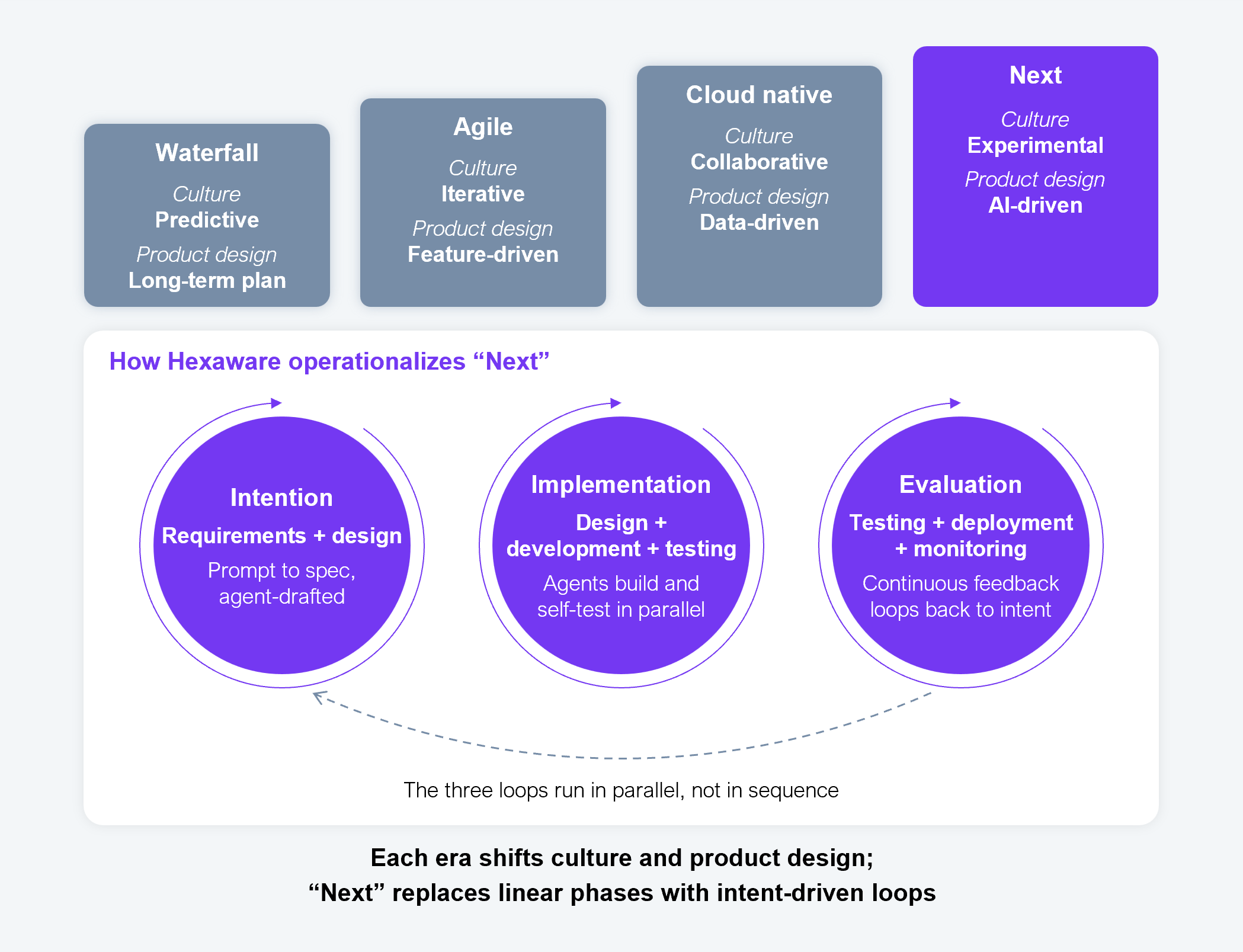
HFS framed the destination as a four-stage evolution, the transition from Waterfall to Agile to Cloud Native to “Next,” where culture moves from predictive to experimental and product design from long-term plans to AI-driven (see Exhibit 2). “Next” is a different operating model altogether, where requirements compile toward running software and the handoffs disappear.
Source: HFS Research and Hexaware, 2026
This situation is where a provider’s own journey serves as a useful test, and Hexaware is an instructive example in the market. Two years ago, at what its leaders call the “GPT moment,” the firm did zero-based thinking about its mainstay digital-engineering business and split its response into two motions: AI for IT (“guardrails first, autonomy next”) and AI for Business.
On the IT side, Hexaware redrew the SDLC exactly as HFS described. It pushed requirements and design to collapse into an intent loop, design-build-test into an implementation loop, and test-deploy-monitor into an evaluation loop. It then moved customers along a path from prompt-based AI to spec-driven development to agent-driven development, which requires two kinds of context: the customer’s security guardrails and the customer’s business logic.
The lived detail matters. In the firm’s own pilots, junior-developer output dropped in pure prompt mode because they shipped code they could not evaluate, while senior developers got faster. This is precisely the pattern we identified when we noted that only 19% use GenAI to replace developers. The differentiator is context discipline, not the tools that simply augment or automate how software serves the business.
The largest prize to be won is the installed base, but therein lies the largest trap: overcoming legacy requires technology and business context. HFS’s legacy modernization research found that the market has matured to the point where enterprises can source AI-driven, end-to-end modernization rather than lean on the traditional SDLC, but warned that modernization only pays off when treated as the first step toward becoming AI-native, not a one-off migration.
CIOs should heed the warning that enterprises that skip the operating-model work find that AI amplifies existing dysfunction rather than removing it. Modernization is also changing shape. It is no longer only monolithic-to-microservices but monolithic-to-agentic, with AI agents augmenting or replacing legacy functions and customers shifting from paid software to open source.
Hexaware’s legacy work illustrates the new economics. In one banking case, the firm automated COBOL modernization by parsing and extracting business logic, cutting migration time by 98%, reducing post-migration defects by 75%, and reducing manual effort by 60% in a regulated environment. Its “Zero License” offering attacks the same problem from the cost side. For a customer running roughly 400 workloads on a vertical workflow platform, it moved 75% of workloads to a cloud-native, agent-based footprint and eliminated the associated license drag. Done this way, modernization does more than clean up code; it stops the legacy estate from taxing every new initiative.
The moment anyone can generate code, modernization moves out of controlled pipelines and into the hands of anyone with a prompt box. HFS has been blunt, stating that the default outcome is shadow AI and citizen development and vibe coding are accelerating faster than enterprise governance can track. Its prescribed antidote is structural: the forward deployment engineer, an embedded role that codes, tests, and operationalizes with business teams while building governance, compliance, and lineage into frontline development rather than bolting it on afterward. This is exactly why Hexaware leads its IT motion with “guardrails first, autonomy next” and why its agent-driven development depends on a context engineering approach. Focusing on contextual engineering is about what the data is meant to do while encoding the customer’s security mandates and business rules before agents generate inside the customer’s own IDEs.
The same discipline shows up in operations. Its Reasoning Ops approach lifts the automation ceiling from the 30%–40% that scripted automation hits to roughly 70% by adding reasoning and planning, but only after three months of ingesting telemetry, tickets, and SOPs to build the taxonomy and ontology that ground the agents. Here, governance and context are what make autonomy possible in the first place.
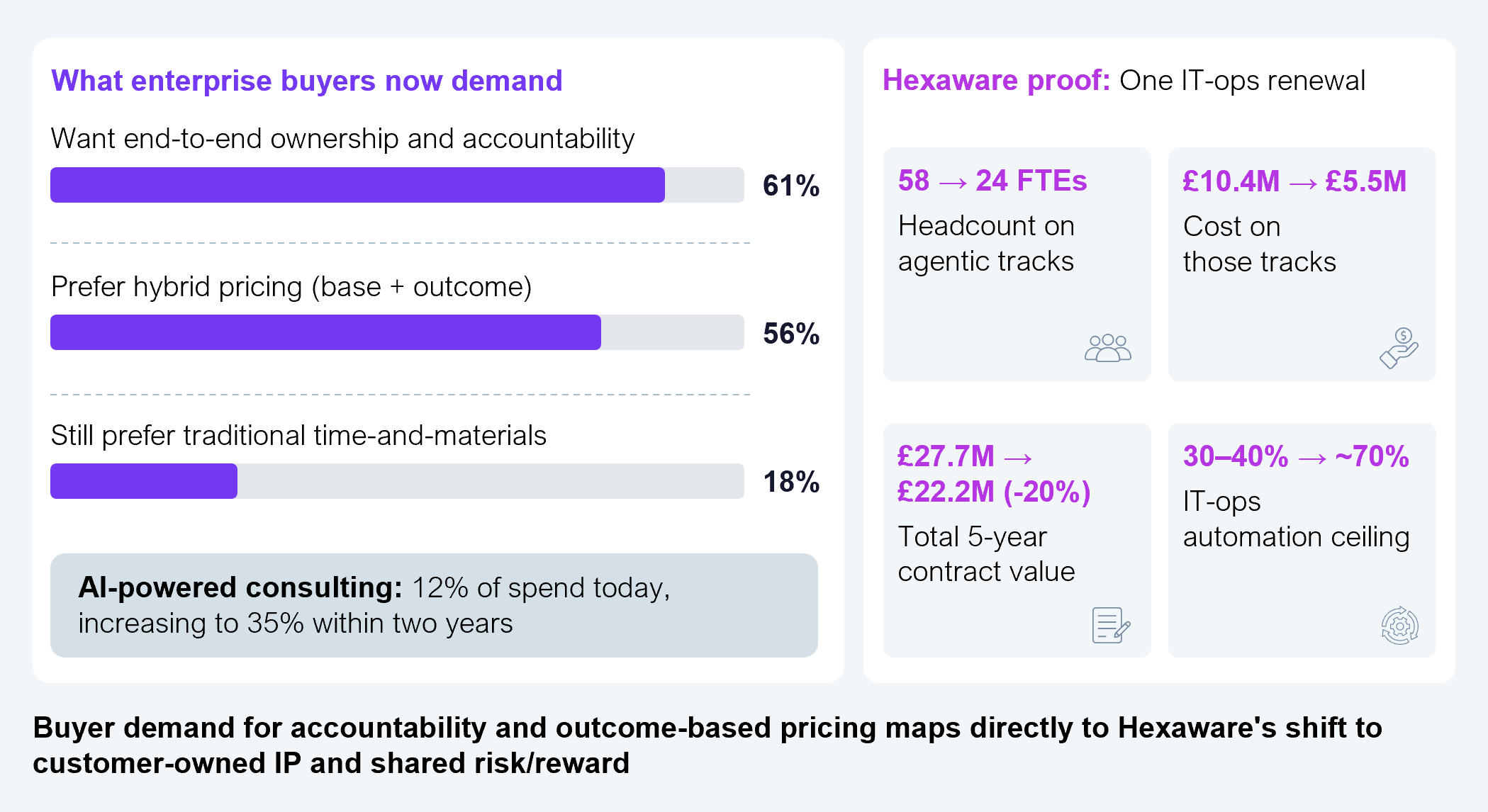
If the work has changed, the contract must change with it. HFS research finds that traditional time-and-materials and FTE-based models are structurally incompatible with AI-era delivery. Sixty-one percent (61%) of enterprises now want end-to-end ownership and accountability from partners, 56% prefer hybrid pricing that blends a base fee with an outcome kicker, and only 18% still prefer pure time-and-materials. The advisory market is moving the same way. Eighty-three percent (83%) of leaders say AI-powered delivery beats traditional advisory, and HFS expects the share of consulting delivered with pervasive AI to roughly triple from 12% to 35% within two years (see Exhibit 3).
Source: HFS Research, 2026
Hexaware’s model is a concrete reading of that demand. In software development, it retains no platform license and no IP. Instead, it builds and customizes pre-built agents in the customer’s environment, and the customer owns the agents and the code they produce. Its Agentverse stack follows the same logic. Hexaware stands up the core foundation in 90 days, the development, testing, and operations studios in the next 90, and transitions full ownership to the customer by day 180.
Where it does retain IP, across managed IT operations and contact centers, it offers clients prices based on achieved business outcomes. One such example is when Hexaware restructured a renewal, a deal that it would have booked at £27.7 million under a traditional model, into an agentic-first deal that reduced headcount on the targeted tracks from 58 to 24 and costs from £10.4 million to £5.5 million, with overall contract value down 20% to £22.2 million. That kind of transparent, self-cannibalizing price-point variation is rare among providers, yet it is precisely the signal a CIO should be asking for.
Look across your application estate and ask not which tool is fastest, but which partner can carry an AI vision from the technology layer into a business result. Five filters separate the real ones from the expensive sources of false confidence:
As bots do more of the coding, the scarce skills are, increasingly, the human ones, and the partner that understands this is building for outcomes rather than billing for effort.
HFS has been following the emergence of a shift away from SaaS lock-in and costly SDLC efforts toward one that converts business intent into outcomes using the latest in software development tooling and practices and business-plus-IT collaboration. With AI, CIOs have new tools that are finally fulfilling the intent of Agile, APIs, containers, low-code, and more. The challenge isn’t speed from creation-to-deployment and validation-at-scale but ensuring that they develop the software needed to drive business outcomes consistently.
Hexaware is one such firm whose journey now mirrors HFS’s long-standing thesis. The discipline of choosing on these terms is what will separate the enterprises that modernize from those that simply vibe-code their way to a faster, more confident kind of failure.
Register now for immediate access of HFS' research, data and forward looking trends.
Get StartedIf you don't have an account, Register here |
With the exception of our Horizons reports, most of our research is available for free on our website. Sign up for a free account and start realizing the power of insights now.
Our premium subscription gives enterprise clients access to our complete library of proprietary research, direct access to our industry analysts, and other benefits.
Contact us at [email protected] for more information on premium access.