
The operating model tipping point is for CEOs, COOs, CHROs, and transformation leaders confronting the organizational barriers slowing enterprise AI adoption.
Enterprises spent the last decade building intelligent systems. They will spend the next decade organizing around them. For years, the AI conversation focused on models, data, platforms, and use cases based on the assumption that organizational change would naturally follow technological progress.
Enterprise leaders now find that the harder challenge is redesigning their organizations to work alongside intelligent systems. Hierarchies are being reduced before new coordination mechanisms emerge. Processes are being automated before they are redesigned. Leadership teams are being asked to govern systems they don’t yet fully understand.
We are at the operating model tipping point: the moment when the organization around the technology becomes a greater constraint than the technology itself.
To understand how leaders are navigating this shift, HFS Research, in collaboration with EY, surveyed 302 senior executives across the Global 2000. The survey was designed to surface the unspoken truths. The concerns leaders rarely raise in steering committees. The conversations that happen after the formal meeting ends.
The unspoken truths behind the operating model tipping point


What follows is a map of where enterprises actually are, the seven unspoken truths shaping the transition, and the decisions leadership teams can no longer afford to postpone.
Transformation keeps failing at stubbornly high rates. The technology gets designed first, and the people who have to run it get designed around. Every wave of enterprise change has been absorbed by humans.
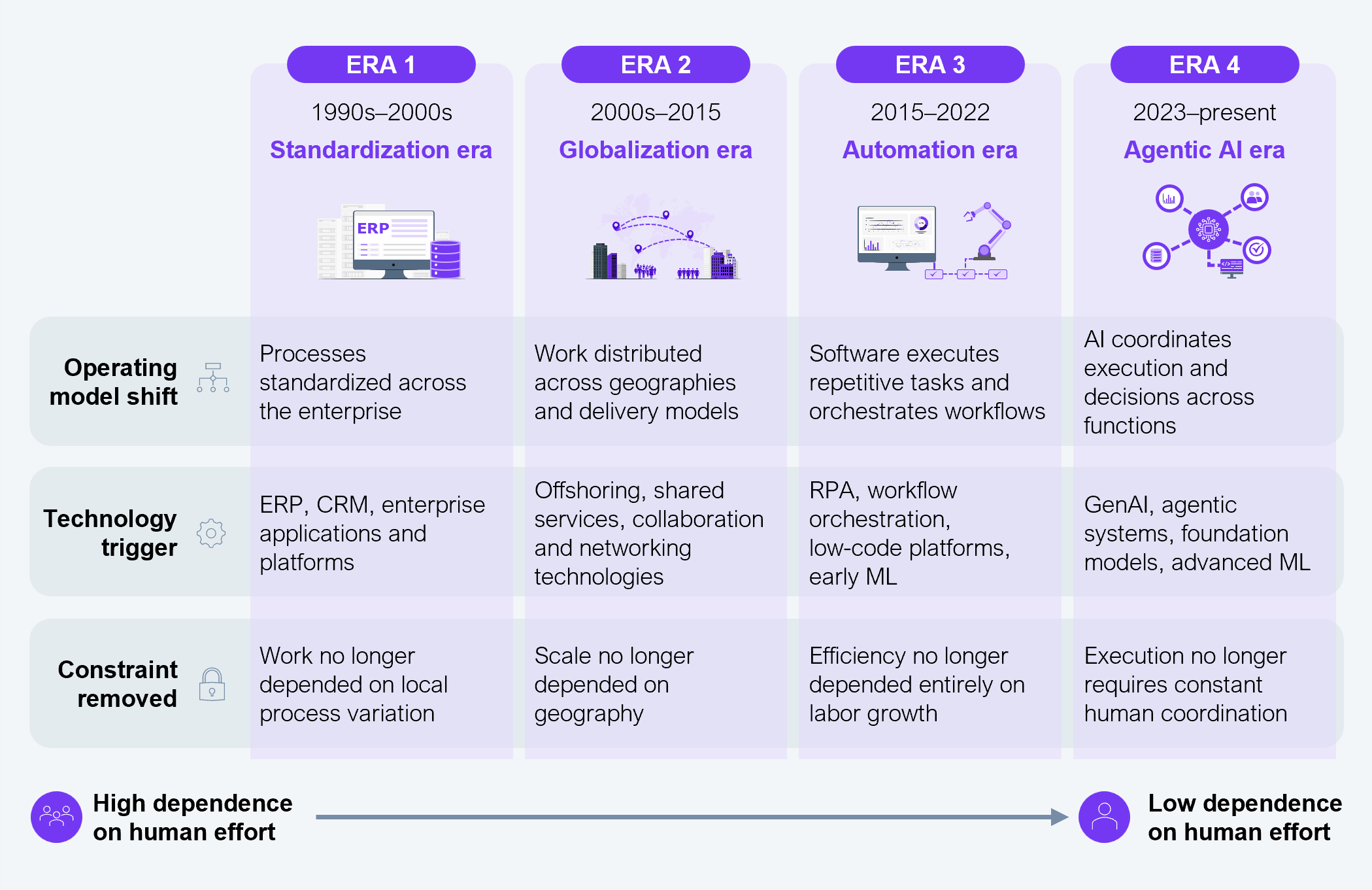
ERP systems have standardized processes and data. Global delivery models have separated work from geography. Automation has shifted routine execution from people to software. Each has changed how work was performed but left the coordination logic that held the organization together largely intact.
Through every transformation, humans continued to manage the enterprise. They made decisions, ran the handoffs, resolved exceptions, and carried accountability across increasingly complex systems. Technology expanded what organizations could do, but people remained responsible for making it all work (see Exhibit 1). That’s what makes this moment different.
Agentic AI introduces something enterprises have rarely had to design for: systems that don’t just support work but help coordinate it. For the first time, the assumption that humans direct the work while technology executes the tasks is beginning to change. The shift is that technology is starting to do some of the directing too.
Sample size: 302 Global 2000 executives
Source: HFS Research with EY, 2026
Previous technology waves improved the efficiency of existing operating models. Agentic AI raises a more fundamental question: what happens when coordination itself becomes shared between people and intelligent systems?
The answer will not be found in the technology alone. It will be found in how organizations redesign accountability, decision making, governance, and work itself around a new relationship between human and machine intelligence.
What follows are seven observations about where the current operating model has stopped working as AI changes the assumptions underneath it. By operating model, we mean a set of elements that determine how a company actually runs: strategic intent, authority and structure, work design, governance, leadership, data and technology, and the partners it depends on. The seven truths examine each one.
“We don’t have an AI strategy,” a senior executive noted. “We have a collection of disconnected opinions from people who read different articles.”
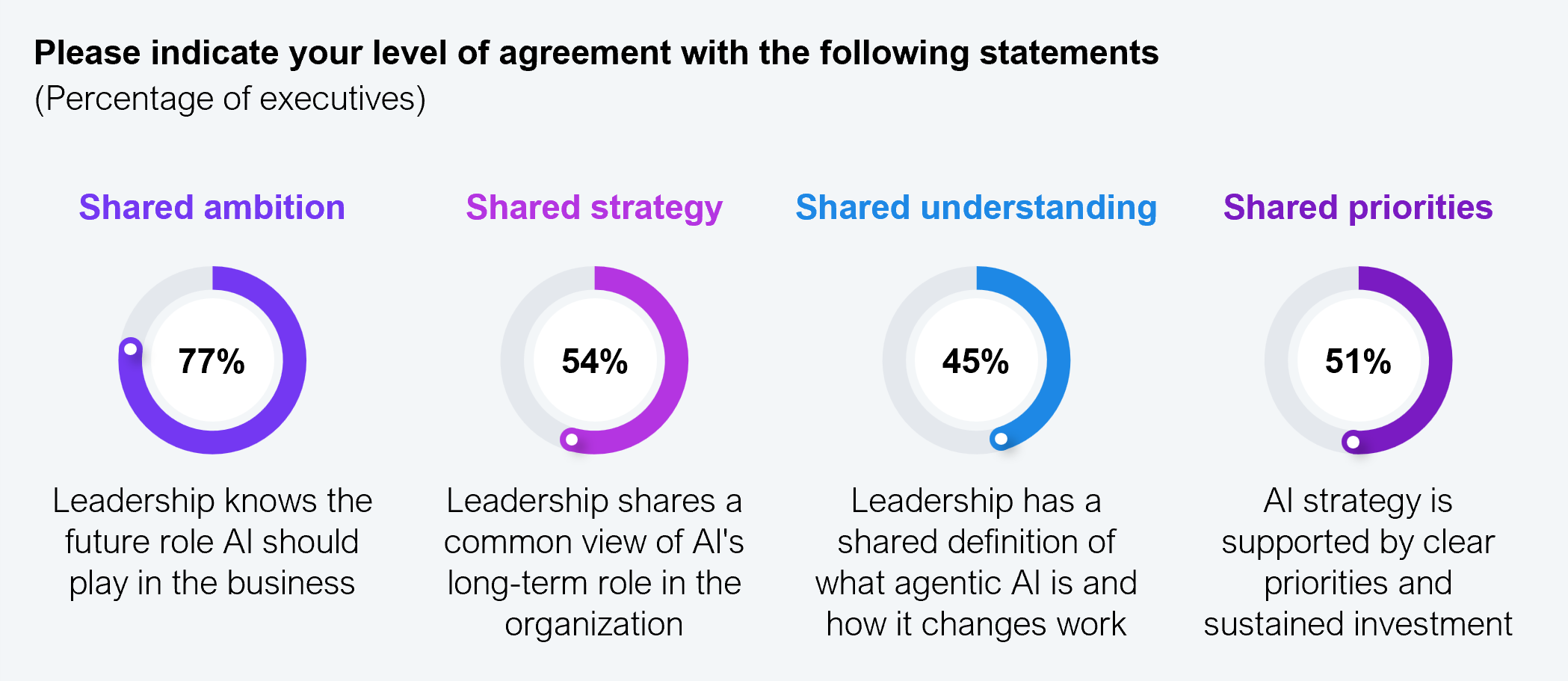
Few executives still question whether AI will shape the business. That conversation has moved on. The harder one, about what it actually changes, has barely started. The gap is no longer between believers and skeptics. It is between a shared ambition and a shared understanding of what comes next.
At first glance, leadership teams appear aligned. Then the questions become more specific, and a gap opens between what leaders agree on and what they actually understand.
Shared ambition is nearly universal at 77%. Shared strategy drops to 54%. Shared understanding of what agentic AI actually is falls to 45%. Shared priorities sit at 51%. The gap between ambition and understanding is the most consequential number on this chart (see Exhibit 2).
Sample size: 302 Global 2000 executives
Source: HFS Research with EY, 2026
The gap shows up the moment leaders are asked to define the practical consequences. What happens to management when arbitration increasingly happens through systems? How should accountability work when outcomes are shaped by both people and machines? Which decisions remain human by design?
As one respondent put it, “Everyone in the room can tell you AI is the future. Ask them what we are actually building, and you get four different answers from four different functions.”
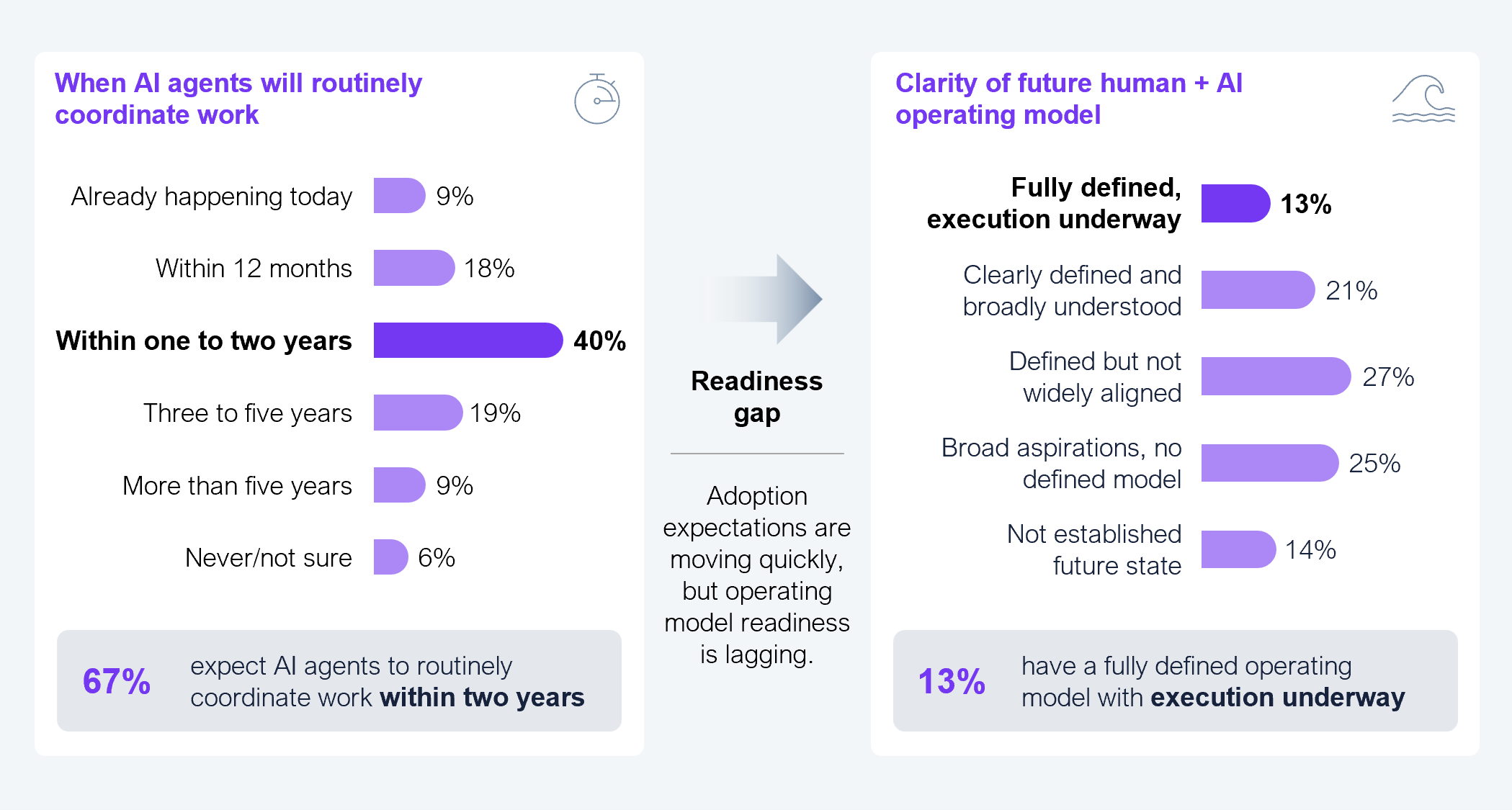
Sixty-seven percent of leaders expect AI agents to routinely coordinate work across systems within the next two years. Yet only 13% have a fully defined human + AI operating model already in execution, while another 21% report having a clearly defined model (see Exhibit 3).
Organizations are becoming increasingly confident about the role AI will play in the future enterprise. They remain far less certain about the management system required to support that future.
Sample size: 302 Global 2000 executives
Source: HFS Research with EY, 2026
Think of a retailer that announces 500 new stores, signs the leases, and issues the press release before figuring out who will run them, how they will be supplied, and what the staffing model is. That’s where most enterprises are with AI agents. Many have a clear vision of what they want AI to do, but far fewer can describe the operating model that will support it. Unless enterprises rethink their management system, governance, accountability structure, data foundation, and partner relationships, AI won’t deliver much value at scale.
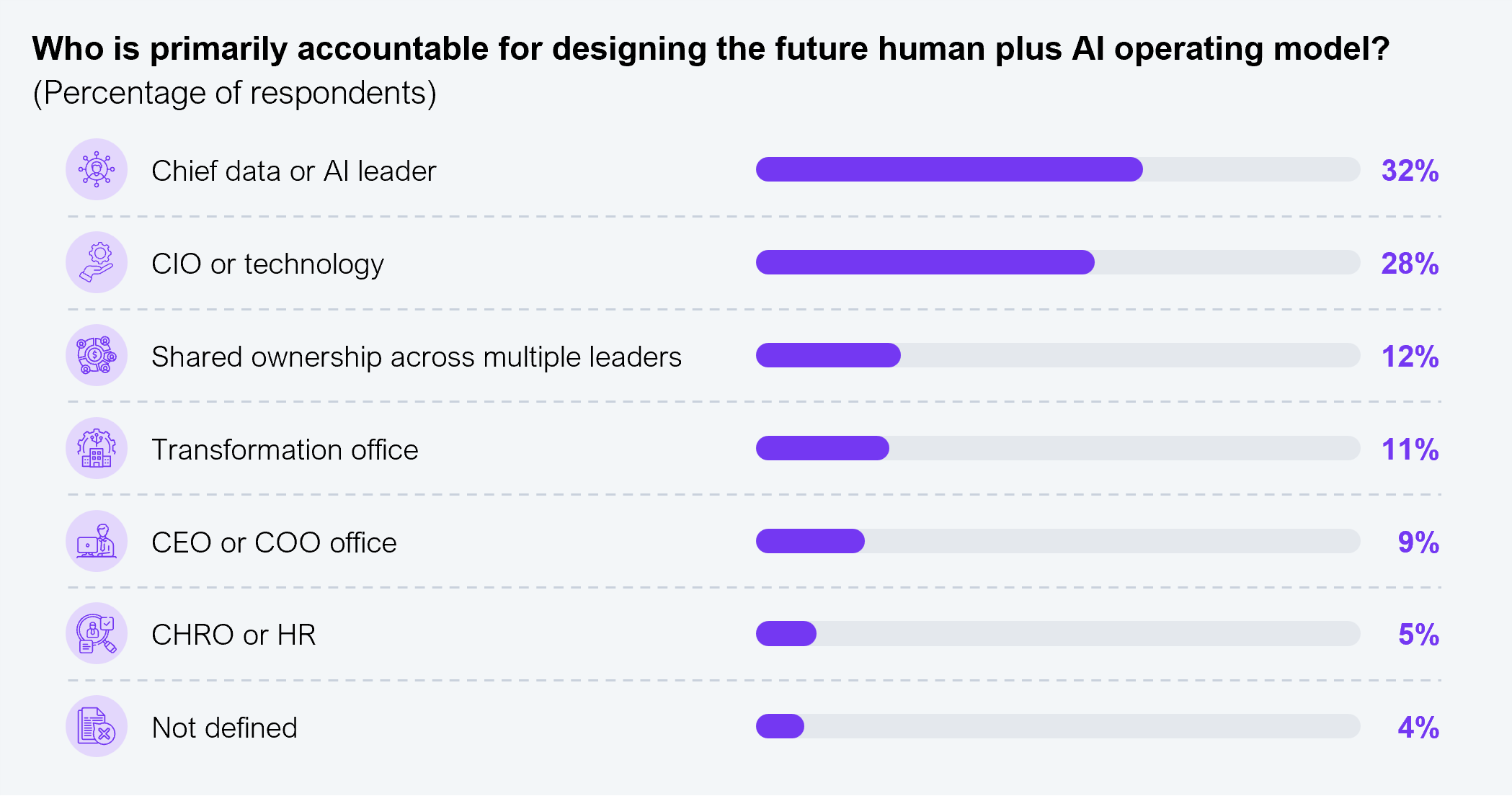
Sixty percent of respondents identify the chief data, AI officer, or CIO as the main executives leading this work. Only 14% point to the CEO, COO, or HR combined (see Exhibit 4).
Sample size: 302 Global 2000 executives
Source: HFS Research with EY, 2026
However, the people who actually own how the company is organized, how work is structured, and how people are paid, promoted, and held accountable have not stepped forward to take control of the conversation.
An executive said this part out loud: “Most of our senior leaders talk about AI like it’s already transforming us. Behind closed doors, nobody actually knows what we’re supposed to do with it.”
Without a shared view of what AI changes, each function starts solving for a different future. Technology builds one. Operations imagines another. HR prepares for a third. Finance budgets for a fourth. Four versions of the future are now running in parallel inside the same company. None of them is the one the CEO would describe if you asked.
Ask the leadership team to describe, in one sentence, the company they are building. Most teams cannot. That is the gap.
“We keep trying to bolt AI onto an organization that was built for a different century.”
The organization chart has survived every previous technology wave. ERP, offshoring, cloud, and automation changed what the enterprise can do. None of them changed how it was organized to do it. Agentic AI is the first wave that does.
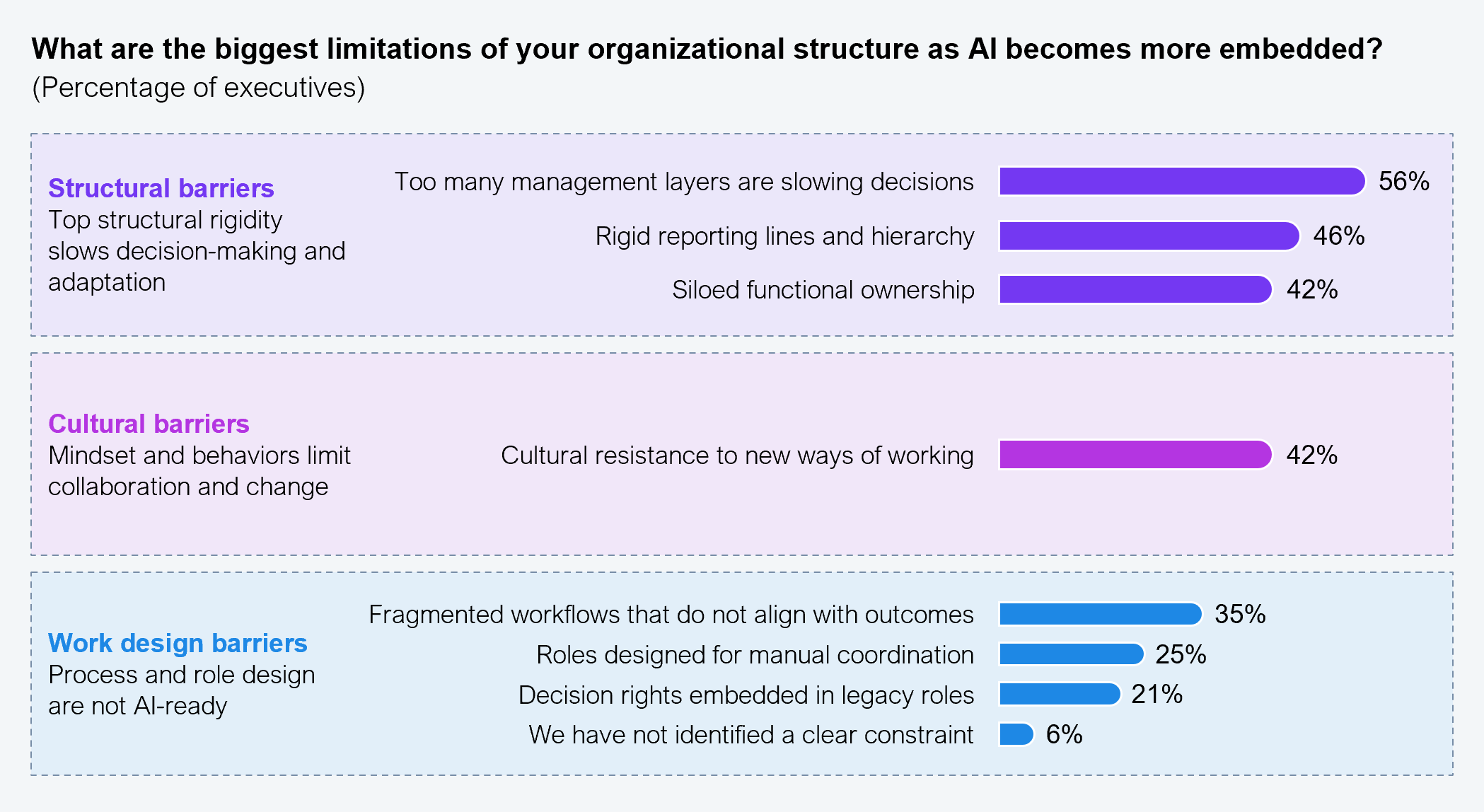
Asked what is getting in the way of AI, leaders did not point to edges or exceptions. They named the load-bearing structures of the modern enterprise: management layers, reporting lines, cultural defaults, and the silos around how work is owned. The structure that built the enterprise is the structure now blocking what comes next (see Exhibit 5).
Sample size: 302 Global 2000 executives
Source: HFS Research with EY, 2026
Every item on this list used to be a solution. Management layers existed because decisions needed someone to escalate to. Reporting structures solved the problem of assigning accountability. The very same mechanisms that made the enterprise governable before AI are now the barriers that leaders want to remove.
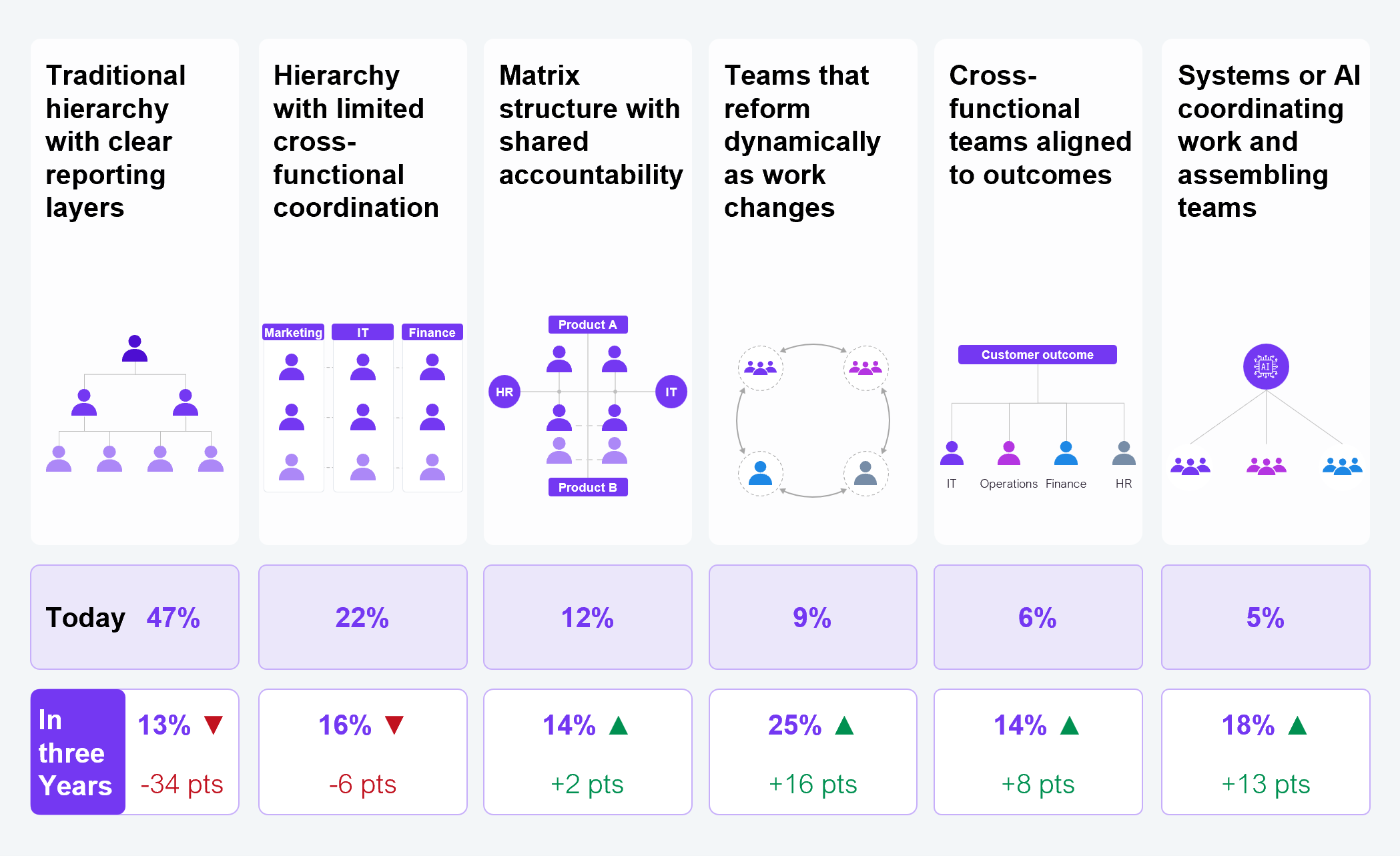
Within three years, leaders expect traditional hierarchy to be a minority structure inside their own companies. What replaces it is not a single new shape. It is several: dynamic AI-enabled teams that form around a problem and dissolve, cross-functional outcome teams, and networked structures. Each takes a share from the organization chart that held the modern enterprise together for forty years (see Exhibit 6).
Sample size: 302 Global 2000 executives
Source: HFS Research with EY, 2026
This is what a dynamic AI-enabled team looks like in practice: a pricing decision that used to move through three management layers and a weekly committee now sits with a four-person team. This includes a pricing analyst, a margin owner, a sales lead, and an AI agent that monitors competitor moves and runs scenarios. The team convenes when a market signal triggers it, decides within a day, and disbands. The committee still exists on paper. The decision no longer waits for it.
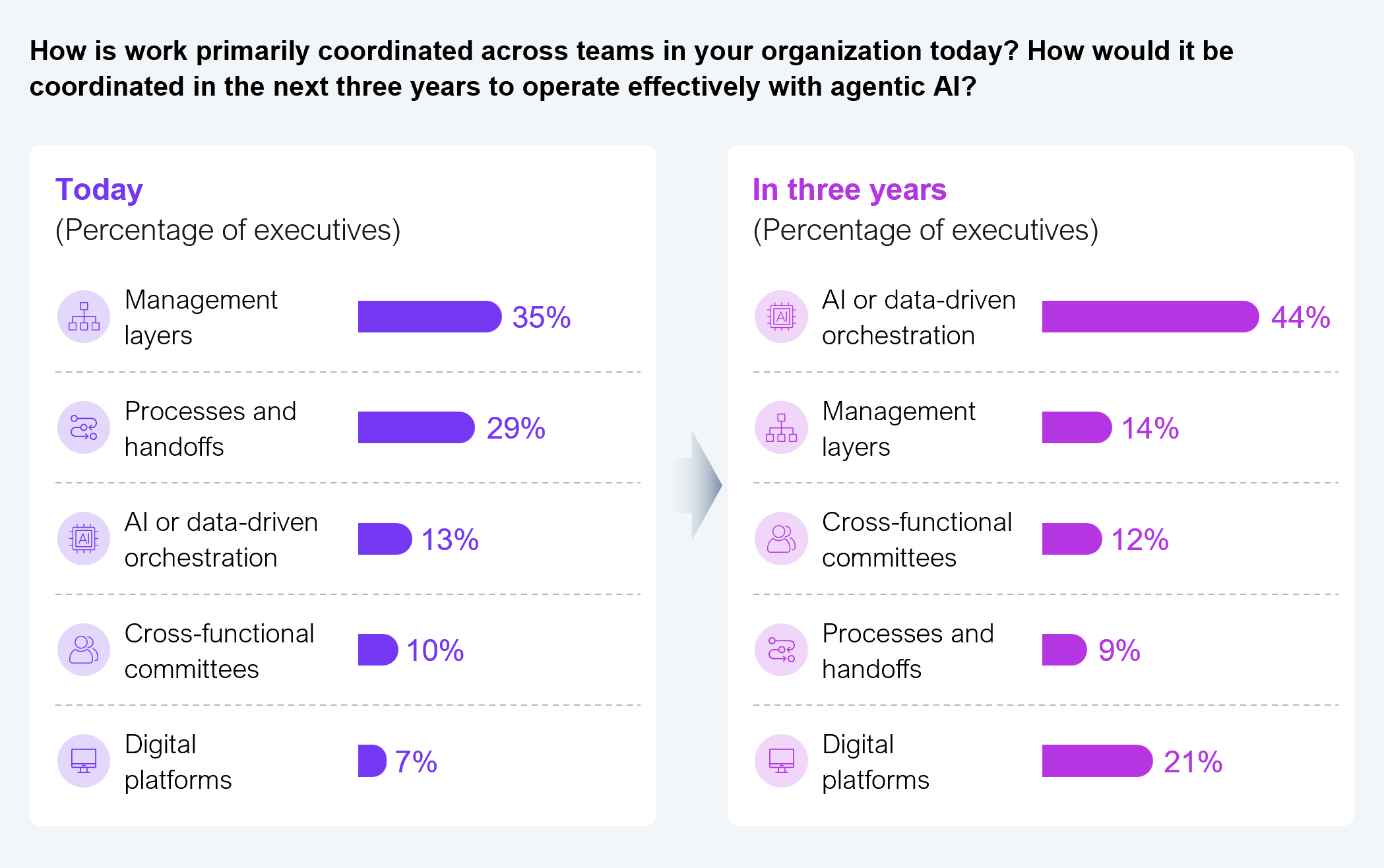
Where management used to do most of the coordinating, leaders expect systems to do most of it in three years. It is the largest “now versus three years” movement anywhere in the survey (see Exhibit 7). Coordination is what the chart measures. Arbitration is what coordination becomes when the choices have real stakes. The activity is moving; what enterprises have not yet built is the arbiter that does it well.
Sample size: 302 Global 2000 executives
Source: HFS Research with EY, 2026
The data does not describe a faster manager, but a different system doing the arbitrating. In 2020, a discount request from sales would sit with a manager for a week while margins pushed back, sales escalated, and the customer threatened to walk. In 2028, leaders expect a system to weigh the margin impact, the customer’s lifetime value, and the competitive context, make a call, and route only the genuinely close cases to a human. The manager is still in the company but no longer the arbiter.
A respondent described what happens once orchestration moves into the platform layer: “Humans stop second-guessing AI outputs because they’ve been right so often.”
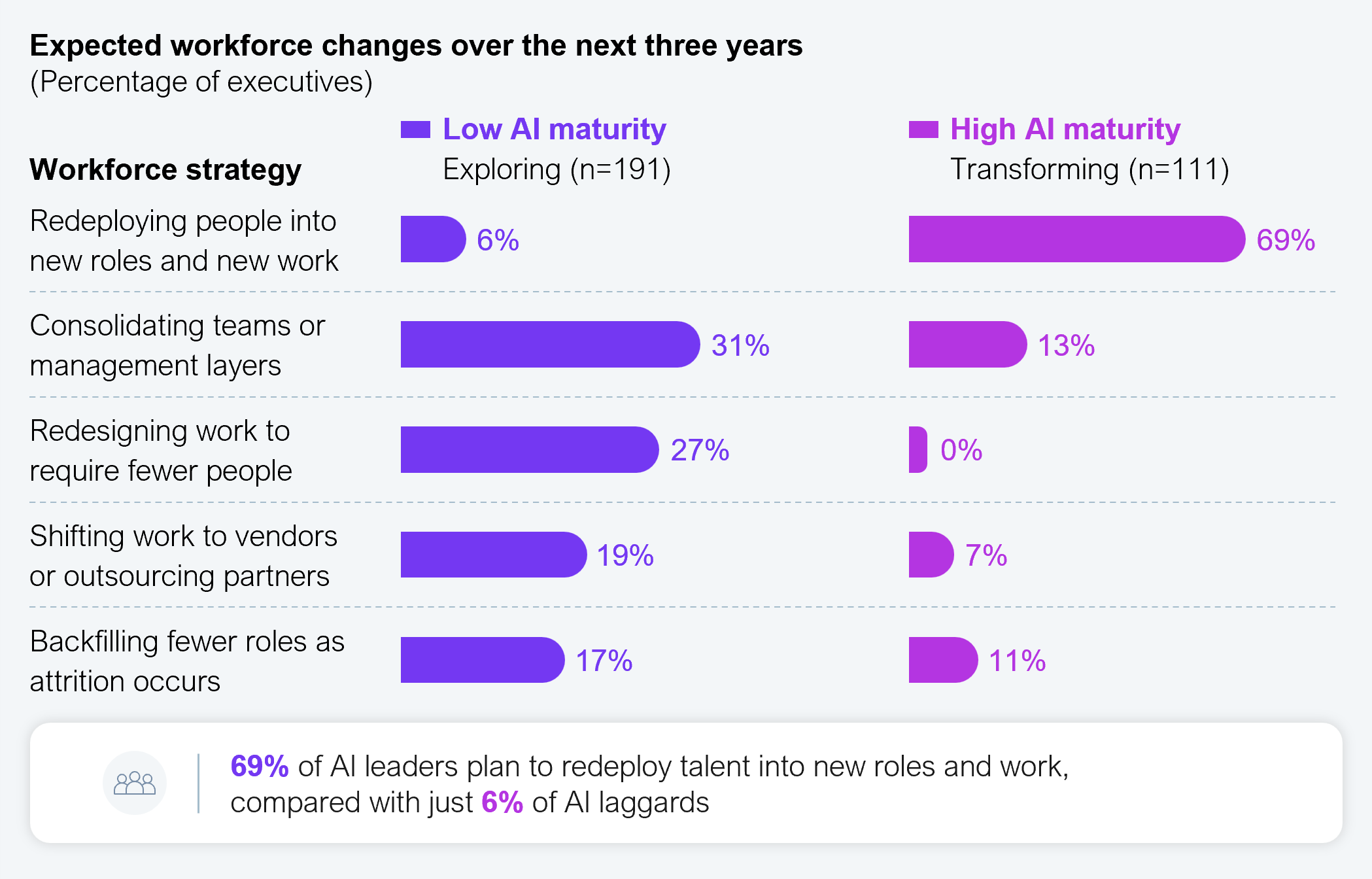
Among leaders whose companies are still exploring or scaling AI, the workforce response is a familiar one: consolidate teams, redesign work to require fewer people, and shift more to partners. Among those that have AI embedded or transforming the business, the playbook inverts. Sixty-nine percent of them plan to redeploy people into new roles. Just 6% of the earlier-stage group say the same (see Exhibit 8).
Sample size: 302 Global 2000 executives
Source: HFS Research with EY, 2026
Laggards are more than twice as likely to consolidate teams or management layers. Their workforce response is based on the older playbook: redesigning work so fewer people are required and backfilling less as attrition occurs. The mature adopters are doing it differently: moving people into new roles.
Once the structure for routing decisions, escalating exceptions, and assigning accountability is gone, those activities still have to happen somewhere. The question every leader needs to answer is “where.”
“We’ve automated pieces of the process, but if we’re honest, the process itself probably shouldn’t exist in its current form.”
Most enterprises are not rethinking work. They are speeding it up. That distinction explains most of what follows.
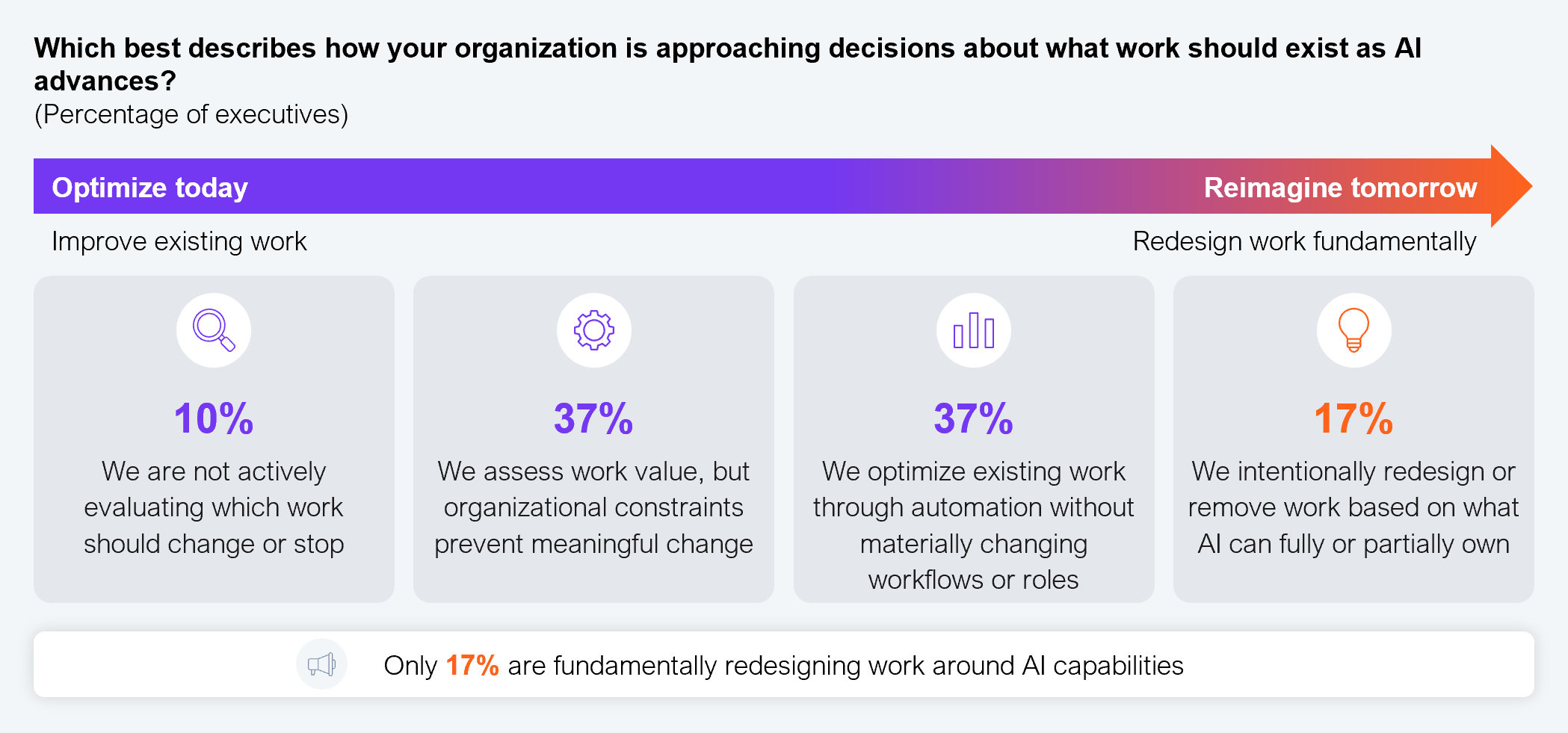
When asked how their organizations are approaching decisions about work as AI advances, only 17% report intentionally redesigning or removing work based on what AI can fully or partially own. Most of the rest (83%) are either automating without redesign or acknowledge they should be redesigning but cannot (see Exhibit 9).
What the 17% looks like in practice: a contracts team deploys an AI reviewer, then realizes fourteen of their twenty-three review steps existed because the original workflow predated electronic signatures. The team cuts the steps. The AI reviews the nine that remain. The team did not get faster at the original work. The original work just got smaller.
Consider a finance team processing employee expense claims. An automation-first approach uses AI to review receipts, validate policy compliance, and expedite approvals. The process remains intact; it simply moves more quickly. A redesign-first approach starts with a different question around why most low-value, low-risk claims require approval at all. The organization removes approval requirements below a defined threshold, allows AI to continuously audit exceptions, and reserves human review for unusual cases. The goal is fewer, faster approvals.
Sample size: 302 Global 2000 executives
Source: HFS Research with EY, 2026
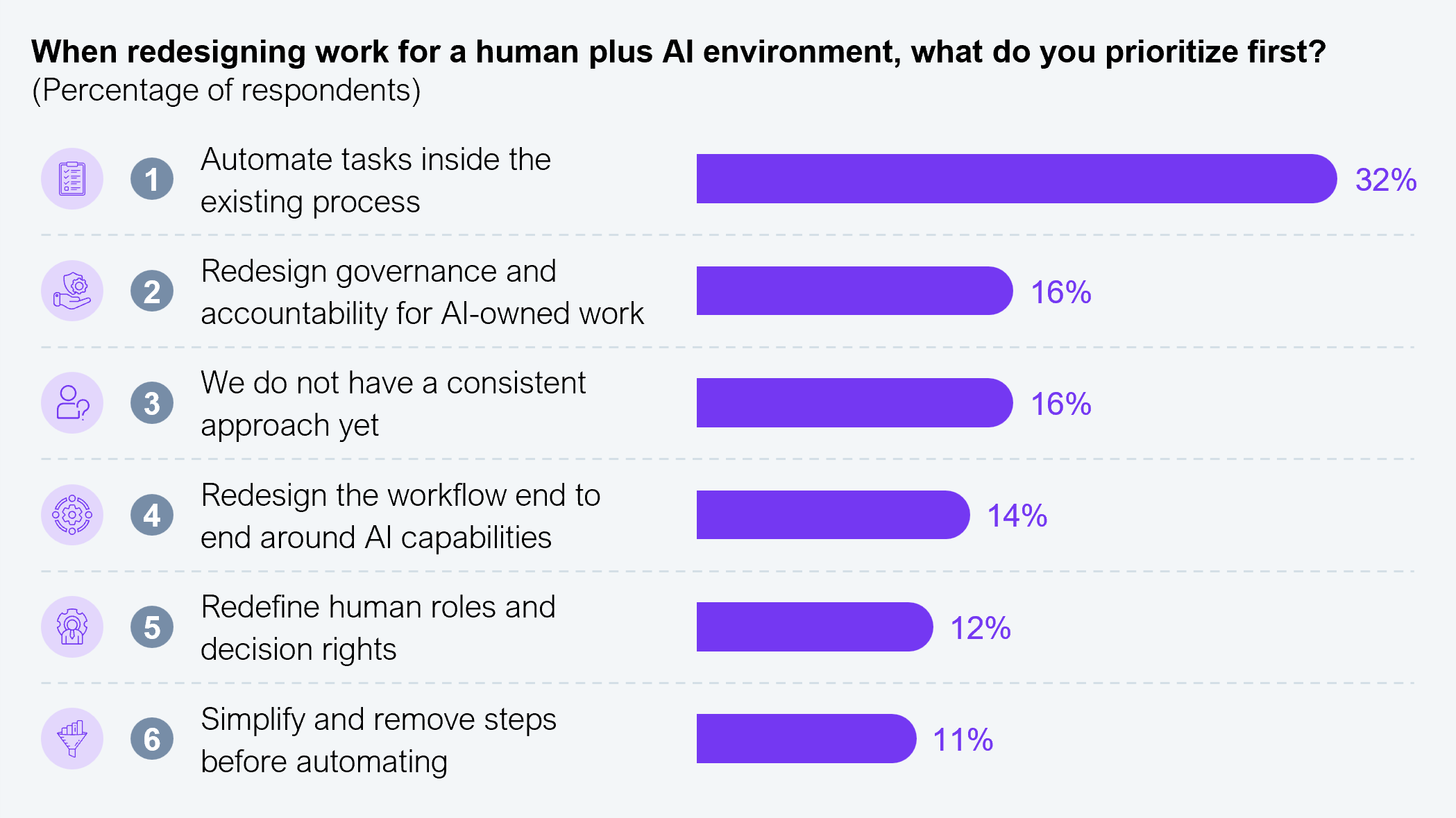
When asked what they prioritize while redesigning work for a human + AI environment, relatively few respondents focus first on governance, accountability, workflow redesign, or decision rights. Automating tasks inside existing processes remains the dominant priority (see Exhibit 10).
Picture an HR team that adds an AI screener to an existing recruiting workflow. Same job description, same interview loop, and same rubric, but the resumes get screened ten times faster. That is what 32% looks like in practice.
Sample size: 302 Global 2000 executives
Source: HFS Research with EY, 2026
The most value will come from harder questions. Which activities still create value? Which processes should disappear entirely? Companies that can answer those questions will be running a different company than their competitors. The rest will be running the same company faster.
“We’re deploying these systems faster than we can understand their failure modes.”
Governance always catches up to technology after deployment, not before. With agentic AI, the lag is bigger and the associated cost is higher. The systems are making decisions before the institutions that should govern them have decided how.
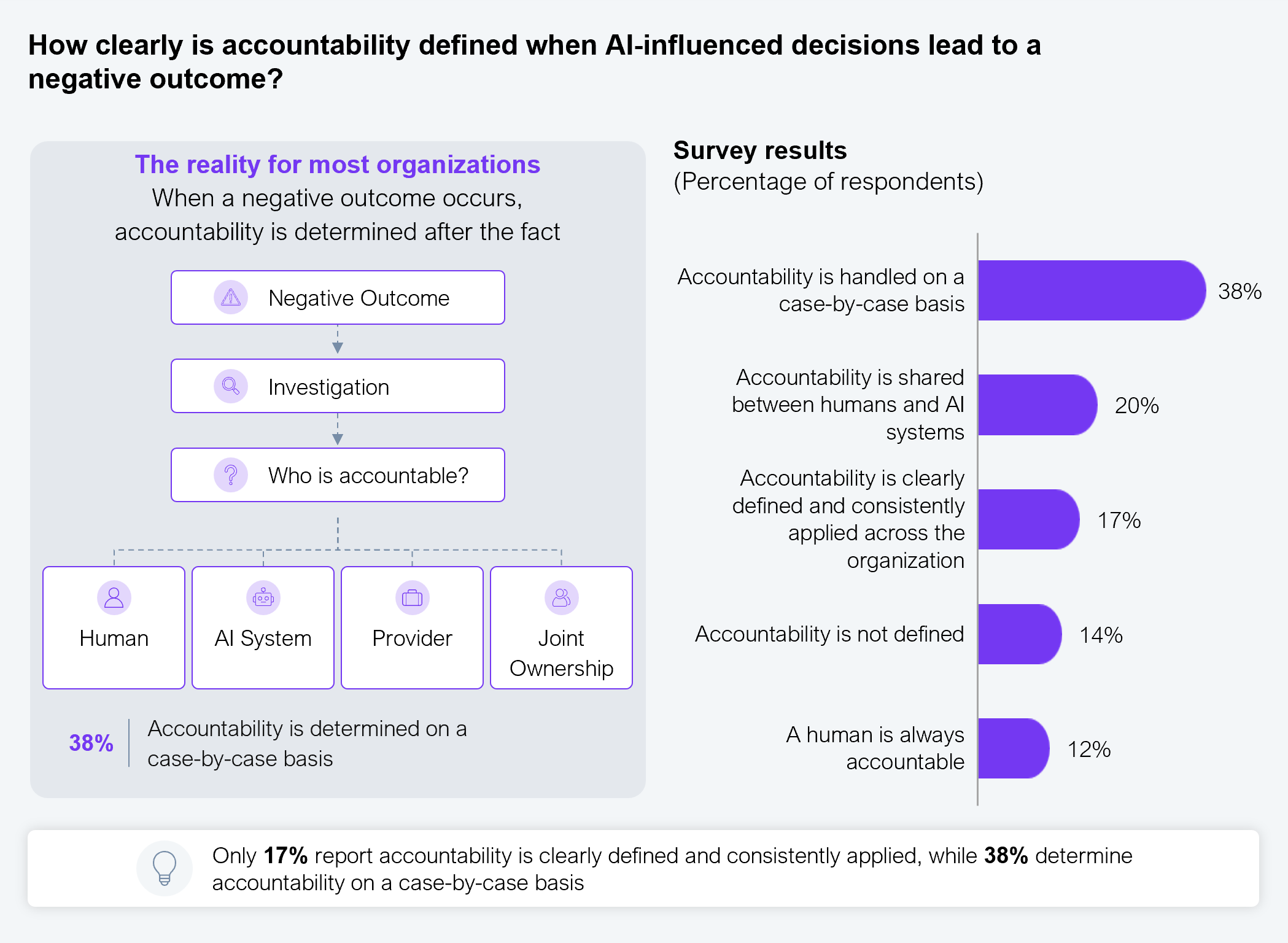
Only 17% of enterprises have clear accountability that is consistently applied when an AI-influenced decision goes wrong. The most common approach, at 38%, is to figure it out case by case (see Exhibit 11).
Sample size: 302 Global 2000 executives
Source: HFS Research with EY, 2026
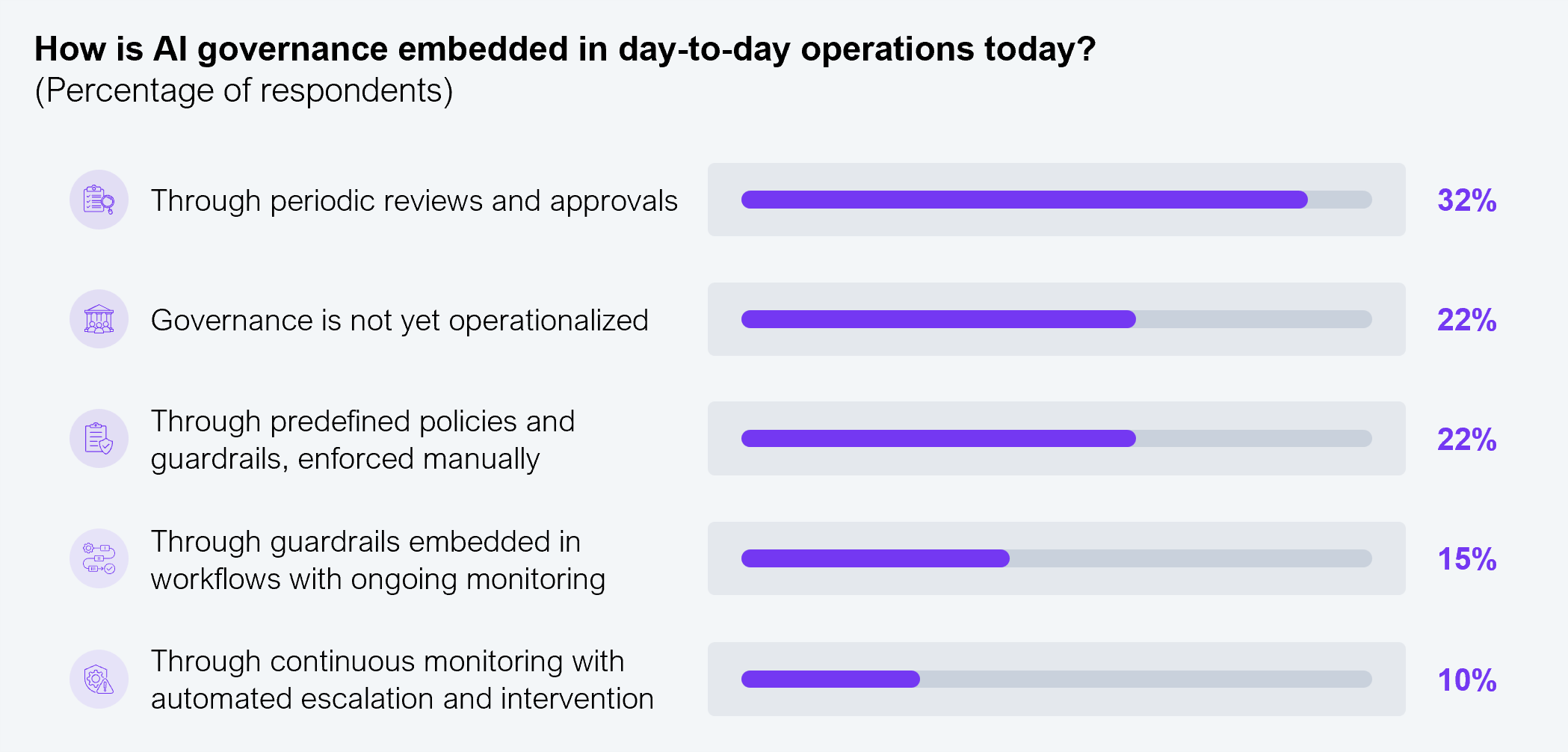
AI makes decisions in real time, while most governance happens in quarterly reviews and after-the-fact audits. Asked how AI governance is embedded in day-to-day operations, 32% rely on periodic reviews and approvals and only 10% depend on continuous monitoring with automated escalation (see Exhibit 12). The time between when a decision is made and when it is examined would allow new systems to scale across an organization unchecked.
Sample size: 302 Global 2000 executives
Source: HFS Research with EY, 2026
Asked where they feel most uneasy about humans and AI sharing responsibility for outcomes, leaders did not name a single use case. They identified a pattern. Accountability diffuses. Judgment erodes. Audit trails disappear. And the deployment keeps moving.
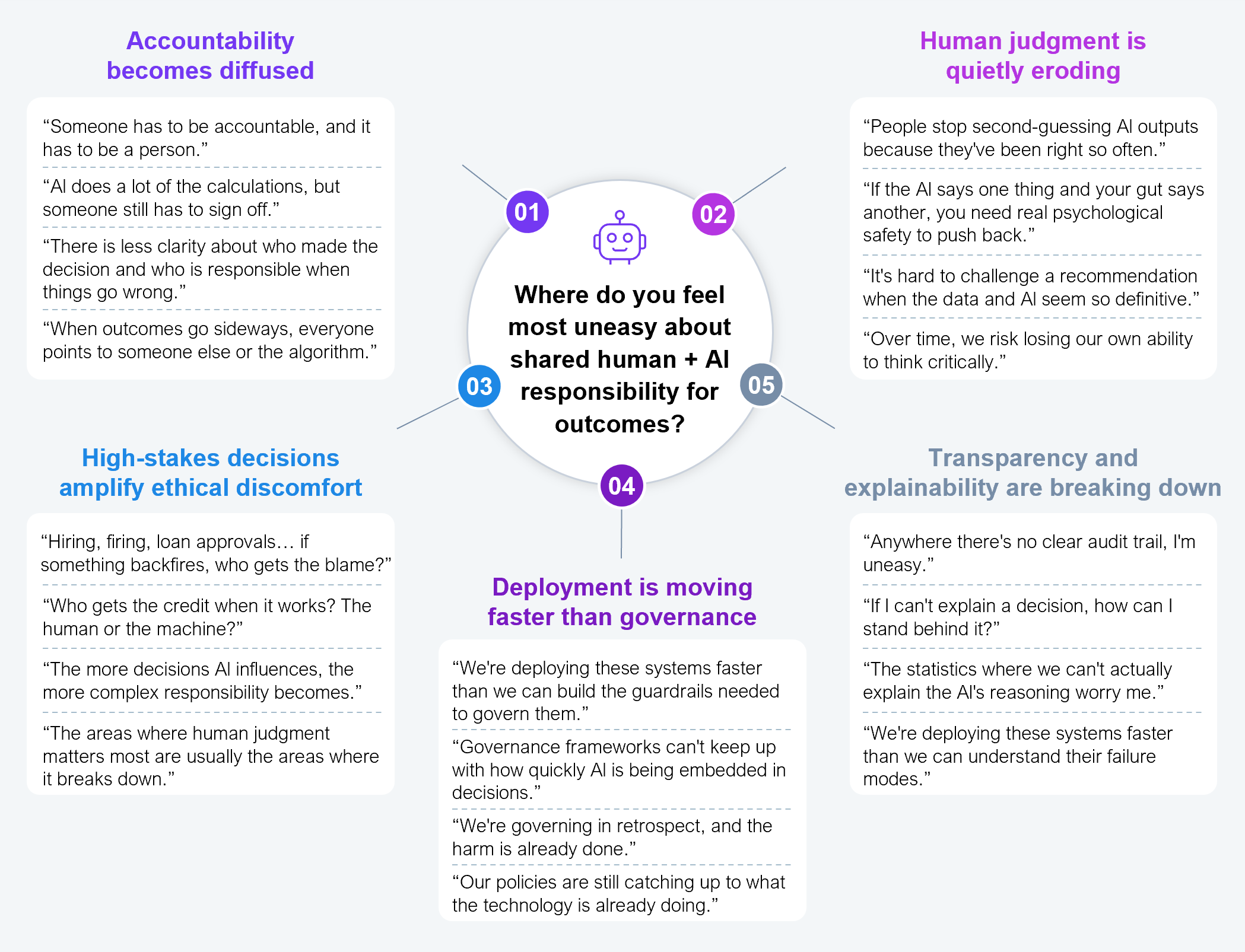
Sample size: 302 Global 2000 executives
Source: HFS Research with EY, 2026
Governing AI cautiously is not the same as governing it well. The test of an accountability structure is what happens when something goes wrong. If the answer to “who is responsible” requires a case-by-case investigation, the structure does not exist yet. Building one is the actual work.
“I am watching my team defer to AI tools they don’t fully understand.”
The AI conversation in most enterprises has been about technology, structure, and governance. It focused less on the factors that decide whether any of them work: culture, communication, and the leaders’ readiness to translate strategy into daily decisions. Those are the parts of the operating model that capability investment most consistently skips.
Picture a marketing analyst on a Tuesday morning. She has been using a generative tool for three months. Her last review mentioned that her team had become “more efficient.” Her colleague at the next desk took a buyout in October. Nobody from the company has ever explained whether her job is changing, ending, or staying. She has filled the silence with the assumption that whatever it is, it is not good..
Forty-two percent of the respondents say AI is seen as a threat to jobs and human value within their company. Twenty percent see it as a tool that makes humans more efficient. Only 6% describe culture as systematic collaboration where human + AI is the default. The cultural starting point in most enterprises is not neutral. It is afraid (see Exhibit 14).
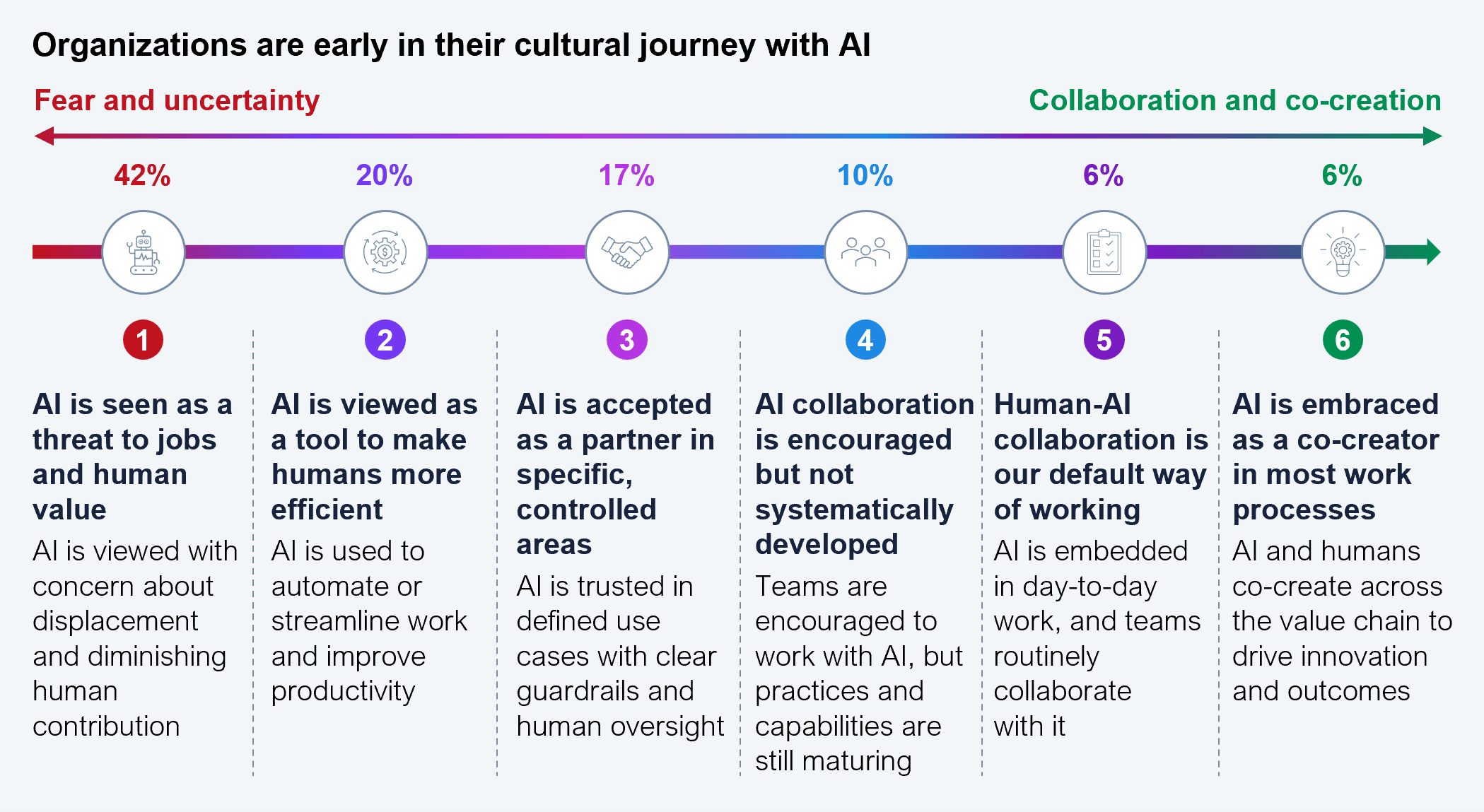
Sample size: 302 Global 2000 executives
Source: HFS Research with EY, 2026
Only 10% of respondents say their organization communicates the workforce implications of AI clearly. Seventy-six percent describe communication as limited, selective, or incomplete. Even capability programs designed to close the gap largely miss the real issue: fear, uncertainty, and leaders who do not model new ways of working (see Exhibit 15).
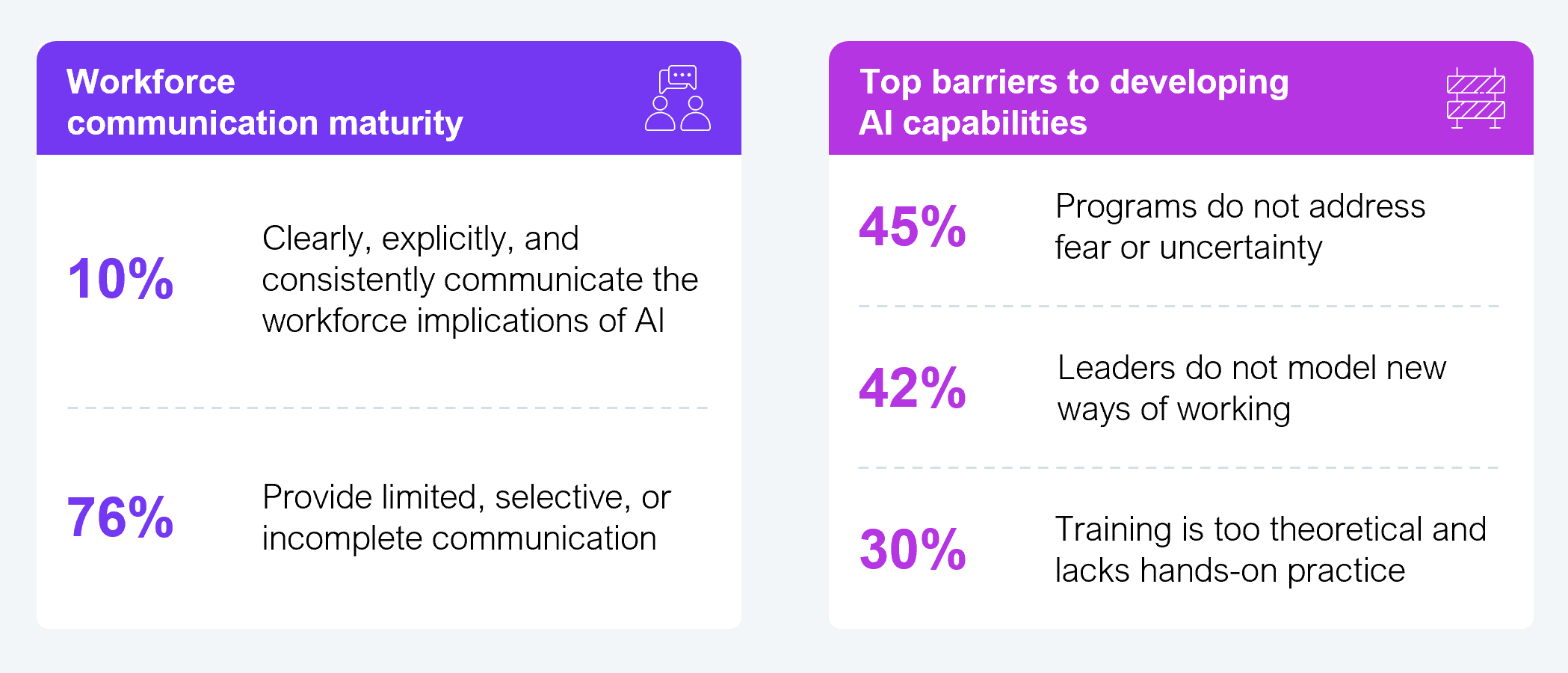
Sample size: 302 Global 2000 executives
Source: HFS Research with EY, 2026
Enterprises are investing in skills and silence at the same time. The skills are being taught around the edges of the workforce, not at the layer where the work changes most. The silence is filling the gap with whatever assumption the employee already brought into the room. Most enterprises are running an unspoken negotiation between what the company will say and what the employee already believes. The employee usually wins.
One respondent named the dynamic most companies avoid: “How do you tell someone they’re being let go partly because a productivity model flagged them? Do you even mention the AI? We haven’t figured this out.”
Asked which part of their workforce is least prepared to work alongside AI, leaders pointed up, not down. Middle management and senior leadership together account for nearly three-quarters of the answers. The frontline, where most capability programs are aimed, is the layer the data says is most ready (see Exhibit 16).
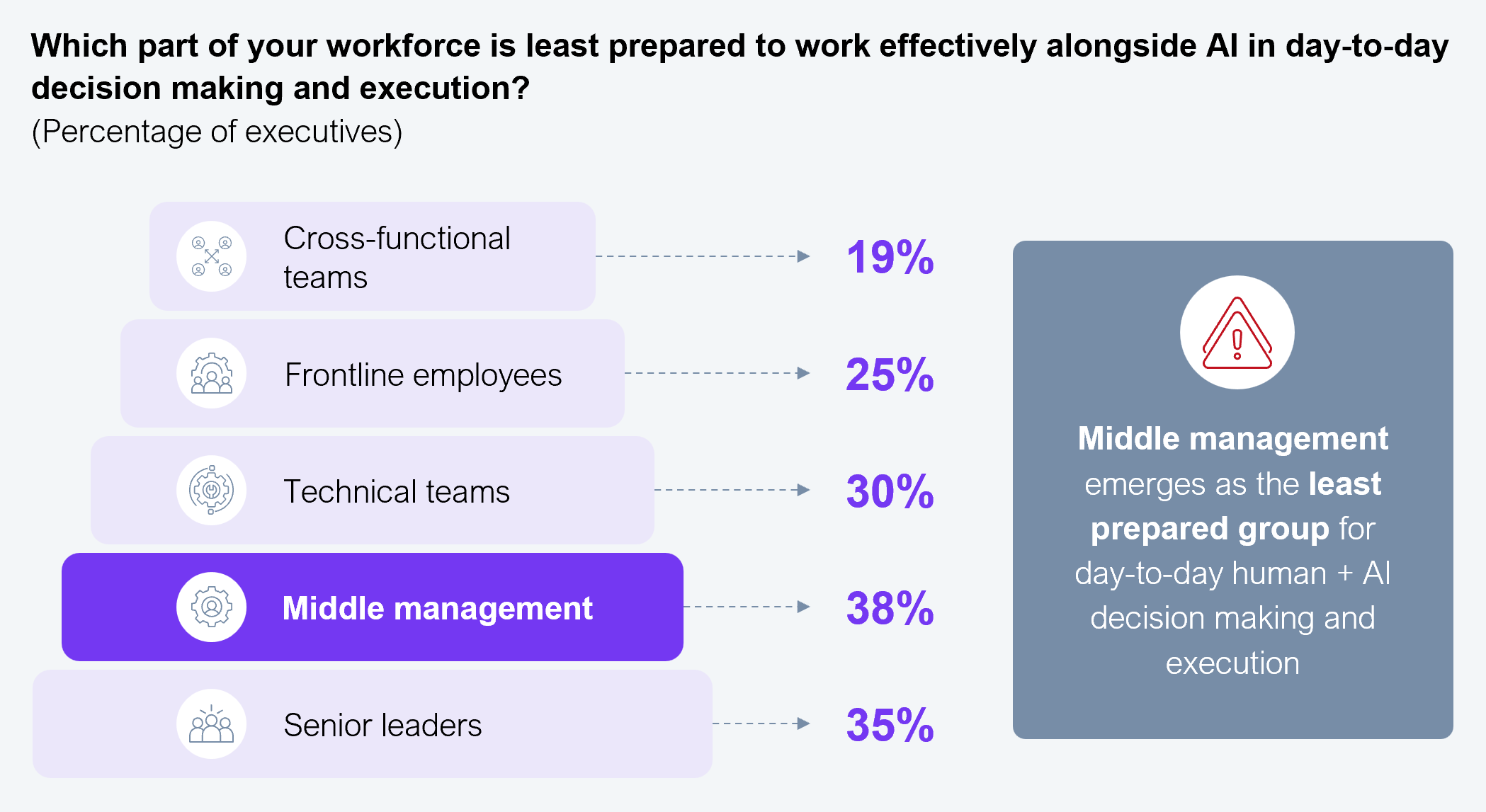
Sample size: 302 Global 2000 executives
Source: HFS Research with EY, 2026
This is the gap that compounds. A frontline employee who is not ready is a training problem. A middle manager who is not ready is a decision-making problem. A senior leader who is not ready is a strategy problem. The further up the gap sits, the more it shapes everything downstream.
The gap is leadership readiness. Closing it means two things: picking a leadership team that can run the company AI is rebuilding underneath them and telling the workforce honestly what the new company is asking of them before the systems arrive and answer the question for them.
“Fragmentation is killing us. We have the data, just not in any form the model can use.”
For most enterprises, AI is being built on a foundation that was never designed to carry it. The interesting conversations are about models and use cases. The harder conversations are about the layer underneath.
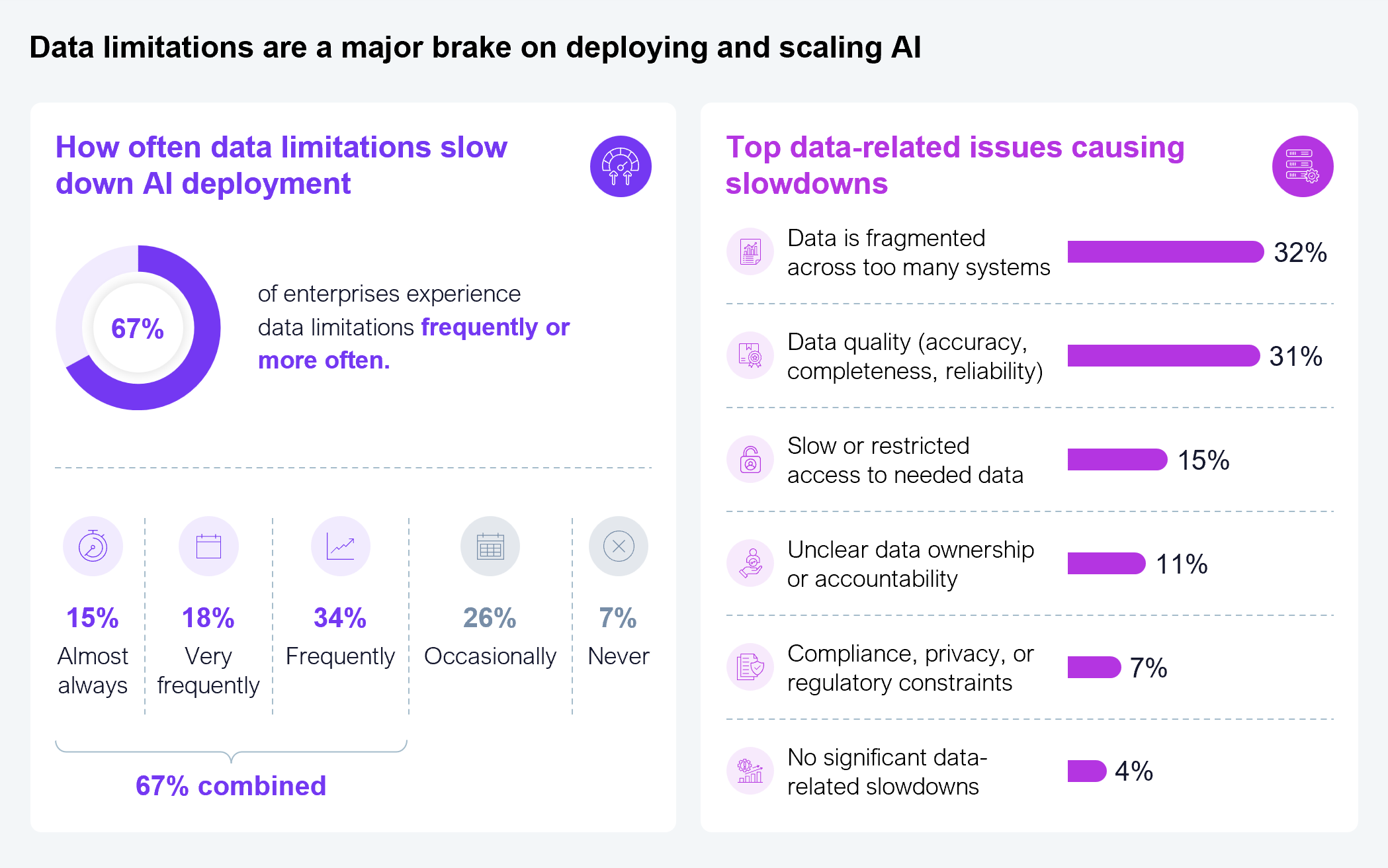
Two-thirds of enterprises hit data limitations that slow AI deployment frequently or worse. When leaders are asked what causes the slowdowns, the answer is neither novel nor exotic. Fragmentation across too many systems and basic data quality together account for nearly two-thirds of the bottleneck. Both predate AI (see Exhibit 17).
Sample size: 302 Global 2000 executives
Source: HFS Research with EY, 2026
Both these are problems that predate AI by a decade or more. The enterprises that did not solve them when the constraint was a slow report are now trying to solve them with an agentic workflow on top.
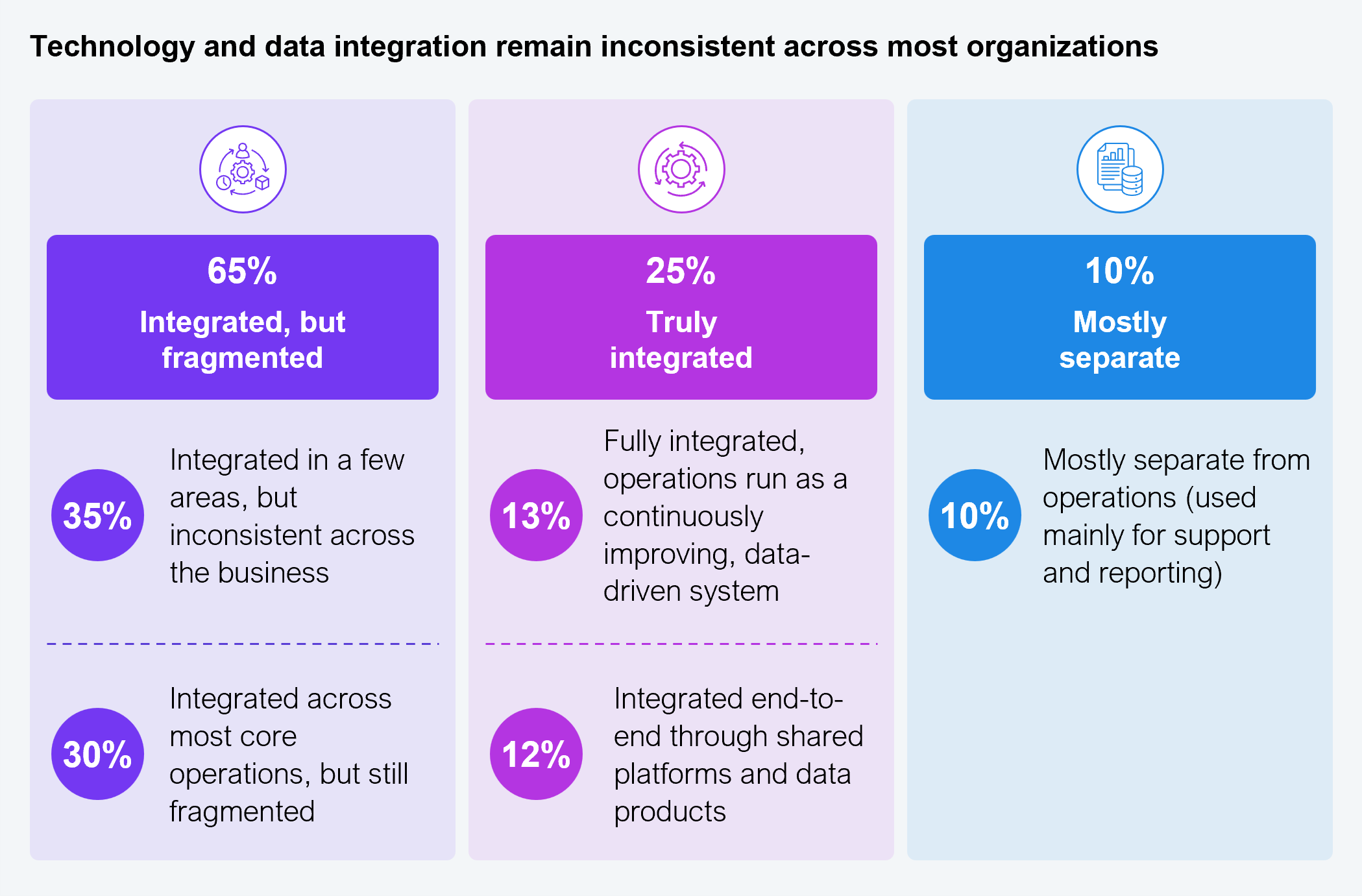
Only a quarter of enterprises describe their technology and data environment as integrated end-to-end. The remaining three quarters report some version of fragmentation: inconsistent integration across the business or coverage of most operations, but not all. The AI being deployed on top of this layer is asking it questions it was not built to answer (see Exhibit 18).
Sample size: 302 Global 2000 executives
Source: HFS Research with EY, 2026
The AI runs on data plumbing and integration; both are consistently deprioritized. The systems already deployed will ask questions the foundation underneath cannot answer. The bill comes due when they do.
Most enterprises are entering the agentic era with partner relationships designed for a different one. What they expect from partners has changed. What the relationship is built to deliver has not.
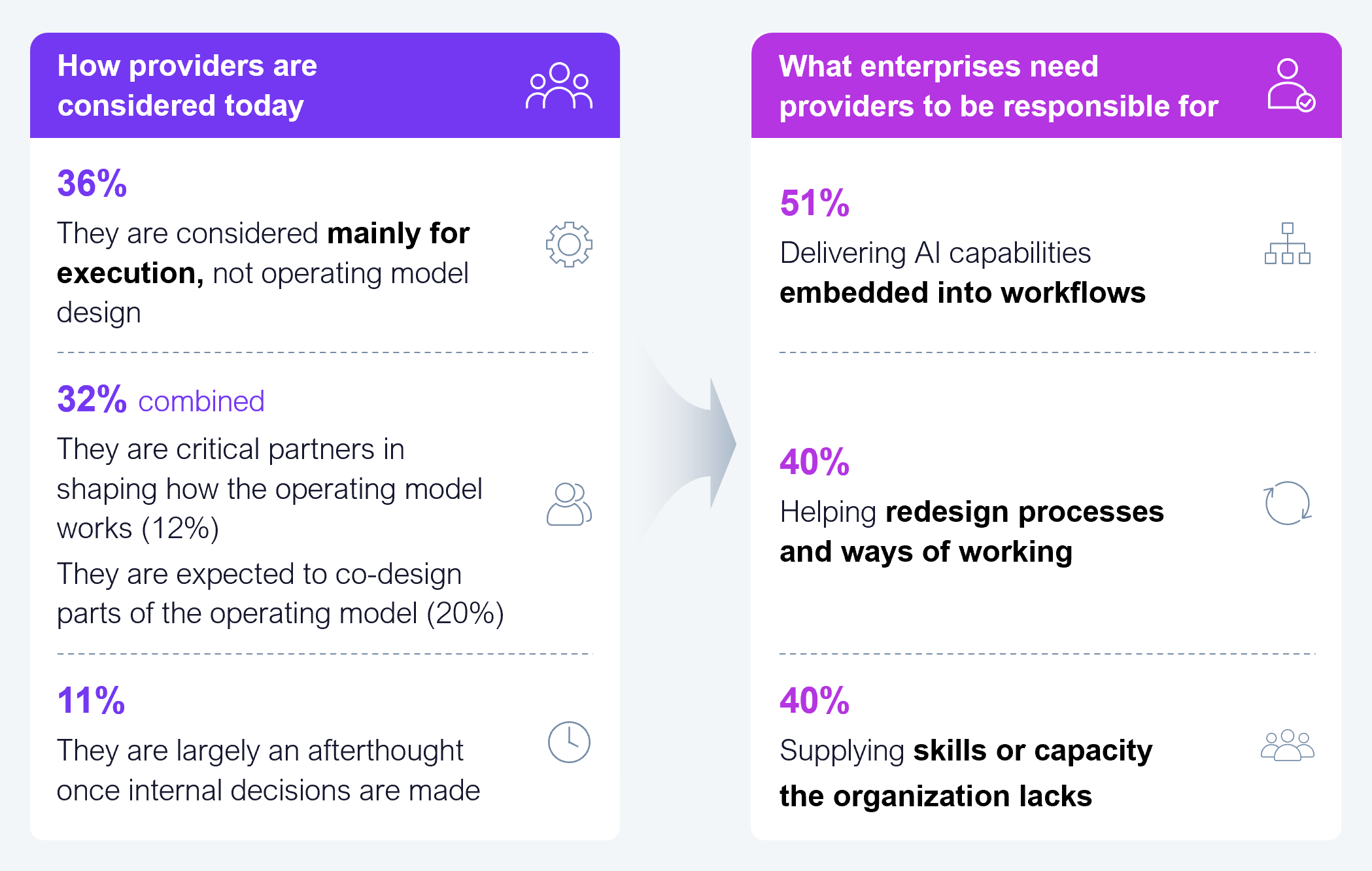
Enterprises know what they want from partners. Around half of them expect AI capabilities embedded directly into workflows. Forty percent want them to redesign processes. Another 40% count on them to supply skills the organization itself does not have. That is operating model work, not technology delivery.
In the design conversation, the picture changes. Only 12% of providers are considered critical partners in shaping how the operating model works. Thirty-six percent are assigned to execution. Eleven percent become an afterthought once internal decisions are made (see Exhibit 19).
Sample size: 302 Global 2000 executives
Source: HFS Research with EY, 2026
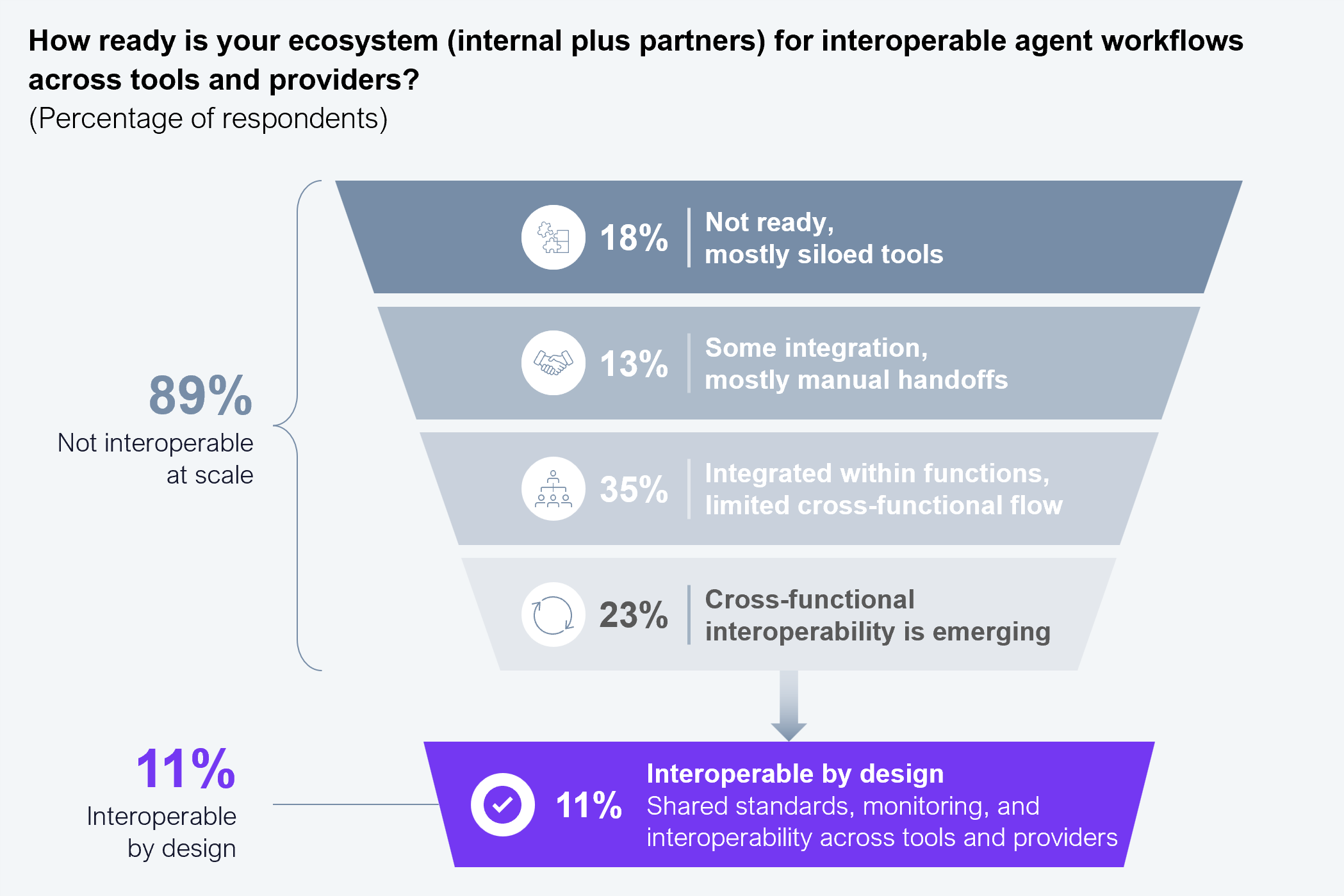
Only 11% of the respondents describe their ecosystem as interoperable by design (see Exhibit 20). Consider a multinational that bought an AI agent from one partner for customer service, a different agent from a second partner for risk and compliance, and a workflow platform from a third. Each works within the function that bought it, but none know about the others. When a customer service exception triggers a compliance review, the routing has to happen through a person because the systems were never wired to pass work between them. The enterprise paid three partners for AI that operates as three islands.
Sample size: 302 Global 2000 executives
Source: HFS Research with EY, 2026
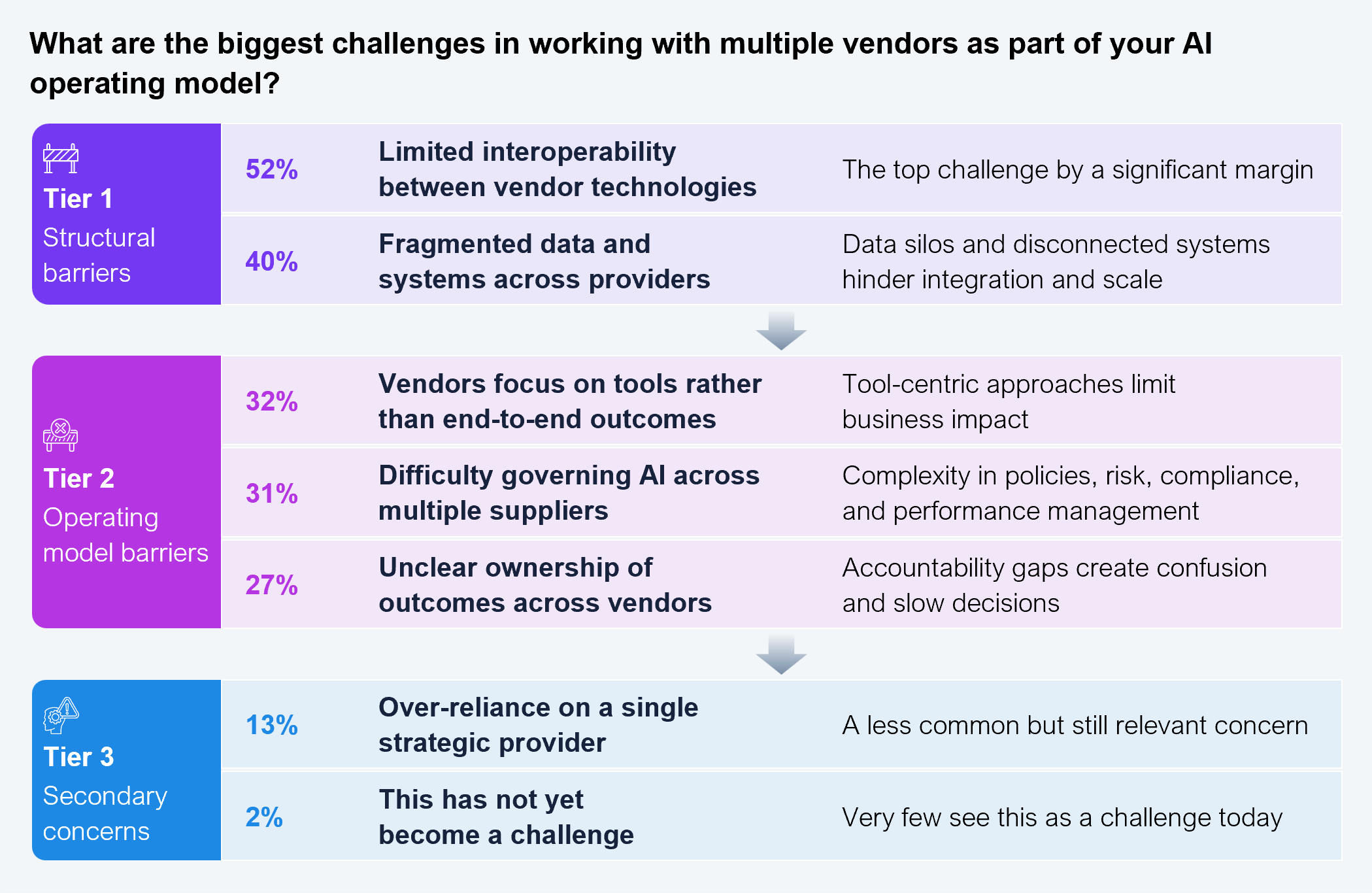
Fifty-two percent of the respondents name limited interoperability between partner technologies as the biggest challenge in working with multiple AI partners. Forty percent name fragmented data and systems across providers (see Exhibit 21).
Sample size: 302 Global 2000 executives
Source: HFS Research with EY, 2026
The interoperability problem sits in what no one is being asked to design. Enterprises buy AI partner by partner and then ask each one to participate in a single AI-enabled operating model none of them knew existed. The architecture inherits the structure of the buying process, not the structure of the work it is supposed to do.
The question is not how many AI partners you have. It is whether they are engaged to help design the operating model or simply deliver pieces of it. That distinction will determine whether AI scales as a connected enterprise capability or a collection of disconnected implementations.
The seven truths in this report are not about AI. They are about how the company actually runs: authority, arbitration, work, accountability, leadership, data, and partners. Each one looks like a technology problem, but none of them is. The constraint on AI value has stopped being technological. It is now organizational. The companies that see where the bottleneck has moved will pull ahead. Those still solving the technology constraint they already cleared will not.
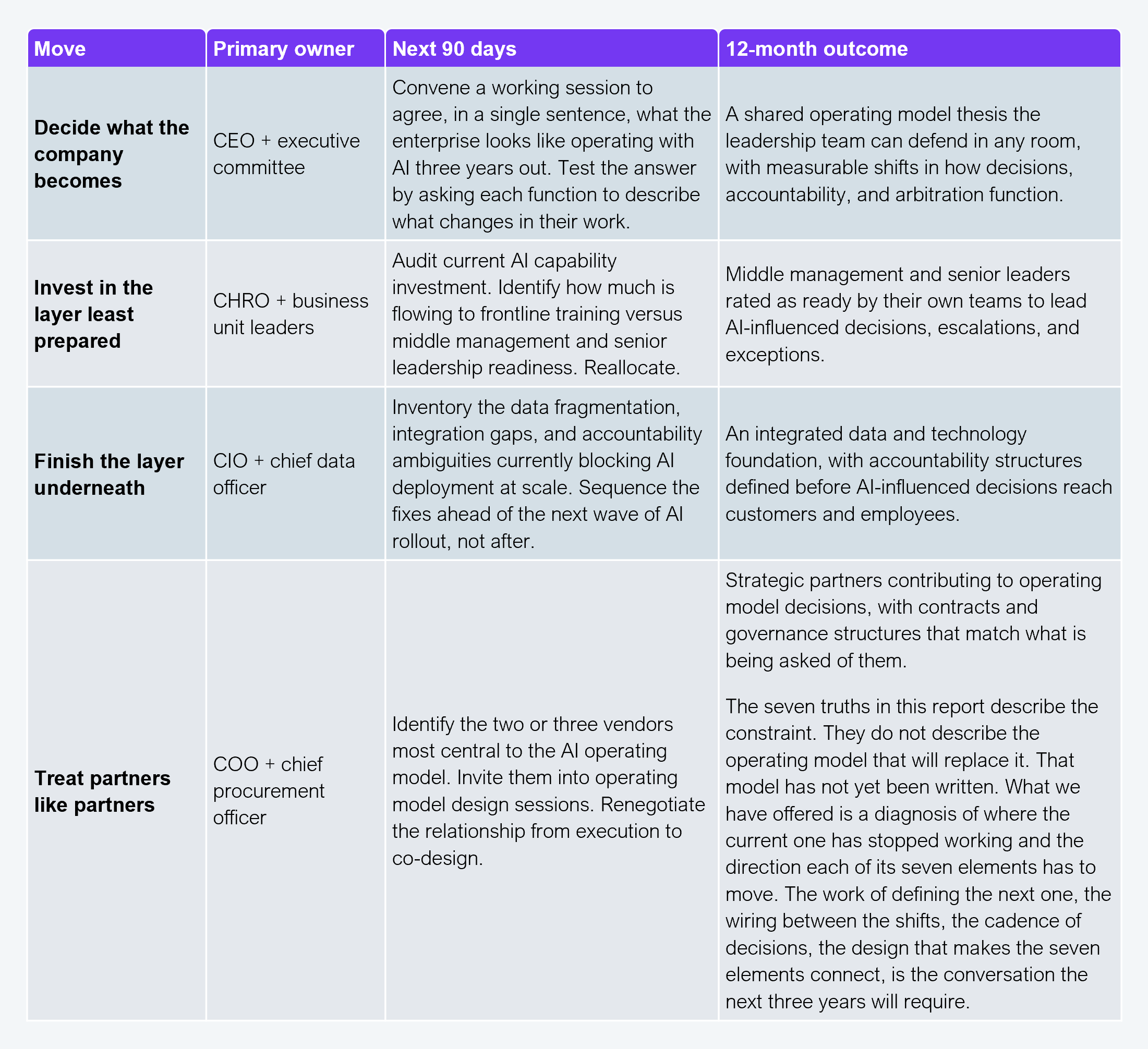
The seven findings above define the issues to address. The four moves below provide a starting agenda. Each names an owner, what to do in the next 90 days, and what to expect in twelve months.
Register now for immediate access of HFS' research, data and forward looking trends.
Get Started


If you don't have an account, Register here |
With the exception of our Horizons reports, most of our research is available for free on our website. Sign up for a free account and start realizing the power of insights now.
Our premium subscription gives enterprise clients access to our complete library of proprietary research, direct access to our industry analysts, and other benefits.
Contact us at [email protected] for more information on premium access.

