
Non-traditional disruptors are increasingly dictating the present and future of the industrial sector (encompassing the manufacturing and energy industries). Incumbent executives know this, and they also know that the talent isn’t available at scale—either internally or readily available to hire—for them to face this disruption alone. They must therefore be clear in their strategies for services and partnering; the innovation ecosystems already exist that will be critical in separating the industrial sector’s leaders and laggards. Those who embrace and embed disruptive innovation now will propel themselves ahead of their peers, who will become so stuck in their legacy technology and cultures that they’ll be left trying to play catch up.
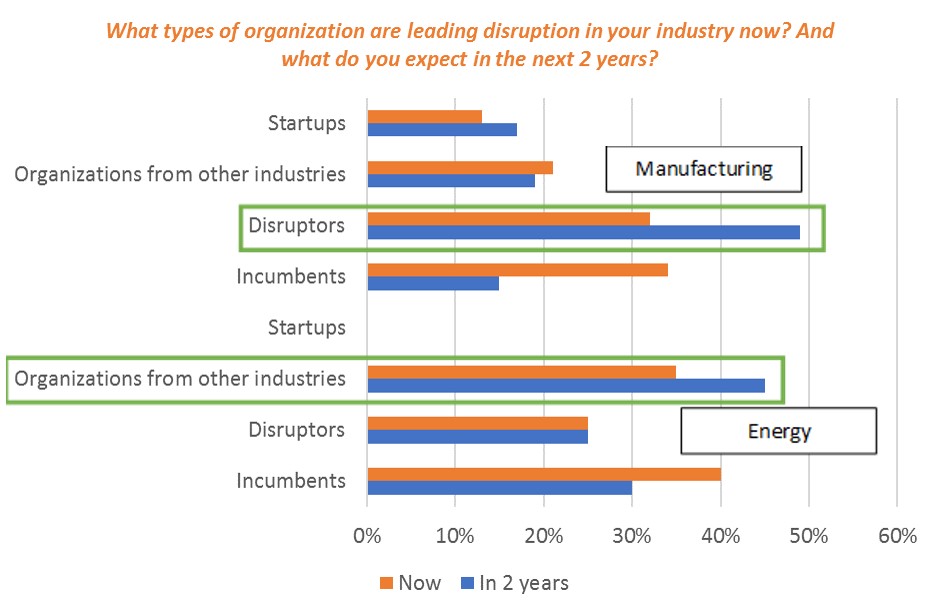
Forty-nine percent (49%) of manufacturing executives in our State of Operations and Outsourcing 2019 survey expect digital disruptors to shape their industry in two years, compared with 32% feeling the same way about the present (see Exhibit 1). Innovation led by incumbents will also fall away over the next two years as startups and disruptive vendors emerge with innovation in the industrial space—capabilities that leading service providers will continue to embed in their offerings—causing new headaches for traditional firms’ executives that grapple with the decision of innovating in house, through services, or by partnering.
The signs are already there in manufacturing. Their traditional B2B style of commerce is moving toward the disruption seen in B2C sectors: manufacturing is now experiencing the same logistical upheavals as a plethora of emerging technology is being integrated throughout their supply chains and core production processes. Emerging technologies, such as AI and smart analytics, are altering the way manufacturers make industrial decisions. An increasing ability to customize and personalize products is shifting demand; both products and manufacturing methods are developing at such a rapid pace that traditional economic rules are changing throughout the value chain.
Exhibit 1: Disruption is shifting away from incumbents in manufacturing and energy: in manufacturing, it’s non-traditional disruptors; in energy, it’s outside organizations.
Source: HFS Research, State of Operations and Outsourcing 2019
Energy executives, meanwhile, see an increasing influence of disruption coming from outside organizations, as disruption led by incumbents dies away as it did in manufacturing. One avenue fueling this type of disruption is oil and gas giants’ move to rebranding themselves as “energy companies” as they aim to dissociate themselves (at least in branding terms) from fossil fuels.
Secondly, just because the fear of “disruptors” in energy doesn’t appear to be increasing in Exhibit 1, doesn’t mean it isn’t there. For example, newcomer ohm connect, a California company, pays consumers to limit their energy consumption at peak demand, meaning the state can avoid turning on fossil fuel-based power plants—a model disadvantaging usage and threatening top-line revenues for traditional energy producers that don’t look to reinvent their business models.
The industrial sphere of manufacturing and energy might be fearing disruption from different sources, but they have much in common when it comes to the root-causes of their problems and how they might go about addressing the threat.
Our Business and IT Industry survey for 2019 laid bare that both manufacturing and energy execs see a lack of talent as a significant barrier to their digital achievements. They know how much of a problem it is. Over 90% of executives in both verticals acknowledge the criticality of in-house skills to implement new technologies. Unfortunately, with engineering and similar traditional degrees struggling to adapt and catch up to the rate of change in the industrial sector, it is unlikely that, in the short-term at least, retraining existing staff of hiring the necessary skills at a sufficient scale is viable. Non-traditional education and means of retraining—which HFS has previously covered—might go some way to help. Still, in industrial verticals that are plagued by legacy technology, processes, and cultures, and who struggle to keep pace with change, leaders can’t rely on revamping their talent strategies alone to solve their digital problems.
While in the medium or long term, there is clearly a need for industrial execs to address the sector-wide talent shortage, in the short-term, it’s vital that servicing and partnership strategies are rock solid.
From HFS and Accenture’s 2018 Intelligent Operations survey, the oil and gas sector is a clear mover in the right direction, focusing digital transformation efforts on servicing and partnering rather than retraining existing employees. The sector has recognized that averting disruption is not going to come from within, but rather from ecosystems.
One obvious way of preventing disruption from ousting your market position or fueling your competitors is to bolt it on to your own operation. Industrial execs might do well to consider the wealth of innovation partnerships and centers of excellence (CoEs) run by service providers and not-for-profit third parties (universities, for example) to help them keep pace with change and be disruptors, not the disrupted.
Executives throughout the industrial sector of manufacturing and energy know that disruption is changing; they also know that they don’t have the in-house talent to combat it alone. To keep pace in the short term, they must be clear in their servicing and partnering strategies. Fixing the talent shortage is a long-term game.
The innovation ecosystems are out there and ready to go for industrial firms. Their current providers will almost certainly have their own partner networks, if not specific hubs or CoEs tailored toward their needs. It’s time to worry and act quickly if industrial disruption is coming as a surprise… competitors that embed themselves and embrace industrial innovation will be the winners in a market that has little mercy for falling margins.
Register now for immediate access of HFS' research, data and forward looking trends.
Get StartedIf you don't have an account, Register here |
With the exception of our Horizons reports, most of our research is available for free on our website. Sign up for a free account and start realizing the power of insights now.
Our premium subscription gives enterprise clients access to our complete library of proprietary research, direct access to our industry analysts, and other benefits.
Contact us at [email protected] for more information on premium access.

