
HFS recently published HFS Top 10 IoT services and HFS Top 10 Industry 4.0 services reports, in which we analyzed leading global service providers in the IoT and Industry 4.0 service spaces. We observed that the year-over-year (YoY) growth of service providers is in the double digits, and the overall adoption of IoT and Industry 4.0 has increased. Through different use cases, IoT and Industry 4.0 bring significant changes to the business landscape, thus impacting how enterprises interact with customers, manage operations, and scale overall business. As emerging technologies are changing rapidly and influencing several organizational factors, including industry boundaries, product complexity, and business models, so enterprises must anticipate the future landscape and prepare themselves for future disruption. Accordingly, service providers also need to develop capability and necessary offerings so that they can support enterprises across different areas of IoT and Industry 4.0. In this PoV, we discuss the current landscape and future state of IoT and industry 4.0.
2019 in review: five key patterns we observed in the IoT and Industry 4.0 landscapes
The IoT and Industry 4.0 landscape is changing rapidly in terms of the geographic client portfolio, technology platforms, and technology adoption among others. We have identified five key patterns that emerged in 2019 in this space.
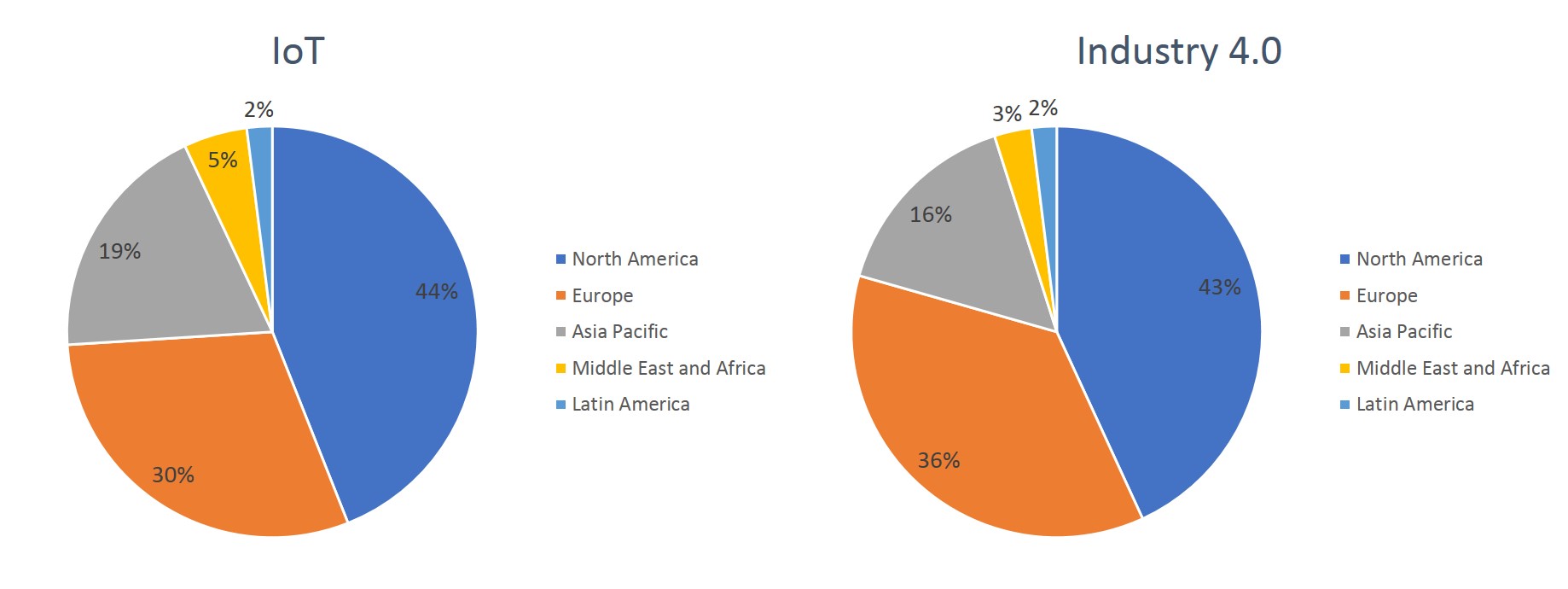
Though IoT and Industry 4.0 service providers have a significant number of clients in Europe and the Asia Pacific region, North America remains the biggest market for the service providers (see exhibit 1). Across industries, North American enterprises have embarked upon several IoT and Industry 4.0 initiatives in several areas, including operational excellence and customer experience.
Exhibit 1: Most IoT and Industry 4.0 clients are from North America and Europe
Source: HFS IoT and Industry 4.0 Services Top 10 Reports
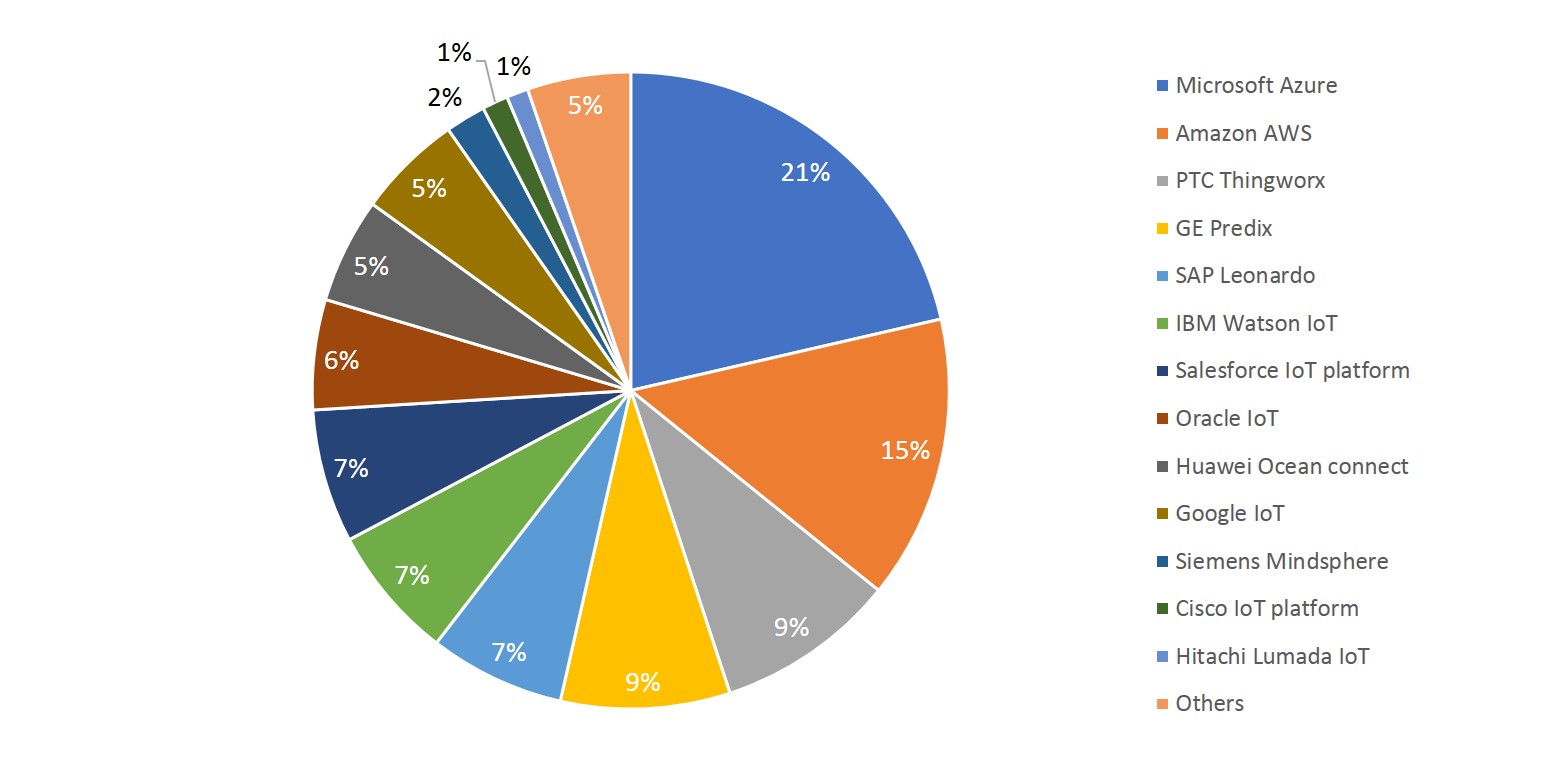
We have observed that the hyper-scalers (Microsoft and Amazon) are leading the IoT platform landscape, as Exhibit 2 describes. Other IoT platforms are also leveraging cloud platforms; for example, GE Predix and PTC ThingWorx have partnered with Microsoft, and Siemens MindSphere has partnered with Amazon. The use-case libraries, security features, ease of scalability, and UI/UX experience are some of the factors accelerating the adoption of Microsoft and Amazon.
Exhibit 2: Distribution of engagements across different IoT platforms
Source: HFS IoT Services Top 10 Report; 1,000+ engagements
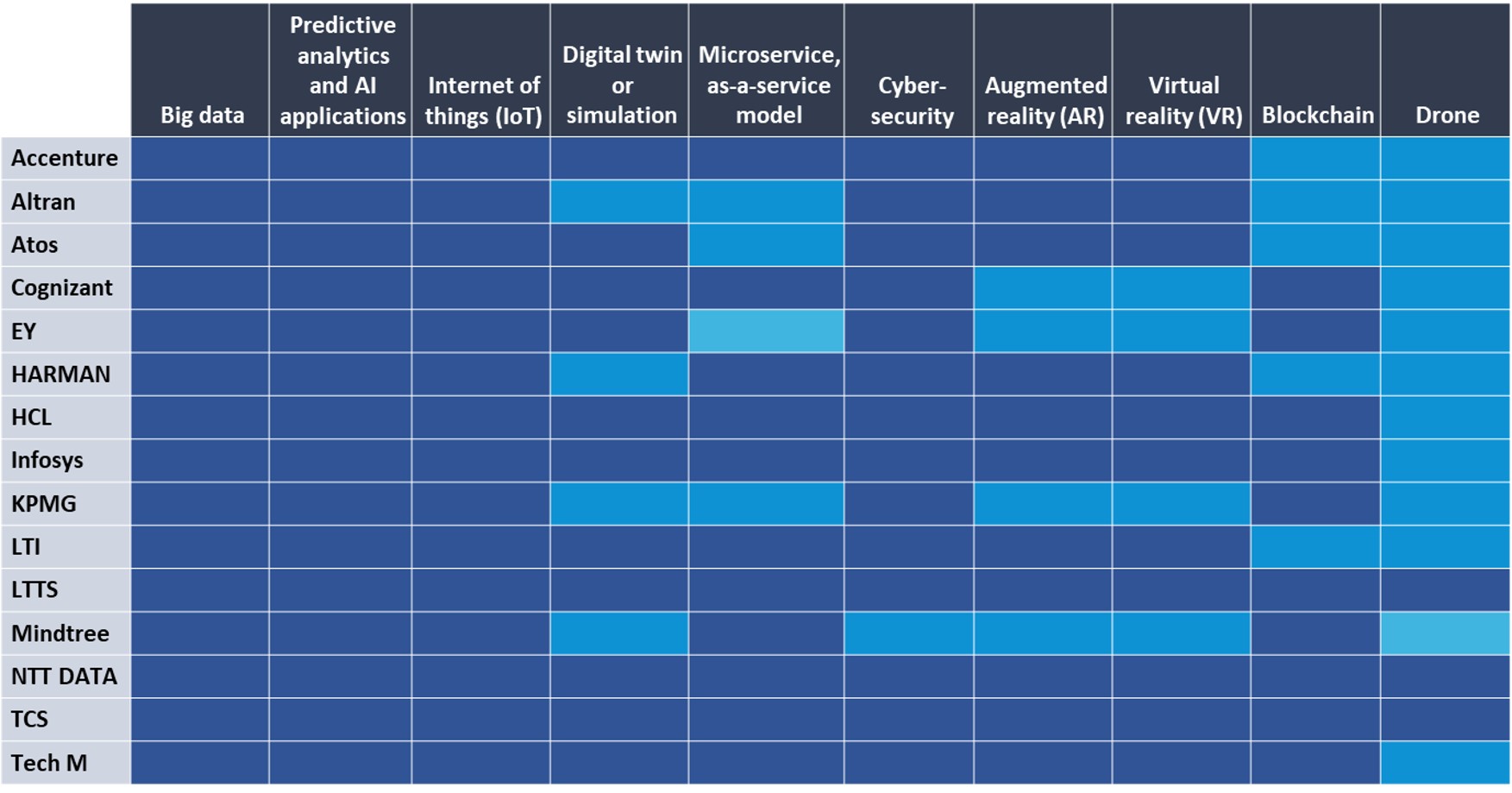
Predictive analytics and AI applications, big data, and IoT are the most mature segments among generic Industry 4.0-enabling technologies, as shown in Exhibit 3. IoT provides real-time data flow and data analysis methods used for deriving business insights. Cybersecurity is a major concern for enterprises because of exposure through devices, IoT hubs, and applications.
Exhibit 3: Data processing and IoT are the most adopted technologies among Industry 4.0-enabling technologies (generic technology components)
Source: HFS Industry 4.0 Services Top 10 Report
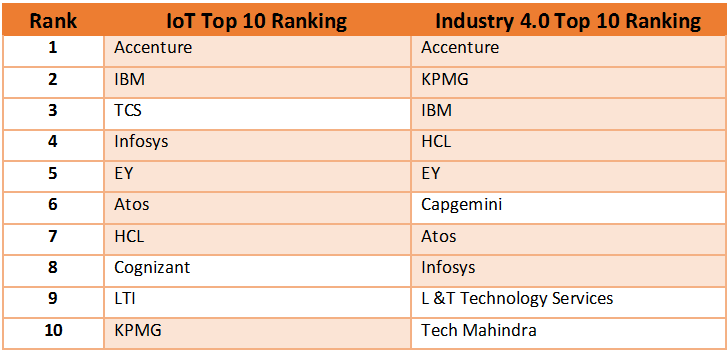
Since IoT is a core tenet of Industry 4.0, there is a significant overlap of service providers (Accenture, IBM, KPMG, EY, HCL, Atos, and Infosys) that are featured in the top 10 lists for both IoT and Industry 4.0 services, as shown in Exhibit 4.
Exhibit 4: Accenture is the leader in both IoT and Industry 4.0 services
Source: HFS Research, 2020
With the advent of 5G, advanced AI methods, 3D printing, and other technologies, there has been an increase in data processing and improvements in connectivity, decreasing the technology barriers of IT-OT convergence. Using these new technologies, enterprises are unlocking new revenue channels, increasing automation, and improving the overall organizational efficiency level.
The IoT and Industry 4.0 market is evolving rapidly
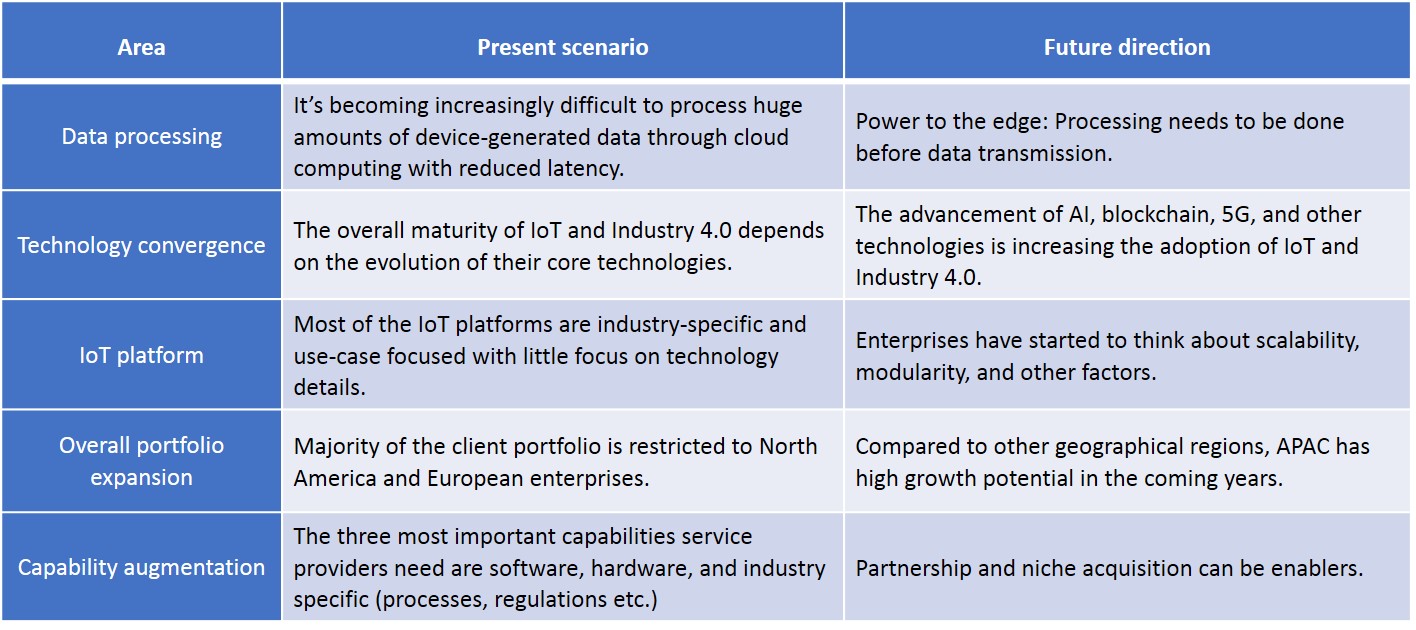
We have highlighted the evolution of some of the critical tenets (both technical and business factors) of the overall IoT and Industry 4.0 market, as shown in Exhibit 5.
Exhibit 5: Technology factors are expediting the changes in the IoT and Industry 4.0 landscape
Source: HFS Research, 2020
Top five trends that IoT and Industry 4.0 practice leaders should strategize around in 2020 to stay ahead of the curve
The Bottom Line: IoT and Industry 4.0 practice leaders should be flexible and agile enough to accommodate this dynamic market.
As IoT and Industry 4.0 advance, the very notion of a clear dividing line between reality and virtual reality is becoming blurred. Enterprises and service providers need to foresee the trends and absorb the changes to gain a competitive advantage. These trends will enable IoT and Industry 4.0 practice leaders to accommodate near-term changes.
Register now for immediate access of HFS' research, data and forward looking trends.
Get StartedIf you don't have an account, Register here |
With the exception of our Horizons reports, most of our research is available for free on our website. Sign up for a free account and start realizing the power of insights now.
Our premium subscription gives enterprise clients access to our complete library of proprietary research, direct access to our industry analysts, and other benefits.
Contact us at [email protected] for more information on premium access.


