
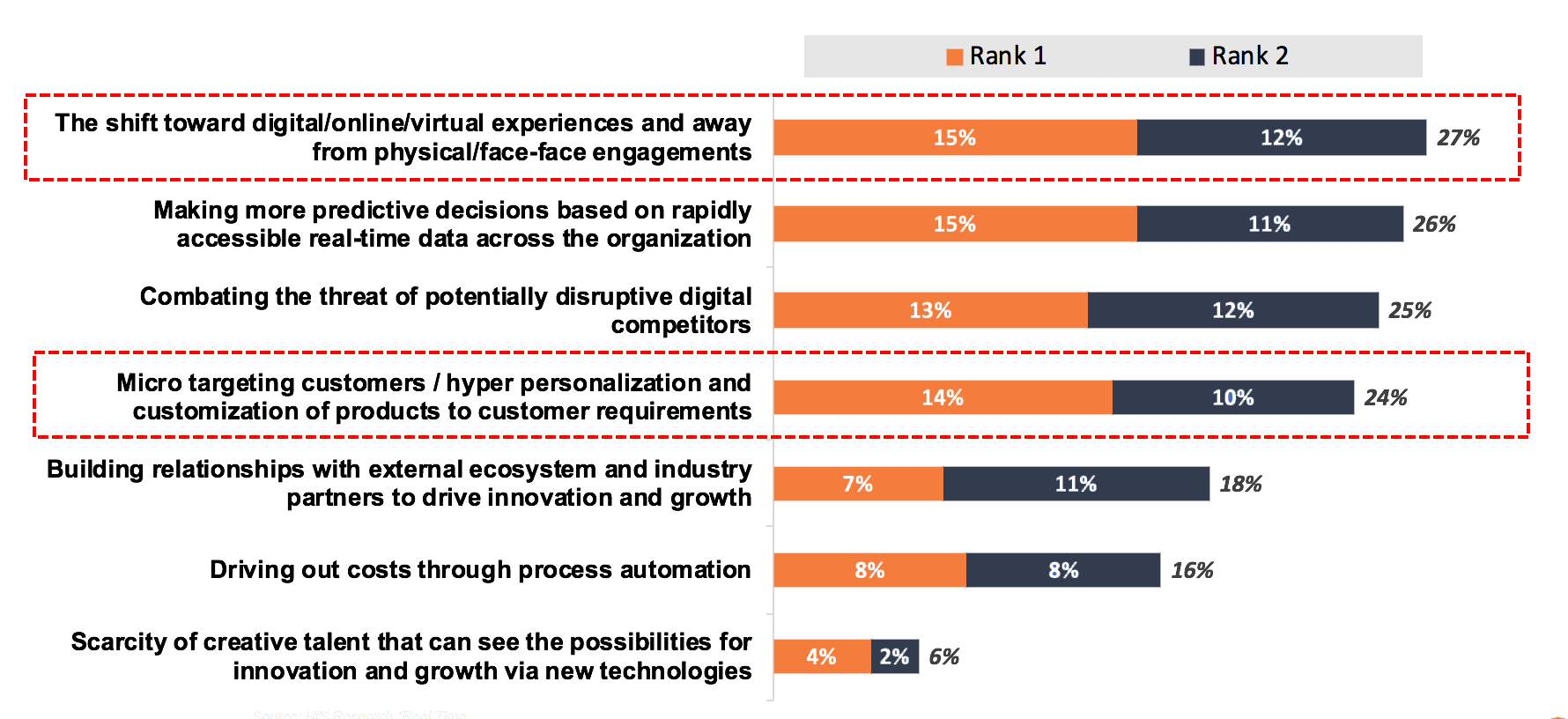
Customer expectations for a touchless, personalized experience have been increasing in the travel space, particularly with airlines. A recent HFS study of 460 operations leaders clearly outlined this importance:
Exhibit 1: Which of the following business drivers will have a major impact on your business? Rank (Showing Top 2)
Source: HFS Research 2018
Sample: Enterprise Leaders = 460
With the availability of real-time interactive technologies, sophisticated global services, and more incisive analytics, airlines can craft seamless experiences with the right planning and investment—and must invest in doing so. One of the necessary elements for earning a traveler’s trust and ongoing business is the capability to predict customer events rather than just react to them.
This kind of intuitive service is becoming essential to stay competitive and build loyalty among customers. Delivering on this kind of customer service isn’t just about having the right pieces in place in the front end with apps and customer service; it is increasingly about simplifying and modernizing behind-the-scenes operations to better support the customer-facing elements. Baggage is the ultimate example for airlines—a complex process that is supported by legacy systems and that has a negative impact on customers when it fails. Knocking down barriers between the front, middle, and back offices is the HFS concept of Digital OneOffice. In this POV, we look at how a leading North American airline, with the help of its partner Infosys, has reimagined its baggage handling applications to support better customer experience.
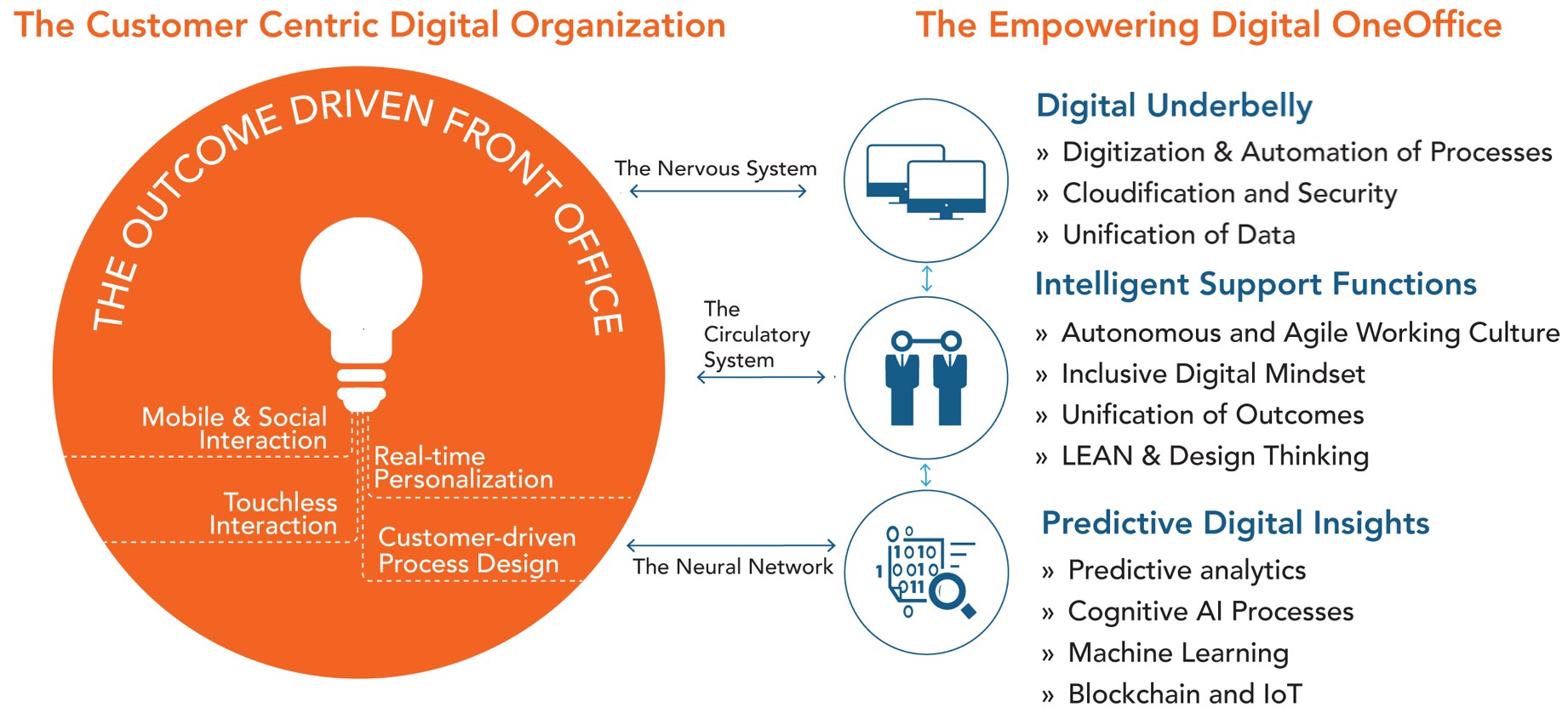
In today’s hyper-connected economy, enterprises of all shapes and sizes have quickly learned that a genuine customer-centric digital capability is only effective as an enterprise-wide initiative, connecting back and front offices as we describe in our Digital OneOffice framework.
Exhibit 2: The Digital OneOffice Framework—collaborative, unified, dynamic, intelligent, responsive, and simple
Source: HFS Research, 2019
You can only provide a predictive, real-time customer experience if your operations can service customers’ needs in real time. Companies can gain a foothold over competitors if they have the intelligence to anticipate their needs—and having this customer responsiveness is nowhere more critical than in the travel and hospitality industry.
Customer experience is not just about creating a fancy UI; it’s about making users’ experiences the core of an enterprise’s strategy and operations. For the airlines, creating these digital interfaces has been just the beginning. The hard work of digitalizing and connecting all the underlying support elements and making them more intelligent is underway. We can find many examples of these “hyper-connected” customer-centric business models in digitally savvy traveltech companies with cultures and business models that have the customer at the core. Traditional airlines and travel companies are also putting customers at the heart of their business to stay relevant, fend off disruption, and drive consistent improvement to balance sheets; this requires a path toward the OneOffice with modernized back-office processes that are connected to support customer experiences.
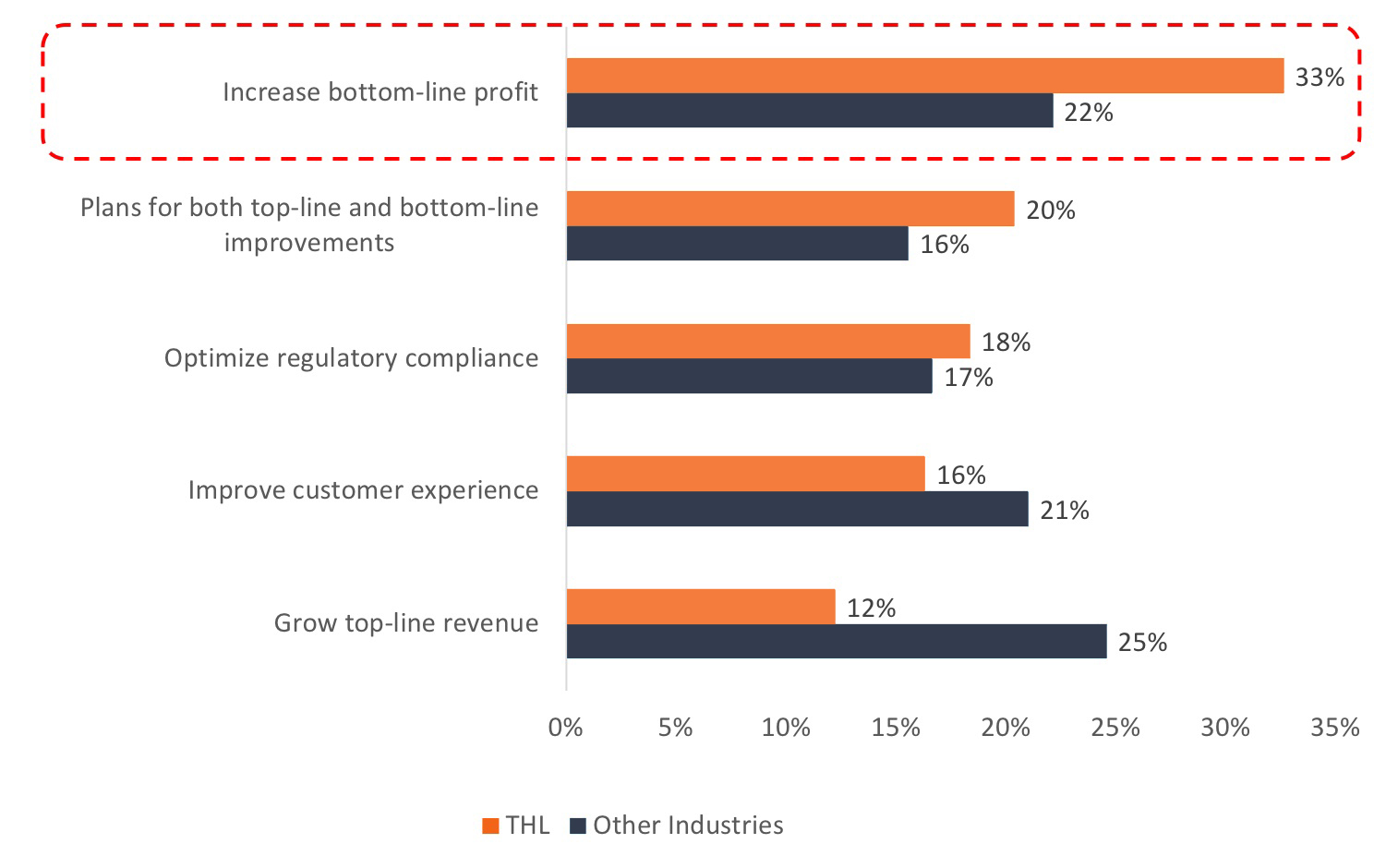
HFS believes there is an intrinsic link between the mindset and goals of an industry and the ability of companies operating within it to embrace Digital OneOffice transformation and position themselves for future success. The travel industry has been largely focused on increasing bottom-line profit for the last several years, primarily through aggressive cost management strategies. The focus is understandable given the many uncontrollable variables impacting the airline business, like fuel prices and weather events, but customer expectations continue to change and grow, making it critical that airlines take a longer-term look at re-investing those profits to remain competitive. Travel companies are less focused on improving customer experiences for business operations transformation than other industries on average (see Exhibit 2). Our health analysis of the supports this view, showing a real push to drive and preserve profit performance—the question is whether this strategy will include funding additional investment to enable new offerings.
Exhibit 3: Travel firms focus on the bottom line over CX and growth
Q: What are your top objectives for business operations transformation over the next three years?
Source: HFS Digital Transformation by Industry 2018; THL n= 54; other sectors n= 376; other sectors include manufacturing, energy, utilities, healthcare, pharma, retail/CPG, high-tech, insurance, BFS, and telecommunications
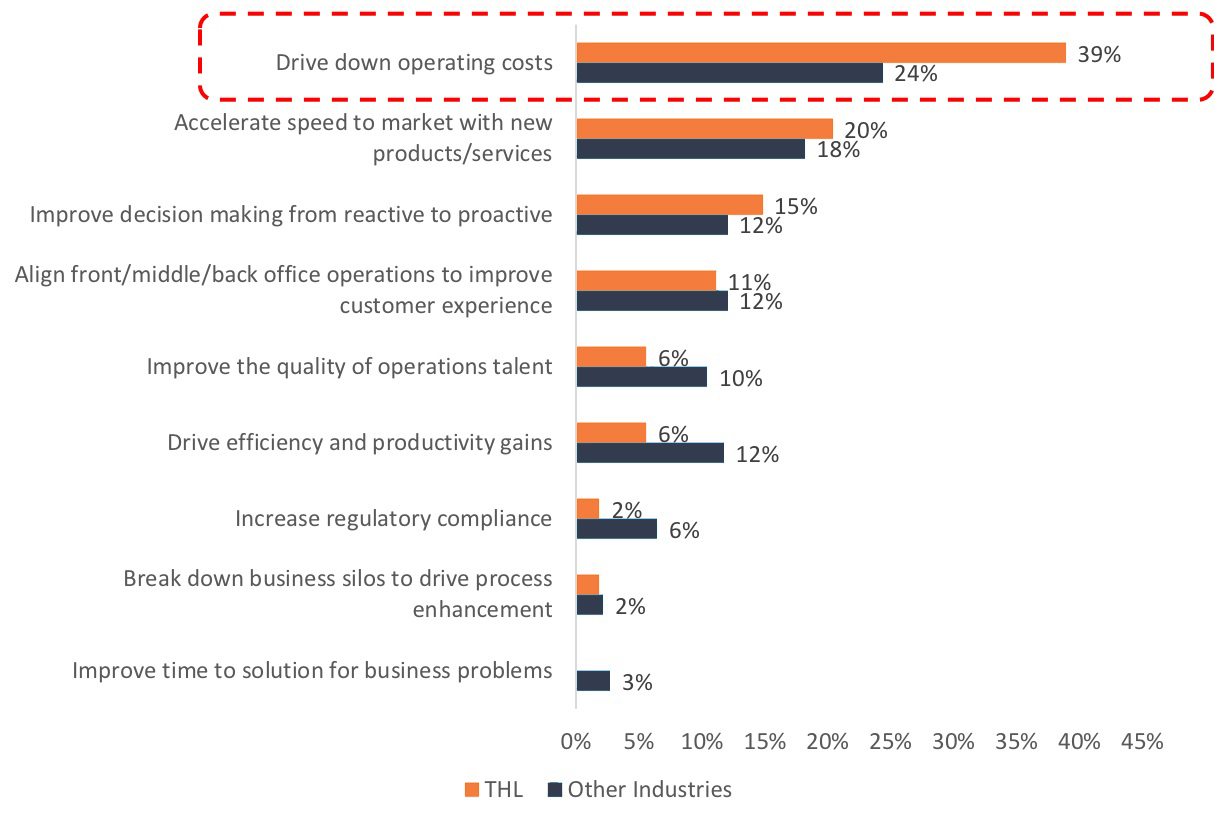
When asked what they would focus on to achieve their desired business transformation objectives, THL enterprises overwhelmingly cited driving down operating costs as their critical outcome (see Exhibit 3). At least travel firms’ desired objectives and outcomes are consistent with each other. Lowering operating costs will certainly assist with profit recognition, but it is a short-term approach. THL firms will be hard-pressed to achieve their secondary objective of accelerating speed to market with new products and services with this emphasis on cost take out. What travel firms need is a conscious pivot to focus on top-line revenue growth—the combination of customer centricity and the OneOffice framework is the way to do it.
Exhibit 4: Travel companies are hyper-focused on cost management
Which business outcome is the most critical to achieving your operations transformation objectives?
Source: HFS Digital Transformation by Industry 2018; THL n= 54; other sectors n= 376; other sectors include manufacturing, energy, utilities, healthcare, pharma, retail/CPG, high-tech, insurance, BFS, and telecommunications
One topic in travel that highlights how important it is to connect the front, middle, and back offices is the importance of baggage handling in the airline industry. It also emphasizes how customer experience is NOT just about some slick, front-end interface. This leading North American airline handles up to 6,000 flights a day and over 100 million passengers per year, so handling the sheer volume of passenger baggage is a business-critical operation and inherent challenge. Many years ago, much of baggage tracking was manual, and while the airline had a baggage management system, it found its custom-built platform in need of a refresh. Over time, we saw the opportunity to make the system better, more automated, and more intuitive to meet customer expectations. “Today our customers want to know everything that’s going on with their bag, flight, and reservation. We needed to start tracking baggage on its journey to keep both employees and customers informed,” said the Senior Manager, IT Applications, for the airline.
“Today our customers want to know everything that’s going on with their bag, flight, and reservation. We needed to start tracking baggage on its journey to both keep both employees and customers informed.”
—Senior Manager, IT Applications, Leading North American Airline
The airline embarked on one of several application development projects with its service provider partner, Infosys, to modernize its baggage handling platform. While there are commercial off-the-shelf (COTS) products on the market, this airline wanted to create a platform that takes its capabilities to the next level. As the Senior Manager of IT Applications of a Leading North American Airline shared with HFS, “Even if only half of our passengers check a bag, from a data management perspective, it’s very complex.” The airline is also keen to get ahead of increasing regulatory requirements from the International Air Transit Association for baggage handling transparency. With the development of its new and improved baggage system, the airline looked at the disaggregated data and many disparate systems that go into orchestrating the baggage distribution and created a “hub,” a central data repository for baggage handling. This hub connects to critical field service apps (including the ramp agents who load and scan the bags) and, ultimately, customer-facing applications to keep the customer informed of the status of their luggage.
The blueprint to success with a project like this is having a solid plan in place and specific goals in mind. Further, selecting a partner that understands your company and what you’re trying to achieve and that wants to be a part of your team’s success is crucial in using a third party. Talent is also a huge factor. The senior manager, IT applications stated, “Given how complicated the airline is to run, the retention of employees that have gained knowledge and expertise of our business has been really important.” The leadership at both organizations has enabled a teamwork mentality that people are excited and proud to be a part of the airline attributes this partnership’s success to allowing Infosys to be a part of all the discussions, letting the company voice ideas, estimates, risks, and issues, and bringing in the leaders as early as possible to leverage their knowledge and experience. Generally, approaching such engagements as a partnership instead of a client/vendor relationship will lead to success.
While there are several ways to measure the success and efficiency of the new platform, ultimately it comes down to problem avoidance and making the customer journey as seamless as possible. So far, the new system has led to a 25% decline in mishandled baggage. There are other drivers, too. There’s an industry score called MBR (mishandled bag rate), which represents the number of bags per customer that have been separated from passengers. All airlines in the United States are required to report these numbers to the Department of Transportation. There are also details managed by the system relating to weight and balance discrepancies, which can lead to fines from the FAA and present safety concerns.
So far, the new system has led to a 25% decline in mishandled baggage
Ultimately for the airline, the success of this system boils down to customer satisfaction; it is diligently tracking this through the CSAT metric and working to improve the “likelihood to recommend” numbers. The Senior Manager of IT Applications at a Leading North American Airline put it simply, “Innovation in this space is about accuracy and performance.” From a passenger perspective, the most important thing is that their flight arrives on time, and the second is making sure the bag arrives with them. While completely avoiding mishandled baggage is ideal, the airline has designed this process so that in the unfortunate case of mishandled or misplaced luggage, the system proactively notifies the customer and the airline puts plans in place to reunite the passenger with their luggage. The new system also enables informing the customer of when the bag has arrived or when the airline will deliver the bag to the customer. This system ties back to the revenue growth objective; as customers have more confidence in checking their bags, the hope is that more will do so, resulting in revenue increases through checked bag fees.
“Innovation in this space is about accuracy and performance.”
—Senior Manager, IT Applications, Leading North American Airline
The implementation of this new system was no short task as one of the world’s largest airlines, and it had to implement the new system at every airport. It took over a year to write the new app and two years to roll it out and replace the devices in the field. The airline is in a period of transformation with other major projects, including cloud enablement of the baggage platform. With so many disparate systems, many new applications, and many legacy applications, integration of data is an enormous challenge to the company’s operations. Still, Infosys is working with its client on building on and improving the baggage system, which has become a critical part of the airline’s operations.
The airline’s next steps are to get even more predictive and to improve on the mishandled baggage analytics already in place. Ultimately, Infosys wants to get into predictive mishandling based on history; using tools that can predict mishandling events, such as tight connection times, will enable the airline to focus resources and attention on high-risk situations. Data analysis of this type is central to things that the business can achieve, like arming employees with a lot more information so they can do their jobs better. For example, tools similar to facial recognition can recognize moving baggage and detect and alert staff to anomalies like the presence of a dangerous good (e.g., a wheelchair battery or dry ice) or let handlers know there are pets traveling.
The airline is also working to increase the sophistication of its notification systems. For example, it doesn’t want a passenger waiting at the carousel when the system knows their bag is not there, exacerbating an already frustrating customer experience. Notifications can also bring good news such as a notification that a bag made it on an earlier flight and is waiting for the passenger. The crux is getting the most relevant and helpful information to both employees and customers at the right time.
The baggage application modernization we heard about from this leading North American airline is only one example of how companies are streamlining their operations behind the scenes to thwart disruption threats and future-proof their businesses by aligning to customers. They are taking a proactive stance on customer experience and going about it wisely by improving processes from the back to the front in the way that HFS outlines with the Digital OneOffice. This is a lesson not just for airlines or travel firms, but something all organizations must learn from to stay relevant in the future.
Register now for immediate access of HFS' research, data and forward looking trends.
Get StartedIf you don't have an account, Register here |
With the exception of our Horizons reports, most of our research is available for free on our website. Sign up for a free account and start realizing the power of insights now.
Our premium subscription gives enterprise clients access to our complete library of proprietary research, direct access to our industry analysts, and other benefits.
Contact us at [email protected] for more information on premium access.


