After declaring RPA as a gateway drug for intelligent automation (IA), it was only a matter of time before we reached the stage where practitioners felt like they were at an AA meeting. AA standing for Automators Anonymous, that is.
The most recent HFS executive roundtable, held in April 2019 in New York City served as the “safe space” where automation and operations leaders from various organizations got together along with executives from HCL Technologies to talk about the state of the market. The consensus was clear – the ‘why’ and the ‘what’ of these technologies, particularly RPA, has largely been solved. We are evidently in the post-hype, implementation age of RPA. We are now debating the ‘how’, getting beyond the growing pains to make multi-technology automation initiatives successful.
IA client challenges today are reflective of the growing market maturity
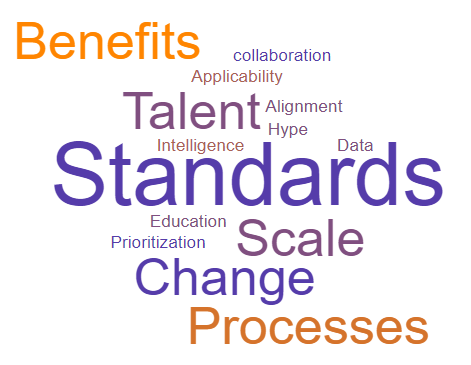
Automation and business transformation leaders at our event are starting to come up against institutional challenges with implementing IA technologies. It’s no longer about how to get started and where to find talent. The focus is now on the fundamental processes and policies to put in place to expand automation initiatives across the enterprise. Exhibit one summarizes the roundtable delegates’ top challenges with IA.
Exhibit 1: Key challenges from the roundtable’s IA clients include setting consistent standards
Source: HFS Research, 2019
The big challenges brought up included:
- A failure to engage HR in the change management that is needed for automation to be fully sustainable in changing operating models.Heard in conversation, HR used to stand for human resources. With a combination of humans and bots making up the workforce, does HR need to evolve to stand for “Hybrid Resources” or no longer be relevant? Lack of job descriptions, roles, change management, and training are really holding firms back.
- The perception/marketing by RPA vendors in dumbing down automation to be only about the bot. This misleads the market who then under prepare for the issues of data ingestion, HR change management and the relationship with IT.“Building a bot in 60 seconds does not change a company’s operating model,” shared one enterprise.
- Balancing the right mix of investment, time, and resourcing that is applied to IA and the right level of priority is aligned to it as compared to other priorities.
- Mutually beneficial collaboration with service providers continues to be a challenge. “What’s on my mind at the moment is as managed service providers hold more and more of transactions, how do we mutually contract to drive efficiency with automation,” shared the Chief Digital and Technology Officer of a large enterprise. This creates an opportunity to change the game for ambitious service providers investing in automating their own service delivery platforms with a human/bot mix.
- Keeping data sciences teams focused on key business challenges and not just academic experimentation. “These data scientists need to stop viewing data as an aphrodisiac!” exclaimed one automation leader about their talent alignment challenge.
Emerging best practices put process and improved experiences at the heart of the IA conversation
So what have we learned so far? Despite the challenges and frustrations with IA, enterprises are eking out best practices and determining what works for their businesses. Distilled wisdom from the roundtable delegates includes:
- Process knowledge is an invaluable asset for IA and shouldn’t be solely retained or led by your partner.
- As a Global Process Automation Leader explained, “What should your organization consider its core IP? Be careful not to hand over process definitions to just any vendor. You could maybe even think of it as patentable.” The leader spoke to their Chief Counsel about treating process artifacts as trade secrets, convincing their team to explore where process knowledge resides and who owns them.
- “I want to be part of the future, encourage us to reskill workforce and own our learning”, said another executive. In their view, often process expertise and knowledge goes out the door when the automation partner leaves, encouraging their organization to retain and own their process automation learning.
- A third enterprise leader explained that while they have third party support for automation, process knowledge is their internal “core IP.” As the company broke down workflows for process reengineering using an outcome-defined approach, it kept the process side and went with a low-cost automation partner for execution.
- Enterprise leaders can use automation to make themselves more relevant. Automation has provided a way forward for many operations-focused executives stuck in legacy practices of cost control and managing service provider relationships to meet annual performance KPIs. Those who do not have a proven automation in their operations will be left behind.
- Scale is the outcome and not the contributor to IA success.
- Scale is often called the biggest challenge for IA implementations. The roundtable explained this as a consequence of managing the intersection points of exponential expectations and linear execution of intelligent automation. Execution largely remains isolated among CoEs and siloed teams implementing singular technology-based projects, rather than taking an integrated approach to automation focused around processes.
- Consequently, enterprises need to rethink the contributors to IA success, and scale will emerge as an outcome. A senior finance director at a high-tech company shared her views about the culture of problem solving they are fostering, with tools being enablers on the journey. “We use 3Es as the metrics of success – efficiency, effectiveness, and experience.” Employee experience is a critical way for the organization to gauge whether the IA initiative will spread and scale.
- Ideally, business drives IA strategy. Regardless, get over who owns the automation agenda and start aligning better within the organization.
- Process is king when it comes to IA. The roundtable concluded that business leaders, process owners, and operations SMEs need to be critical drivers of where and how IA gets implemented. IT is a partner but cannot solely envision IA-led processes.
- The ultimate point is about internal alignment. One roundtable participant candidly shared, “If you have common process, who cares where [the automation ownership] sits? We need to be anchored on key metrics, such as the total cost of ownership. In our organization, we decided what RPA workers should cost, including architectural support, infrastructure, bot support, and licensing. After that, it became less about who owns what piece.”
- The role of the service provider is shifting from outsourcer to partner.
- With the increasing dearth of skills to drive automation strategies and technologies, never has the dependence on competent third parties become so critical. As recent HFS research illustrates, 57% of high performing enterprises now value their primary service provider as a strategic co-innovation partner, as opposed to a vehicle simply for affordable talent.
- Harder to automate when outsourced rather than managed in-house.
- It’s abundantly clear that enterprises in complete control over their back/middle office processes have enjoyed much greater freedom to immerse automation into their operations. Meanwhile, those which have outsourced process management, not only have to gain the buy-in of their in-house staff, but also have to receive the cooperation of their service provider(s) to drive an automation agenda. This can be highly problematic if your provider is unwilling to make any changes to its current people-centric delivery model.
Problems with scale? Move towards integrated automation
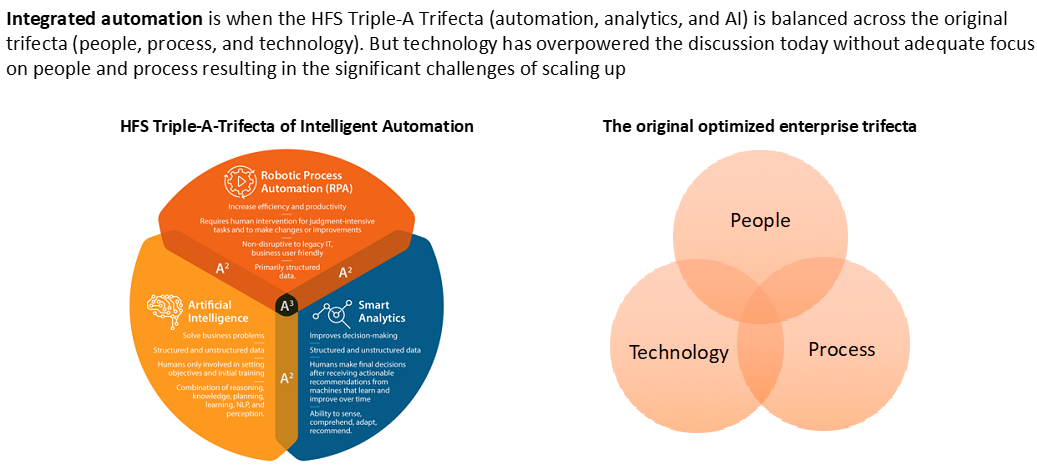
As organizations grapple with post-implementation challenges, the biggest learning emerging is that technology is only part of the answer. As Exhibit 2 below shows, the growing library of intelligent automation technologies must be balanced by an equally important focus on changes to people and processes to tackle scale. Integrated automation is the resulting answer. Notably, the roundtable’s discussions throughout the day, as evidenced above, delved more into people and process issues more so than technology. A true sign that as the market matures, organizations are learning about the rebalancing effort in integrating automation with processes and workforces.
Exhibit 2: What’s missing is integrated automation
Source: HFS Research, 2019
Automation technologies will inevitably have a major impact on people. For some organizations, this is the perfect time for changing perspectives on worker and customer community planning. A Chief Automation Officer at our roundtable brought up the role that his group can play towards the company’s broader corporate social responsibility (CSR) initiatives for diversity and inclusion. In their case, he shared, “Job loss will be inevitable, and we won’t have the reskilling conversation with everyone. Have someone with CSR involved when you do impact jobs, especially in other companies and geographies. For us, we decided that we will reserve part of what we automate to kids with autism that excel at repetitive work and high accuracy.”
The Bottom-line: Enterprise practitioners don’t view IA as a technology project, but rather an operating model change and operations process.
As one roundtable participant summed up, “This is real. There is still a lot of rhetoric, but as a market we are pushing towards reality.” The key is to design and implement IA initiatives in a more integrated way, keeping in mind what culturally makes sense for your enterprise.