This HFS POV is for CIOs, chief AI officers, and enterprise transformation leaders working to scale AI from pilots into production and close the AI velocity gap.
The enterprise AI production crisis is the CIO’s to solve. HFS data from a 2025 study of Global 2000 decision makers shows two-thirds of enterprises stuck in what we call “agentic washing.” Unfortunately, too many leaders believe early wins in AI adoption are transformational, but they are only successfully deploying low-complexity copilots and task automation. Our research shows that only 12% have reached true multi-agent systems in core operations.
The cost of staying in proof-of-concept (POC) purgatory is compounding. Every investment tied to improving productivity in pockets, rather than shipping AI into core operations, extends the gap between enterprises transforming how work gets done and those still perfecting pilots. Those leaders that are frontrunners in AI aren’t waiting for the market to stabilize; they are setting the standard everyone else is chasing. That gap won’t close with catch-up investment. Rather, the compounding advantage frontrunners are building across people, process, and performance becomes structural.
The call to action is clear. CIOs, you don’t need to question whether your organization needs AI. You need to question whether you can scale AI into production, keep it running, and tie it to the business outcomes your board cares about. To achieve this, you’ll need to invest in partners that can bring engineering depth, domain knowledge, and genuine customer collaboration. The speed of AI change is shrinking the window to catch the first movers. Their people, processes, and performance are creating a breakaway that makes them more competitive in the market and more attractive to their customers.
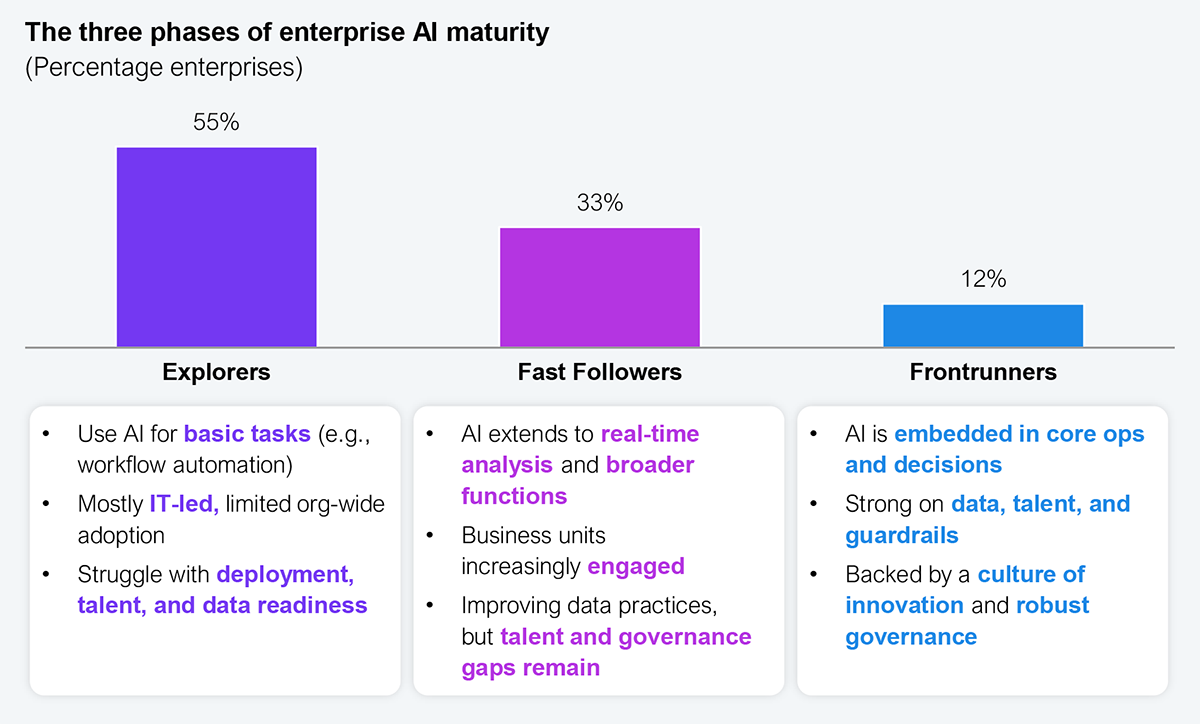
Sample: 553 executives across Global 2000 enterprises
Source: HFS Research, 2026
For 30 years, the IT services industry has run following the simple formula that labor arbitrage delivers cost savings, and technology arbitrage (cloud, SaaS) delivers scale. Both still matter. Neither differentiates anymore.
HFS’s research is unambiguous: 75% of Global 2000 enterprises plan to replace people-run services with software-run services by 2028. We call these Services-as-Software™ (SaS). As SaS and AI are the building blocks of the future, legacy delivery models, focused on bums-on-seats, are no longer relevant, and CIOs deserve partners who are also reinventing themselves for this new paradigm.
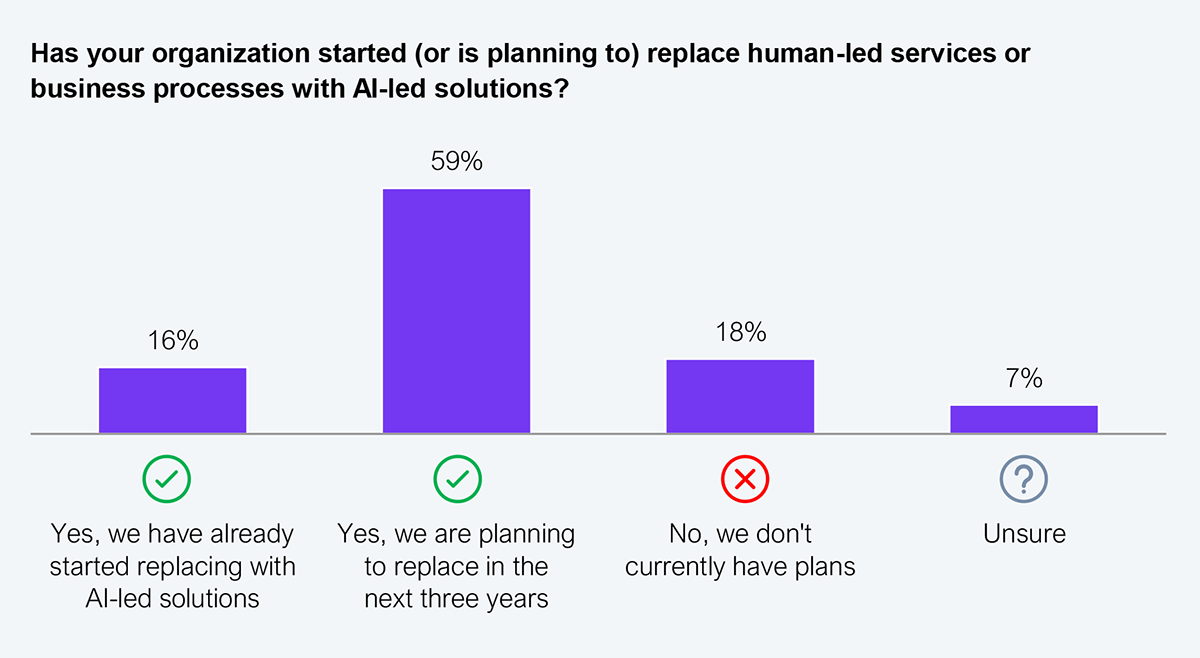
Sample: 305 major enterprise decision makers
Source: HFS Research, 2026
As CIOs drive AI adoption across people, process, and technologies, we are entering the era of knowledge and intelligence arbitrage. This is HFS’s Services-as-Software thesis: the codification of services and task-based labor into software that delivers business outcomes directly to the front line. Services are no longer supported by software—they are software.
The application of AI and SaS models isn’t evenly spread across software or IT services firms. In HFS’s research, we see vendors dealing with models built for everything from software development to packaged SaaS and workforce arbitrage solutions. IT services firms are busy investing in keeping their own lights on while aiding their clients’ transformation, while they also transform themselves.
One company helping its clients navigate this transition is Softtek, which has been delivering nearshore IT and BPO services globally to Fortune 5000 businesses for over 40 years. Seeing the changes being brought by AI and agentic AI, it is investing in realigning how its people, services, and frameworks drive AI-enabled outcomes. Softtek calls this approach “AI that ships” and positions it as a value-first execution model. Softtek built its services on the premise that getting AI into production at enterprise scale requires three things the market consistently underestimates:
Addressing these three aspects of AI adoption is essential for a CIO to overcome the root challenges of AI adoption. As CIOs can see from HFS’s AI velocity gap, your best employees are already AI-augmented while your enterprise is still forming committees. That distance is expanding every day. Within the next 18 months, your employees will be working side-by-side with agentic AI while your enterprise is still debating tools, policies, and pilots.
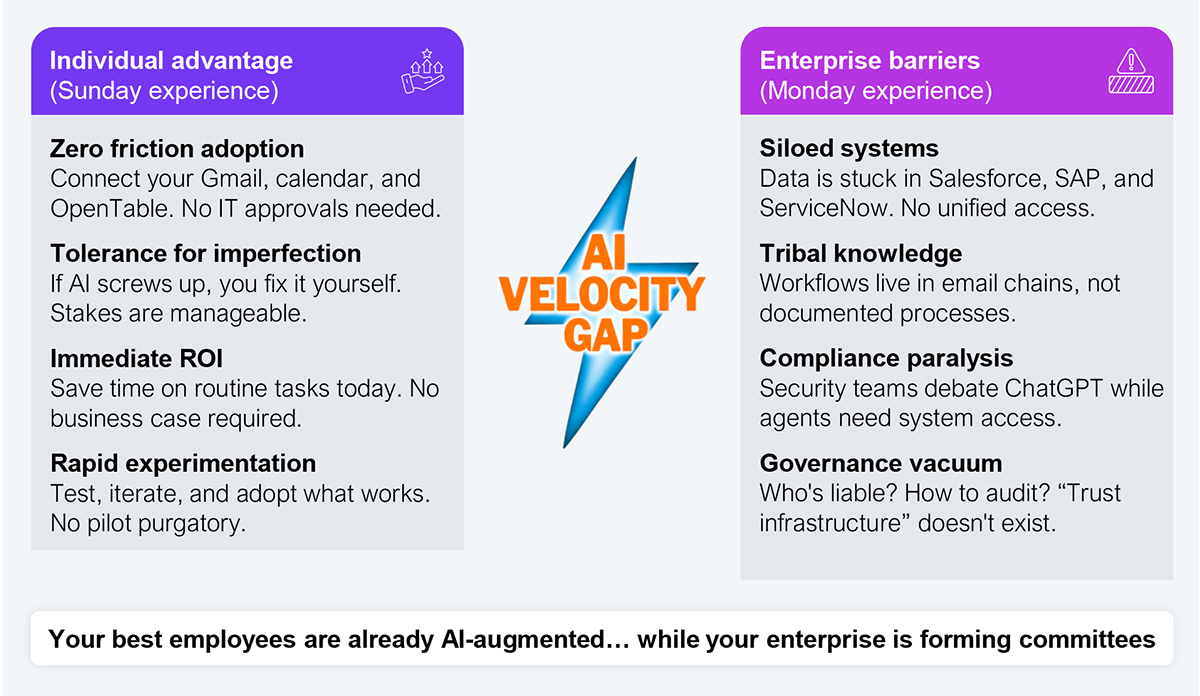
Source: HFS Research, 2026
Softtek’s mindset rests on three pillars designed to break the cycle of pilot purgatory and close the AI velocity gap.
Pillar 1: Start with value, not use cases
Softtek’s approach inverts the logic most AI strategies begin with. Instead of identifying use cases and then searching for value, Softtek maps customer value streams, identifies where waste and pain concentrate, and aligns AI investments to where they generate measurable business outcomes. This inverted approach is the difference between shipping AI that matters and AI that only impresses in a demo.
Softtek deploys elite pods of forward-deployed engineer teams (FDE) blending deep domain and business knowledge with software engineering and AI skills. These FDE teams inject technical capability and business acumen into client environments to facilitate vision alignment and execution readiness before a single model is deployed. The embedded engineering force connects AI technologies to real operational systems and serves as the activation layer that HFS’s Services-as-Software Flywheel identifies as the critical, often-missing ingredient. Without it, LLMs summarize PDFs in sandboxes, agents sit in pilot mode indefinitely, and vibe coding generates architectural fragmentation.
Pillar 2: Codify domain knowledge into technology, or watch your competitors do it
Softtek is investing in packaging its accumulated experience across technical, industry-specific, and process-level expertise into reusable technology layers. This operates at three tiers.
These three tiers represent the codification of expertise into technology we discuss in our Services-as-Software thesis. Codification turns what people know into what software can do, repeatably and at scale. The firms building reusable ontologies and control frameworks for specific verticals are creating defensible competitive positions with real switching costs.
Pillar 3: Orchestrate the system of systems before it orchestrates you
Enterprises are not building AI on a single platform. They are inheriting the AI capabilities that Salesforce, Adobe, Microsoft, ServiceNow, and others bake into their product and feature release cycles. The result is that AI becomes a system of knowledge, devoid of orchestration and observability, and that system becomes the ungovernable Tower of Babel.
To address the enterprise’s need to orchestrate at the semantic and process layers, Softtek built its FRIDA Orchestrator platform for agentic orchestration of multi-platform IT operations. FRIDA Orchestrator is currently deployed with production clients. As HFS has argued, demand for orchestration, observability, and an agent operating system will surge in 2026 as the focus shifts from building agents to governing them. To compete, enterprises don’t need more agents; they just need agents they can rely on.
Softtek’s Agentic Engineering represents a hybrid engagement model that confronts a truth the market doesn’t want to accept. Enterprises can’t build scalable, robust, enterprise-grade solutions on AI-infused coding alone.
Sure, AI can generate code in hours that once took weeks. But building software for an enterprise means navigating distributed architectures, undocumented workflows, legacy systems, security requirements, governance obligations, and technical debt accumulated over decades. The engineering teams of the future will rely on human context, but at AI speed, all with a healthy dose of governance to reduce drift and create scalable solutions. As Softtek’s leadership puts it, “If we can’t help our clients see the path to how efforts can be monetized, the accelerated innovation that AI enables is worthless. The process is accelerated, but the ROI can’t be realized.”
The unrealized ROI is a real outcome of the velocity gap if leadership isn’t addressing it. However, for many leaders and their teams, the fear of AI replacing or creating undue risk holds back their usage at work (see Exhibit 4). Without business-focused support from the engineering team, usage won’t increase because AI is, at its core, a business transition, not a technology transition. To get it right, your engineering team can’t be technology focused; it must be embedded within your teams.
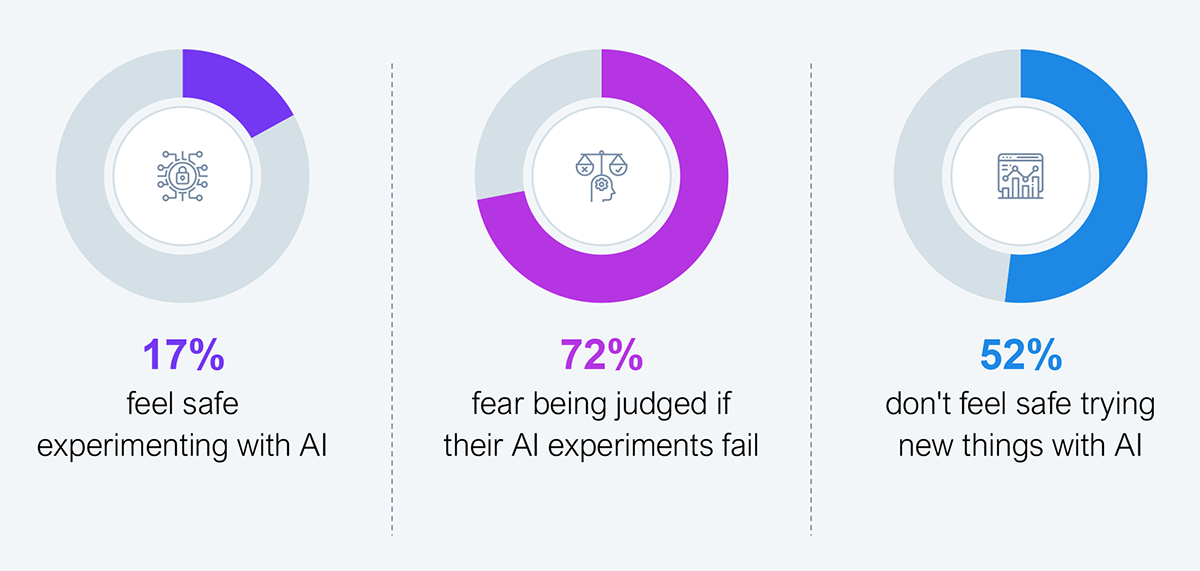
Sample: 505 AI decision makers across Global 2000 enterprises.
Source: HFS Research, 2026
The Softtek Agentic Engineer, the human at the center of its Agentic Engineering Smart Pod, is responsible for three functions: aligning AI activity with business outcomes, orchestrating what AI produces across human and agentic workflows, and validating what AI delivers. The Agentic Engineer approach is not about replacing individual roles with individual agents. It is about restructuring how software gets built for the enterprise, where accountability and human judgment remain non-negotiable.
HFS’s research on the FDE’s role in the Services-as-Software Flywheel (see Exhibit 5) illustrates the importance of an embedded execution layer that wires AI into live data, real permissions, and production governance. Without that engineering discipline, agents sit in pilot mode indefinitely, and vibe coding generates architectural fragmentation.
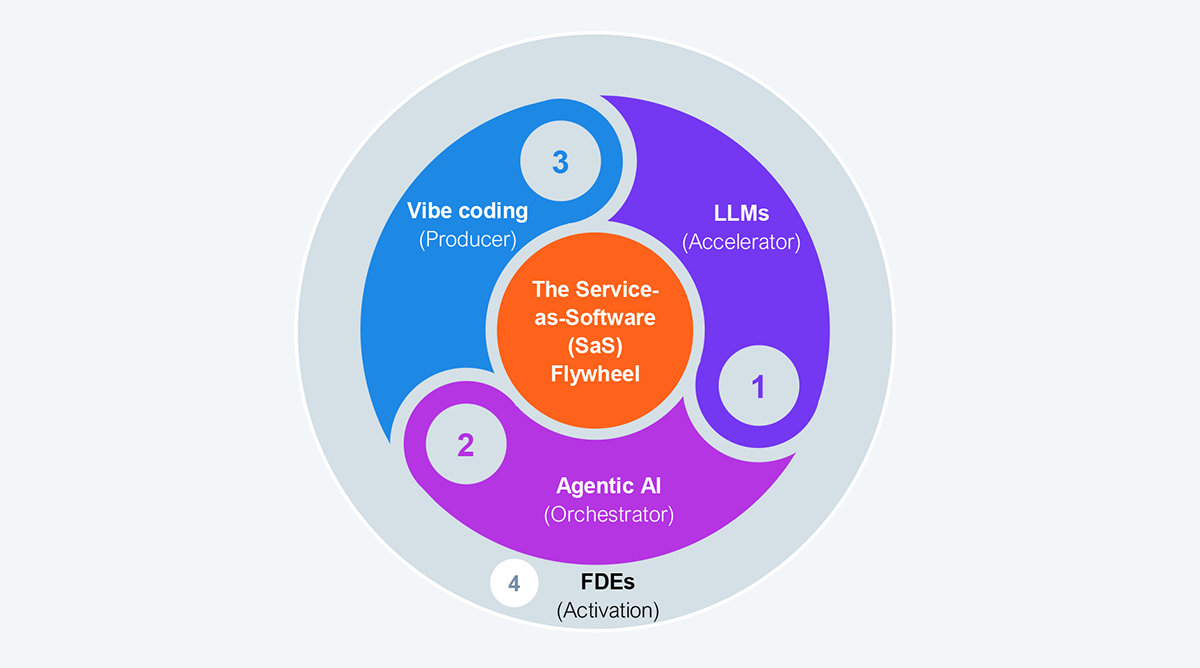
Source: HFS Research, 2026
Here is the question CIOs should be asking their AI partners: “If we achieve everything you are promising, which of our current KPIs become irrelevant, and which new ones emerge?”
Most enterprise KPIs were designed around human constraints, such as how many people you can hire, how many hours they can work, how many licenses you can afford, and how long your customers will tolerate waiting. As agentic AI removes or reshapes those constraints, you must evolve the metrics that define success. Human constraints don’t mean much when resolution times collapse from hours to minutes and workforce productivity shifts from headcount ratios to value-per-outcome. As AI extracts more information from enterprise data in real time, decision velocity will accelerate. The customer support KPI that once measured success as the resolution of an issue within five hours will instead measure whether you turned that resolution into a commercial opportunity.
A partner that only helps you automate against today’s KPIs is optimizing a model that is about to become obsolete. HFS’s research confirms this shift. Old-scale metrics built around revenue and margin per FTE are being replaced by how much value each person creates. The partners worth choosing are those with the customer intimacy and domain knowledge to help you define what your KPIs should become and the engineering capability to instrument AI that delivers against them.
Softtek’s emerging build-operate-share model, which it brands as FRIDA Business Studio, points in exactly this direction: co-funding, co-building, and co-monetizing digital products with clients, sharing in the business outcomes rather than billing for effort. In this commercial evolution, enterprises will increasingly favor deal structures that resemble SaaS businesses over traditional services contracts.
Softtek’s “AI that ships” strategy is built on value stream alignment, knowledge-layered frameworks, and hybrid human-agentic engagement models. This represents a credible and differentiated approach to closing the AI velocity gap for enterprise buyers. The enterprises that choose partners capable of operationalizing AI—governing it, scaling it, and tying it to evolving business outcomes—will define the next era of competitive advantage. The rest will still be forming committees.
Register now for immediate access of HFS' research, data and forward looking trends.
Get StartedIf you don't have an account, Register here |
With the exception of our Horizons reports, most of our research is available for free on our website. Sign up for a free account and start realizing the power of insights now.
Our premium subscription gives enterprise clients access to our complete library of proprietary research, direct access to our industry analysts, and other benefits.
Contact us at [email protected] for more information on premium access.