
This Market Impact Report is for enterprise leaders, C-suite executives, and consulting buyers evaluating how agentic AI is restructuring the economics, delivery models, and commercial terms of professional services.
Enterprise leaders face relentless pressure to transform faster, operate leaner, and deliver measurable impact at scale. Strategic advice alone is no longer enough. They expect consulting partners to deliver solutions that move at the speed of artificial intelligence (AI) rather than the pace of traditional projects.
That shift is exposing the limits of the traditional consulting model, which was built for a world of slower cycles, linear transformations, and manual delivery. The core premise that human-led analysis drives enterprise value is being fundamentally reexamined. With AI introducing new client expectations and service dynamics, clients want more than recommendations—they expect outcomes that can be delivered continuously, not periodically.
This is not just a shift in tools. It’s a rearchitecture of how value is delivered, bought, and governed. IBM and HFS Research surveyed 1,002 senior executives across 16 industries and 14 countries to understand how enterprise demand is reshaping the consulting model.


These findings are more than augmentation. They signal a fundamental shift in how services are structured, delivered, and valued.
Consulting was built for a world of linear change and high-margin strategies. Today’s enterprise leaders are navigating markets that demand real-time action, embedded intelligence, and speed over perfection. The model struggles not because it’s broken, but because enterprise needs have evolved. When business decisions must move as fast as the data behind them, waiting months for recommendations that don’t execute is no longer viable. Leaders want service partners that don’t just advise—but also deliver, adapt, and accelerate outcomes at scale.
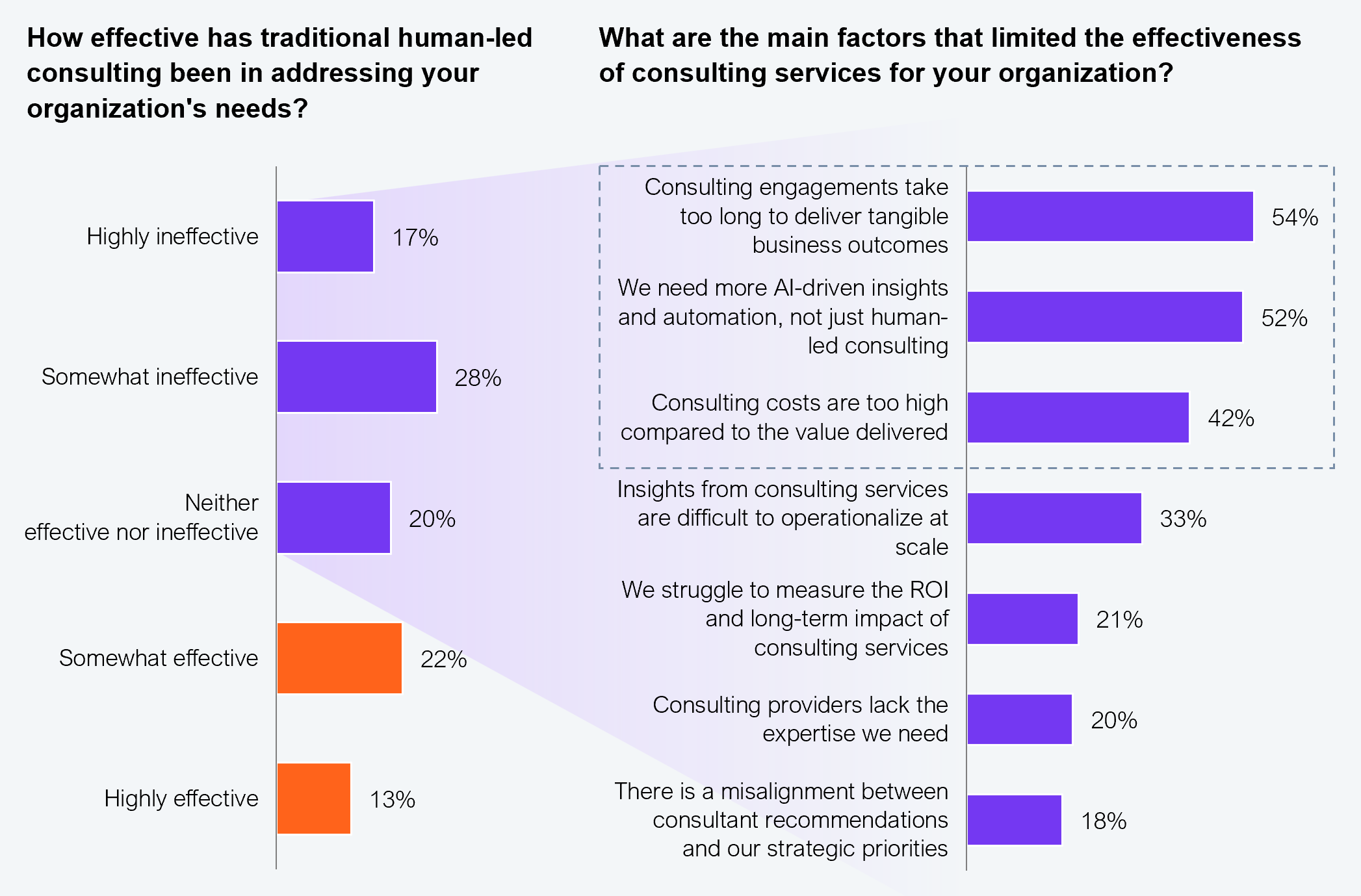
After decades of reliance on traditional human-led consulting, enterprise leaders are now reevaluating its effectiveness. Only 13% rated the model as “highly effective,” and 65% said it fails to deliver real value (see Exhibit 1). These numbers reflect a growing disconnect between client need and what the model is built to deliver.
Sample: 1,002 executives
Source: HFS Research in collaboration with IBM, 2025
The friction points reveal a fundamental mismatch in speed, capability, and value. The concerns aren’t about quality, but about relevance. Apart from better advice, enterprises are looking for different capabilities entirely. The top frustrations with traditional consulting underscore this shift:
Enterprises are raising the bar, expecting services that match the speed, intelligence, and adaptability they’re building internally. This isn’t a call to abandon the model, but a signal that something foundational must change.
Enterprises aren’t walking away from consulting; they’re redefining their needs. The shift to AI-powered services isn’t just about speed or intelligence, but how value is delivered. What used to depend on manual analysis and episodic projects is now expected to operate with continuous execution, embedded intelligence, and scalable systems.
That doesn’t diminish the role of consulting. Strategy, expertise, and guidance remain critical, but these strengths must show up differently now. The future belongs to partners that can combine insight with execution and help design the future while delivering it in real time.
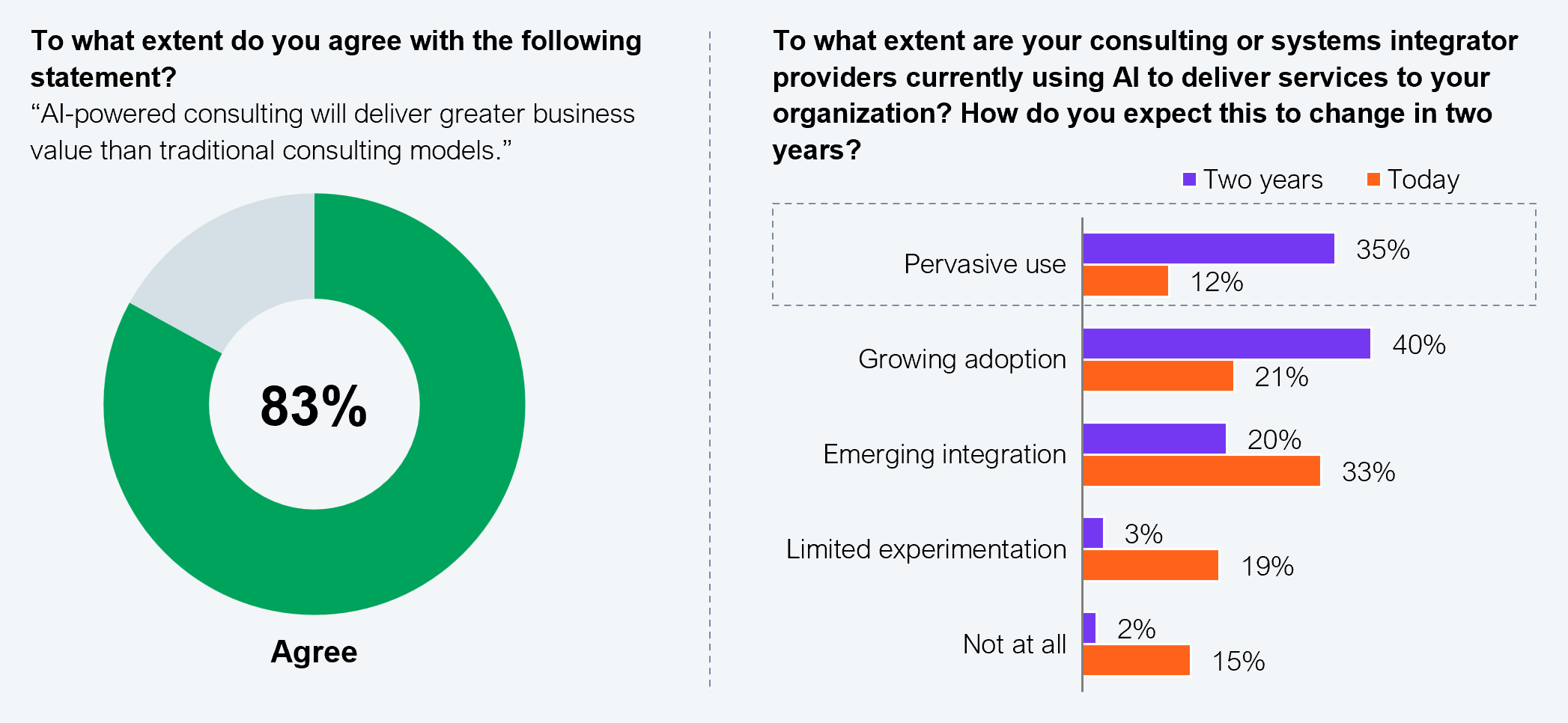
A strong majority (83%) said AI-powered consulting delivers more value than traditional approaches. And the shift is gaining momentum: The share of consulting services delivered with pervasive AI use is expected to nearly triple from 12% today to 35% within two years (see Exhibit 2).
Sample: 1,002 executives
Source: HFS Research in collaboration with IBM, 2025
It’s not advisory work with AI tools sprinkled in. It’s a fundamentally different services model where intelligent systems are the delivery engines. These systems automate analysis, generate insights, orchestrate execution, generate outputs, and adapt based on real-time feedback. Knowledge and expertise are embedded in these digital products and infused into AI models.
This shift reshapes what leaders expect from partners. They’re no longer looking for static roadmaps or long-form recommendations; they want responsive, modular, and embedded solutions that move with the business, requiring a new approach to consulting that delivers outcomes continuously, not occasionally. It also requires a new approach from the client organizations engaging with consultancies, as they will need to adjust how they engage and collaborate to get these benefits.
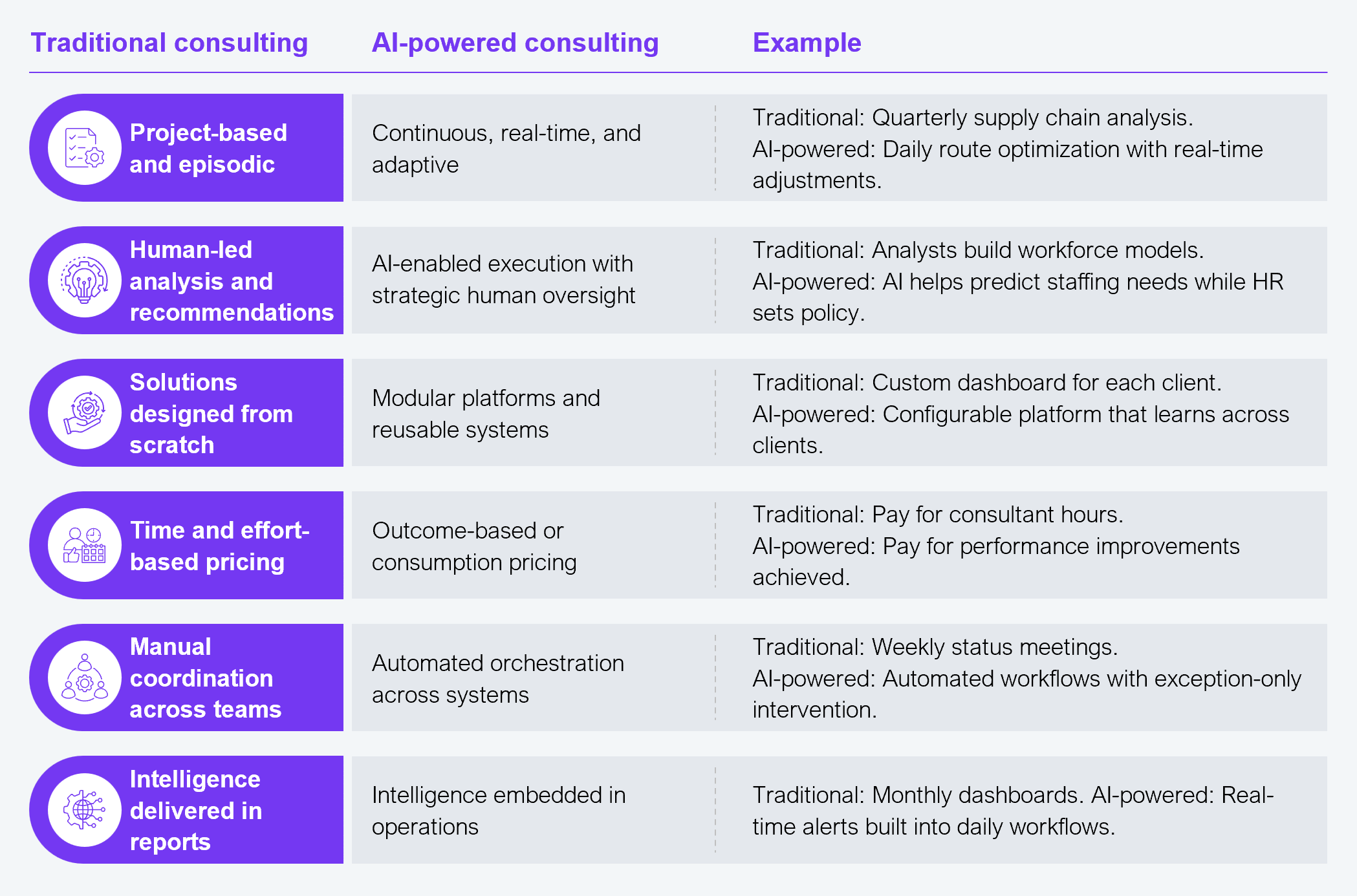
We’ve defined AI-powered consulting by how it operates differently from the traditional model. The difference isn’t just technological; it’s structural (see Exhibit 3).
Source: HFS Research, 2025
This delivery evolution reflects a broader shift across the services industry. For years, consulting and IT services have been grounded in labor-led models: outsourced teams, manual oversight, and fixed, effort-based contracts. That foundation is now eroding with the move to Services-as-Software™, a model where technology takes the lead in delivering services. It minimizes human intervention, increases scalability, and redefines service delivery around efficiency, speed, and continuous value.
As more consulting intellectual property (IP), frameworks, and expertise get embedded into AI tools and digital delivery platforms, enterprises should expect providers to operate as software-native organizations rather than labor brokers. The goal is not one-off deliverables but reusable components, digital agents, and proprietary platforms that can scale and evolve.
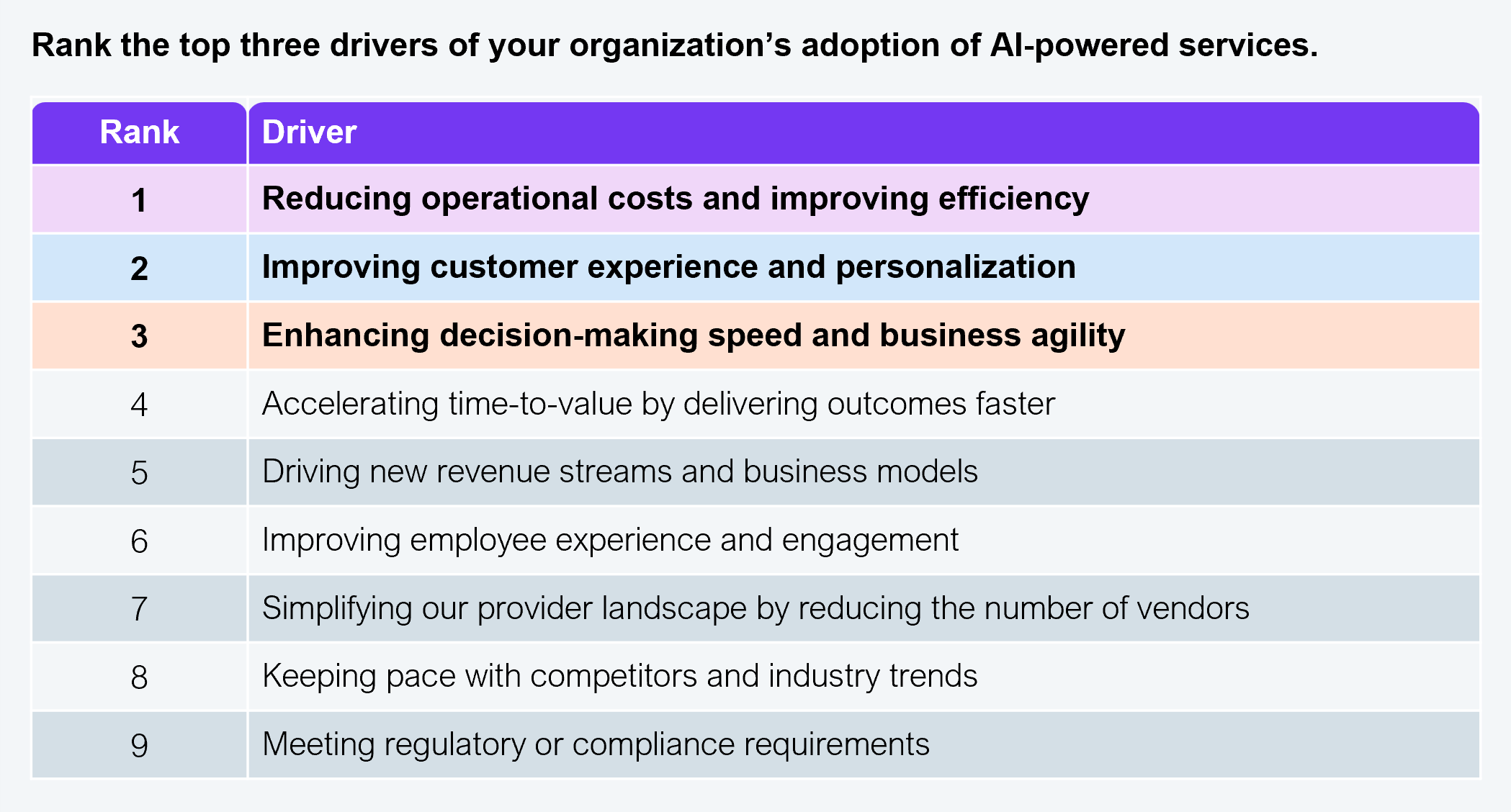
AI-powered services promise to deliver the most impact in places that matter most (see Exhibit 4):
Sample: 1,002 executives
Source: HFS Research in collaboration with IBM, 2025
The next evolution of AI-powered consulting is already emerging. Rather than assisting consultants behind the scenes, agentic systems are beginning to drive service execution directly. These systems can perform tasks, make decisions within defined boundaries, and interact across enterprise systems without constant human input.
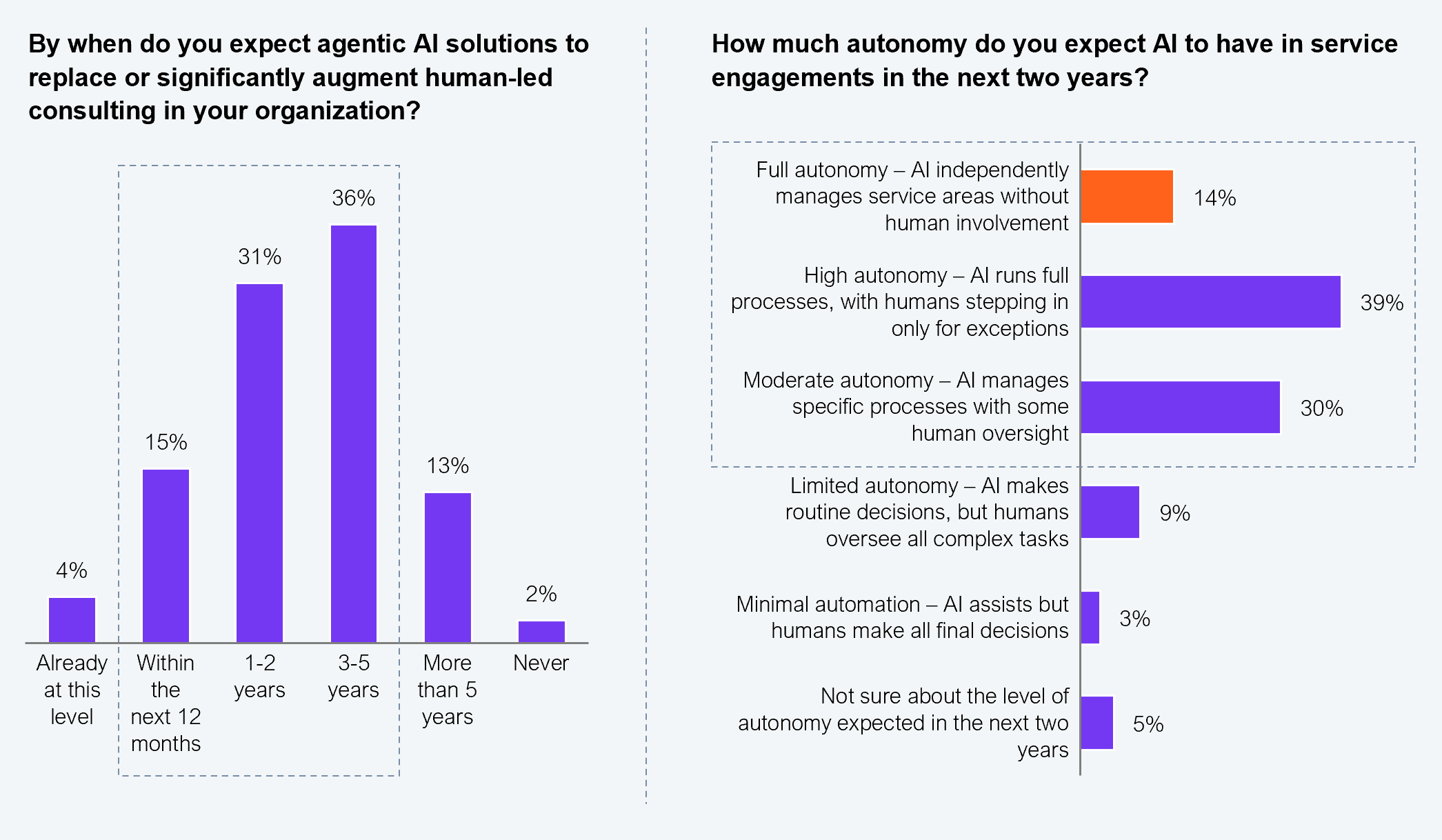
This isn’t about removing humans. It’s about shifting their role away from repetitive coordination and toward higher-order oversight and judgment. Eighty-two percent (82%) of executives expect agentic AI to significantly augment or even replace parts of human-led consulting within five years, and over half anticipate high or full autonomy in some areas within two years (see Exhibit 5).
Sample: 1,002 executives
Source: HFS Research in collaboration with IBM, 2025
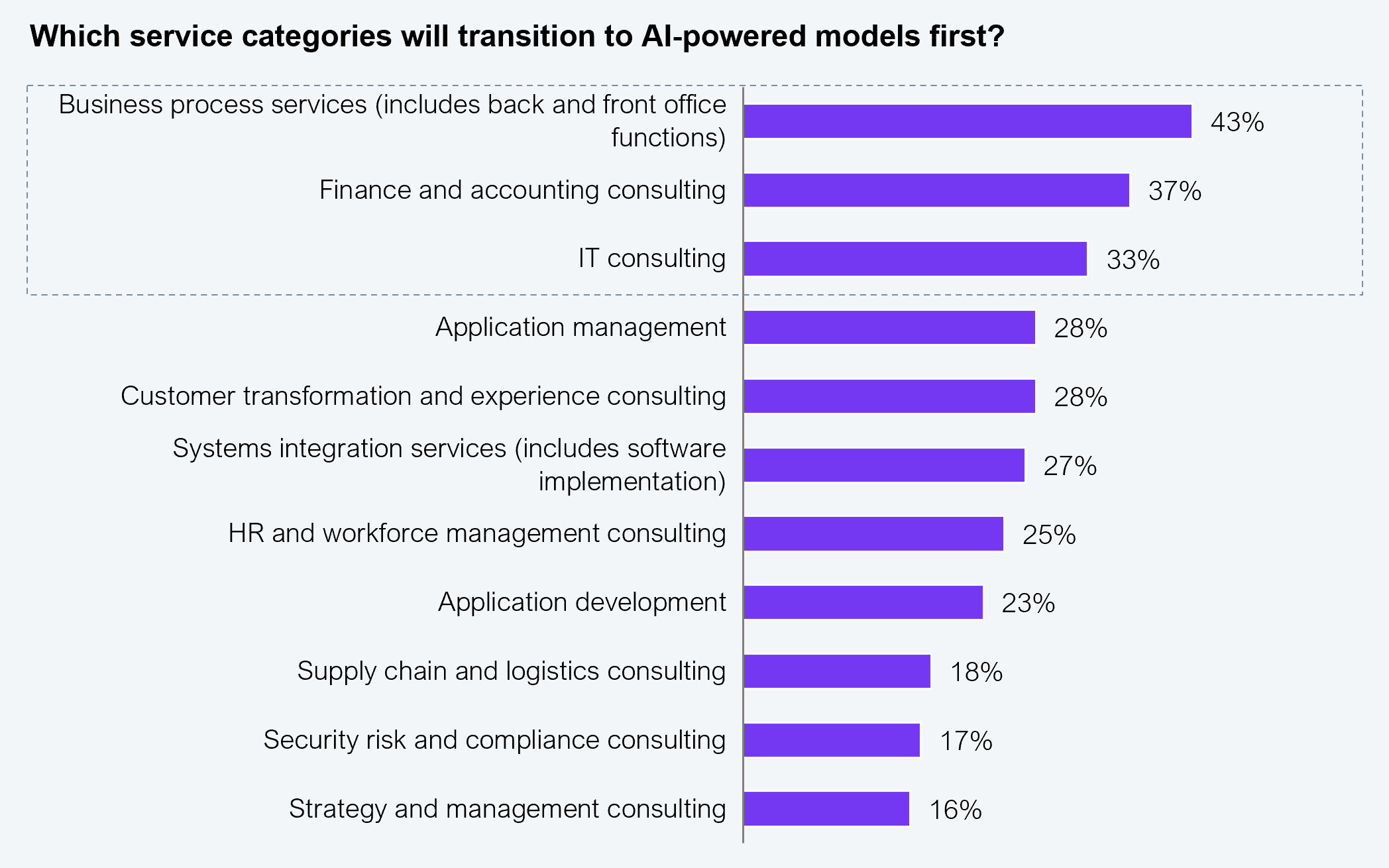
When we ask where AI is landing first, the pattern is clear. Business process services, finance, and IT consulting aren’t just high-volume functions; they’re the support domains where organizations have piloted automation, analytics, and generative AI internally, driving the overall enterprise performance. The shift to AI-first consulting in these areas mirrors how enterprises already use AI to improve speed, reduce cost, and enhance decision-making (see Exhibit 6).
AI thrives where workflows are both repeatable and strategic, and when reducing time-to-value creates competitive advantage and accelerates change and transformation, not just operational efficiency.
Sample: 1,002 executives
Source: HFS Research in collaboration with IBM, 2025
But even as AI takes over more of the delivery layer, human expertise isn’t disappearing; it’s shifting. Orchestration becomes a critical human-led activity in consulting.
As AI transforms the foundation of service delivery, the role of human consultants is not disappearing; it’s evolving. With intelligent systems increasingly handling execution, enterprises need human expertise focused on strategic direction, sense-making, and accountability. This upstream repositioning ensures that people shape decisions without being bottlenecks to scale. Enterprise leaders are now rethinking how they can deploy that expertise, investing in fewer, higher-impact interventions rather than embedding human input at every delivery layer.
AI is reshaping where and how human talent delivers value. In traditional consulting, people were involved at every step—analyzing data, coordinating tasks, and managing delivery. As AI can increasingly handle these activities, human effort is shifting toward the front of the value chain.
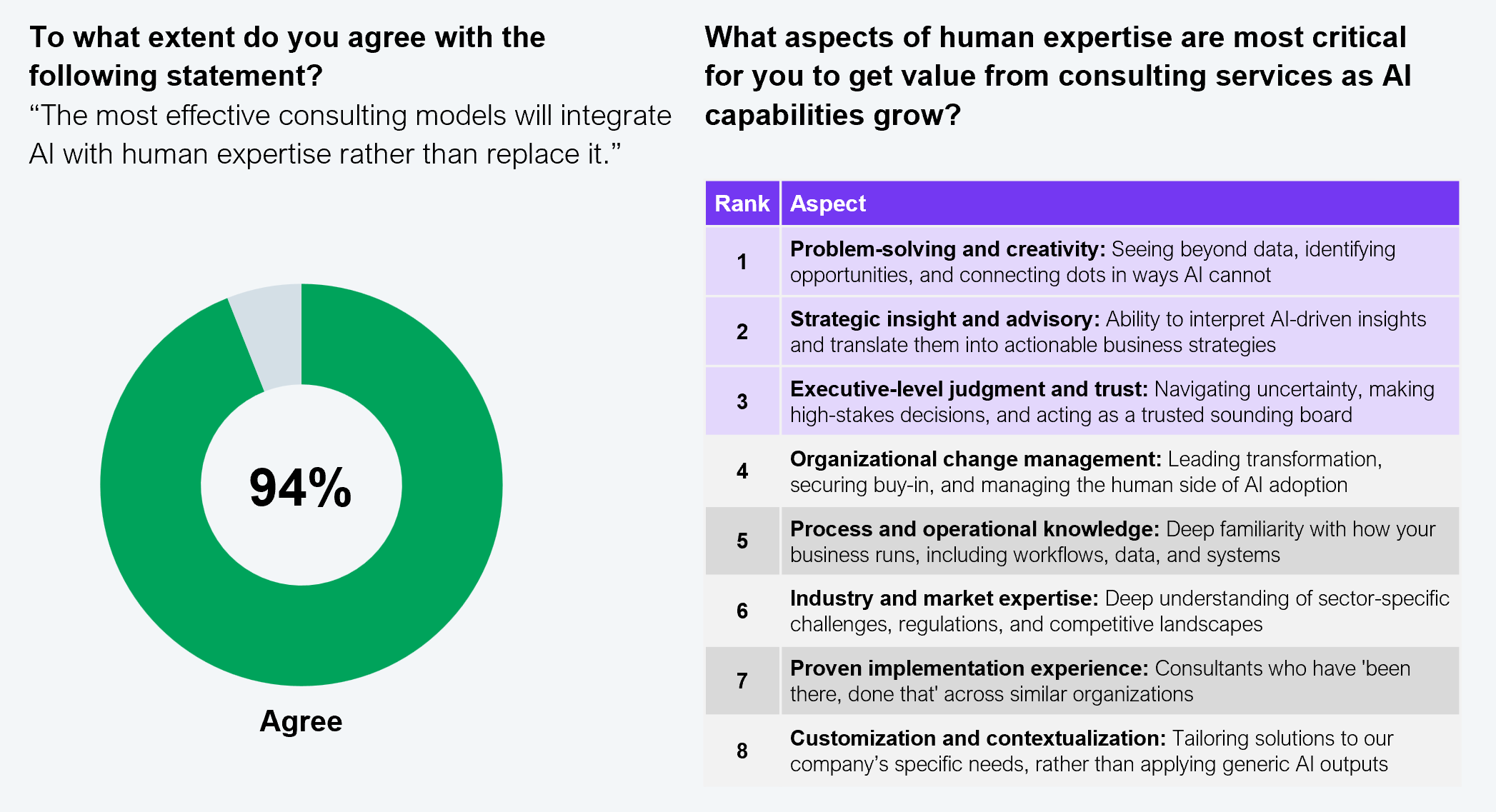
Strategic judgment, creative problem-solving, and contextual decision-making are becoming the most valuable contributions. These capabilities aren’t optional. They are essential for aligning AI systems to business goals, resolving ambiguity, and confidently driving transformation (see Exhibit 7). Enterprises are no longer paying for hours worked; they’re paying for smart decisions and clear strategic directions.
The shift mirrors the changes within enterprise operating models. As automation becomes embedded, employees are being freed from routine execution and asked to contribute at higher levels of strategic and cross-functional thinking. Organizations are finding that human value is not displaced by AI, but redefined and concentrated in new places.
Sample: 1,002 executives
Source: HFS Research in collaboration with IBM, 2025
Consulting partners with strong AI capabilities and high-caliber strategic talent will drive the most impact. Leaders should evaluate providers not only on their AI tooling, but also on their ability to help shape direction, challenge assumptions, and guide change. Internally, this shift also demands a rethinking of talent models. As automation scales, so must investment in upskilling, judgment-based roles, and decision governance. The most effective enterprises will be those that match technical capability with human clarity.
Enterprises aren’t just rethinking how consulting is delivered but how it’s paid for. The commercial models that defined traditional consulting were built around time, effort, and staffing levels. But in an AI-powered world, value is no longer measured in hours logged or teams deployed. It’s measured by outcomes delivered, systems improved, and speed to impact.
Enterprise leaders are questioning whether legacy pricing structures align with how modern services are delivered. Contracts should evolve alongside capabilities, shifting from input-based billing to outcome-based accountability.
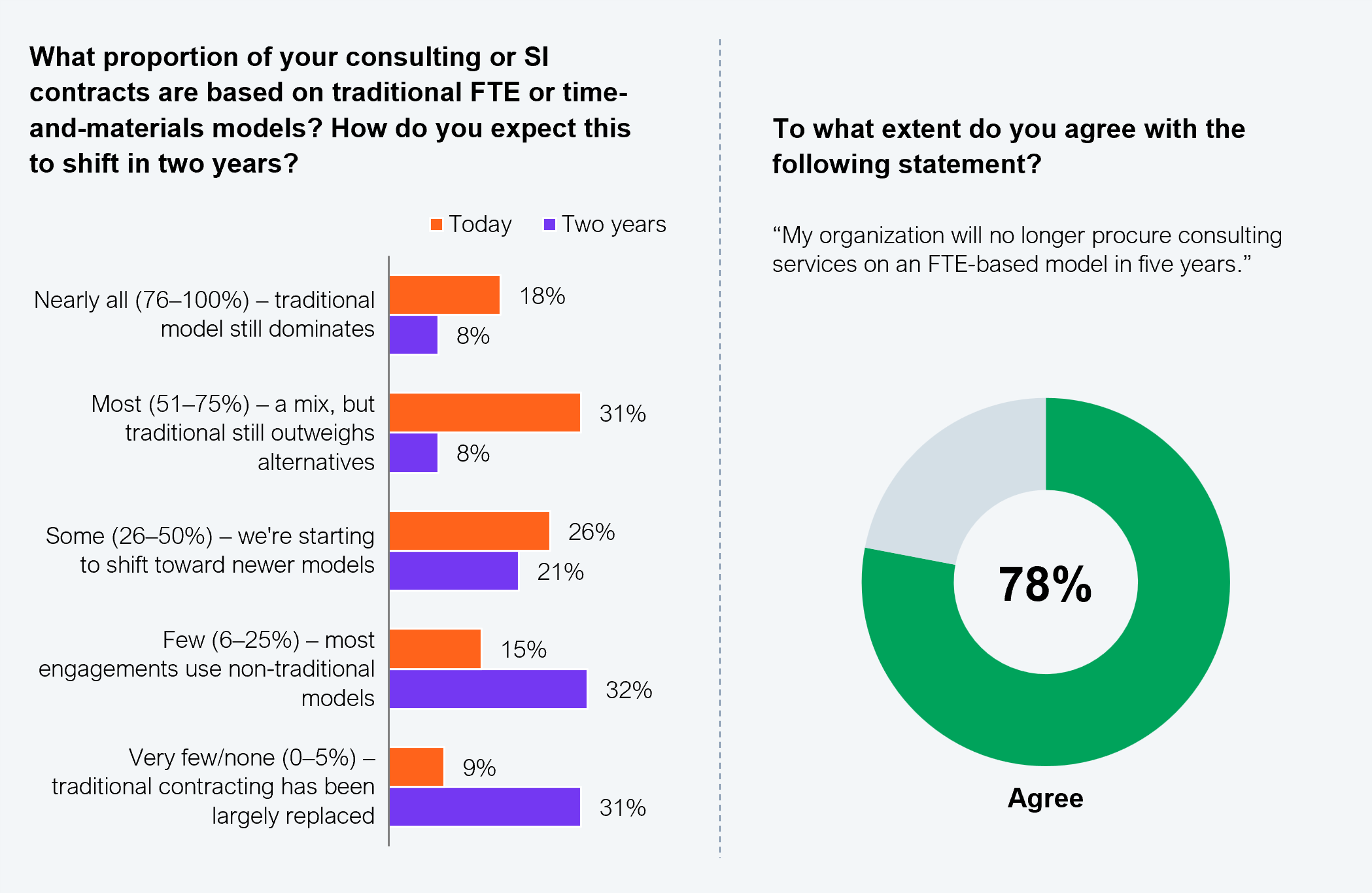
Nearly half of the enterprises still use FTE-based or time-and-materials models for consulting engagements. However, 78% plan to abandon these approaches entirely within five years. The reason is simple: paying for human time makes little sense economically when AI can deliver analysis in hours instead of weeks (see Exhibit 8).
Organizations using predominantly non-traditional models will surge 2.6x from 24% today to 63% within 24 months. This represents a massive shift in how enterprises buy professional services, and those that adapt their procurement practices early will capture better economic terms and performance guarantees.
Sample: 1,002 executives
Source: HFS Research in collaboration with IBM, 2025
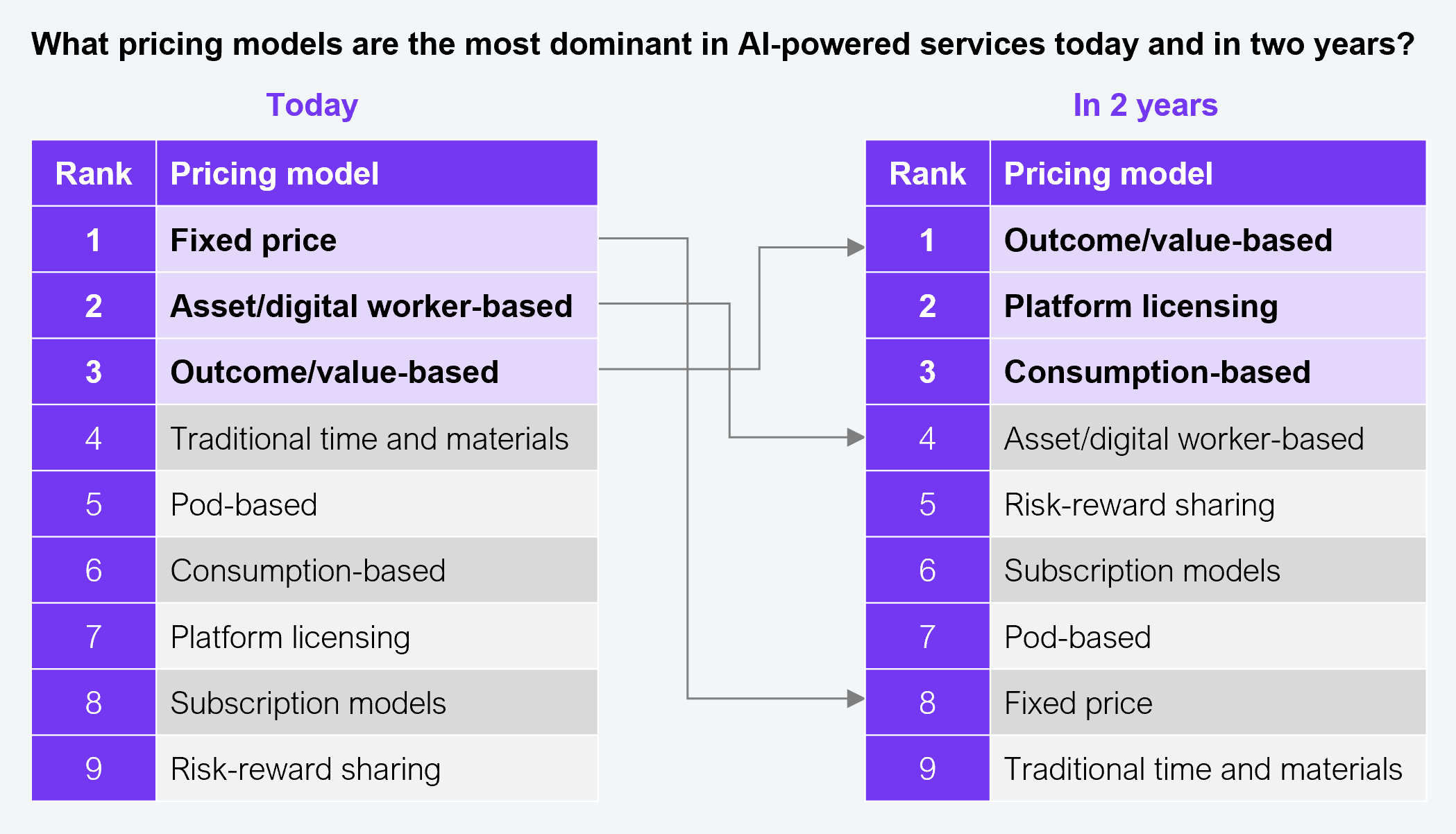
In its place, outcome-based, consumption-driven, and platform-linked pricing are replacing effort-based models. Outcome-based pricing is expected to leapfrog from third place today to the top within two years. Platform licensing will jump from seventh to second place, while traditional time-and-materials models will collapse from fourth to ninth place (see Exhibit 9).
This isn’t just a financial preference. It’s a sign that consulting is being recast in the image of modular, scalable, and continuously adaptive software. Enterprises want commercial models that reflect the pace of AI itself. They’re done paying for time; now it’s about impact.
Sample: 1,002 executives
Source: HFS Research in collaboration with IBM, 2025
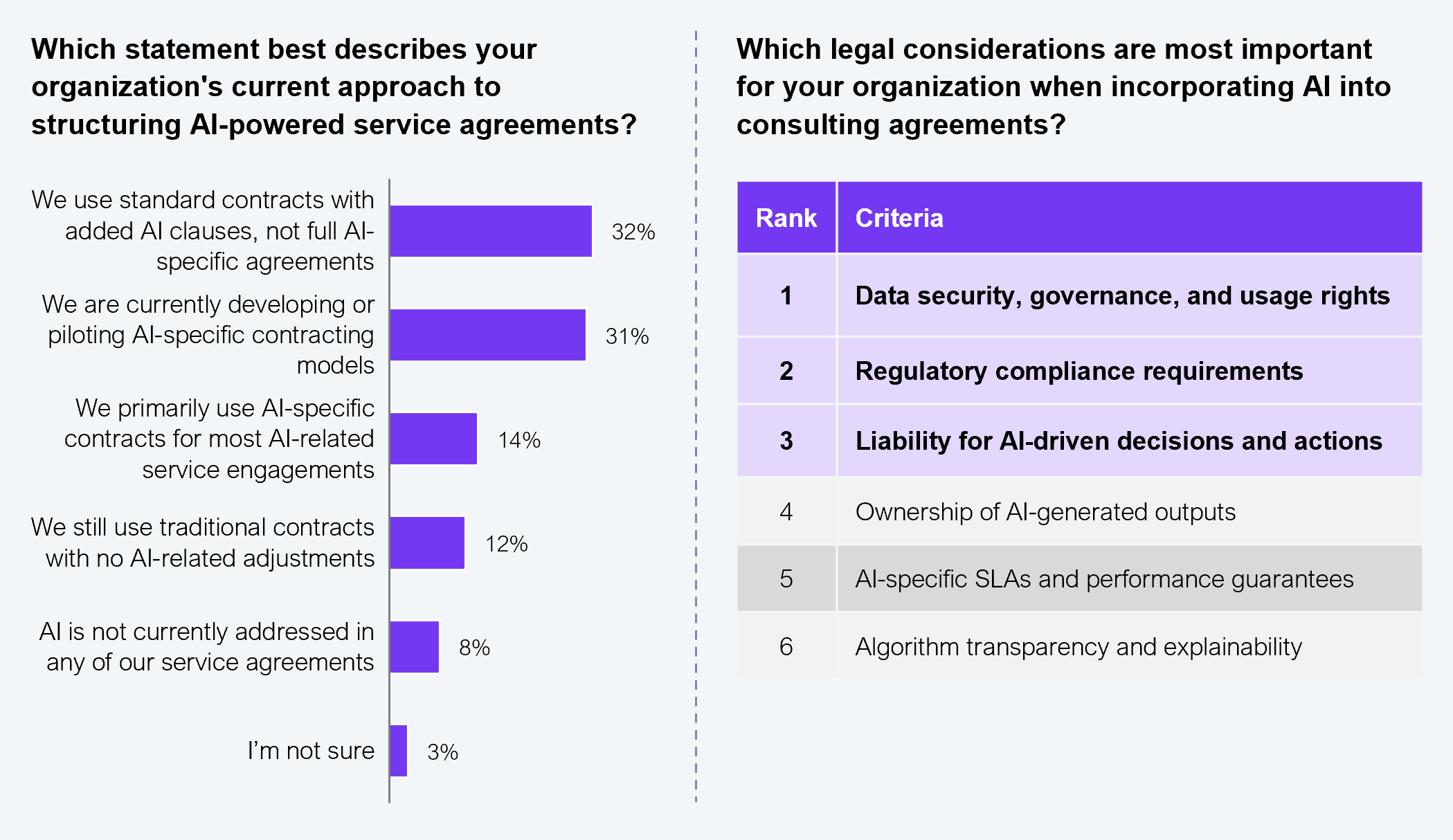
AI-powered consulting brings a new legal and commercial reality, but most enterprises still operate with old tools. Only 14% said they use AI-specific contracts today. Instead, most rely on traditional templates (32%) or are in the early stages of rethinking how they structure service agreements (31%) (see Exhibit 10).
Sample: 1,002 executives
Source: HFS Research in collaboration with IBM, 2025
This disconnect between the nature of AI-powered services and the legal frameworks supporting them has real consequences. These are not minor updates to existing contracts. AI services raise fundamental questions around retraining rights, shared accountability for machine-generated outcomes, IP ownership, and the explainability of automated decisions. Yet legal teams remain behind the curve, often focused on conventional terms such as liability and pricing while underestimating the operational risks of embedded intelligence.
Enterprises are starting to recognize this gap. When asked about the most important legal considerations for AI-infused consulting engagements, leaders prioritized data governance, regulatory compliance, and usage rights over more familiar concerns such as service level agreements (SLAs) or IP ownership. This marks a shift in mindset from protecting the business against human error to governing systems that operate at machine scale and speed.
To make AI-powered consulting work in practice, organizations must build contracts that behave more like software licenses than service agreements.
The appetite is strong. Enterprise leaders are actively seeking AI-powered services that can deliver faster, smarter, and more scalable impact. But while demand is rising, most aren’t yet equipped to operationalize these models. The disconnect is not about vision; it’s execution.
Many enterprises lack the internal muscle to absorb and manage AI-led service delivery. Governance for AI accountability is underdeveloped, contracting models are outdated, and integration capabilities are inconsistent. This isn’t a technology adoption challenge. It’s a full-scale operating model transformation.
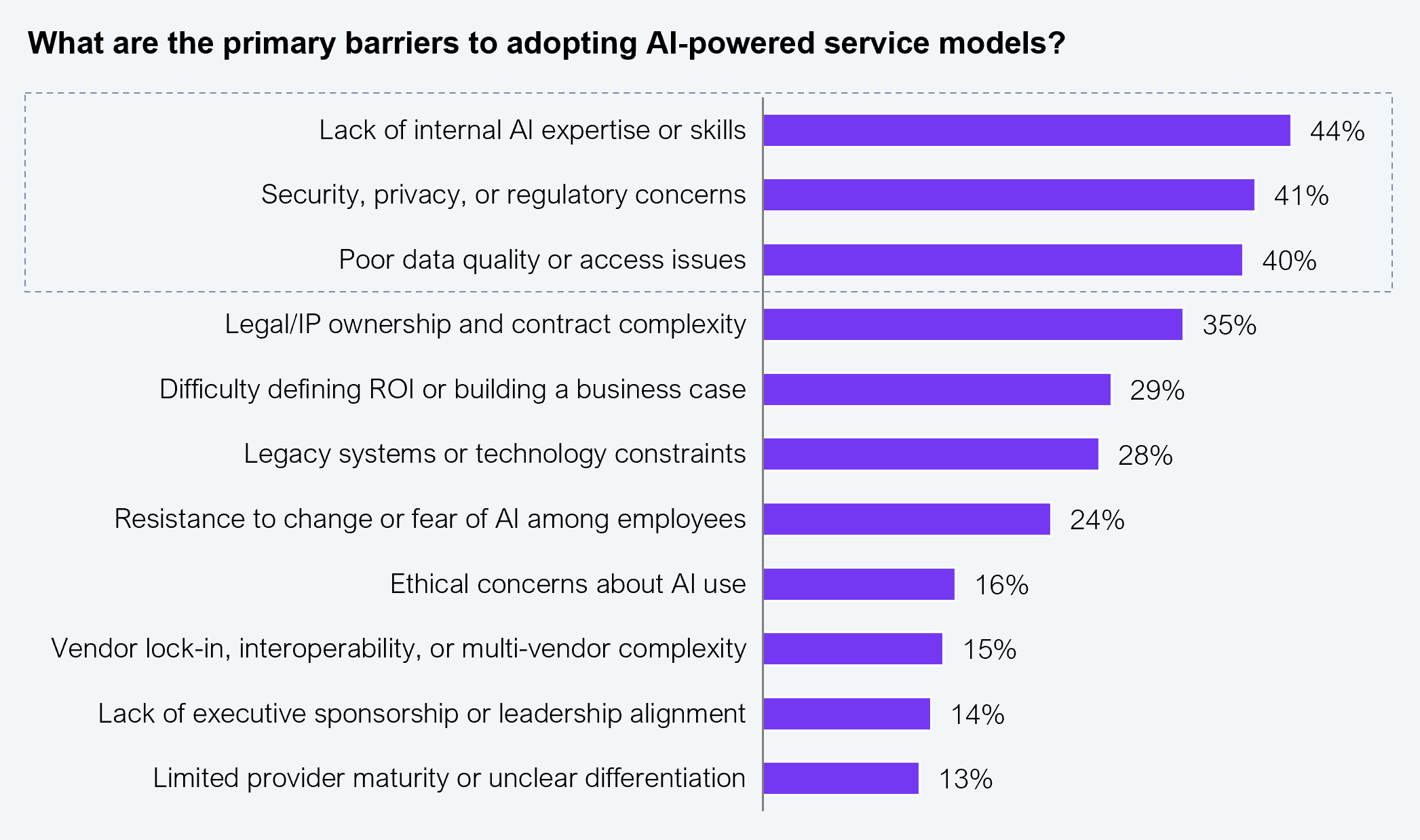
When asked directly about the biggest obstacles to adopting AI-powered service models, the top three challenges are all internal: lack of AI expertise or skills (44%), security and regulatory concerns (41%), and poor data quality or access (40%) (see Exhibit 11).
These aren’t edge cases. They’re structural gaps. AI-powered consulting assumes systems can make decisions, automate actions, and adapt continuously—changing how people interact with services and how they’re expected to contribute. Without the right change infrastructure, those assumptions break. Line managers resist, teams work around new systems, and adoption stays surface-level. The real challenge is not whether AI can deliver, but if enterprises can absorb what it enables.
Sample: 1,002 executives
Source: HFS Research in collaboration with IBM, 2025
The shift to AI-powered consulting isn’t about layering in new tools. It’s a deeper transformation that rewires how work is coordinated, who makes decisions, and how accountability flows. Most enterprises are still structured for human-led service delivery, not AI-native execution. This isn’t just a change initiative. It’s an operating model reset.
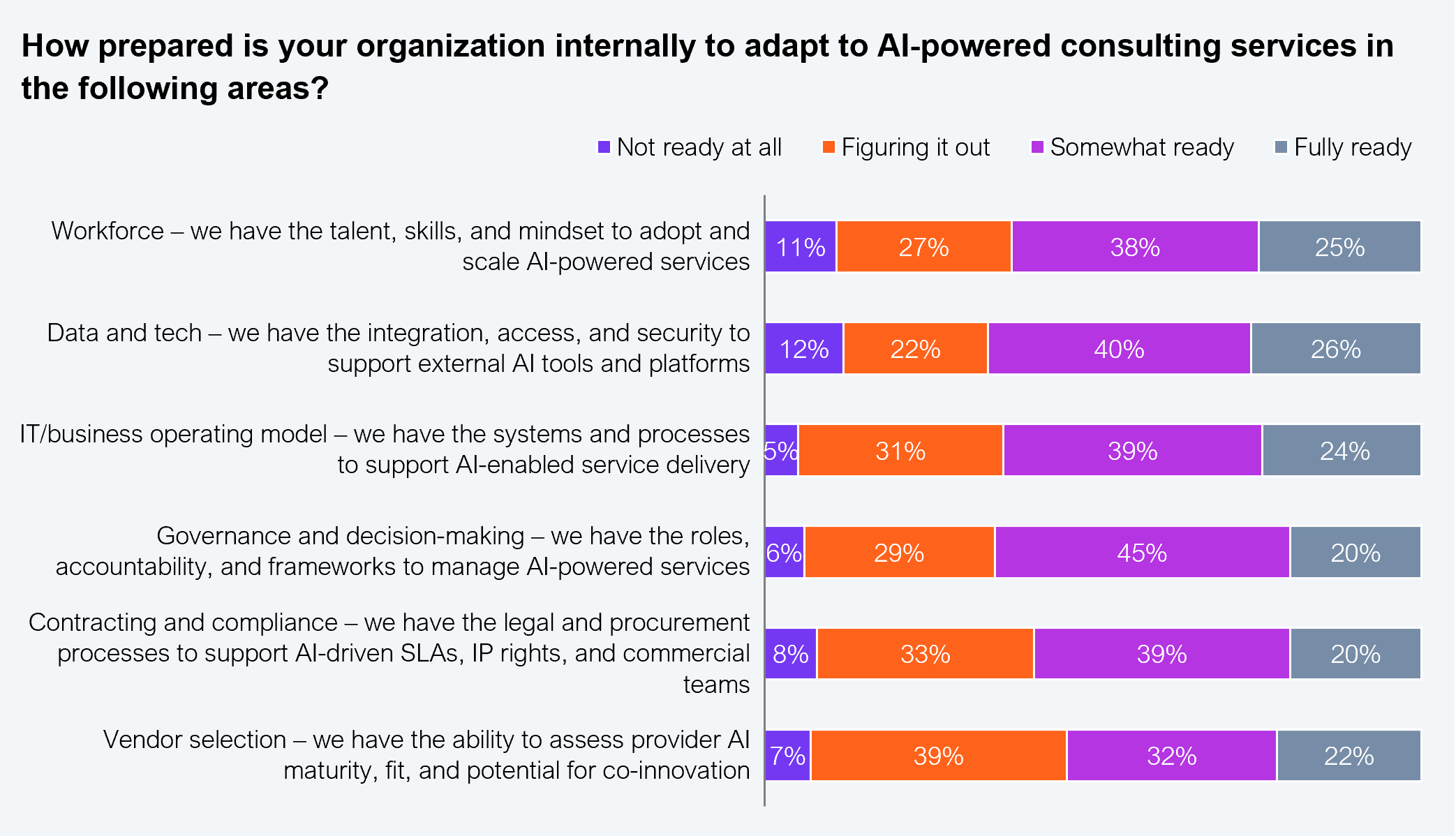
Across workforce, data, governance, and vendor management, fewer than 30% of the enterprise leaders said they are fully prepared (see Exhibit 12). These are not isolated gaps, but symptoms of a larger misalignment between legacy structures and the demands of AI-powered consulting.
Sample: 1,002 executives
Source: HFS Research in collaboration with IBM, 2025
As enterprises adopt AI-native service delivery, internal teams will need to evolve. New roles, such as AI contract managers, orchestration leads, and agent governance architects, will be required to manage systems and accountability, not just vendors and SLAs. Even with stronger internal capabilities, success will ultimately depend on whether enterprises and external partners can orchestrate performance across systems, platforms, and providers. That orchestration challenge defines the next frontier for AI-powered consulting.

Even with internal readiness improving, the next hurdle is external: aligning the ecosystem. AI isn’t delivered by a single tool or vendor; it emerges from a web of systems, services, and platforms that must function as one.
Most organizations aren’t equipped to manage this complexity alone. They’re navigating a sprawl of disconnected providers, models, and architectures without a clear integration path. The differentiator lies in turning this sprawl into a cohesive, governed, and auditable delivery system. What leaders need are partners that can make capabilities work together seamlessly, securely, and at scale.
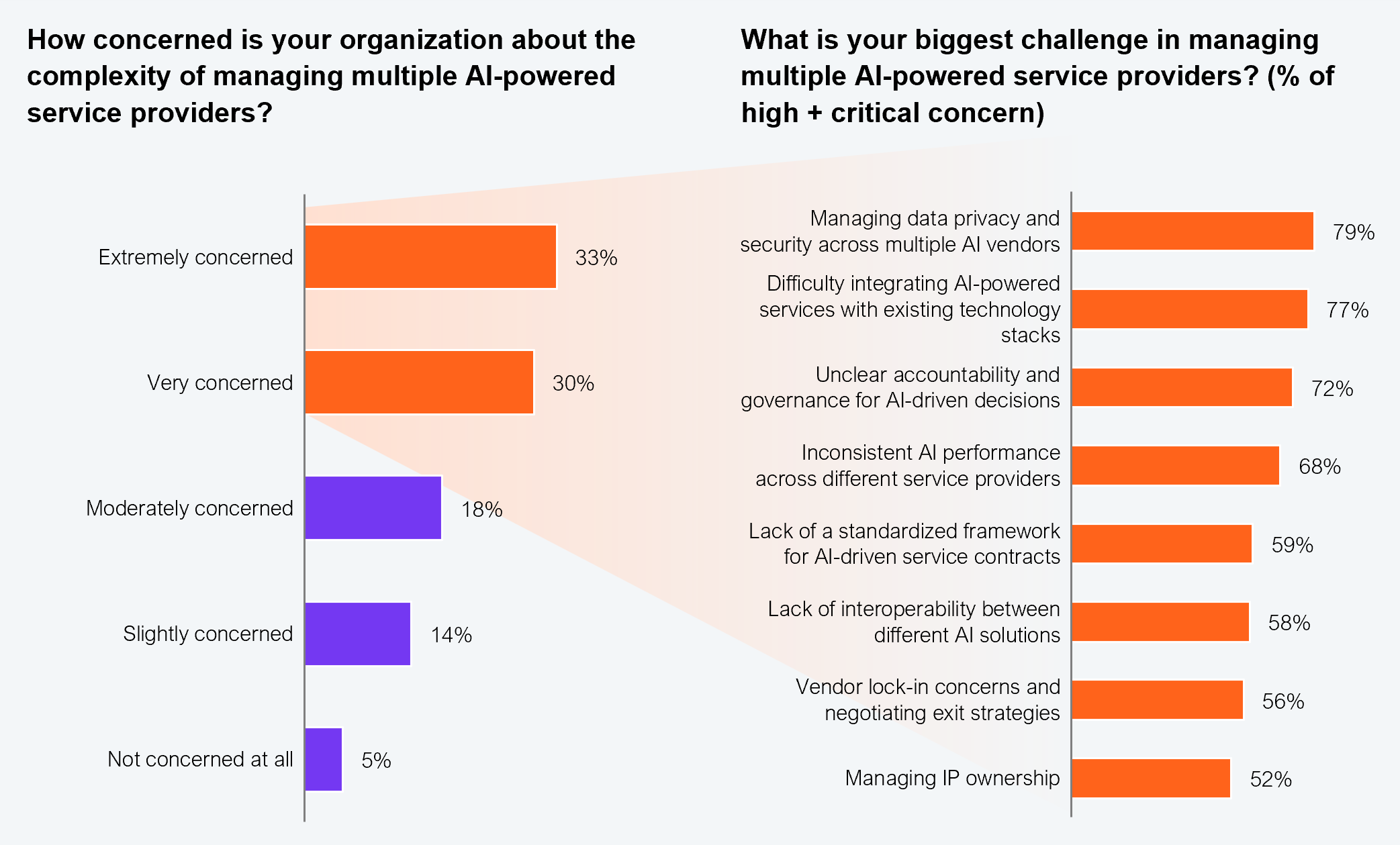
Sixty-three percent (63%) of executives said they are highly concerned about managing vendor sprawl, and 79% cited managing data privacy and security across providers as their biggest challenge (see Exhibit 13).
Integration complexity is where even well-intentioned AI strategies collapse. Enterprises struggle to align vendor performance, standardize data governance, and ensure systems communicate effectively. More than three-fourths (77%) reported difficulty integrating AI services with existing technology stacks, and 72% pointed to unclear accountability and governance for AI decisions.
Sample: 1,002 executives
Source: HFS Research in collaboration with IBM, 2025
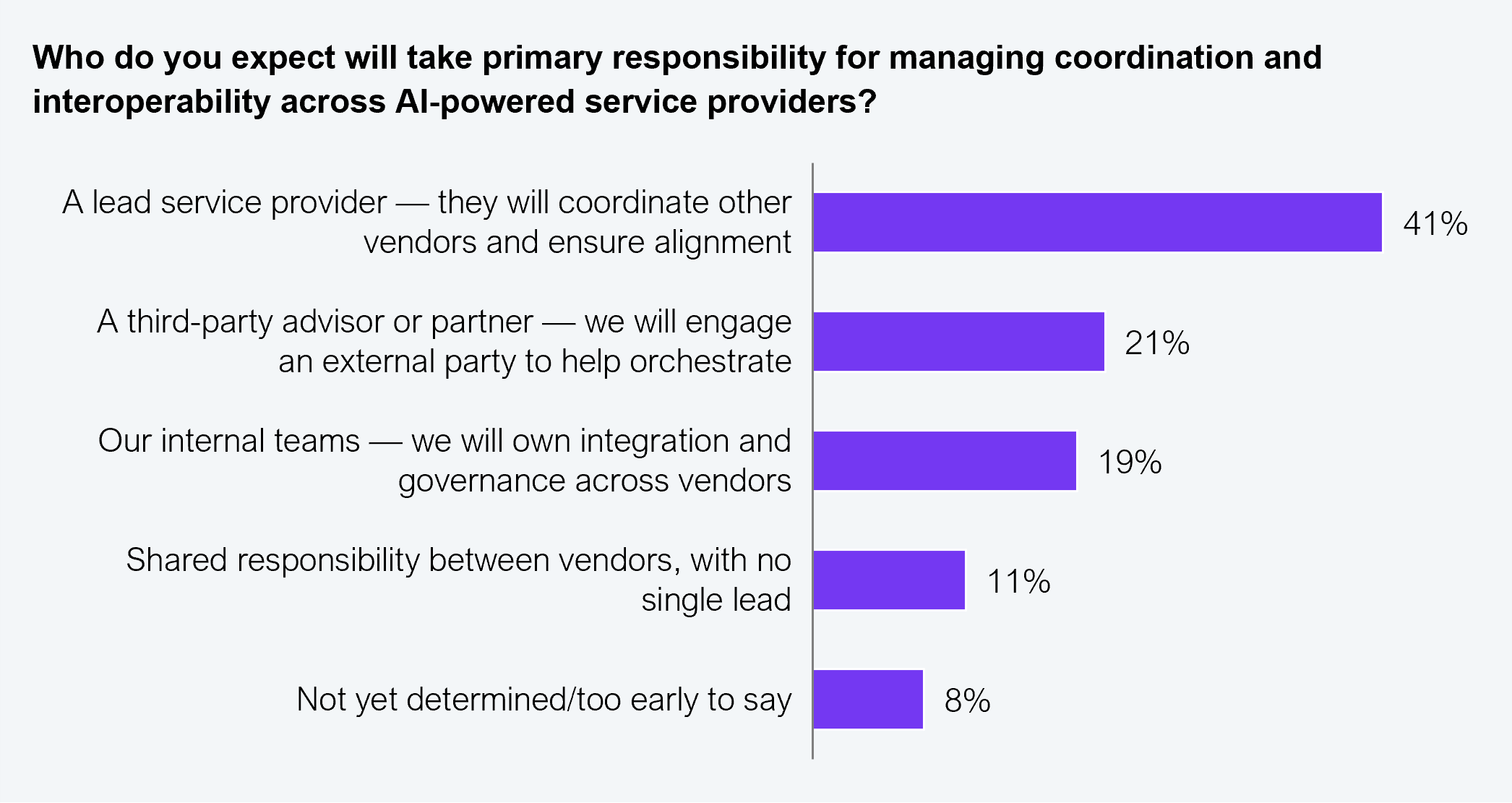
Recognizing these complexity challenges, most organizations don’t feel equipped to handle vendor coordination internally. Just 19% expect to manage integration and governance across AI providers themselves. Instead, 41% said they will look to a lead service provider to orchestrate their ecosystem, while 21% planned to engage third-party advisors for orchestration (see Exhibit 14).
This shift is from an operational realm to a strategic one. The ability to integrate, govern, and evolve a multi-vendor AI ecosystem is becoming a premium capability in its own right. Enterprises that treat orchestration as a core competency, built internally or enabled through trusted partners, will gain the agility, security, and scalability needed to turn fragmented AI initiatives into sustained value.
Sample: 1,002 executives
Source: HFS Research in collaboration with IBM, 2025
An emerging challenge for enterprises is the interoperability of AI agents and platforms provided by multiple consulting partners. In multi-vendor engagements, enterprises often face fragmentation as each provider brings its own AI systems, agent libraries, or proprietary tools. The real value comes from AI that can be orchestrated across vendor boundaries, with reusability, governance, and handover models that allow internal IT and business teams to continue using these agents after the engagement ends. Without clear interoperability standards, enterprises risk vendor lock-in and inconsistent outcomes.

AI-powered consulting is gaining traction, but most enterprises aren’t yet positioned to capture its full value. While expectations are rising, many organizations still rely on legacy models that are not designed for intelligent, adaptive service delivery. The gap between what leaders want and what their systems can support creates friction across procurement, governance, and execution.
Enterprises must rethink how they engage with service providers to close that gap. This isn’t about minor adjustments. It requires shifts in how services are sourced, managed, and measured. Here are six actions that show where that shift must happen and how leaders can build the foundation for scalable, AI-powered consulting.
1. Choose orchestrators, not just executors. A single team does not deliver AI-powered consulting. It spans agents, platforms, and service providers. The value is no longer in headcount, but in the ability to coordinate performance across distributed systems. An orchestrator should
If a provider can’t connect the dots, they’re not accelerating your strategy—they’re adding friction.
2. Make governance a strategic weapon. AI moves faster than policy. Enterprises that wait for legal and compliance teams to catch up will always be behind. Governance must be embedded by design, not bolted on post-deployment. Build proactive mechanisms to
Trust can’t be outsourced. It must be codified at every layer of the AI lifecycle.
3. Redesign procurement for velocity. Procurement is often where AI ambition goes to die. Traditional RFPs, FTE-based benchmarks, and rigid scopes are relics of a slower world. In an AI-native model, speed, adaptability, and impact should guide how services are bought. Shift toward
If your providers can’t price to outcomes, they’re not built for your future.
4. Redesign the operating model. AI transformation isn’t a procurement project, but an operating model shift. The most successful enterprises aren’t clients; they’re co-creators. They embed AI into the core of their business as an operating principle, not a tool. To lead this shift
If your people are doing what AI can do, you’ve failed both.
5. Raise the bar on your providers. Your providers should be moving faster than you are. If they are not embedding AI in delivery, evolving their models, and designing for measurable outcomes, they are liabilities, not partners. Expect
Also ask: Are providers transforming their own delivery operations as they help you transform yours? Firms that modernize internally while guiding clients through disruption bring credibility as well as capability.
6. Treat transformation as a people challenge, not just a platform shift. AI-powered consulting requires more than plugging in new technology. It demands new ways of working, new decision models, and new mindsets across the organization. Change management must move beyond communication plans into real ownership and behavior change. Enterprises must
Organizations that fail to bring their people along will stall adoption, regardless of how advanced their providers or platforms are.
The traditional model of billable hours and slow strategy cycles has collapsed under the weight of AI-powered expectations. Enterprises no longer want advice; they demand adaptability, orchestration, and outcomes at machine speed. Success in this new era won’t come from tweaking old models, but from architecting new ones where
Enterprises that act like architects (designing for speed, intelligence, and outcomes) won’t just adapt to AI-powered consulting; they’ll define it. This shift involves rethinking procurement for outcomes, embedding governance by design, choosing orchestrators over executors, raising the bar on partners, redesigning operating models, and putting people at the center of change.
Register now for immediate access of HFS' research, data and forward looking trends.
Get Started



If you don't have an account, Register here |
With the exception of our Horizons reports, most of our research is available for free on our website. Sign up for a free account and start realizing the power of insights now.
Our premium subscription gives enterprise clients access to our complete library of proprietary research, direct access to our industry analysts, and other benefits.
Contact us at [email protected] for more information on premium access.

