
How Henkel created a shared services hybrid workforce
HFS, with support from Blue Prism, is showcasing real enterprise journeys with robotic process automation (RPA). This report spotlights Henkel, a Germany-based global manufacturer of industrial and consumer goods, on its journey to create a hybrid workforce in its Shared Services Center (SSC) organization using Blue Prism connected-RPA.
If we take a step back from all the hype and rhetoric surrounding intelligent automation (IA), most enterprises agree that its ultimate purpose is to transform business operations. Literally, how work gets done is changing due to the inevitable—yes, inevitable—tide of change agent technologies represented in HFS’ Triple-A Trifecta and their impact on enterprise business processes and workflows. We should regard the very notion of creating a digital workforce to complement the human workforce as a seismic shift requiring enduring change management.
Successful adoption of IA requires curated change for your tech leaders and practitioners, a revamp or reinvention of business processes, and substantial engagement with the workforce to ensure that they are both aware of how work is changing and that they are active in driving it. The successful creation of a hybrid workforce depends on broad change management that pervades people, processes, and technology.
Henkel strives to transform a 140-year-old brand
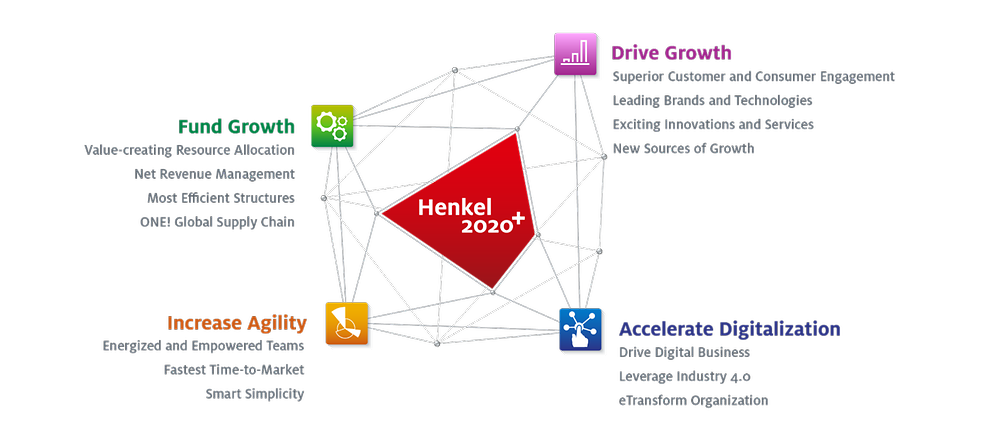
Henkel, founded in 1876, is a German manufacturer of industrial and consumer goods with three operating units—Adhesive Technologies, Beauty Care, and Laundry & Home Care. At the end of 2016, the firm announced a new corporate strategy called Henkel 2020+. The strategy drives sustained and profitable growth based on four strategic priorities—fund growth, drive growth, accelerate digitalization, and increase agility (Exhibit 1)—across its internal processes and customer-facing activities. One of the firm’s key initiatives tied to both digital acceleration and increased agile business processes for internal operations was the next chapter of the transformation of its SSC.
Exhibit 1: Henkel 2020+—its strategic priorities and initiatives
Source: Henkel, 2019
Henkel embraced an SSC model for finance transformation beginning in 2009. This strategy centered squarely on driving cost and process efficiencies and involved centralizing processes in more cost-effective nearshore and offshore countries such as Slovakia and the Philippines and then standardizing operations and driving efficiencies. As it refined its SSC strategy, automation in the form of desktop automation often came into play; thus it was already somewhat part of the SSC culture of efficiency and continuous improvement.
Supported by the 2020+ strategy, the SSC team started evaluating robotic process automation (RPA) in 2016. The firm went through some early trial and error to determine what RPA was and if it would be a viable automation and efficiency tool. By early 2017, Henkel was sufficiently convinced that RPA could help drive greater efficiency and, more specifically, improve the quality of work in the workplace by adding digital workers.
Henkel’s RPA program is born, co-led by IT and its SSC organization
From inception, Henkel built its RPA program jointly with IT, its SSC organization, and business stakeholders. IT’s inclusion was essential to ensure RPA worked well with its existing infrastructure and standards, whereas business operations’ inclusion was critical for sustainable demand management and execution. Henkel formed a steering committee and identified an ambitious array of in-scope processes to focus on, including order to cash (OTC), source to pay (STP), master data management (MD), intercompany (IC), and general accounting/controlling (GA/CO). As OTC was the biggest in-scope area with highest value potential, the company appointed Leonardo Lopez, Corporate Manager IT Consulting Head for OTC and Customer Services, to assume the IT leadership for its RPA program. Lopez, an experienced IT professional with Henkel since 2001, had a strong business consulting and technological background in SAP enterprise resource planning (ERP) and customer relationship management (CRM) program management and he regularly worked across an array of constituencies to drive business transformation.
Henkel named its RPA program “IBotS.” As the program took shape, its three critical pillars emerged:
Bridging the gap between C-Suite approval and workforce adoption
The IBotS project team also realized it needed to mount an extensive, ongoing communication and education initiative for both business and IT constituents. The business needed education about what RPA is and how it would impact their jobs. IT need education about the RPA’s potential, reassurance it would not overload existing IT infrastructure, and confirmation that it would align with security protocols such as identity and access management. As Lopez stated,
“Never underestimate the time it takes people to change. You cannot expect to make RPA work and be accepted in three months. People need time to learn and understand to lose their fear. So, our change management program is continuous. The upside to the need for ongoing education is the potential to identify further opportunities for automation.”
Leonardo Lopez, IT Corporate Manager—Head of OTC & Customer Service Consulting, Henkel
Henkel’s consistent message to its workforce about RPA has been that digital workers can help make the workplace better by reducing repetitive and manual work while expanding capabilities and improving efficiency through automation. This hybrid workforce approach has managed to create many advocates of RPA over the past two and a half years, which fuels the program pipeline and actively contributes to the expansion of Henkel’s automation program. RPA is a key enabler to transform SSCs from transaction–based to knowledge-based services.
As for results and next steps, Lopez indicates that the RPA team has automated about 120 processes and is targeting a total of 250 for this year as the program expands its purview beyond SSCoperations to opportunities within its business units: Adhesive Technologies, Beauty Care, and Laundry & Home Care. The team is also exploring cognitive technologies to complement its RPA baseline. Currently, this includes smart optical character recognition (OCR) for functions such as invoice processing, scanning data, and natural language processing (NLP) to help its bots read and receive emails and to help remove the dependency on coding process variants.
The Bottom Line: The successful creation of a hybrid workforce depends on broad change management that pervades people, process, and technology.
Standing up and scaling an effective automation program requires a delicate balance between people, process, and technology elements. After executive buy-in, the hardest part to get right is often the people element—actively and continually educating IT and business users on the benefits of automation. Gaining the understanding and support of the human workforce paves the way for process and technology change. It is only with the inclusion of the human workforce that the digital workforce can thrive and truly change the face of business operations.
Register now for immediate access of HFS' research, data and forward looking trends.
Get StartedIf you don't have an account, Register here |
With the exception of our Horizons reports, most of our research is available for free on our website. Sign up for a free account and start realizing the power of insights now.
Our premium subscription gives enterprise clients access to our complete library of proprietary research, direct access to our industry analysts, and other benefits.
Contact us at [email protected] for more information on premium access.

