Point of View

Differentiate innovations in technology and pricing to thrive in telecom engineering services

In 2018, we conducted research for the first HFS Top 10 Telecom Engineering Service Providers 2018 report, which outlines client buying behavior in the telecom engineering services market. The process involved interviewing company leaders from a variety of telecom-related enterprises on their telecom engineering experiences. The feedback informed us that telecommunications customers are demanding service providers’ willingness and initiative to innovate. Recent advancements in technology have shaped their expectations, and customers say that innovation is a defining criterion for their service provider selection. In this POV, we discuss the challenges telecommunication players face and how service providers can use technology innovation to overcome these challenges.


This report should help service provider leaders to understand what their customers are saying about them and what innovations their customers expect.


Pricing and technology innovation go hand-in-hand in telecom engineering

As the telecom sector is going through a digital transformation, new revenue streams are replacing core communications revenues, limiting the topline growth. Also, the telecom sector’s initiatives with service providers on emerging areas (intelligent automation and IoT) are more focused on cost optimization rather than revenue generation. To learn more about how co-innovation can enable new revenue opportunity, visit our report, Telcos: Co-innovate to create and replenish evaporating revenue.


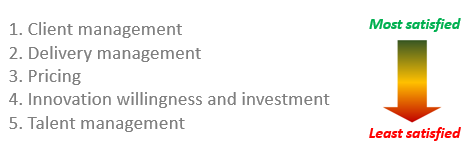
We asked telecom engineering services clients how satisfied they were with five services; Exhibit 1 presents a summary of their feedback.

Exhibit 1: Client satisfaction with telecom engineering services
Source: HFS Top 10 Telecom Engineering Service Providers 2018


Talent management remains the most challenging issue for telecommunication clients. In a separate POV, we discuss the talent-management issues telecommunications players face and how service providers can step up in this space to mitigate them.

Clients are also dissatisfied with service providers’ willingness to innovate and their investments in innovation initiatives. Clients are interested in bringing new technologies into their landscape, and they expect pricing to reflect that with more co-innovation or risk-reward-based pricing, for example.

Some of the most common innovation-related issues clients mentioned are:

  • Clients want nonlinear pricing models. Clients want to explore nonlinear pricing models such as outcome-based or risk-reward pricing so that they can maximize the benefits from their service providers’ telecom digital technology applications. The intent is to both reduce the overall cost burden of transaction-based pricing and decrease risk exposure. Ideally, telecom firms would like to develop propositions for operations optimization and then leverage any found cost to reinvest in further optimization or new offerings and capabilities.
  • Clients expect expertise in emerging telecom areas. Clients said that service providers lag in emerging areas such as operations and business support systems (OSS and BSS), network function virtualization (NFV), and 5G. Clients praised service providers’ expertise in testing and product support areas, but they expect service providers to have the expertise required to help them explore new product development initiatives.
  • Clients demand effective technology innovation. Clients mentioned they had observed a few impactful innovation initiatives from service providers. Often, clients receive recommendations for value addition in terms of productivity improvement, low-level automation of some business processes or functionalities, and code modification for application performance enhancements. Clients are very keen on co-innovation and application of digital engineering in the existing landscape.


Time-and-material and fixed-price models dominate telecom engineering services engagements

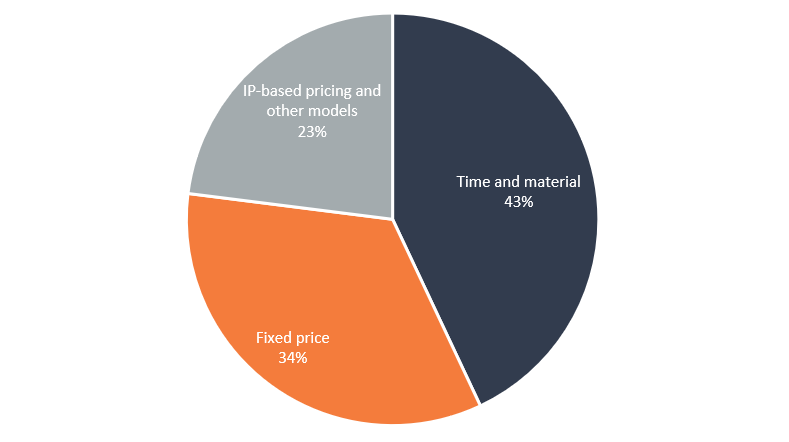
In our HFS Top 10 Telecom Engineering Service Providers 2018 report, we evaluated 12 leading service providers. Exhibit 2 reflects the distribution of their aggregate revenue from different pricing models; it shows that they earn more than 75% of telecom engineering services revenue from fixed-price and time-and-material pricing models. There are very few examples of end-to-end nonlinear pricing engagements, and in most cases, some of the application development, testing, and maintenance work in the project are linked with nonlinear pricing models.


Exhibit 2: Telecom engineering services revenue breakdown by pricing models
Source: HFS Top 10 Telecom Engineering Service Providers 2018


Service providers need to do these four things to add innovation to client engagements

  • Invest in co-innovation initiatives. Service providers need to invest in co-innovation models through joint IP development, research labs, and other go-to-market initiatives. We observed leading service providers working on patents on behalf of clients for specific business requirements. IP-based partnerships (including legacy product takeover, long-term sustenance, and technical customer support) are also on the table.
  • Offer flexible outcome-based pricing and commercial models. There is a shift from custom solutions development toward XaaS (anything as-a-service) models in telecom engineering, which service providers need to respond to by adopting outcome-based pricing models. In co-innovation assignments and projects with an unpredictable volume of work, service providers can offer transaction-based and risk-reward based pricing.
  • Leverage the partner ecosystem to speed up and scale up innovation capabilities. Service providers need to collaborate with startups for niche skills and can design joint go-to-market solutions for client engagements. There is a growing focus on open source technologies that enable building reference solutions and new customer engagements. These open source, software-based developments accelerate time-to-market and future technology upgrades.
  • Take a holistic digital transformation approach rather than disconnected, siloed, piecemeal steps toward innovation. With the advent of digital technologies, clients are increasingly looking for suitable digital transformation technology partners. As we have seen in our research on the HFS Digital OneOffice and Phil’s 19 predictions for 2019, the next wave of the Digital OneOffice is going to be in the hyper-connected economics ecosystem. To elevate and scale-up capabilities to that plane, service providers must leverage strong advisory and consulting-led delivery models, along with strong digital engineering expertise in providing telecom engineering services.


The Bottom Line: Service providers should focus on innovations to help customers meet their goals

Emerging areas, particularly digital technologies, are influential factors for telecom engineering services. The application of artificial intelligence, the cloud, analytics, automation, and IoT is increasing in different areas of the telecom engineering value chain; these technologies are transforming the traditional telecom infrastructure and business processes. Service providers also need to align their client priorities accordingly through technology innovation.

Sign in to view or download this research.

Login

Register

Insight. Inspiration. Impact.

Register now for immediate access of HFS' research, data and forward looking trends.

Get Started

Download Research

    Sign In

    Sign up for a free
    research account

    With the exception of our Horizons reports, most of our research is available for free on our website. Sign up for a free account and start realizing the power of insights now.

    Digests/Newsletters: Overviews of the latest news, insight, and research by HFS.

    HFS Events: Exclusive invitations to HFS webinars, roundtables, and summits, bringing together key industry stakeholders focused on major innovations impacting business operations.

    By registering you agree to our privacy policy.

    I hereby consent that HFS Research can process my personal data.

    Premium Access

    Our premium subscription gives enterprise clients access to our complete library of proprietary research, direct access to our industry analysts, and other benefits.

    Contact us at [email protected] for more information on premium access.

    Help

    If you are looking for help getting in touch with someone from HFS, please click the chat button to the bottom right of your screen to start a conversation with a member of our team.

    [email protected]

      Contact Ask HFS AI Support