
Enterprise customers want to use intelligent automation (IA) to improve how they run their businesses—usually by reducing manual work. HFS Research’s studies have produced evidence that shows that while robotic process automation (RPA) can help with some labor reduction, enterprises are learning that they can automate more processes with better accuracy and ROI by including cognitive elements to complement RPA, moving closer to HFS’ Triple-A Trifecta framework. We have begun referring to these emerging permutations of RPA plus another AI or analytics technology change agent as RPA++.
Enterprises may agree that RPA needs (elements of) AI such as natural language processing (NLP) or computer vision to enable end-to-end intelligent automation but bringing these change agents together effectively is still more art than science. There are no off-the-shelf tools that deliver broad-purpose intelligent automation.
HFS interviewed enterprises using RPA, service providers delivering RPA services, and RPA software companies to triangulate on the best ways to combine RPA and cognitive technologies to deliver advantages over standalone RPA. Ultimately, there is no singular winning strategy, but there are some playbooks that enterprises should examine to achieve RPA++. This POV discusses these emerging approaches.
RPA software vendors are making a concerted effort to complement their core offerings with cognitive capabilities
RPA software companies agree that RPA + cognitive is the future their companies are embracing— the method of the “+” varies. Some examples are:
Service providers are taking a bird’s eye view of automation to tie RPA and cognitive together for clients
Service providers are doing a lot of the heavy lifting behind the scenes, creating rigorous methodologies to string together disparate technologies to solve particular client problems and developing their own IP that combines elements of RPA and AI. Examples include:
Enterprises are looking beyond RPA to true intelligent automation by thinking in terms of business outcomes
Enterprises are increasingly making efforts to combine RPA and cognitive elements into intelligent automation strategies, although it’s still early days, as shown in Exhibit 1. Often these efforts result in numerous POCs, most of which don’t go far, but it’s an encouraging indication of an important mental shift away from thinking of RPA as the holy grail of automation rather than a tactical tool in a bigger toolbox.
Exhibit 1: Enterprises’ current approaches to realizing intelligent automation
Question: How well are you able to develop integrated solutions leveraging multiple intelligent automation technologies to solve business problems?
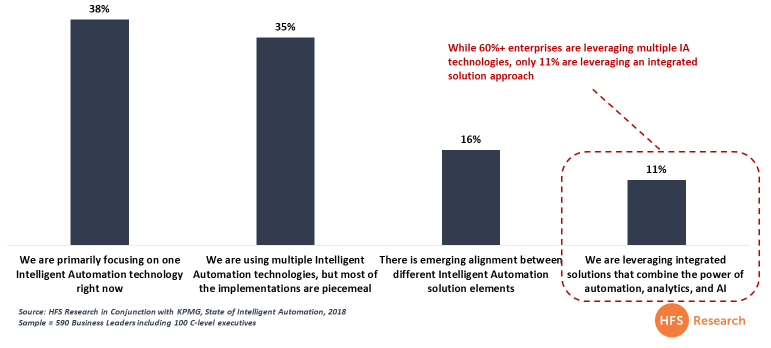
Source: HFS Research in conjunction with KPMG, State of Intelligent Automation, 2019
n = 590 business leaders, including 100 C-level executives
Recent enterprise examples of evolving IA strategies encompassing RPA + AI include:
There are still practical barriers to enterprise-scale of end-to-end automation, but they’ll soon start disappearing
The elephant in the room, of course, is that even AI cannot yet deliver full end-to-end automation for enterprises. Directionally, the future is RPA + AI, but practically, there is still no broad-functionality RPA++. This is in large part because current AI systems require intensive training and specialize in fairly narrow tasks—not unlike RPA. Moreover, the training data required to thoroughly train an AI model is either expensive or not in an accessible (structured) format, even within enterprises.
However, this is changing as developments like memory networks promise to turn today’s laser-focused AI into general-purpose intelligence. As such, this gap is likely to start closing sooner than expected as memory networks lead to a proliferation of AI use cases. Likewise, the technology to make sense of unstructured and vernacular data is rapidly improving through the efforts of firms like re:infer.
The Bottom Line: Relying on RPA alone is not the answer. Enterprises must start looking at RPA as just one piece of the automation puzzle.
There is no doubt that enterprises have a duty to start planning how to position RPA within their automation agendas as just one cog in a larger, more complex machine, turned by more powerful and adaptable cognitive change agents, with AI at the forefront. The evolving options to access this broad range of capabilities include buying directly into hybrid solutions, adopting platforms that stitch AI and RPA together, and relying on a service provider to bring the right combination that meets the enterprise’s needs. The path, or combination of paths, enterprises take will depend on the clarity of the organization’s automation vision and its existing technical knowledge and resources to successfully implement RPA++. The time to start evaluating which of these approaches is right for your enterprise was yesterday, so there’s no time to waste. Success favors the bold and the fast!
Register now for immediate access of HFS' research, data and forward looking trends.
Get StartedIf you don't have an account, Register here |
With the exception of our Horizons reports, most of our research is available for free on our website. Sign up for a free account and start realizing the power of insights now.
Our premium subscription gives enterprise clients access to our complete library of proprietary research, direct access to our industry analysts, and other benefits.
Contact us at [email protected] for more information on premium access.

