
The digital demands of the pandemic proved the benefits of low-code in delivering the agility now demanded by a change-hungry, fast-paced, new ‘business metabolism’ in the enterprise, says Appian CEO Matt Calkins.
Appian has responded with all-you-can-eat pricing to encourage enterprises to take broader benefit from what Calkins describes as an offering which is; “not BPM, not workflow, not RPA, not IDP – it is all of these together in a cloud-native, low-code automation platform.”
Get ready for the end of technical-debt-laden ‘slow software’
Speaking at Appian World 2021, Calkins illustrated one advantage that low-code had delivered during COVID19-disrupted 2020 – mobile readiness. Every Appian app was inherently ready for a mobile device without modification or upgrade since low-code enables one development for every scenario – covering devices both online and off with one version of the software, he said.
Appian mobile usage rocketed 1,970% in 2020 versus alternative enterprise-wide use of mobile – up just 220%.
Calkins described the pandemic as an extinction event for ‘slow software’ – software that takes a long time to make and to change. Going forward his expectation is for low-code to broaden its appeal beyond the business and into IT enabling developers to build 10 times faster and with the flexibility to handle a world of change without incurring additional technical debt.
An Appian first: All-you-can-eat subscription model to simplify licensing
With a focus on convenience, Appian announced a new ‘all-you-can-eat’ licensing model. The Appian Unlimited License means that, for a time-boxed subscription fee, clients can create an unlimited number of applications, with unlimited users, and with unlimited usage of both RPA bots and AI services. In addition, RPA is now natively integrated into Appian with a low-code interface (as opposed to its original Jidoka high-code java incarnation).
The pricing plan aligns with the Appian’s belief that AI, workflow, RPA, and process management are synergistic –working best when they work together. By providing them all on one platform, it is convenient to consume these elements together. The Appian intent is to build on that convenience by weaving them into a unified environment in which each element can be referenced from the workflow. This will make the synergies apparent – inspiring enterprises to make fuller and broader use of the platform’s capabilities.
Appian also announced expansion in its app market, and improvements to support training with its Community Edition – where anyone can learn the Appian ropes free of charge.
There is also increased focus on DevSecOps, and continued containerization in an Appian microservice development architecture in beta later this year. In RPA, the focus is on low-code bot composition with computer vision, browser interactions and Windows UI Automation on the list.
‘Respect for the enterprise’ to defuse customer data fears
The all-you-can-eat model offers some reassurance for customers facing a future of unknown and unknowns, in which low-cost, rapid iterative cycles of test-and-learn are a core part of responding to change at speed.
And unlike many rivals, Appian offers more reassurance when it comes to data and its ownership.
“It’s no small thing to reassure customers. We do mean to defuse some of the data fears. The main way is by respecting the customers’ enterprise. We will always leave the enterprise the way we found it,” said Calkins. Appian leaves both data and architecture where they find it. Calkins says most organizations that would sell a code platform to the enterprise want to take data outside, re-do the architecture – and to some extent, take over.
“That is scary and yet very common these days. All of us who own data are, collectively, becoming fearful that our own data could be used against us in future negotiations with suppliers,” he warned.
Low-code data enables non-experts to select, retrieve and connect data
As part of the promise to ‘leave the enterprise as they find it’, Appian is introducing ‘Low code data’ – a way of synching data by enabling relationships through a virtual data layer to make it easier for organizations to make data available at the moment of decision in their business workflows. The virtual layer means no requirement to change the enterprise’s architecture.
Low-code data also means non-data scientists can select, retrieve and connect across databases with zero need to move data and no requirement to make their own data available outside of the organization.
The data-silo-busting approach gets an update this May with the latest release of Appian in version 21.2.
A shift toward industry solutions targets a new range of enterprise buyers
A new focus on solutions delivery will target new buyers for Appian. Calkins believes every platform needs to supplement its offerings with solutions focused on industry or function-specific outcomes. In Appian’s case, he believes offering solutions will introduce the business to organizations seeking faster resolution of specific problems – and offers global SIs the opportunity to add value through applying their expertise with the Appian platform to deliver specific solutions for their clients.
Going deep on industry solutions in government, financial services, and insurance will help bring context to Appian’s clients and drive greater relevance. A general-purpose tool can be a harder sell. This move makes Appian more relevant to specific industries and aligned use cases. Expect more of this from them.
Unified low-code and automation lines up with HFS’ OneOffice vision
Low-code automation brings together low-code – where applications are created by drawing a workflow with visual objects, with automation – in which workflows coordinate work across people, bots, apps, and AI-infused algorithms. Customers will be able to use Appian’s own bots and AI services, or include their own preferred suppliers, in the workflows they design.
Appian has a strong heritage in business process and case management, and for all the focus on low-code, those roots are clear in the workflow-centered storyline at the heart of ‘low-code automation’. Vendors such as Appian play a key role in enabling the HFS OneOffice vision through the HFS OneOffice Emerging Tech Platform (Exhibit 1).
Calkins sees Appian’s unification of low-code and automation as very much aligned with OneOffice.
“We are making an offering of what used to be components,” he said. “Automation and low-code are both about workflow – they absolutely belong together. We have to recognize this synergy and put the pieces together,” he added.
Exhibit 1: Services, such as those provided by Appian, are integral to the OneOffice Emerging Tech Platform
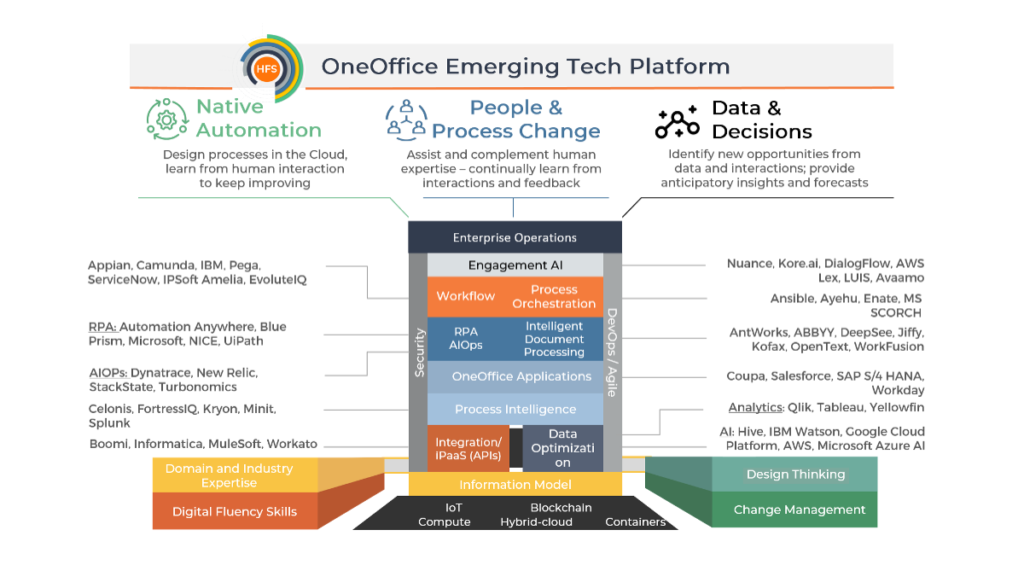
Source: HFS Research, 2021. Examples are representative
The Bottom Line: Inspiring full use of unlimited licenses is key to proving the value
Appian has made a robust automation solution to meet modern enterprise needs: cloud native, low-code extensibility, with a broader approach to cognitive automation through BPM, RPA, and AI in an integrated platform – all with easy to consume pricing.
The proof of the pudding will be Appian’s ability to inspire the enterprise to leverage the power of the platform rather than continue with automated workflows that use one tool at a time. The integration – as we illustrate in the OneOffice Emerging Tech Platform – is the ultimate power.
Register now for immediate access of HFS' research, data and forward looking trends.
Get StartedIf you don't have an account, Register here |
With the exception of our Horizons reports, most of our research is available for free on our website. Sign up for a free account and start realizing the power of insights now.
Our premium subscription gives enterprise clients access to our complete library of proprietary research, direct access to our industry analysts, and other benefits.
Contact us at [email protected] for more information on premium access.


