
IBM’s intention to acquire applications resource management (ARM) and network performance management (NPM) provider Turbonomic for a reported $2bn is focused on an area that rarely makes the big headlines: Observability.
Observability is the extension of, or some purists say, complementary to, traditional monitoring approaches. IBM’s strategic focus is on managing hybrid cloud environments. So Turbonomic’s capabilities in assuring the performance of applications that run on containerized microservices, make for a good fit.
Tools like Turbonomic help to overcome silos in IT Operations ARM and NPM are sub-segments of the wondrous world of AIOps, which is an immensely heterogeneous segment and one that is dominated by deeply technical marketing. Organizations have to integrate a plethora of point solutions to run their IT Operations. Yet, we are not even close to achieving enterprise-wide service management and monitoring. To progress toward the OneOffice organizations have to develop the ability to convert insights from logs, metrics, traces, and dependency maps into actions across the enterprise. For most organizations, the progress has stopped at insights. And those insights are often confined within siloes rather than providing an enterprise-wide view. The North Star is the ambition to run operations across the boundaries of IT and business. To accelerate the journey toward the OneOffice, technologies line Turbonomic have to be integrated into broader workflow and automation strategies.
Turbonomic helps the enterprise manage applications performance and ultimately costs
It is not easy to summarize the value proposition of Turbonomic in a way that it also makes sense for folks outside IT Operations. Turbonomic allows customers to see how business applications and transactions are performing. It is doing this by understanding the complete stack from hardware to applications. More specifically it understands the resource relationships at every layer and the risks to performance. I.e. from applications to containers to virtualization, cloud, and on-prem compute, storage, network, and beyond. With a drag-and-drop menu, users can navigate to the applications seeing the greatest surges in demand and understand where performance risks exist. The menu enables users to execute actions with a click, as part of a workflow, or in real-time. Of particular relevance for hybrid cloud environments is the ability to execute prescribed actions to prevent resource starvation. This means organizations don’t have to over-provision infrastructure to meet surging demand, ultimately resulting in significant cost savings. A Turbonomic client put it succinctly, “ we understood that the constraints for application performance were infrastructure and operations, not applications themselves”. Put another way, Turbonomic can help companies to overcome organizational silos. By extending the Observability capabilities to automated resourcing and automated actions, the acquisition is strongly aligned with operationalizing the OneOffice.
Where does Turbonomic fit into the IBM ecosystem?
The acquisition is being driven by IBM’s software division to expand the capabilities of its “IBM Cloud Pak for Watson AIOps” offering. The ambition is to build the most comprehensive set of AIOps capabilities for Hybrid Cloud in the industry. Thus, the context is the acceleration of the journey toward Cloud Native. One way to think about those Cloud Paks is that they are containerized AI applications that help to integrate workloads and applications into Red Hat OpenShift. By the same token, this description summarizes the strategic intent of IBM, namely to cross-and upsell and a broader set of capabilities. IBM already had an OEM relationship with Turbonomic, thus the planned acquisition is the next logical step. It follows hot on the heels of IBM’s acquisition of Instana which offers application-centric real-time Observability. In the words of IBM, Turbonomic will provide businesses with full-stack application observability, meaning the performance of an application can be monitored across all dependencies with environments and systems – critical in managing complex Hybrid Cloud environments. Technically, Turbonomic is not focused on Observability but actions to optimized workloads ( cost/performance). Instana is focused on Observability. No one in the industry has built out the Observability to action connection as yet. IBM suggested it will be the first one to have this comprehensive approach. Exhibit 1 provides an overview of the strategic components of IBM’s Cloud Pak for Watson AIOps offering.
Exhibit 1: Turbonomic is meant to extend IBM’s Observability portfolio to cross-functional automation
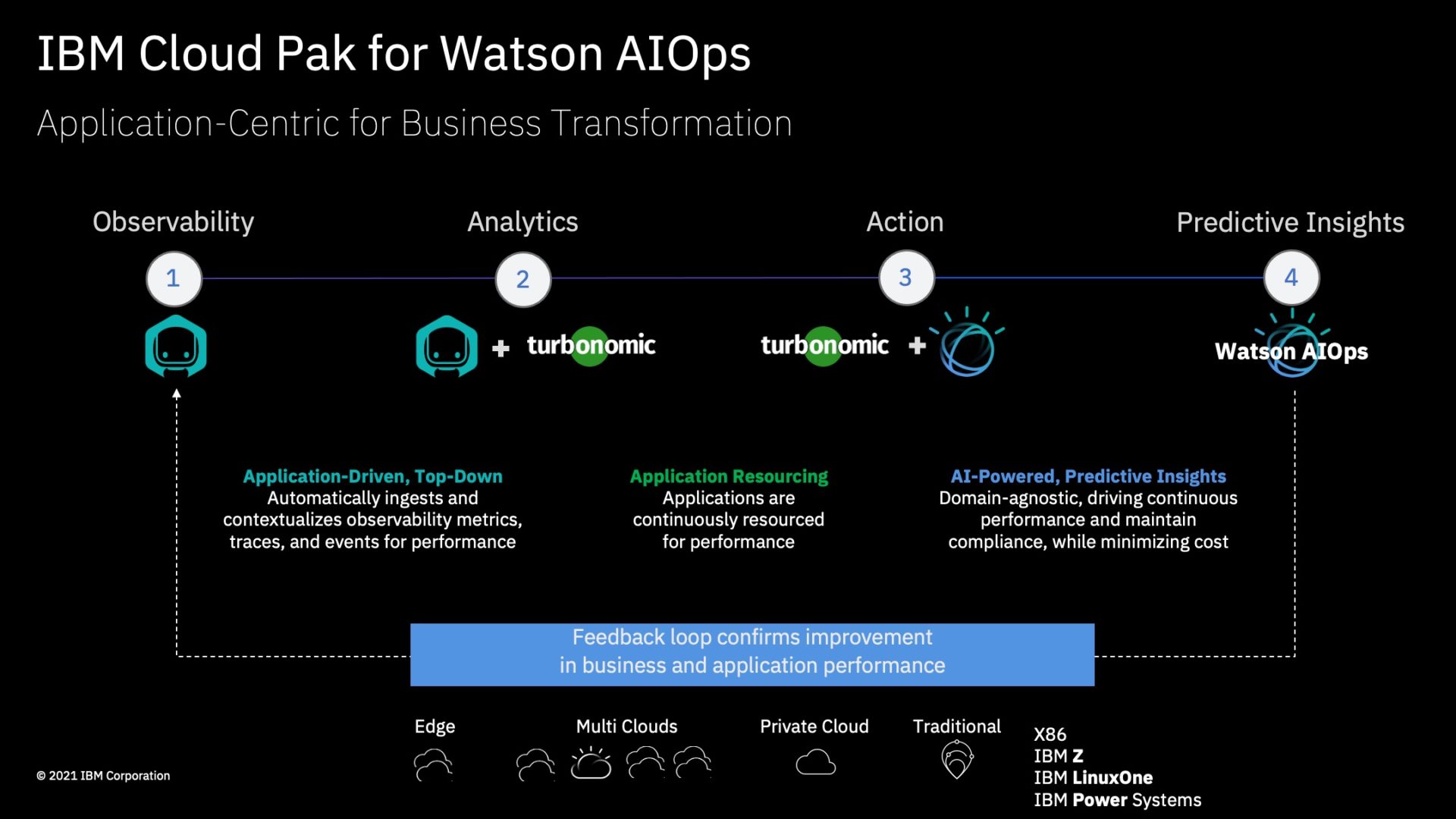
Source: IBM 2021
Turbonomic will support a holistic automation approach but it will not (yet) be in the form of end-to-end automation
We have to ask what automation in IT-centric scenarios really means. Much of it is in automating approval processes where tools provide recommendations for “next best action”. Hence the intent is to merge Turbonomic and Watson AIOps capabilities, especially around recommendations. IBM suggests that they provide “the visibility, the analytics as well as the actions”. Thus, they are progressing from reactive to predictive. To ultimately get to a proactive setup, more investments into capabilities that provide more than lip service to the notion of self-healing are necessary.
The Bottom Line: IBM Software is addressing cloud-native complexity – now IBM GBS must help clients to take full advantage of cross-functional, OneOffice workflows
With both Instana and Turbonomic, IBM is making solid progress toward enterprise-wide monitoring and full-stack Observability. It will allow customers to address the complexity as well as the challenges of the plumbing for Hybrid Cloud. Yet, to advance to broader cross-functional workflows a services-led approach is mandatory. IBM GBS can now leverage a much deeper, proprietary stack of technology capabilities and it must find ways to cross-fertilize the experiences of IT and business-centric automation to create best value for its customers. The North Star is cross-functional workflows that are inherent in the OneOffice mindset.
Register now for immediate access of HFS' research, data and forward looking trends.
Get StartedIf you don't have an account, Register here |
With the exception of our Horizons reports, most of our research is available for free on our website. Sign up for a free account and start realizing the power of insights now.
Our premium subscription gives enterprise clients access to our complete library of proprietary research, direct access to our industry analysts, and other benefits.
Contact us at [email protected] for more information on premium access.


