
Mphasis has spotted a gap in the growing quantum computing ecosystem. Many quantum computing systems already exist—and they’re accessible over cloud—but Mphasis wants to be a coordinating player in the ecosystem and provide solutions and services, from consulting through to implementation, aimed at business problems that NEED quantum computing: so far, optimization and simulation in logistics and financial services are focus areas for Mphasis—and more broadly these use cases form a significant part of the near-term value of quantum computing. Mphasis is still searching for client number one—but in building a portfolio of use cases is aiming for an early-mover advantage across a range of services; currently, these include helping companies assess their need for quantum computing, workshops to identify use cases, consulting to set up environments and training programs, and algorithm development where Mphasis can leverage its growing patent pool of accelerators, blueprints, and its EON (Energy Optimized Network) framework which aims to help business users access quantum systems.
To realize a first-mover advantage, Mphasis needs to find clients quickly and turn its test use cases into real use cases; Mphasis must educate both the market and its own employees, with a relentless focus for those business outcomes that optimizations, simulations, and other sweet-spots for quantum computing might achieve.
Mphasis is aiming to be an end-to-end player in the quantum ecosystem where it is partnering aggressively to provide access to hardware, software, consulting, and managed services. Quantum computing services at Mphasis have been developed over the past 12-18 months through its Next Labs focusing on those quantum computing use cases that are both achievable now, and are tipped over the next 5-10 years to be either better-suited or only achievable on quantum systems—primarily optimization and simulation; see our separate take on the IBM quantum industry roadmap.
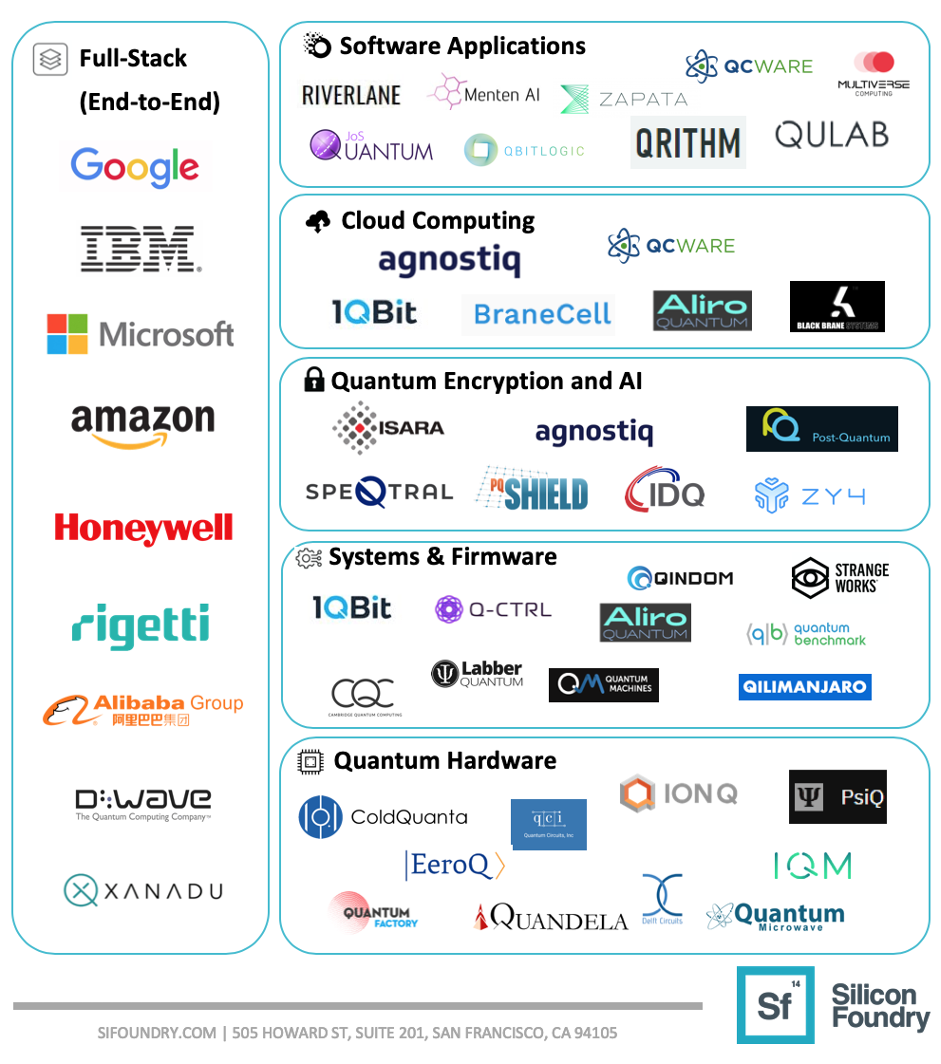
Mphasis’ solutions are being developed for accessibility on cloud platforms including AWS, Azure, and GCP—making use of the rapidly expanding quantum ecosystem of hardware, software, startups, and multi-national service providers like IBM, Google, D-Wave, Rigetti, IonQ, Honeywell, and many more (see Exhibit 1). Accessing quantum computing through cloud is attractive for several reasons—not least the cost and complexity of building and operating a quantum computer. Via cloud, these powerful machines can effectively become an outsourced form of computing power on demand—solving complex problems and helping train algorithms on vast amounts of data.
Exhibit 1: A snapshot of the quantum computing ecosystem.
Source: Silicon Foundry, 2021
Many existing machine learning (ML) systems can search through large data sets—but ML trained and operated on quantum systems is expected to be game-changing in analyzing financial markets, physical systems (including climate), cybersecurity, and more. But a key challenge of quantum ML involves adapting classical computing algorithms to run on quantum computers—and traditional methods of data input don’t always work in quantum systems; data cleaning and pre-processing efforts are in some ways similar to those involved in non-quantum ML—but in summary, they become exponentially more demanding in quantum systems.
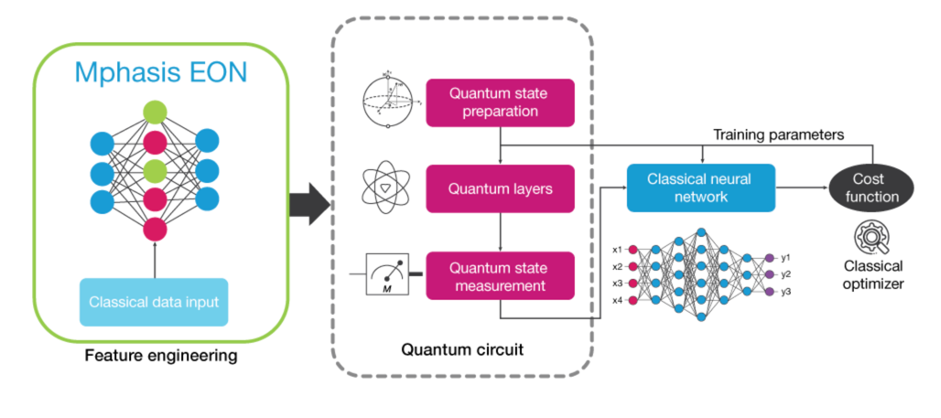
To address the challenges of data input into quantum systems, Mphasis has created the patent-pending EON (Energy Optimized Network) framework to help less-technical business users access quantum systems (see Exhibit 2). EON takes care of tougher activities like data pre-processing—so that a business user only needs to bring data, and EON/the quantum system can, to some extent, “take over from there” (without wishing to make it sound overly-simplistic).
There’s also an internal demand for EON at Mphasis. EON means a need for fewer qubits (the quantum computing equivalent of a bit—but with exponentially more power) that means paying less to the quantum system provider—and ultimately less time to reach solutions. Mphasis is also building similar frameworks specifically for optimization and simulation problems.
Exhibit 2: Mphasis’ EON framework (Energy Optimized Network) for adapting classical data inputs for quantum computing systems.
Source: Mphasis, 2020
Mphasis is building use cases that outline potential business value to existing and prospective clients
Mphasis’ portfolio of quantum computing services includes assessing a company’s need for quantum computing, workshops to choose use cases, consulting to set up environments and training, and algorithm development where Mphasis brings in its series of patents. Mphasis emphasized that it’s helping a series of prospective clients in their early journeys despite having no live clients as of yet—with a few conversations developing to more advanced stages. Mphasis is also providing its offerings on AWS marketplace (10 blueprint quantum computing offerings including simulated quantum systems that can run on regular devices).
Mphasis’ use case library is building across a range of optimization scenarios; the measured benefits in these cases center around the time taken to find an optimal solution, total cost, algorithm training time, risk, accuracy, confidence in the solution, and portfolio return. Supply chain and logistics, and financial portfolio optimizations are where Mphasis is putting its efforts for the time-being to prove tangible value. It remains clear, however, that without existing clients, and the roadmaps predicted by others in the industry, it’ll still be 3-5 years, if not more, before we’re seeing quantum computers becoming the only or significantly better option that can tackle certain problems.
The Bottom Line: Mphasis has a vision for providing quantum solutions—but it needs to rapidly educate potential clients if it wants to get an early-mover advantage.
Mphasis wants to be a leading force in this ecosystem in 2 years. There’s energy coming from the CEO desk in pitching to potential clients—so it’s clearly a priority within Mphasis. Mphasis is setting one example for other service providers to explore and get their feet in the quantum computing door. Time will tell how many providers in Mphasis’ sphere of competition will go down the same path of partnering and building on top of existing quantum systems, and how many will either acquire or self-learn the expertise they need—and which parts of the value chain and ecosystem will they all play in?
The development of Mphasis’ tools and accelerators has the potential to help its consultants and ultimately clients with their go-to-market time—including Mphasis’ ability to capture “low-hanging fruit” where quantum computing can showcase tangible value. But there’s also a process of convincing Mphasis employees, as well as prospective clients, of the value of these quantum solutions. Quantum computing needs to become one tool in the emerging technology box for Mphasis teams; more recognition of the interplay between emerging technologies is something we’ve been calling for.
The need for Mphasis to develop talent is obvious with perhaps the most emerging of emerging technologies. But there’s a process of education that needs to happen throughout the ecosystem—and Mphasis must work with this ecosystem if it wants to really hammer-home its early-mover status.
Register now for immediate access of HFS' research, data and forward looking trends.
Get StartedIf you don't have an account, Register here |
With the exception of our Horizons reports, most of our research is available for free on our website. Sign up for a free account and start realizing the power of insights now.
Our premium subscription gives enterprise clients access to our complete library of proprietary research, direct access to our industry analysts, and other benefits.
Contact us at [email protected] for more information on premium access.

