
Know the landscape: AI is a multi-faceted and dynamic market
AI is one of the most hyped, yet most valuable, technologies available to enterprises as they look to optimize and future-proof their businesses. Automation, analytics, and AI leaders must take a holistic approach to the emerging range of technologies under the AI umbrella. This POV outlines the building blocks of AI and the multi-dimensional capabilities required to take enterprises toward the institutionalization of machine learning (ML) and other AI approaches.
The current breed of AI is powered by algorithms, formulaic code that instructs the software on how to process and learn from input data. AI’s value and the excitement it inspires lie in its ability to process data in far greater volumes, at far greater speed, and with the promise of infinitely better accuracy than humans can. By design, AI doesn’t just mimic human analytical capabilities; it outstrips them. As such, organizations are actively looking at AI to drive cost savings by cutting down on FTEs, to better leverage their internal and external market data to generate deeper competitive insights, and to equip themselves to become predictive rather than reactive businesses. Multiple studies show that AI is already better than humans at certain tasks—predicting turnover rates and profiling customers, for example. Further testimony to AI’s power is the funding pouring into the sector and the rate at which buyers are snapping up AI start-ups.
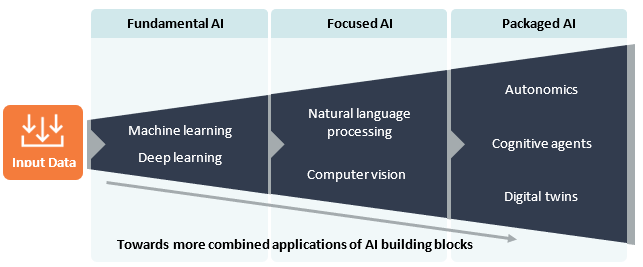
AI can be viewed as a set of fundamental, focused, and packaged technologies
Exhibit 1: The Building Blocks of AI
Source: Untangling The Gordian Knot: The HFS Dummies’ Guide To Enterprise AI, HFS Research, 2018
There’s a fundamental issue stopping many enterprises from unlocking AI’s full potential. People tend to discuss AI as if it is a monolith or single category, when in fact there are many specialized AI subcategories for specific tasks. The boundaries between AI subcategories are still rather blurred and fluid due to the speed at which the space mutates and evolves into new branches. Consequently, we treat standalone AI technologies (such as natural language processing [NLP] and ML) and productized versions based on them (such as cognitive agents) as equivalents. To clarify matters, HFS has drawn some hard lines between the three broad AI groups in the market (see Exhibit 1).
Execute along these six dimensions for impactful AI
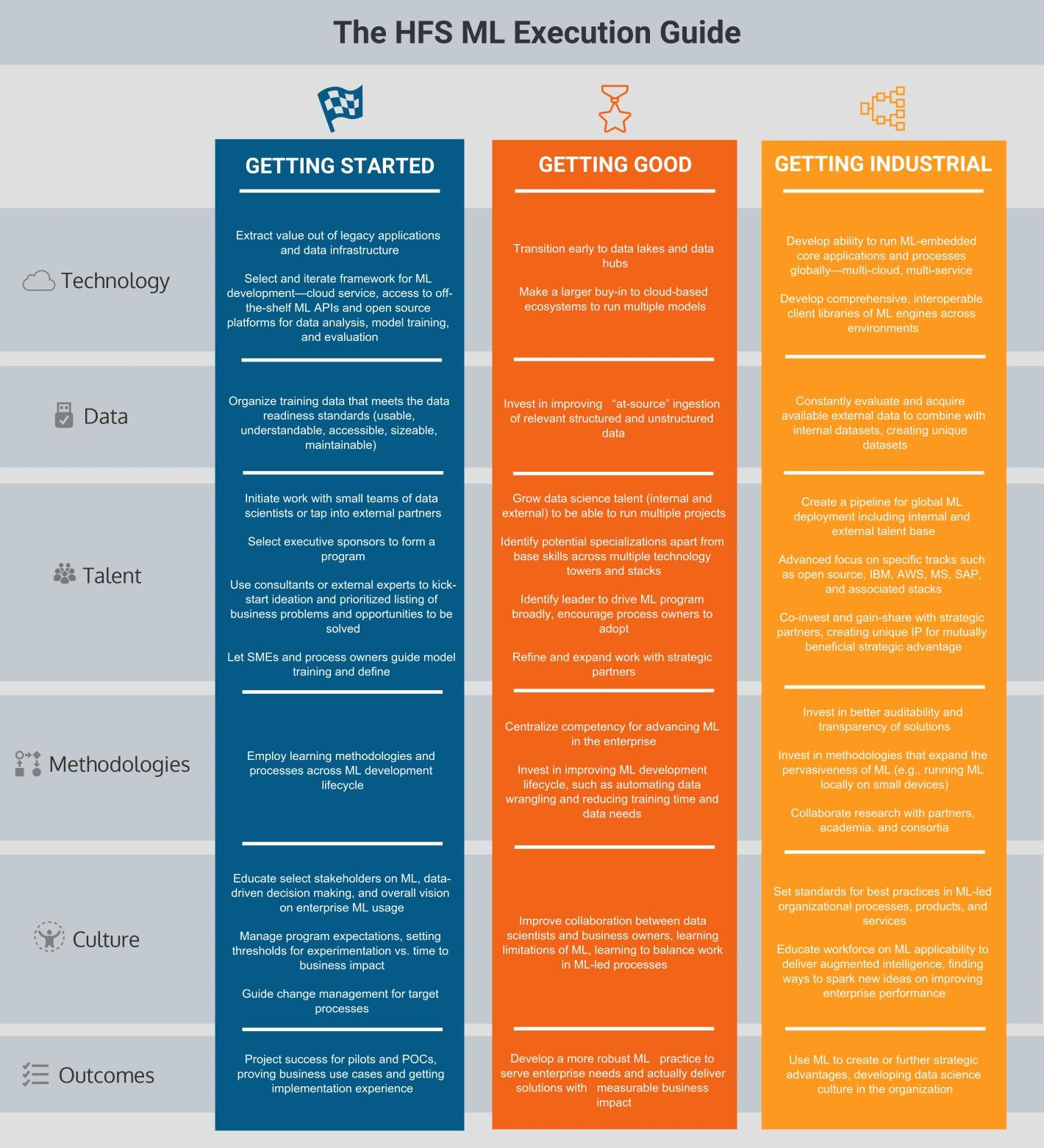
As a foundational building block, machine learning is the most common starting point for AI today. HFS has observed a few patterns emerging for how enterprises can get started with machine learning, how they can deliver value over time and develop more robust capabilities, and, ultimately, how they can build industrialized, machine language-enabled operations. The HFS Machine Learning Execution Guide in Exhibit 2 charts out the multi-dimensional capabilities that enterprises will need to develop toward the institutionalization of machine learning. It is important to note that the steps aren’t necessarily linear across the stages. In some cases, enterprises might be more advanced on one dimension, even though they are just getting started. The dimensions and stages are a guide for the typical starting and advancement points for enterprise ML adoption.
Exhibit 2: The HFS Machine Learning Execution Guide
Source: How To Avoid Your Looming Machine Learning Crisis, HFS Research, 2018
Technology giants and early adopters have shown us that machine learning can have valuable impacts on many applications, and businesses are following suit. Two fundamental needs emerge: first, the need for client organizations to focus on business impact as opposed to broad technological experimentation and, second, the need for integrated solutions, not viewing ML or other AI technologies as a standalone answer. Meanwhile, the whole industry is experiencing a learning curve as discoveries are made every month across hardware, software, architecture, and applications.
The Bottom Line: As enterprise leaders, you need to plan and execute on AI proportionate to its growing importance and rapid evolution.
This much is clear: business models and operations of the future are going to be heavily influenced and defined by AI techniques such as machine learning. The challenge — and opportunity — is envisioning the future business models and operating models using ML and other AI technologies in the next few years. However, there are steps that you can take to get ready as machine learning becomes mainstream. Use the HFS ML Execution Guide to get started, get good, and finally get industrial to create value with AI.
Register now for immediate access of HFS' research, data and forward looking trends.
Get StartedIf you don't have an account, Register here |
With the exception of our Horizons reports, most of our research is available for free on our website. Sign up for a free account and start realizing the power of insights now.
Our premium subscription gives enterprise clients access to our complete library of proprietary research, direct access to our industry analysts, and other benefits.
Contact us at [email protected] for more information on premium access.

