
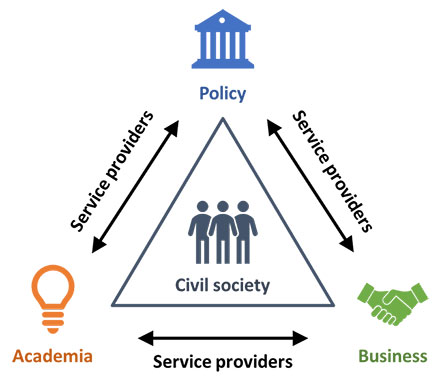
Partnerships are all the rage these days. To cross the chasms between businesses, policymakers, academia, and civil society, service providers can be the foundation of cross-party collaboration; their enterprise clients are the most critical stakeholder in pioneering these partnerships. The groups in Exhibit 1 have vastly varying priorities, and to bridge these gaps:
Exhibit 1: Service providers can be both brokers and enhancers of cross-party collaboration
Source: HFS Research, 2019
The links between policy, academia, businesses, and civil society can be strengthened by providers to create value for all concerned.
The market is used to service providers brokering their partners for mutual profit, but what we’re talking about here is providers leveraging their presence and influence in academia, business, and government to build and strengthen an ecosystem of partnerships. In Exhibit 1, we can see how the role of service providers, given their spread, influence, and war chest, can extend far beyond traditional partnerships directly involving their own efforts.
“Civil society,” at the center of Exhibit 1, refers to charities, NGOs, other non-profits, and the general public.
The key lies in answering these questions: What does the other side want from the relationship? How can multiple parties work toward one outcome, but with different underlying goals? And how does each actor realize the true value of the other?
We see great examples of service providers already driving far-reaching partnerships.
Accenture Development Partnerships (ADP), which pioneers the sustainable development space, emphasizes the gap between businesses and academia, charities, NGOs, and policymakers. Many potential partners for enterprises, while having specialized knowledge, commonly lack business awareness. As a result, they struggle to take the initiative and bridge the gap themselves. We separately discuss how enterprises must bridge the gap specifically into academia.
Wipro Ventures, the provider’s strategic investment arm, doesn’t see acquisition as a partnership end-goal. Instead, Wipro Ventures offer strategic capital. In a recent briefing with HFS, its approach to talent firmly stood out as “if talent won’t come to you, go to it.” Wipro Ventures sees what its partners really want and what their biggest challenges are—market access and proliferation opportunities—for which extending their partners’ own partnership ecosystems is an immense driving force.
Providers already have vast networks of partnerships in place which fuel their own service offerings. Now, they must use these networks to broker and drive new partnerships, with two goals in mind: partnerships directly benefiting their clients, and partnerships which add expertise to providers’ own offerings.
Leading service providers are in a prime position to facilitate partnerships and build world-leading combined solutions.
Louise James, Managing Director of Accenture Development Partnerships (ADP), who we met with earlier this year, spoke about the importance of “Critical Friend Partnerships.” Within partnerships, players must be clear about what each side wants from the relationship and understand that each side’s goals can be—and possibly should be—different, even when they are working together toward the same outcome. These partnerships need to be continually reassessed, and providers can offer the required sense of context and clarity.
Service providers must ensure that their clients have the best opportunity to maximize the return from a partnership, following three key messages:
Enterprises must see the business opportunities in these partnerships
Enterprises must use the knowledge and experience of leading actors in their field, and their service providers can add the business skills required for scalability, strategy, and operating model improvement.
Partnerships can also engage outside parties who “want in.” These fringe players see stability and commercial viability of a partnership with the backing of multiple parties.
Enterprises must invest the time to build trust
Enterprises must be transparent. Unclear expectations are the downfall of many partnerships, and both parties must periodically reassess expectations. Businesses must dispel the image that they have a secret agenda or that they will blatantly try to exploit a partner. All players in a partnership must communicate clearly on where unique, individual challenges exist and work through them to be transparent and align their goals.
Enterprises must engage
You can’t ask people to compromise their goals, especially within academia and civil society, and enterprises must, therefore, understand that potential partners may challenge them. Enterprise leaders mustn’t be afraid to seek out many partners, even in the face of several rejections, as there’s a high chance of a misalignment between parties’ goals. To specifically engage with policy, sides must work together for the best combination of business value and socio-economic improvement that the collaboration can yield.
The Bottom Line: In the hyperconnected economy, no one will solve problems on their own.
Everyone says that their business strategy involves partnering, especially when it comes to emerging technologies. However, a lack of trust, transparency, understanding, willingness, and all the other common downfalls of partnerships, mean that “partnership strategies” are easier talked about than acted upon. Service providers already have vast arrays of their own strategic partnerships. Now they must step in where enterprises, policymakers, academics, and non-profit groups fail—brokering alliances between these parties to create solutions greater than the sum of their parts.
Register now for immediate access of HFS' research, data and forward looking trends.
Get StartedIf you don't have an account, Register here |
With the exception of our Horizons reports, most of our research is available for free on our website. Sign up for a free account and start realizing the power of insights now.
Our premium subscription gives enterprise clients access to our complete library of proprietary research, direct access to our industry analysts, and other benefits.
Contact us at [email protected] for more information on premium access.

