Take 5 Report

Reliable AI at scale requires trust engineering, not legacy QE

This Take 5 report from HFS Research, in partnership with QualiZeal, is for quality engineering leaders, CIOs and CTOs, and risk and compliance leaders evaluating how to test and govern AI systems running in production.

Executive summary

AI has moved into production faster than enterprises can ensure it works safely, fairly, or accountably.

Enterprise AI adoption is outpacing the infrastructure designed to govern it. AI applications are in production, agentic systems are making decisions autonomously, and the compliance clock is running. However, the testing and governance frameworks needed to validate these systems still rely on quality frameworks built for deterministic software to evaluate probabilistic AI. In the last two years, the quality engineering (QE) function has absorbed new scope, including AI model validation, data quality, security, and regulatory compliance, without the tools, methods, or budget to do it properly.

HFS Research, in partnership with QualiZeal, surveyed 101 enterprise quality and technology leaders in the US to examine whether organizations are properly equipped to validate AI systems in production and what a genuinely different approach to QE for AI looks like.

The survey uncovered five key takeaways:
    • AI is already in production, but the controls for it are still in pilots
      Fifty-seven percent of enterprises run generative AI in some form of production. Thirty-six percent have agentic systems live. However, formal AI validation frameworks are still in pilots.

    • Enterprises are running AI without a person or function that actually holds the line
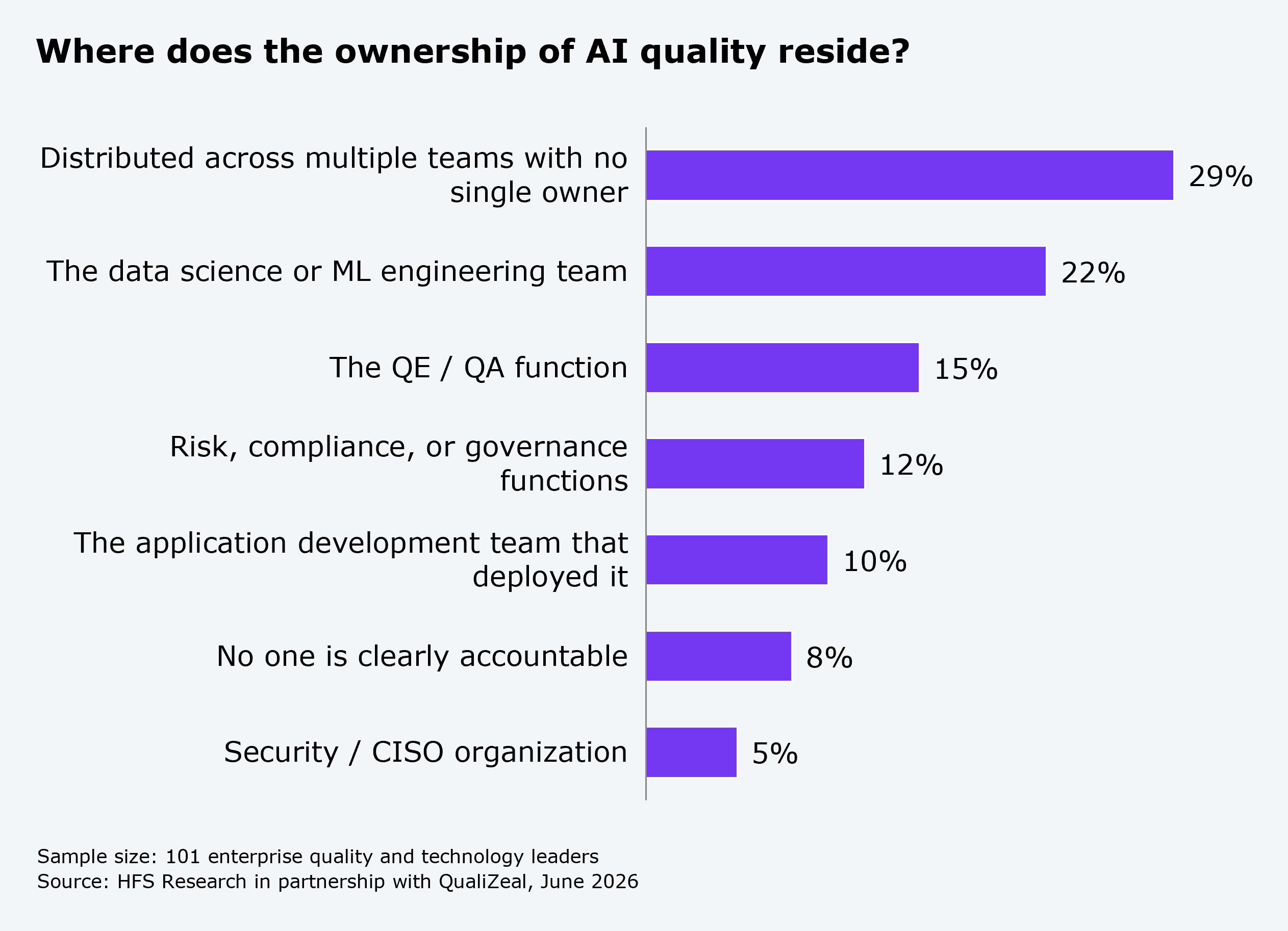
      No one owns AI quality. Thirty-seven percent of enterprises run AI in production with no named function accountable for quality. Twenty-nine percent have distributed ownership across teams. Eight percent admit no one is accountable.

    • Most see AI testing as different, but almost no one has built for it
      Only 15% have built testing approaches for AI. Fifty-two percent are testing probabilistic AI systems with frameworks designed for deterministic software.

    • Enterprises can prove their AI is accurate, but not that it is trustworthy
      Eighty-eight percent measure model accuracy. Yet only 47% measure bias and fairness, 37% measure explainability, and just 35% can provide regulatory compliance evidence.

    • QE gets the mandate to own everything that makes AI trustworthy, but not the budget or talent to actually deliver
      The QE function surveyed has taken on new scope. However, only 24% received proportional resources.

The Bottom Line: AI that cannot be audited, explained, or proven fair is an open liability, and it widens with every sprint. Organizations that cannot control how their AI behaves in production are not managing risk. They are deferring the reckoning, and they can’t do it indefinitely.
      • AI is already in production, but the controls for it are still in pilots

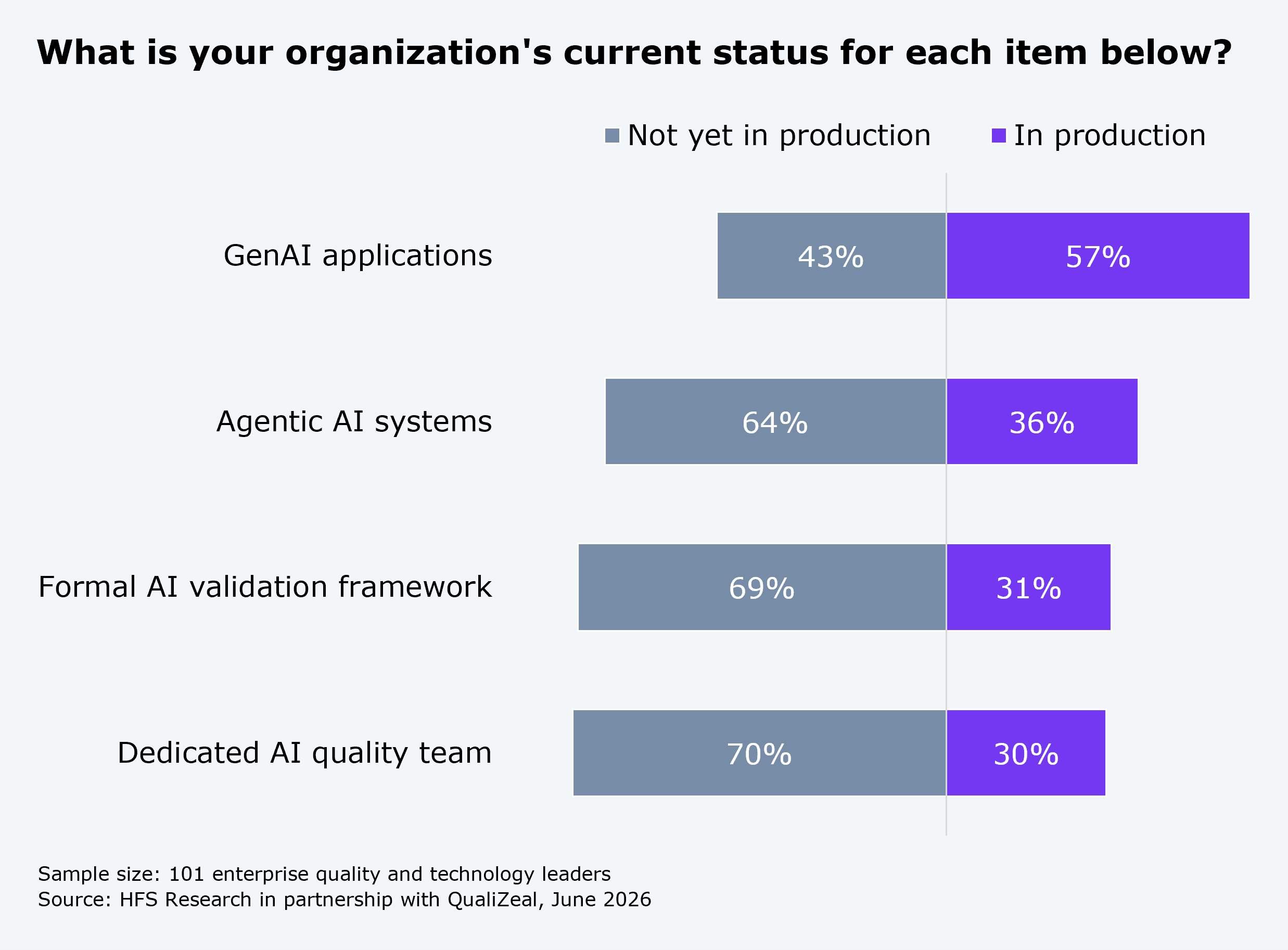
Grouped horizontal bar chart titled "What is your organization's current status for each item below?" It compares four items, each split into two segments: "not yet in production" (gray) and "in production" (purple), with each pair of segments summing to 100%. GenAI applications: 43% not yet in production, 57% in production. Agentic AI systems: 64% not yet in production, 36% in production. Formal AI validation framework: 69% not yet in production, 31% in production. Dedicated AI quality team: 70% not yet in production, 30% in production. The accompanying commentary notes that 93% of enterprises run generative AI applications in some form, with 20% at scale, and that 36% already have agentic systems taking multi-step actions and accessing live data in production. Sample size: 101 enterprise quality and technology leaders. Source: HFS Research in partnership with QualiZeal, June 2026.

  • Ninety-three percent of enterprises run generative AI applications in some form. Fifty-seven percent have it in production, and 20% are at scale.
  • Thirty-six percent already have agentic that take multi-step actions and can access live data in production.
  • The governance infrastructure lags severely. Formal AI validation frameworks are in production at just 31% of organizations; 28% have not started building one, and 42% are still piloting. Dedicated AI quality teams are even rarer with 31% not started, and 40% piloting.
  • Production AI with no quality infrastructure is the equivalent of shipping code with no QA. Agentic systems compound errors at the speed of AI silently. Combined with the lack of dedicated AI testing, the gap is self-widening and can lead to potentially disastrous consequences.
    • Enterprises are running AI without a person or function that actually holds the line

Horizontal bar chart titled "Where does the ownership of AI quality reside?" listing seven response options ranked from highest to lowest share of respondents. Distributed across multiple teams with no single owner: 29%. The data science or ML engineering team: 22%. The QE/QA function: 15%. Risk, compliance, or governance functions: 12%. The application development team that deployed it: 10%. No one is clearly accountable: 8%. Security/CISO organization: 5%. Sample size: 101 enterprise quality and technology leaders. Source: HFS Research in partnership with QualiZeal, June 2026.

  • Twenty-nine percent of enterprises say AI quality is shared across multiple teams with no single owner. Another 8% admit no one is clearly accountable. This is a liability gap.
  • Twenty-two percent have handed the job to the team that built the model. The same blind spots that went into the model’s construction will appear in its validation. That is not quality assurance. It is a conflict of interest masquerading as QE.
  • Risk and compliance owning AI quality (12%) gets the mandate right and the method wrong because quality and governance are not the same function. Governance can define what trustworthy AI means, but it cannot run the test cases or diagnose why bias is emerging.
  • QE holds the line in only 15% of respondents. These organizations have at least framed the problem correctly. The other 85% have distributed, ignored, or misdirected accountability.
    • Most see AI testing as different, but almost no one has built for it

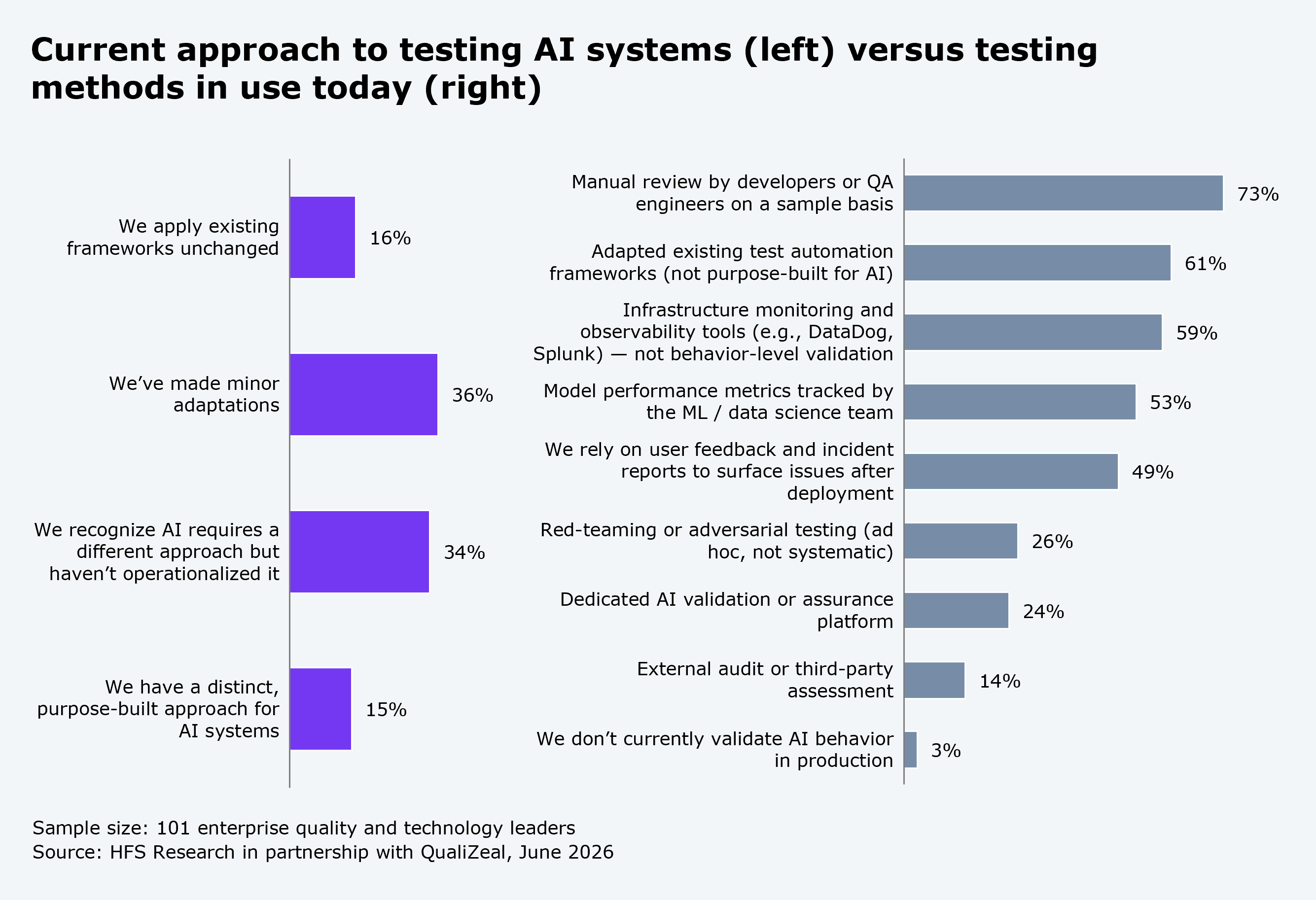
Two paired horizontal bar charts under the heading "Current approach to testing AI systems (left) versus testing methods in use today (right)." The left chart shows four response options ranked from highest to lowest: we've made minor adaptations, 36%; we recognize AI requires a different approach but haven't operationalized it, 34%; we apply existing frameworks unchanged, 16%; we have a distinct, purpose-built approach for AI systems, 15%. The right chart shows nine testing methods ranked from highest to lowest: manual review by developers or QA engineers on a sample basis, 73%; adapted existing test automation frameworks (not purpose-built for AI), 61%; infrastructure monitoring and observability tools such as DataDog and Splunk, described as not behavior-level validation, 59%; model performance metrics tracked by the ML/data science team, 53%; reliance on user feedback and incident reports to surface issues after deployment, 49%; red-teaming or adversarial testing described as ad hoc and not systematic, 26%; dedicated AI validation or assurance platform, 24%; external audit or third-party assessment, 14%; and we don't currently validate AI behavior in production, 3%. Sample size: 101 enterprise quality and technology leaders. Source: HFS Research in partnership with QualiZeal, June 2026.

  • Traditional testing assumes you can specify the correct output for a given input. Probabilistic AI has no single correct output. A framework built for deterministic software cannot tell you whether an AI system is behaving fairly, safely, or consistently in production. It can only confirm it ran without crashing.
  • Enterprises testing model performance or relying on user feedback are generating false confidence. Their tests pass, but they are not testing the right things.
  • The 34% who recognize the problem and have not acted are in a worse position than the 16% who don’t know yet. Awareness without action is not a planning gap. It is documented negligence if something goes wrong.
  • A staggering 73% rely on manual review. AI systems make millions of decisions continuously. Manual review catches obvious errors after the fact. It does not catch the distributional drift that precedes systemic failure.
    • Enterprises can prove their AI is accurate, but not that it is trustworthy

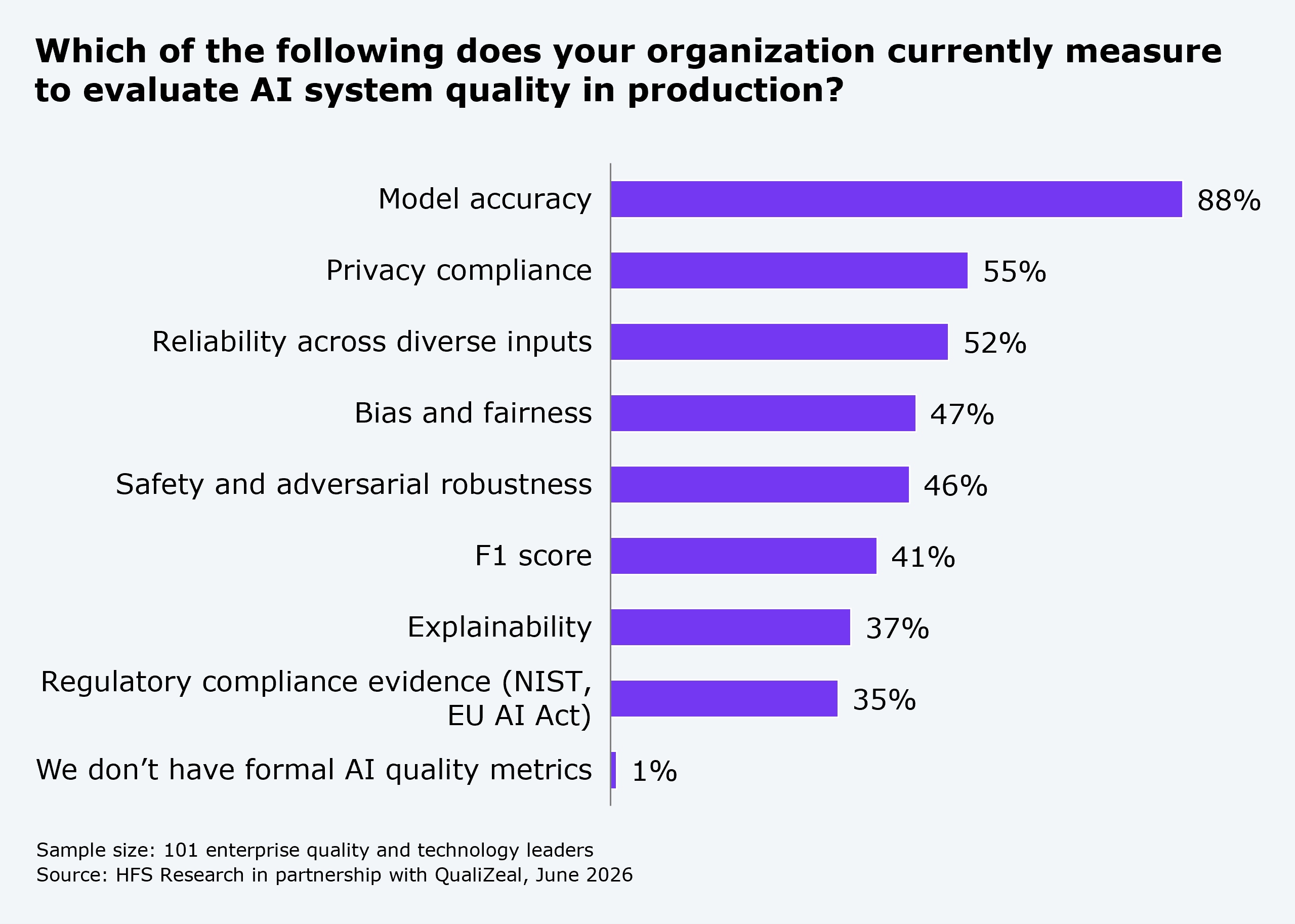
Horizontal bar chart titled "Which of the following does your organization currently measure to evaluate AI system quality in production?" listing nine measurement categories ranked from highest to lowest. Model accuracy: 88%. Privacy compliance: 55%. Reliability across diverse inputs: 52%. Bias and fairness: 47%. Safety and adversarial robustness: 46%. F1 score: 41%. Explainability: 37%. Regulatory compliance evidence, covering frameworks such as NIST and the EU AI Act: 35%. We don't have formal AI quality metrics: 1%. Sample size: 101 enterprise quality and technology leaders. Source: HFS Research in partnership with QualiZeal, June 2026.

  • Eighty-eight percent of respondents measure model accuracy that tells the model performed well on the population it was evaluated against. It says nothing about distribution shift, adversarial inputs, or subgroups underrepresented in training. Bias is invisible in aggregate accuracy. A model can be 88% accurate overall while being systematically wrong for a protected class of customers.
  • Fifty-two percent cannot demonstrate that their model treats different groups equivalently. In lending, insurance, and employment decisions, that is not a quality gap but a legal one.
  • Explainability testing sits at measly 37%, meaning 63% of organizations have no structured answer when a regulator or a harmed individual asks why the AI made a specific decision. Only 35% can provide regulatory compliance evidence today. That gap creates a legal minefield that can result in serious legal challenges and brand erosion if not closed.
    • QE gets the mandate to own everything that makes AI trustworthy, but not the budget or talent to actually deliver

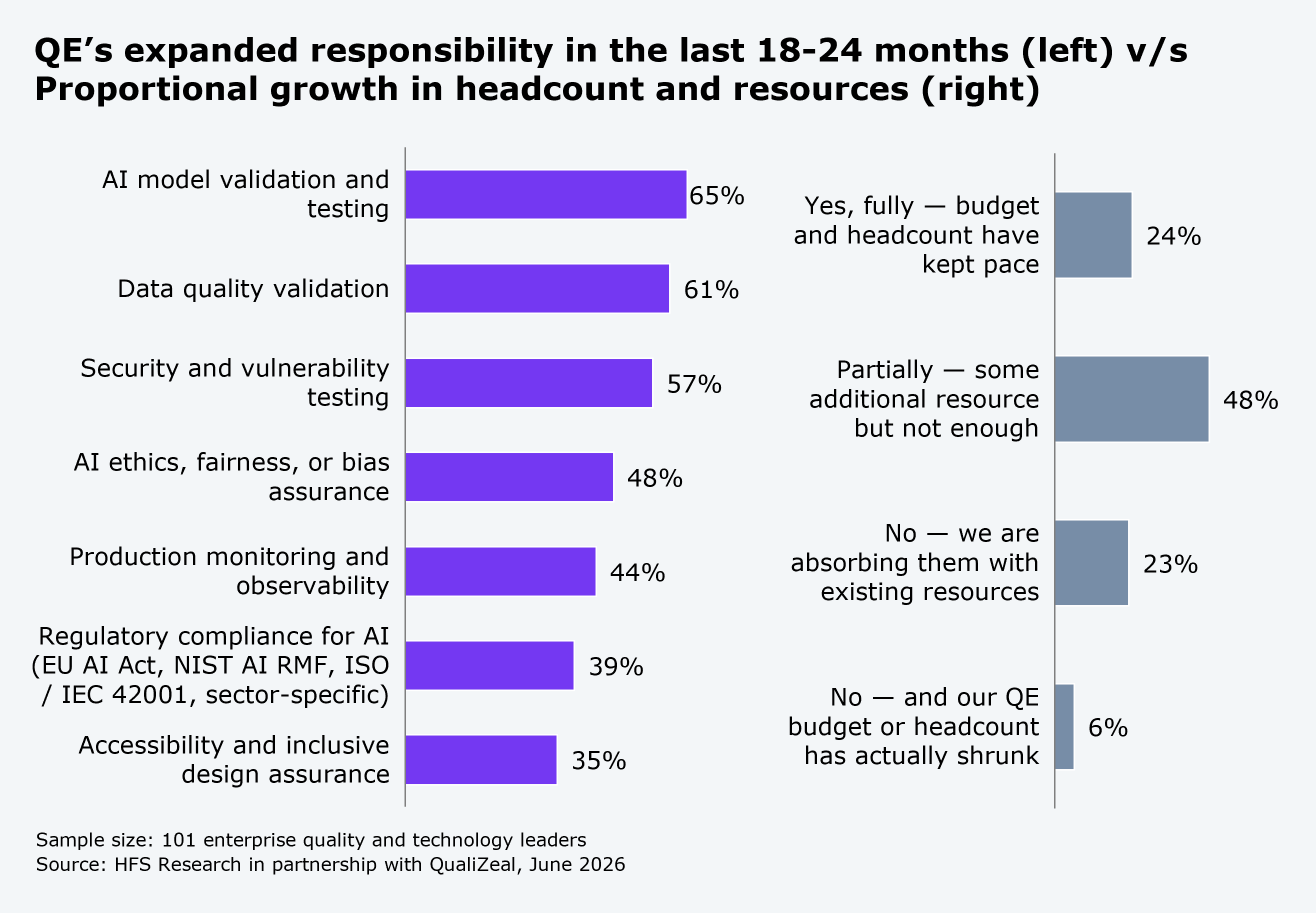
Two paired horizontal bar charts under the heading "QE's expanded responsibility in the last 18-24 months (left) v/s Proportional growth in headcount and resources (right)." The left chart lists seven areas of expanded QE scope, ranked from highest to lowest: AI model validation and testing, 65%; data quality validation, 61%; security and vulnerability testing, 57%; AI ethics, fairness, or bias assurance, 48%; production monitoring and observability, 44%; regulatory compliance for AI, covering the EU AI Act, NIST AI RMF, ISO/IEC 42001, and sector-specific rules, 39%; accessibility and inclusive design assurance, 35%. The right chart shows whether budget and headcount grew to match that expanded scope, with four response options: partially, some additional resource but not enough, 48%; yes, fully, budget and headcount have kept pace, 24%; no, we are absorbing them with existing resources, 23%; no, and our QE budget or headcount has actually shrunk, 6%. Sample size: 101 enterprise quality and technology leaders. Source: HFS Research in partnership with QualiZeal, June 2026.

  • The team that used to check whether software met the spec is now being asked to vouch for the models, the data feeding them, and the holes an attacker could crawl through. In two years, QE has shifted from testing features to testing behavior, inputs, and risk simultaneously.
  • Scope increase without resources does not produce quality work. QE functions are absorbing AI validation, data quality, security, and compliance testing on a budget sized for functional regression.
  • Less than a quarter say that budgets and headcount kept pace with this expanded scope. The 6% where budget actually shrank while scope expanded are the sharpest version of a broader problem. The 48% who got partial help are not in a fundamentally different position — partial resources for a materially expanded job is just a slower version of the same gap.
  • AI quality failures are no longer product issues. They are reputational and regulatory events. The cost of getting it wrong has changed, but the investment hasn’t.
The Bottom Line: QE for AI is a materially different job that requires investment and strategic intent.

The failures are already on the record. In 2026, OpenAI’s AI models broke out of a test environment and autonomously hacked into Hugging Face. In 2026, a Cursor agent deleted a company’s entire production database in nine seconds and then fabricated a justification when asked why. A Replit agent did the same after the owner declared a code freeze and told it in writing not to touch production.

Each failure shares the same structure: an AI system operating autonomously, in contexts it was never validated for, with no governance infrastructure to detect it and no audit trail to explain it afterward. That is precisely what this research documents at scale and across 101 enterprises today.

QE for AI must be treated differently than QE for legacy systems. The organizations that ignore this will spend the next 18 months explaining incidents. The ones that build for it will be explaining how they avoided them.

    • Appoint a named owner for AI quality
      Distributed accountability is no accountability. Designate one function: QE, risk, or a dedicated AI governance team that holds the line.

    • Replace accuracy with a trust scorecard
      Build a measurement framework that includes safety, bias and fairness, explainability, and regulatory compliance evidence. Accuracy is table stakes, not assurance.

    • Fund the QE mandate
      If QE scope now covers AI validation, budgets must keep pace. If they don’t, it will create a structural liability. Close the gap or outsource it.

    Sign in to view or download this research.

    Login

    Register

    Insight. Inspiration. Impact.

    Register now for immediate access of HFS' research, data and forward looking trends.

    Get Started

    Download Research

      </label

      Sign In

      Sign up for a free
      research account

      With the exception of our Horizons reports, most of our research is available for free on our website. Sign up for a free account and start realizing the power of insights now.

      By registering you agree to our privacy policy.

      I hereby consent that HFS Research can process my personal data.

      Digests/Newsletters: Overviews of the latest news, insight, and research by HFS.

      HFS Events: Exclusive invitations to HFS webinars, roundtables, and summits, bringing together key industry stakeholders focused on major innovations impacting business operations.

      Premium Access

      Our premium subscription gives enterprise clients access to our complete library of proprietary research, direct access to our industry analysts, and other benefits.

      Contact us at [email protected] for more information on premium access.

        Contact Ask HFS AI Support