HFS Research’s recent Top 10 RPA Services Providers 2018 report has shown that there is something rotten in the state of robotic process automation (RPA). Despite the hype surrounding the technology, there is a major stumbling block to RPA delivering value for enterprises: both service providers and enterprise clients lack the requisite talent pool size and depth of experience. RPA is often marketed as being low-code or “easy,” which seems to have led users to believe that building robust RPA talent pools is optional. In fact, RPA requires as much effort and strategic planning as any technology, and experienced talent is crucial to delivering RPA success. As enterprises start scaling their RPA initiatives, this lack of experienced talent threatens to become a crisis inhibiting the ability to scale automation programs. If service providers, and more importantly their enterprise clients, don’t start making deep RPA talent cultivation a top priority immediately, enterprises’ RPA ventures will be all but guaranteed to fail.
This POV explores the current state of the state of RPA talent in greater detail, examines what’s at stake if stakeholders don’t prioritize RPA talent creation, and tells service providers and enterprises what they can do individually and together to prevent the pending RPA implosion.
The stage is being set for an RPA disaster—providers and enterprises must act now to prevent it
Enterprises’ passivity and over-reliance on service providers for RPA ROI combined with service providers’ lack of significant capabilities beyond strictly technical ones are making for an impending disaster. Circumstances are now coming together to set this disaster in motion.
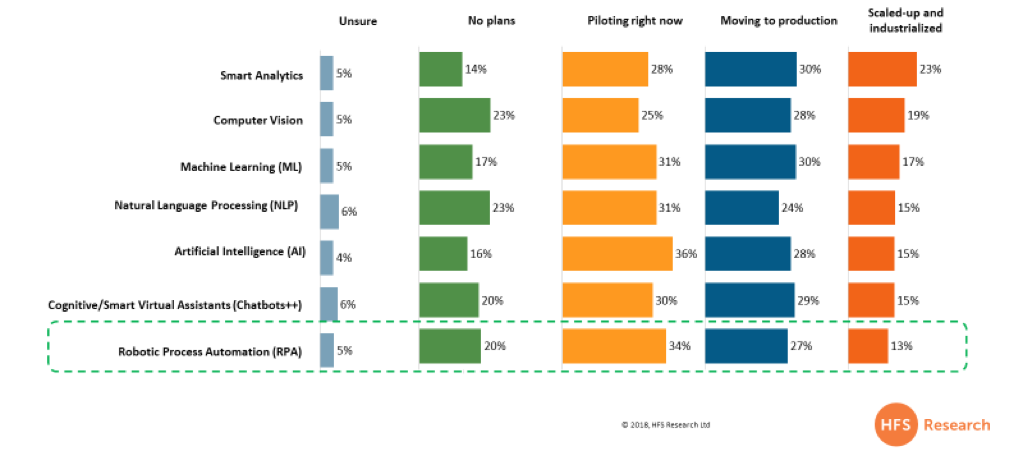
The average RPA engagement’s duration for the 148 clients in our study is just 11 months. According to HFS’ upcoming report on intelligent automation, currently, only 13% of enterprise RPA initiatives are scaled across the entire organization (see Exhibit 1). In other words, until now, RPA projects have been nascent and exploratory. But now, as they begin hitting the one-year mark, more enterprises are trying to take RPA organization-wide. At this juncture, the lack of experienced talent both within client organizations and among their service providers will become painfully apparent.
As more enterprises start trying to scale RPA without the requisite talent, the 77% average satisfaction score given by clients in our RPA services study will start dropping, costing clients investment money and service providers contracts. In other words, a major RPA disillusionment and reckoning is coming for both sides of the market.
Exhibit 1: The current state of enterprises’ IA technology adoption
Question: What is the current state of adoption of the following intelligent automation (IA) technologies in your organization?
Source: HFS Research in conjunction with KPMG, State of Intelligent Automation, 2018
n=590 business leaders including 100 c-level executives
Enterprises aren’t pulling their weight to ensure RPA initiatives deliver ROI
As we’ve seen above, the average client satisfaction score for the RPA Services Top 10 study is a tepid 77%. However, it’s crucial to emphasize that much of the responsibility for this current state of RPA lies with enterprise clients. Perhaps the single biggest problem facing the RPA market is enterprises’ passivity when it comes to ensuring that their RPA and broader intelligent automation (IA) programs deliver results.
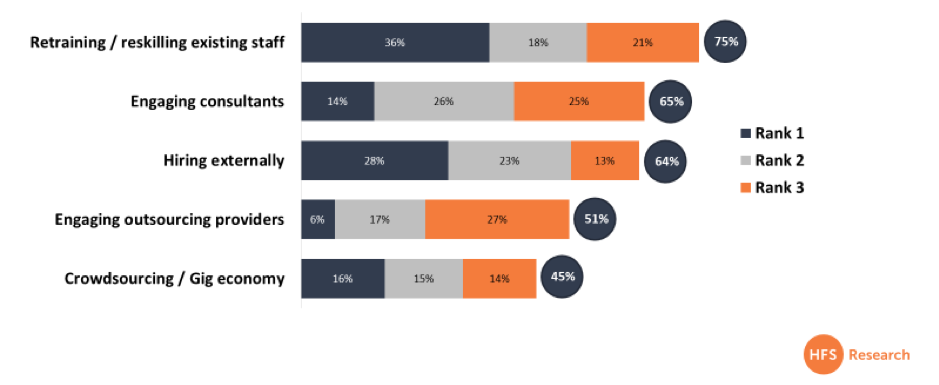
According to a recent survey conducted by HFS and KPMG on intelligent automation, fully 75% of enterprise (IA) clients are planning to retrain or reskill their existing employees to create internal RPA talent reserves (see Exhibit 2). However, we have seen little evidence of the required budgetary heft needed to enable this— at the level of technical resources as well as business-side sponsors and those responsible for identifying RPA use cases in their organizations. This balance between IT and operations is critical to ensure a balance of outcomes. As a result, the onus is mainly placed on service provider partners to deliver ROI on RPA programs. Retraining non-technical professionals as RPA experts is a tall order. The notion of an average business user—say an accounts payable clerk or a business analyst—sitting down and creating bots to automate mundane tasks is not the reality. While simple bot creation is feasible for such users, there is a world of difference between building a bot and automating an entire task, process, function, or enterprise.
Exhibit 2: Enterprises’ approaches to accessing intelligent automation talent
Question: In which of the following ways are you accessing Intelligent Automation (IA) talent that you need to drive your strategy?
Source: HFS Research in conjunction with KPMG, State of Intelligent Automation, 2018
n=590 business leaders including 100 c-level executives
RPA is murky and hard to execute and finesse and requires knowledge of enterprises’ legacy systems. To ensure RPA makes a tangible difference to a way a company does business, process owners must bring their knowledge and experience to the table to help with process mapping and beyond. Executives, meanwhile, are indispensable for drawing up automation roadmaps and change management and education initiatives to handle the transition. Even the best-performing RPA service providers shouldn’t be doing clients’ work for them, and clients shouldn’t be entirely reliant on third parties for RPA success. Enterprise knowledge and company vision are two crucial elements of RPA success that can only be supplied by the client organization.
If successful RPA initiatives depend on service providers and their clients meeting each other halfway with their respective strengths, then the current reality is that one party isn’t pulling its weight when it comes to cultivating RPA resources. And, as we shall see, at the same time service providers lack many of the capabilities their clients are assuming they have.
Service providers have some significant weak spots in their RPA delivery
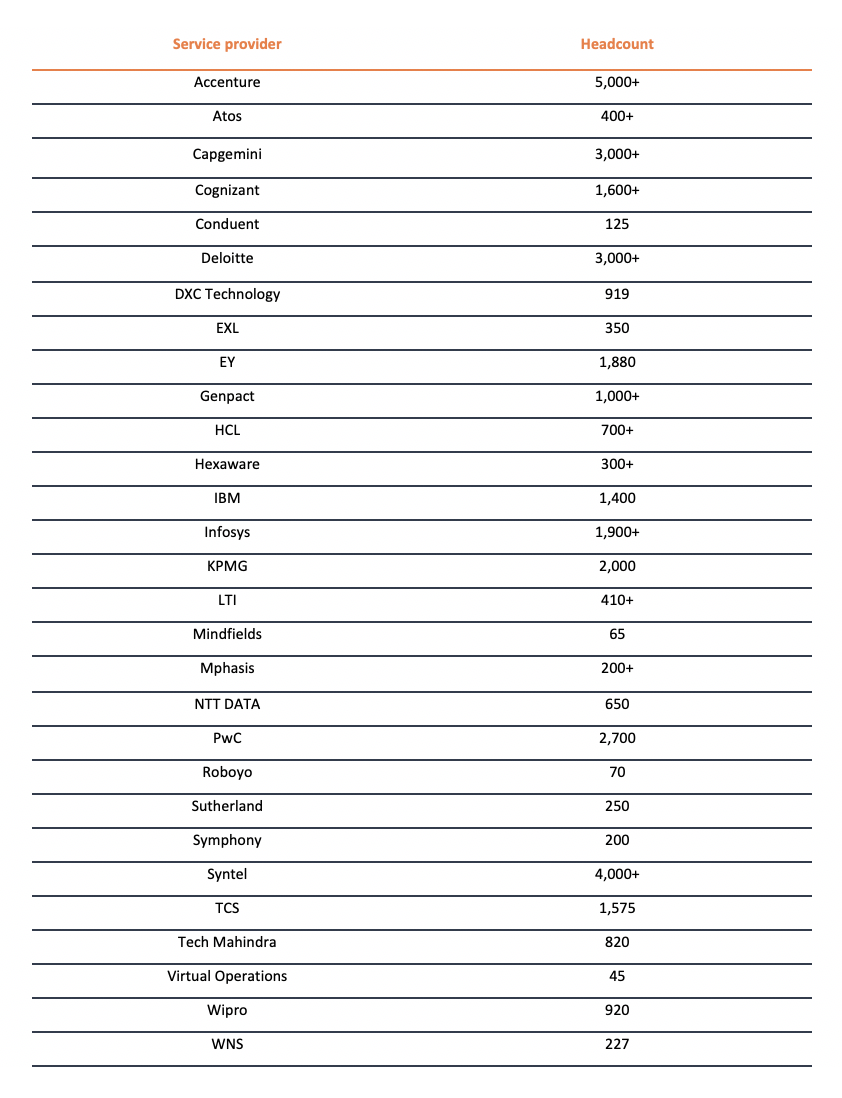
Data collected in our RPA Services Top 10 study shows that at least 80% of the 32,474 RPA resources across the 29 providers included in this study (see Exhibit 3) have two years or less of direct RPA experience. This lack of an experienced talent pool is primarily due to market forces beyond providers’ control: RPA is still a relatively young market, with most focused RPA activity only taking place in the past three years. Service providers are doing what they can to make up for the shortfall—60% of surveyed providers are internally reskilling their RPA resources to create the talent that they can’t find or buy in the marketplace.
Exhibit 3: RPA service provider talent headcounts
Source: HFS Research Top 10 RPA Service Providers 2018 study
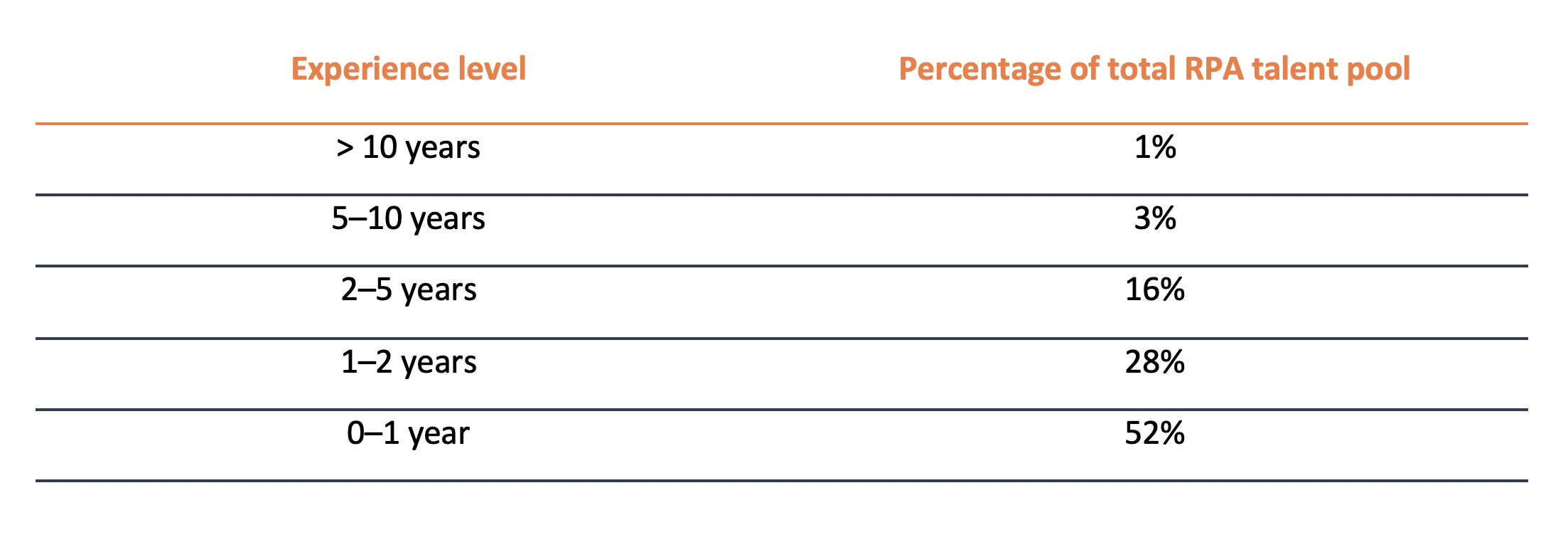
However, despite the shallowness of their resources’ RPA expertise, service providers are promoting inexperienced RPA professionals to senior roles while in other technology areas, senior developers and team leads typically have a minimum of seven years of experience, according to HFS data. By comparison, only 1% of RPA resources currently have a decade of direct RPA experience under their belt, and only 3% have 5 to 10 years (see Exhibit 4). Elevating junior professionals to senior RPA roles is impacting more than service providers’ technical capabilities: their ability to provide change management capabilities and assist with setting up and maintaining ongoing governance were the lowest-rated execution criteria, as scored by references.
Exhibit 4: Baseline RPA resource skill levels
Source: HFS Research Top 10 RPA Service Providers 2018 study
Perhaps even more concerningly, the vast majority of service providers’ RPA resources are located offshore, away from client locations where help is most needed. While 57% of RPA resources are located in APAC (predominantly India), 80% of clients are in EMEA and North America (see Exhibits 5 and 6). Some service providers have awoken to the danger of treating RPA as an offshoring operation and have begun building out regional delivery centers.
All this suggests that for all the talk from service providers about the importance of governance and change management for ensuring RPA success, this is still largely lip service rather than a high priority. Combined with enterprises’ passive role in ensuring the success of their RPA initiatives, these shortcomings threaten to create a potentially catastrophic situation.
Exhibit 5: Average percentage of service providers’ RPA talent pools per geography
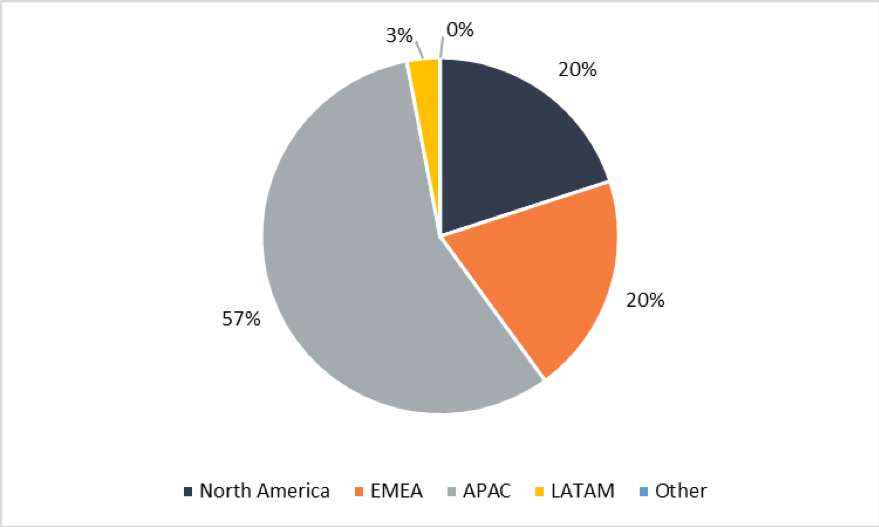
Note: n=21 due to data availability or quality; and APAC numbers are elevated due to high RPA talent numbers in India
Source: HFS Research Top 10 RPA Service Providers 2018 study
Exhibit 6: Average percentage of service providers’ RPA clients per geography
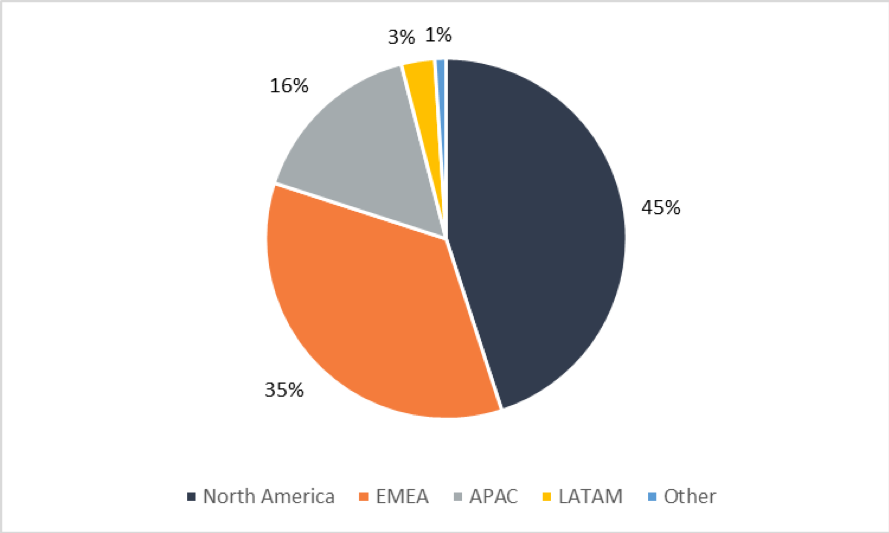
Note: n=27 due to data availability or quality
Source: HFS Research Top 10 RPA Service Providers 2018 study
Enterprises and service providers must start implementing best practices for RPA talent cultivation to prevent the coming RPApocalypse
The picture isn’t entirely black, however. From our RFI responses and reference calls, we have culled several key emerging best practices for service providers and enterprise RPA clients to begin implementing immediately to prevent this pending RPA implosion, listed in Exhibit 7.
Exhibit 7: Emerging best practices for RPA talent cultivation
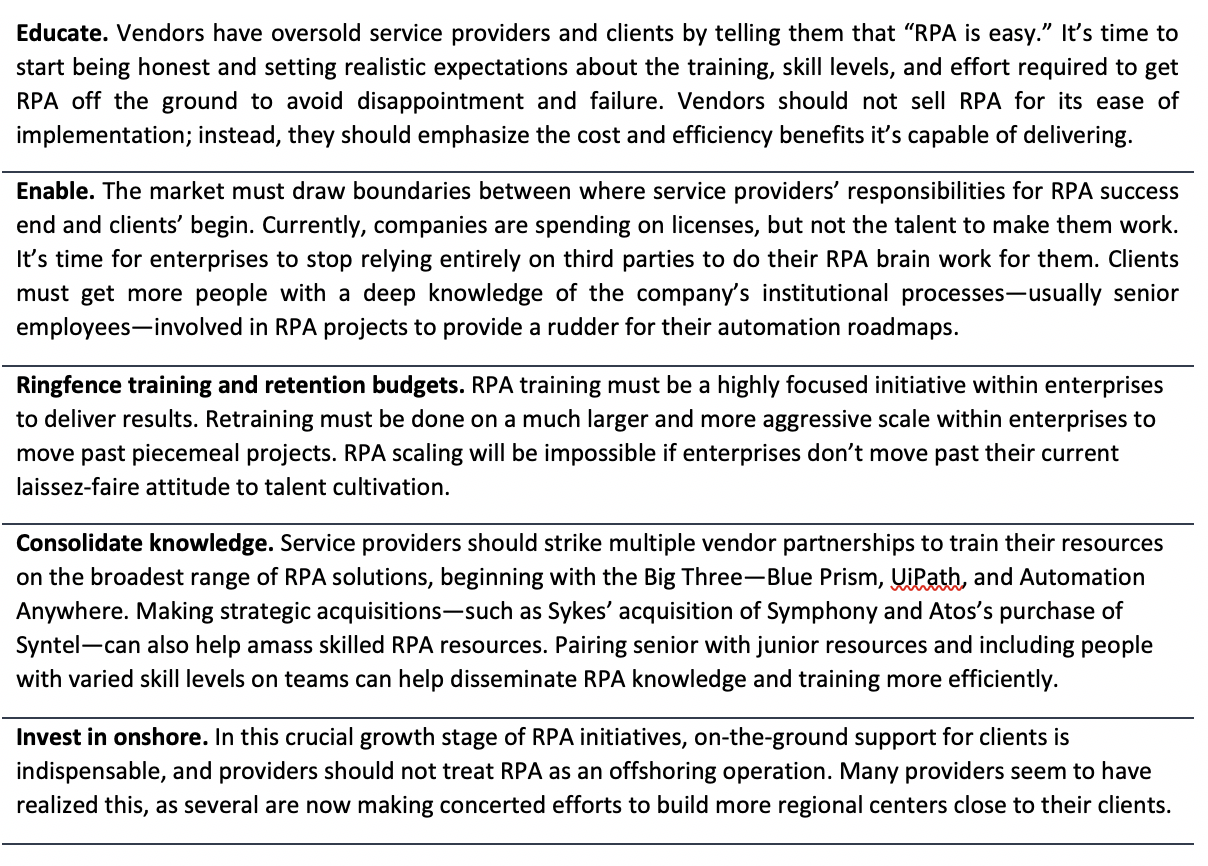
Source: HFS Research, 2018
Bottom line: Investment in talent—both technical and automation mindset training—is essential to enable RPA to scale
Meaningful investment in talent will require planning, budgeting, change management, and intensive education on behalf of service providers and, more importantly, enterprise clients. What both parties must take away is that scaling talent, not software, is the biggest issue facing the market today. RPA initiatives will fail dramatically if amassing specialist talent keeps being treated as a peripheral issue. The inability to scale up RPA talent is what could topple this house of cards. If you run RPA initiatives as siloed projects within organizations, they simply will not scale.
The time has come to recognize that RPA is valuable because it promises immense benefits, not simplicity. It improves the quality of work by eliminating repetitive tasks and driving cost savings. The RPA market is long overdue for an aggressive education push. There has been too much dumbing-down going on, and no one will realize the potential of RPA unless everyone starts doing their homework.
Register now for immediate access of HFS' research, data and forward looking trends.
Get StartedIf you don't have an account, Register here |
With the exception of our Horizons reports, most of our research is available for free on our website. Sign up for a free account and start realizing the power of insights now.
Our premium subscription gives enterprise clients access to our complete library of proprietary research, direct access to our industry analysts, and other benefits.
Contact us at [email protected] for more information on premium access.