This HFS Take 5 report is for private equity operating partners, CIOs, heads of value creation, and investment partners deciding how to buy AI-led services across their portfolio companies.
Executive summary
New research finds that private equity (PE) value creation is being operationalized. AI-led modernization, productized delivery, and underwritten outcomes now define how PE firms buy services.
PE firms have stopped treating technology as back-office support. AI and automation now top the portfolio value-creation agenda, backed by a wave of capital. The buying logic has changed, and execution increasingly runs through productized, repeatable delivery alongside expanding in-house and GCC capability. PE firms reward quantified, underwritten outcomes and productized, repeatable delivery that scales across portfolio companies. They are skeptical of broad capability and orchestration claims that are not backed by proof.
HFS Research, in partnership with Cognizant, surveyed 102 decision-making executives at global PE firms to understand where they are placing their AI bets, how sourcing models are shifting, and what a Services-as-Software model means for their value creation.
The survey uncovered five key takeaways:
-
AI-led value creation tops PE firms’ agenda
AI and automation is the top portfolio value-creation priority (54%), with 79% of PE firms planning to increase their AI budget by more than 25% over the next two years.
-
Services-as-Software is becoming the go-to model for PE firms
Eighty-one percent of PE firms plan to expand Services-as-Software and 88% for GCC usage, while 1 in 4 expects to cut traditional IT outsourcing.
-
Diligence, documents, and fund admin lead AI’s scaling shortlist
The AI use cases set to scale concentrate in PE firm functions are deal diligence (51%), document intelligence (43%), and fund administration (41%).
-
For PE firms, proven results beat broad claims
The claims PE firms find most believable are specific and measurable: underwritten pre-close cost savings, platform-first delivery, and cost-effective onshore and nearshore delivery. Ecosystem orchestration draws the most doubt. PE firms want proof, not partner logos.
-
PE firms are running ahead of their portfolio companies on AI
A third of PE firms (34%) already run production-grade AI, while nearly half of PortCos (47%) remain at exploration or earlier stages. The firm itself is the natural place to start and then scale to portfolio companies (PortCos).
The Bottom Line: PE firms are looking to operationalize AI through Services-as-Software. The firms that pull ahead demand quantified baselines, underwritten outcomes, and repeatable delivery that scales across their portfolio companies, holding partners to proof rather than positioning.
Why this matters now
PE firms must create value faster, but the traditional outsourcing model was not built for outcome accountability or portfolio-scale speed.
Returns increasingly depend on operational improvement, not financial engineering, so PE firms need faster, more reliable ways to drive change across the portfolio.
Why PE firms are rethinking how they buy services:
-
Traditional outsourcing gives cost but not certainty
Headcount-based, effort-priced models offer no underwritten outcomes, limited control, and little that scales repeatably across portfolio companies.
-
AI changes what is possible
As delivery shifts from people to software, PE firms can buy productized, outcome-backed services rather than effort.
AI and automation top PE firms’ value-creation agenda, with 79% of them planning to increase their AI budget by more than 25% over the next two years.
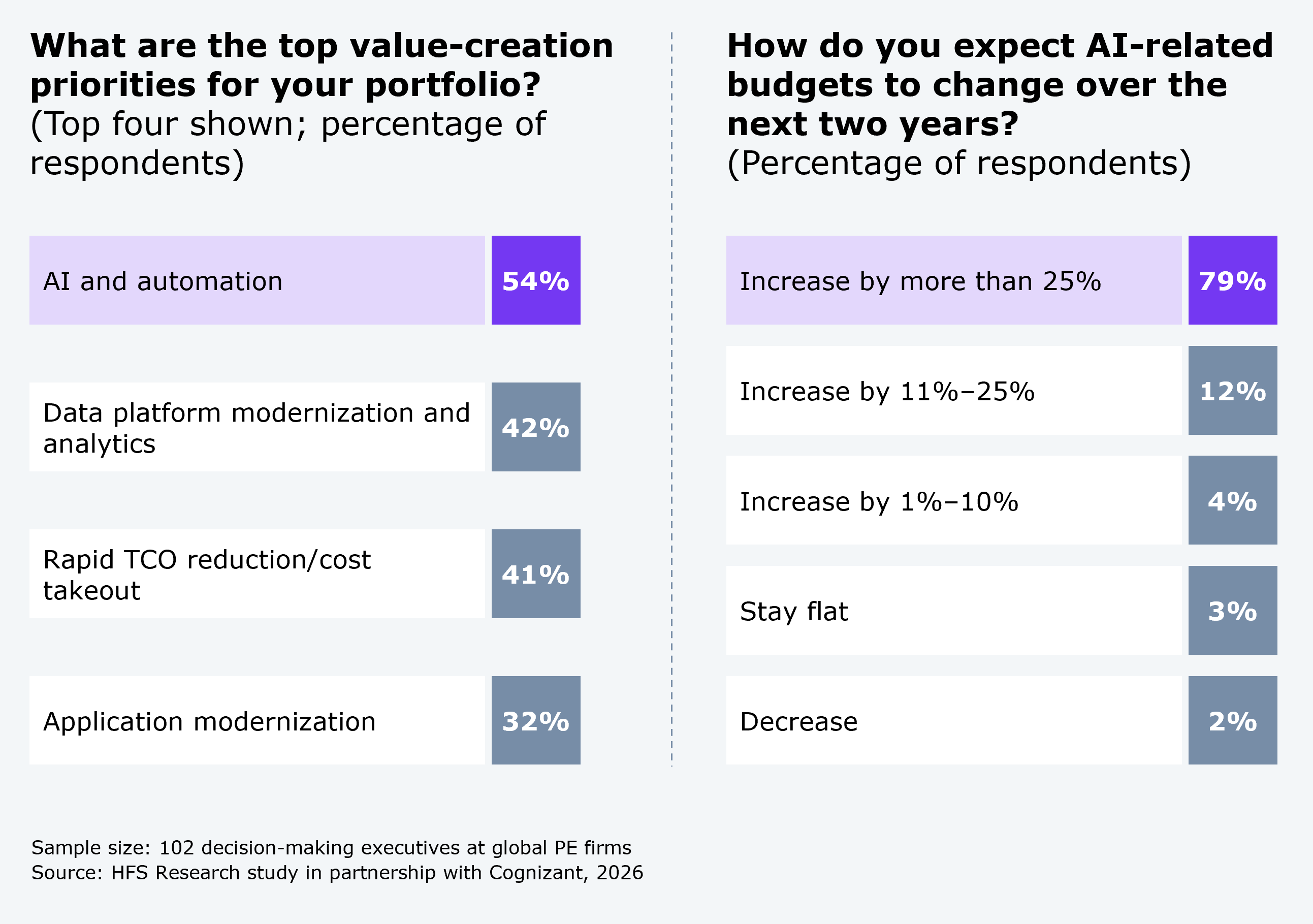
- AI is where incremental capital is heading, with a vast majority of PE firms planning to raise AI budgets over the next two years.
- The top two priorities, AI and automation (54%) and data modernization (42%) show that PE firms are banking on intelligent operations to drive results.
- The shortlist is execution-led. Rapid TCO reduction (41%) and application modernization (32%) round out the top four, showing that operational hygiene still earns budget alongside the AI push.
- PE firms expect AI to be embedded across data, cloud, and application programs, not bought as a standalone initiative.
- Traditional levers such as BPO and consulting are now judged against execution outcomes, not funded as standalone spend.
Eighty-one percent of PE firms plan to significantly expand Services-as-Software, while one in four expects to cut traditional IT outsourcing.
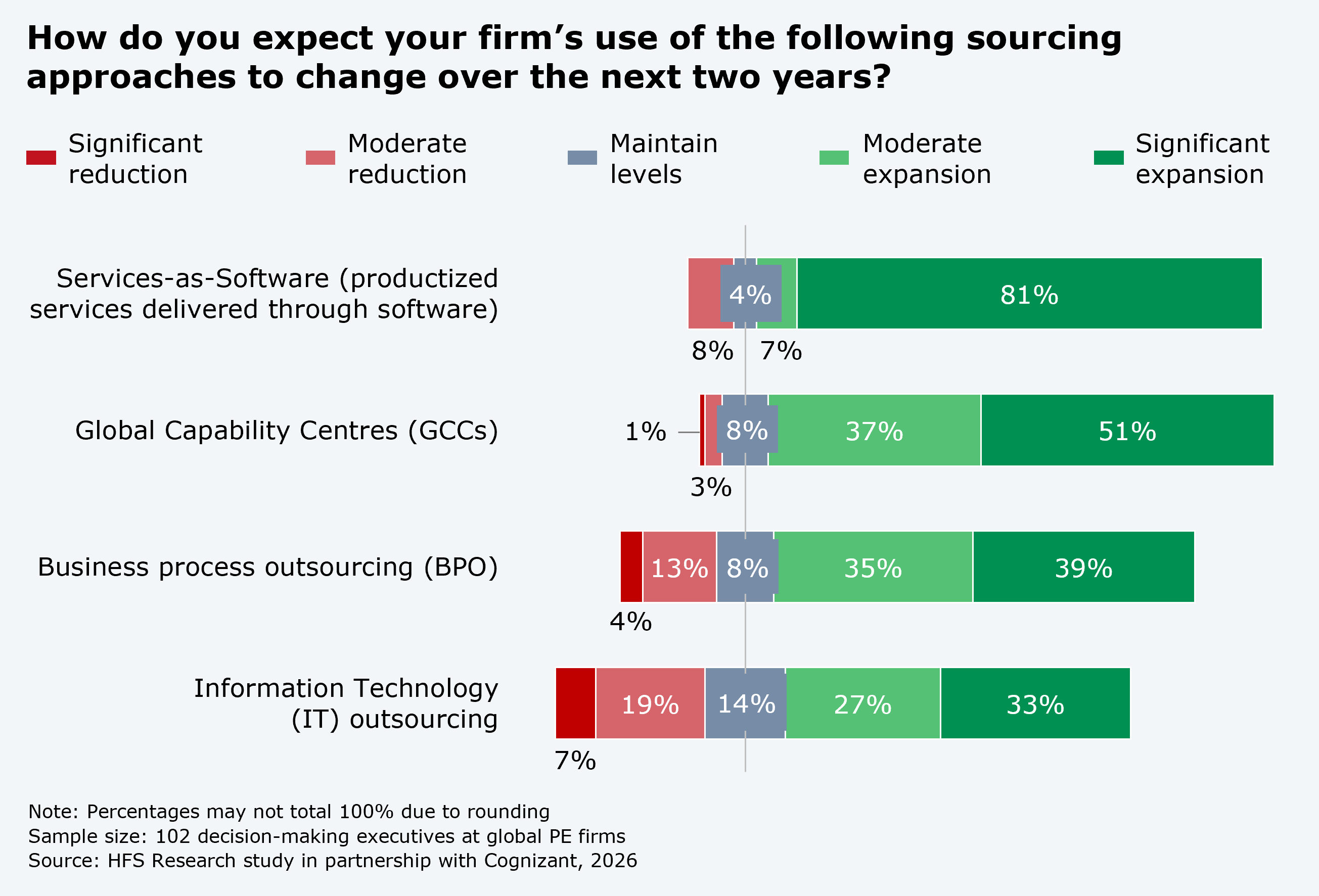
- Services-as-Software is emerging as the preferred scaling model. PE firms want productized, replicable delivery that reduces dependency on headcount-based approaches.
- GCCs show similarly strong momentum as firms prioritize control, IP ownership, and repeatability across portfolio companies.
- Traditional IT outsourcing is the casualty of this shift, squeezed between the efficiency of software and the strategic value of GCCs.
- One in four PE executives expect to reduce IT outsourcing spending over the next two years.
- Rising delivery costs and the desire for greater in-house control are the leading reasons for cutting back.
- Certainty is what PE firms are buying, with quantifiable savings, risk transfer, and access to talent driving the expansion of Services-as-Software.
The use cases set to scale sit squarely in PE firms’ functions: deal diligence (51%), document intelligence (43%), and fund administration (41%).
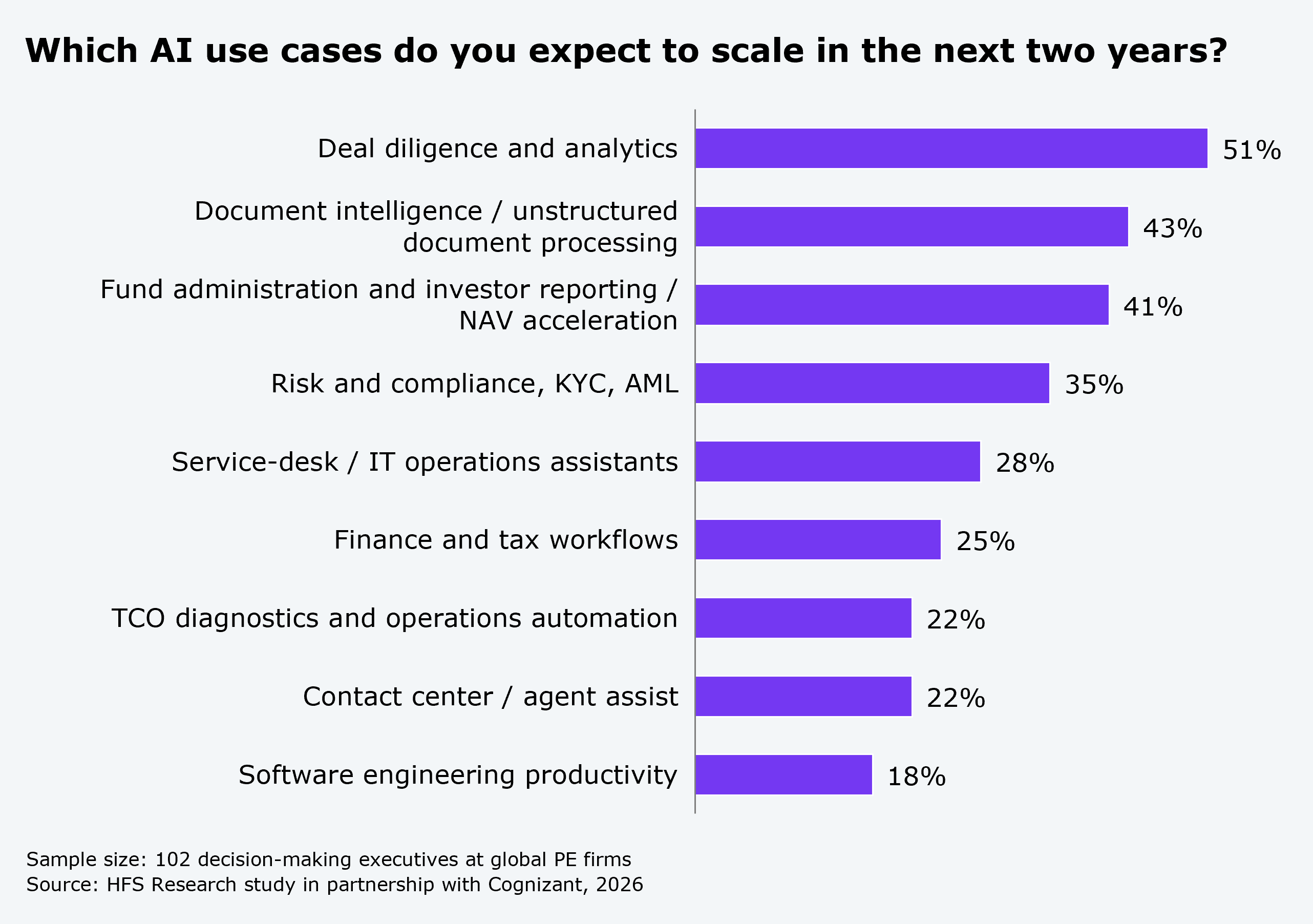
- The AI use cases scaling first are the ones best suited to the Services-as-Software model: productized, repeatable, and sitting where data is already centralized at the firm, so adoption can be standardized quickly.
- The top use cases share a common profile: document and data-intensive, rules-based work built on repeatable workflows.
- That profile is what makes them the easiest wins, where AI augments existing processes rather than forcing operational change.
PE firms back partners that can prove specific, measurable results, not those promising broad, all-in-one capability.
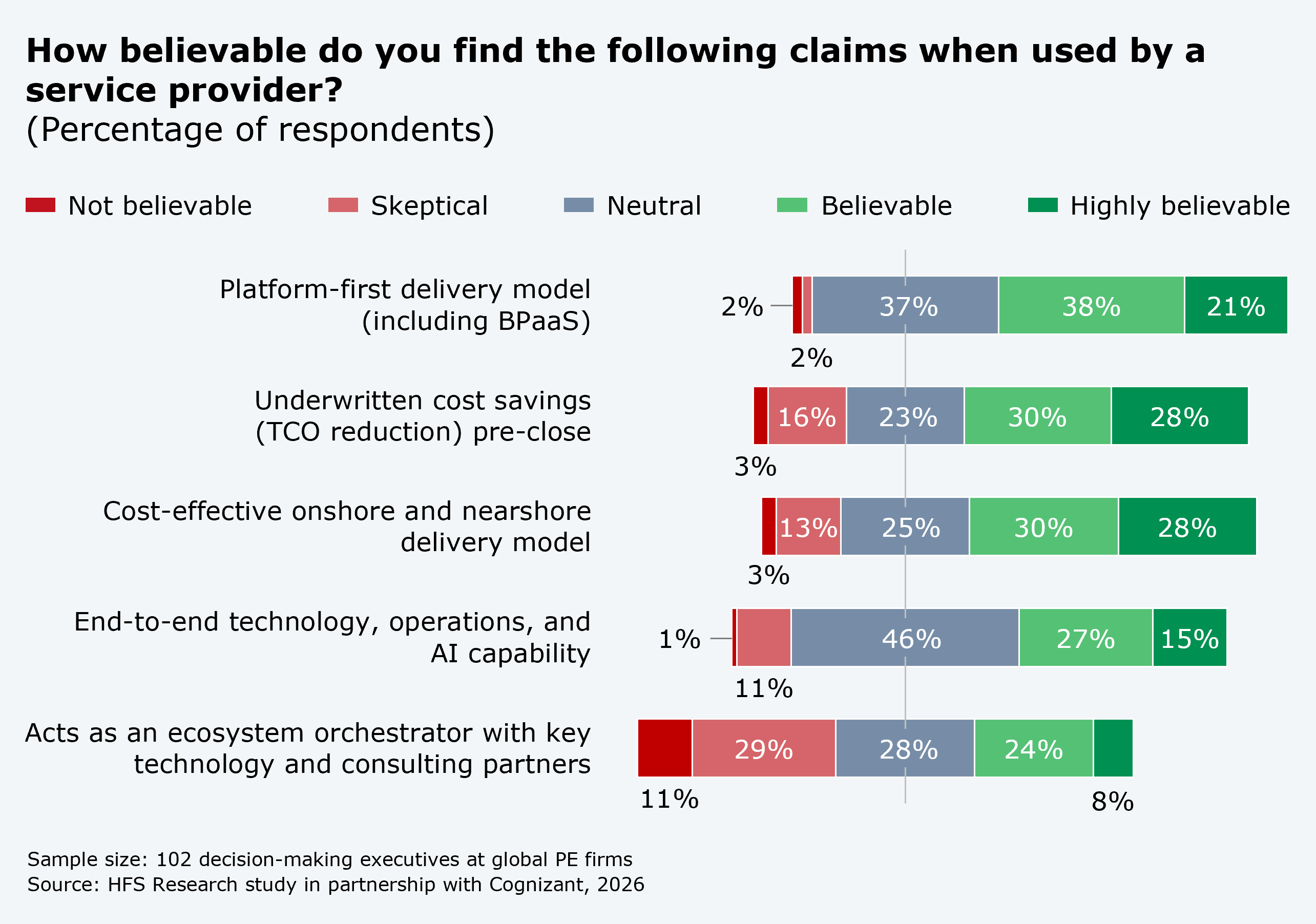
- PE firms believe what they can measure. Platform-first delivery (59%), underwritten pre-close cost savings (58%), and cost-effective onshore and nearshore delivery (58%) are the claims they trust most.
- Firms only buy underwritten savings when partners can prove how they’ll get there and stand behind the result.
- The broadest claims draw the most doubt. Only 42% find end-to-end technology, operations, and AI capability believable, and 46% sit on the fence, so it reads as a stretch rather than a strength.
- Ecosystem orchestrator is the least credible claim of all, at 32% believable and 40% outright doubtful. Many PE firms would rather manage those relationships themselves.
A third of PE firms (34%) already run AI in limited or scaled production, while nearly half of portfolio companies (47%) remain at exploration or earlier.
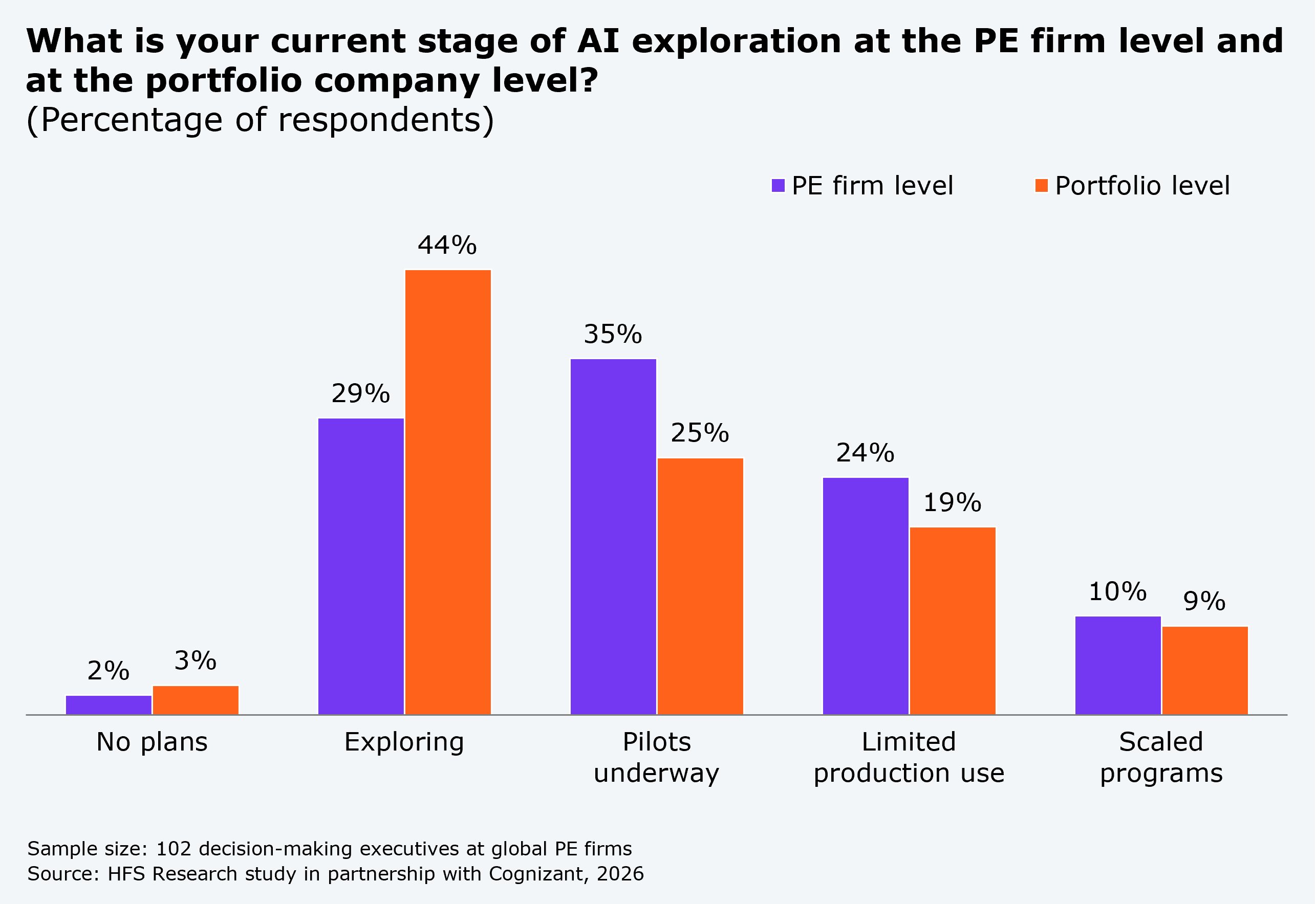
- PE firms are ahead of their PortCos: 34% run AI in limited or scaled production versus 28% of portfolio companies, while 47% of PortCos have not moved past exploration.
- The firm is the natural place for PE investors to start. They control their own operations, data, and decisions, so AI moves from pilot to production faster at the firm level than across the portfolio.
- PE firms also control governance and funding decisions early, while PortCos need business-case approval, leadership alignment, and integration into operating budgets.
- Scaling across PortCos is inherently slower because each company starts from its own systems and stage of readiness.
The Bottom Line: PE firms are looking to operationalize AI through the Services-as-Software model
The firms that pull ahead demand quantified baselines, underwritten outcomes, and repeatable delivery that scales across their portfolio companies
AI-led modernization at a portfolio scale is within reach, but only when claims are quantified, governance is explicit, and delivery is repeatable. That is the bar PE firm leaders should set
To capture the value, PE firms must
-
Demand portfolio playbooks, not point solutions; get partners to show how value is created repeatably across PortCos
-
Buy impact, not effort; insist on underwritten, outcome-backed commercials over time-and-materials
-
Expect more than platforms; assemble complementary partners that cover orchestration, data, and execution
Orchestration is judged on results, not positioning. PE firms test it through execution metrics: Outcomes delivered, not partner logos