
HFS has started describing TCS as the “Walmart of IT services”—the firm can pretty much win any large deal it wants and deliver it effectively. TCS grew impressively at 9% last year to end 2018 at $19 billion in revenue with an envious operating margin of 25% (for comparison, Accenture has a 15% operating margin). Its “Experience Certainty” message underpins its execution focus and resonates with almost every client that we’ve interviewed over the last year. However, the same research also reveals that its brand perception around innovation continues to struggle despite its narrative around “Business 4.0” and “Machine First” and investments in R&D. Why is that? Is the underlying innovation capability lacking? Or is it TCS’ ultra-conservative style?
HFS Research attended the TCS Innovation Forum North America on May 7, 2019, in New York. The day showcased loads of cool TCS research and applied innovations. But, we were struck by how the enterprise constituents mainly consisted of CIOs and IT leadership, a sign of TCS’ continued IT-centric worldview. This could be the cause of TCS’ lacking innovation reputation – its research and innovation capabilities are not being recognized beyond its core comfort client in IT leadership.
The TCS Innovation Forum showcased interesting research and applied technology, partner capabilities, and a window into enterprise transformation journeys. As the following examples from the event illustrate, the relevance of the tech comes from its application at the business process level. COOs, CDOs, CMOs, and CISOs would have had a field day going deep with innovations that could help them enable transformation.
HFS’ framework for digital business transformation is the Digital OneOffice. The Digital OneOffice is where teams function autonomously across front- and back-office functions to promote broader processes with real-time data flows that support rapid decision making. The silos separating the front and back offices will cease to exist as they become OneOffice—operating as a unified digital business. The key here is that enterprises are striving for business change, guided by desired business outcomes. While this is of course enabled by technology change, it cannot be done without business context – the most critical element for the success of initiatives that directly impact business operations.
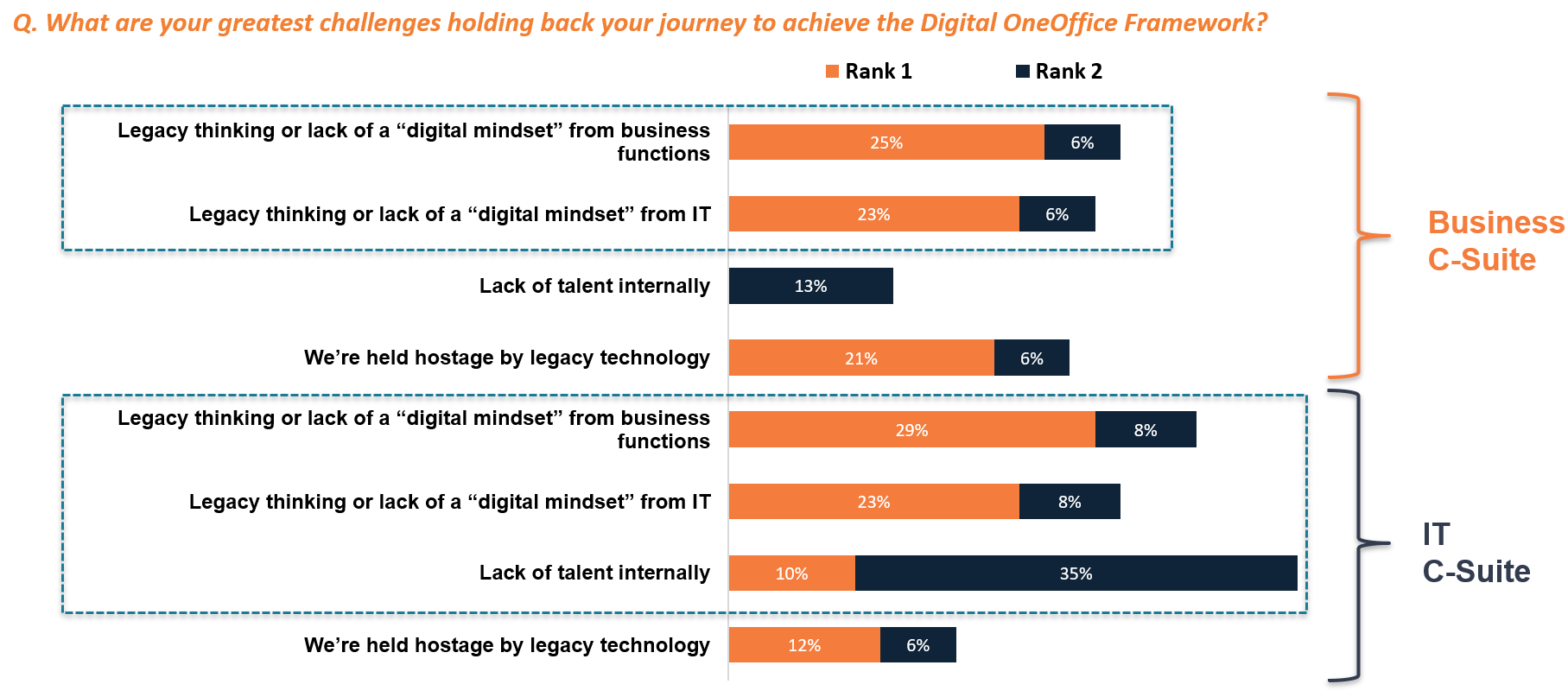
In a recent HFS study, we queried 100 C-level executives on barriers to digital transformation (Exhibit 1). The results show a stark contrast between business and IT leadership perspectives. Business leadership identifies a lack of mindset as the most significant barrier to change, whereas IT leaders are overwhelmingly focused on their lack of skilled talent internally. The reality, though, is that there is nothing to execute on if there is not a clear business objective. The need for business and IT collaboration at both the strategy and execution levels is greater than ever.
Exhibit 1: Making the leap to Digital OneOffice: IT lacks talent; business lacks mindset
Source: HFS Research, 2019
Sample: C-Level Enterprise Executives = 100
The theme for TCS’ North American innovation forum was “Agile. Machine First. Innovation.” (which almost works better as a theme without the marketing periods). This was TCS’ attempt to focus the narrative of the day around its Business 4.0 concept of transformation—essentially curating a discussion around how enterprises are leveraging a vast array of disruptive technologies to drive behavioral shifts in business. Given that most of enterprise constituents were CIOs and IT leadership, and TCS’ message itself was IT-centric, its seems TCS defines transformation through the IT lens. TCS needs to go broader than its comfort clients if it wants to drive its Business 4.0 digital transformation agenda forward.
The TCS Innovation Forum was a useful curation of emerging technologies and use cases focused around enabling the Digital OneOffice. However, despite the repeated insistence that digital business transformation is only achievable through collaboration between business and IT, the target enterprise audience was decidedly IT-specific.
TCS is quietly emerging as the “Walmart of IT services” with the depth and breadth to win and deliver any deal it wants. Its focus on size and execution puts it in a commanding position in the market, which makes it tough to compete with. Its investments in innovation have been critical to this rise and spell trouble for traditional competitors. Of late, TCS has been actively targeting beyond its usual sweet spot of IT leadership to the broader C-suite. It needs to take its own advice and further open the aperture to ensure it is bringing more than IT leaders to the table if it wants to achieve its version of the OneOffice—Business 4.0.
Enterprise leaders should also take note that while digital business transformation is actively changing the traditional role of the CIO, much of the potential change will stem from business process optimization and the creation of new business models. The necessary inclusion and elevation of business leaders to work collaboratively with IT leadership is imperative to realize the potential of digital business transformation.
Register now for immediate access of HFS' research, data and forward looking trends.
Get Started

If you don't have an account, Register here |
With the exception of our Horizons reports, most of our research is available for free on our website. Sign up for a free account and start realizing the power of insights now.
Our premium subscription gives enterprise clients access to our complete library of proprietary research, direct access to our industry analysts, and other benefits.
Contact us at [email protected] for more information on premium access.

