This Market Vision Paper is for CIOs, chief AI officers, and other technology and business leaders looking to move GenAI from pilot to enterprise-wide adoption by targeting urgent C-suite outcomes.
The enterprise AI landscape is at a crossroads. Despite immense potential, adoption is stuck in lengthy pilots and proofs of concept (POCs), bogged down by complexity and unclear returns. This paper introduces a bold new vision: persona-led AI solutions designed to address the urgent and specific needs of C-suite leaders. By targeting tangible top-line outcomes such as revenue growth, product-market fit, and market expansion, these solutions promise to break the cycle of stalled adoption and inspire enterprise-wide AI transformation.
To succeed in the enterprise, generative AI (GenAI) must pivot from its consumer roots. Enterprise AI is distinct from consumer AI’s obsession with the race for artificial general intelligence and a personal agent to rule them all. While it’s important to offer competitive performance, enterprise AI is more focused on using tried and tested technology to deliver business outcomes such as revenue growth, cost reduction, and risk mitigation.
To achieve this, enterprise AI must offer robust privacy, governance, and security frameworks while allowing customization, explainability, and integration within existing enterprise workflows.
Those working with consumer AI shouldn’t worry about the difficult realities of interoperability across departments and industries—enterprise AI lives or dies by exactly such interoperability.
Providers such as Inflection AI are leading the charge to enterprise AI by offering turnkey AI systems tailored for enterprise use, prioritizing control, transparency, and business outcomes. Their approach demonstrates how AI can integrate seamlessly into enterprise workflows, delivering measurable value from day one.
This paper outlines a path forward for enterprises and tech providers alike. Enterprises must embrace persona-aligned solutions for immediate wins, while tech firms must adopt a service-oriented mindset to understand and truly meet enterprise needs. Together, these efforts will spark a new wave of AI adoption, supported by comprehensive enterprise tech stacks to operationalize AI at scale.
To unlock the full potential of enterprise AI, the focus should be on delivering persona-led solutions that solve critical business challenges today, paving the way for long-term transformation tomorrow.
AI has become a hammer looking for nails, leading to excessively long adoption cycles as firms are confronted with ocean-boiling solutions and little idea about where to start. Our research among enterprise leaders and conversations with tech firms in and beyond Silicon Valley reveals that a fresh approach of greater mutual understanding is required: (i) tech firms should respond to the specific and tangible near-term needs of C-suite leaders with a new focus on persona-led business needs and (ii) C-suite leaders should come to grips with the realities of scaling AI into the enterprise.
Ultimately, focused solutions will be the on-ramps to broader enterprise impact. Such focus will accelerate adoption by making the value more straightforward for the C-suite to identify (ideally, C-suites with urgent issues to solve, such as quarterly targets to hit). Only the CEO will make a call on a more comprehensive enterprise-wide adoption program—and they will do so based on evidence from the success of the on-ramp solutions.
Inflection AI has been confronting this new reality since pivoting to meet enterprise AI needs mid-year in 2024—a move HFS predicted much of the industry would follow. The firm licensed its tech to Microsoft—where it now serves as the foundational layer for Copilot. But Inflection still owns its tech. It is scaling its headcount rapidly with a new mission—to deliver turnkey AI systems to enterprises in which privacy, customized functionality, and agentic (actionable) AI capabilities define a new value proposition.
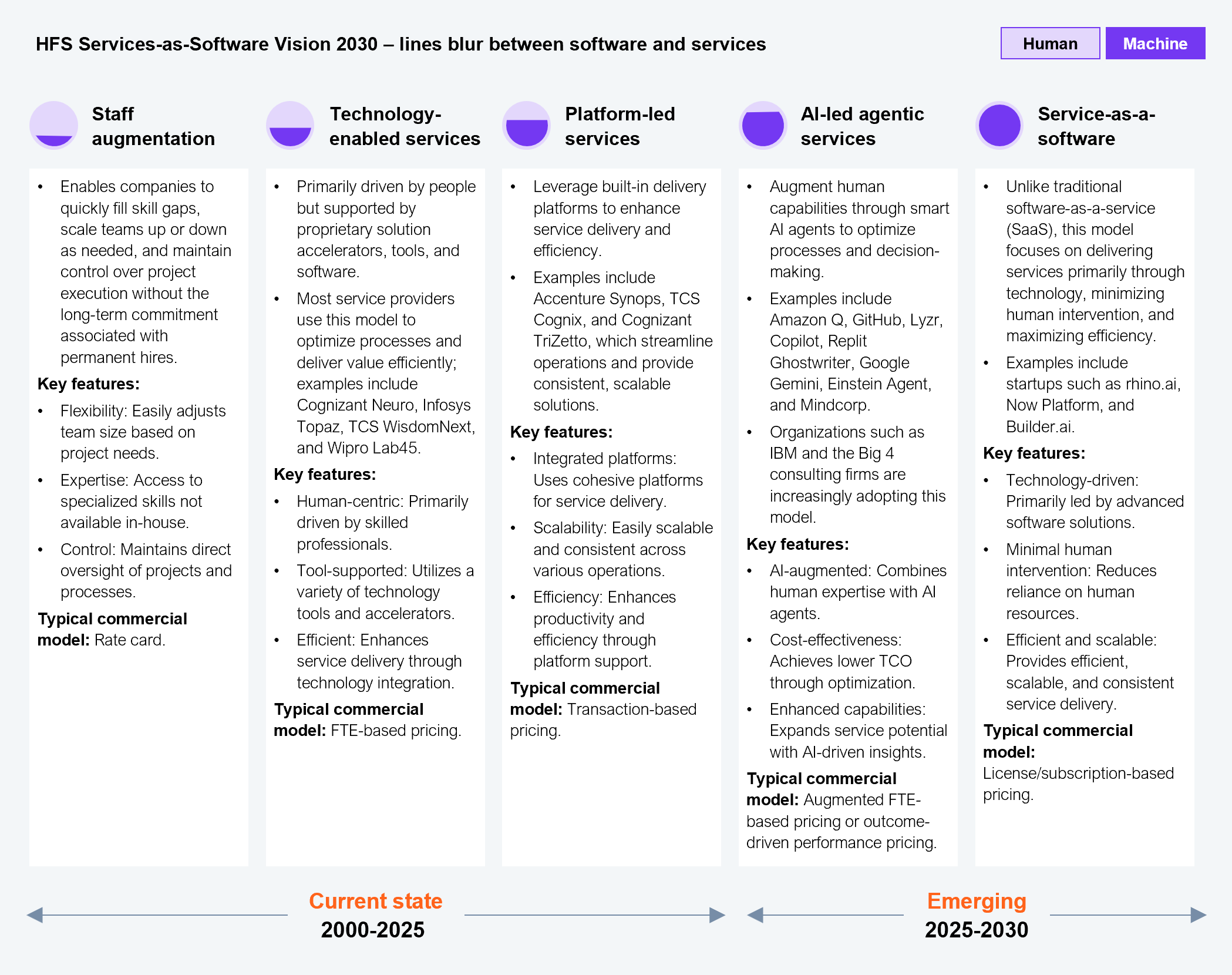
Just as services firms must become software providers—shifting right on the HFS Services-as-Software vision (see Exhibit 1)—tech firms must learn from and adopt a services mindset—shifting left toward services.
Services do not come naturally to Silicon Valley—home to many emerging enterprise AI industry leaders. However, as the HFS 2030 vision (see Exhibit 1) reveals, services are no longer the intensely labor-led solutions they once were. Thanks to AI, services firms must adopt tech firm approaches—using software to replace many of their service portfolios. Services are becoming tech. If tech firms are to serve enterprises better, they must move in the opposite direction—taking a leaf from the services firms’ playbook—built on a deep understanding of their enterprise buyers’ needs.
Source: HFS Research, 2025
Adopting a services mindset means:
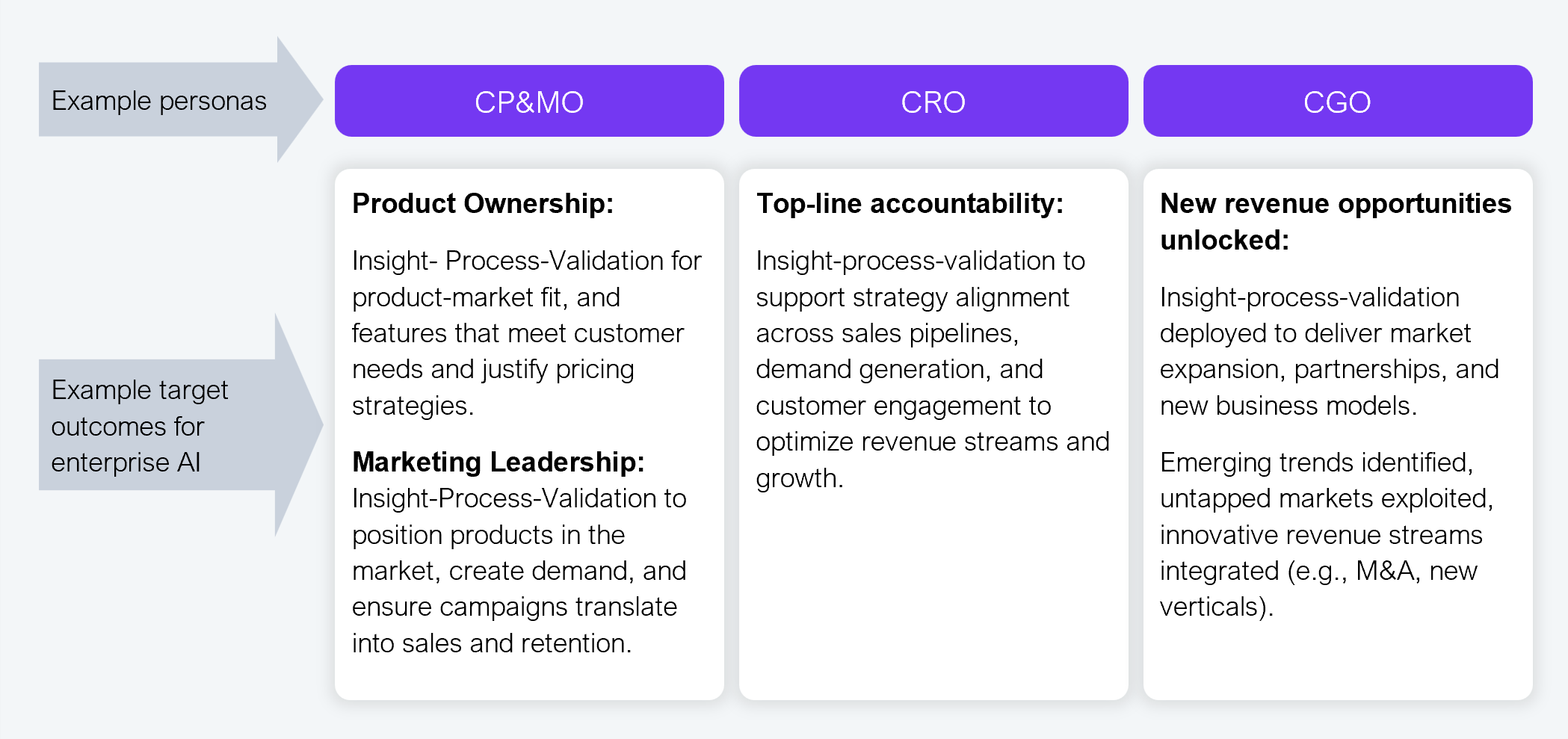
As AI firms shift to a services mindset, they become better positioned to develop solutions that combine insight (to identify what should be done), process (to do what needs to be done), and validation (to ensure alignment with goals and compliance with regulations).
Exhibit 2 illustrates examples of outcomes for chief product and chief marketing officers (CP&MO), chief revenue officers (CRO), and chief growth officers (CGO).
While it is inevitable that the range of C-suite personas goes beyond our initial list, HFS is conscious that GenAI is yet to find its ‘burning platform’ moment. Instead, it persists as a smoldering platform. The personas we provided as three examples are those with urgent ‘burning platform’ top-line requirements to deliver every month or quarter—such as revenue for CROs, innovations, new revenue streams for CGOs and CMOs, and new products for CPOs.
Source: HFS Research, 2025
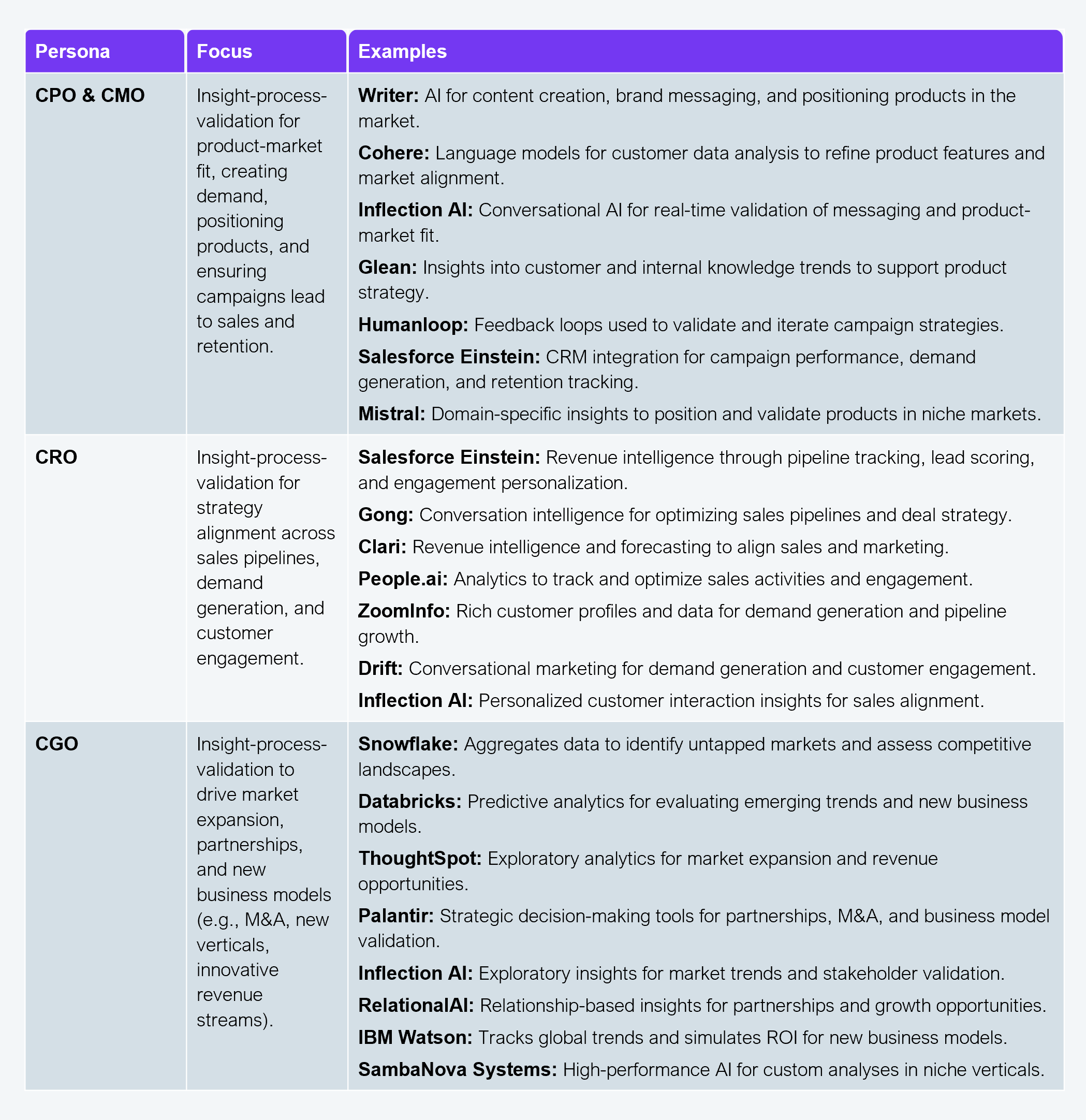
Exhibit 3 illustrates how the market is starting to respond to and address specific C-suite persona needs.
Source: HFS Research, 2025. Examples should not be considered exhaustive.
Serving identifiable persona-based outcomes can ignite the fuse on enterprise adoption, giving specific business leaders reasons to buy and reasons to buy now. But no one should be under any illusion about what comes next.
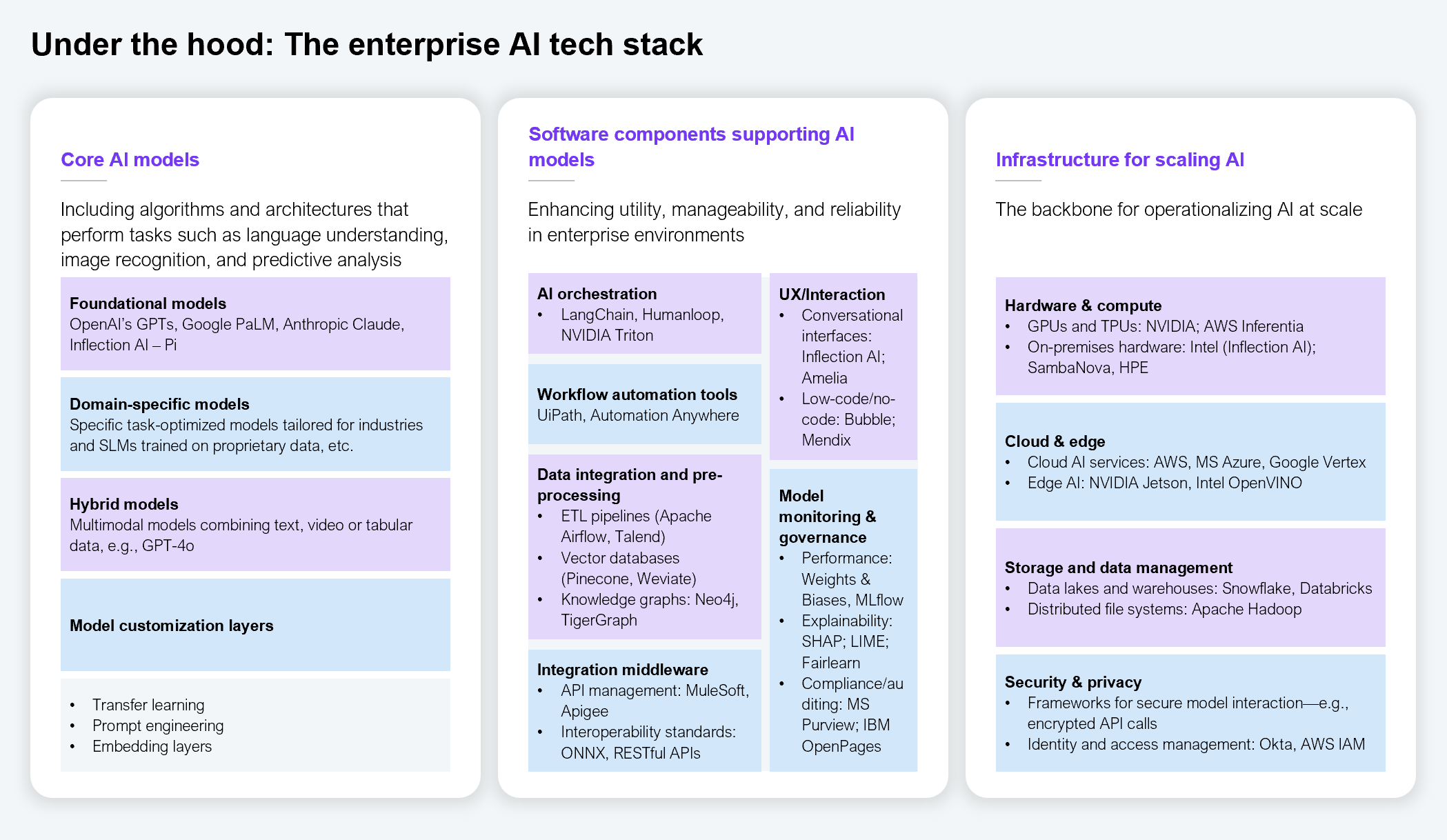
Comprehensive adoption requires a new enterprise tech stack consisting of core AI models, a range of software components supporting AI models, and delivery of orchestration, workflow, UX, integration, and more. It also requires additional infrastructure to operationalize AI at scale (see Exhibit 4).
As firms find increasing value in persona-based, outcome-focused solutions, many will reach the point at which shifting to a comprehensive adoption program becomes viable and desirable—enabling them to use their own AI system (including LLM) rather than cloud-based resources. The benefits include data security, enhanced business continuity, customization, integration, and cost control.
After two years, your operation costs can easily be reduced by 30%.
— Director of product, global online marketplace
Source: HFS Research, 2025
A new enterprise AI reality is emerging from the wreckage of failed POCs and pilots. Many initial AI plans hit the buffers because the total cost of the comprehensive technology adoption program required to deliver AI at an enterprise scale far exceeds what any single benefit case justifies. That perceived fail rate creates resistance to scaled adoption (see Exhibit 5).
Generative AI is not a data science problem. It’s a software engineering problem in the enterprise. The focus is on building solutions that deliver business results.
— AI and analytics head,leading US financial services firm
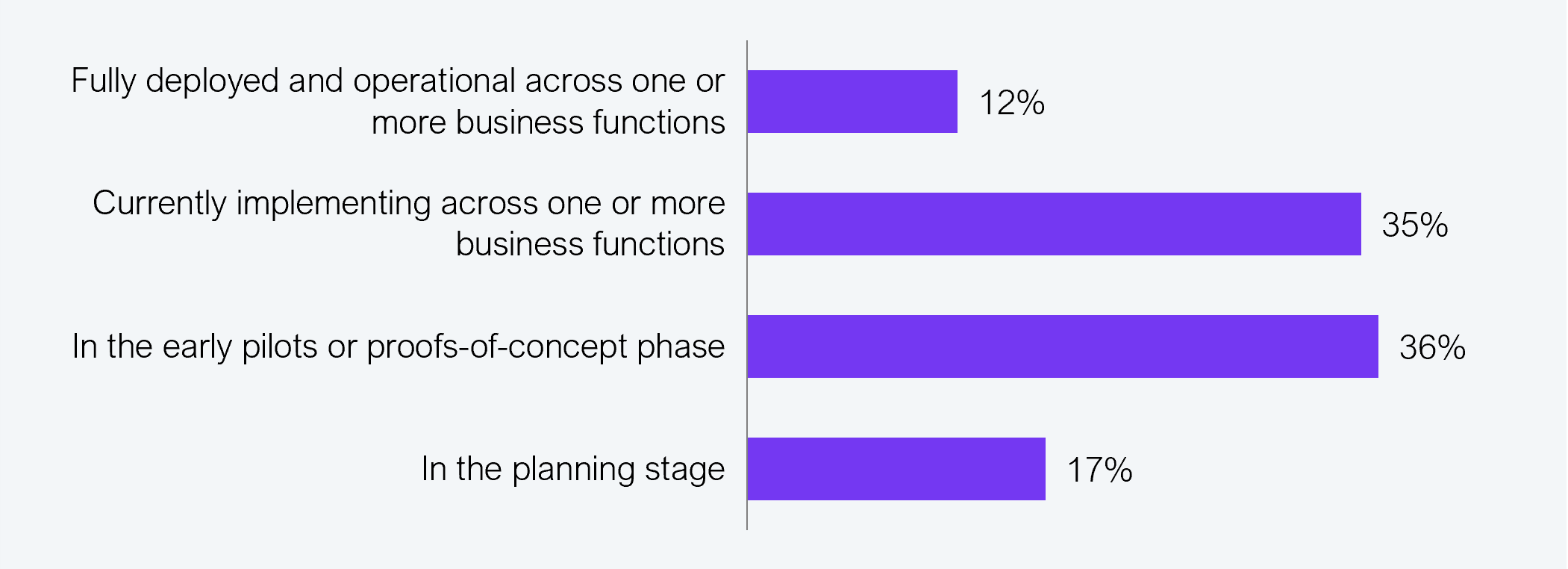
Source: HFS Research, 2025, N=260 enterprise leaders with GenAI experience
Leaders are stuck in a chicken-and-egg situation. Firms need to experience several clear AI benefit cases in order to move beyond point solutions toward a more comprehensive adoption program. Yet, multiple wins are unlikely without significant investment.
To break the cycle, firms must consider enterprise AI distinct from the consumer AI we have all experienced with public versions of ChatGPT or DeepSeek, for example.
In consumer AI, people just want it to work. In enterprise AI, the focus is on outcomes—how it reduces costs, improves processes, or provides measurable ROI.
— Director of product, global online marketplace
Enterprise leaders can’t ignore data, privacy, and governance challenges. Privacy concerns weigh heavily on enterprise AI adoption, demanding solutions such as Inflection AI’s privacy-first approach, where data is processed within environments wholly owned by the enterprise—offering complete transparency and control. In contrast, once your data is in the black box of Microsoft’s version of OpenAI, there is some risk that bad actors could steal it if they manage to infiltrate Microsoft. And since Microsoft holds that data for 30 days, judiciaries in markets where Microsoft operates could subpoena it.
Complete ownership and control of your data certainly resonates with sectors under intense scrutiny, such as finance and healthcare, and in jurisdictions where regulatory frameworks such as GDPR impose strict data controls.
In enterprises, it’s not just about trust. The lack of explainability and control is a big barrier. We need to know why and how decisions are made.
— Head of data and AI, European airline business
While enterprise leaders must consider AI through the lens of their own challenges, AI firms such as Inflection AI must meet the enterprise where it is and deliver shorter-term ROI.
Budgets have shifted, with businesses now controlling 46% of IT spend (and most of the rest is spent at the behest of business in any event). Business leaders have short-term problems and can’t afford to boil the ocean to get there. Business leaders don’t want tech or a tool—they want a solution to a problem. They are focused on the outcome.
Contrary to the generalist approach of companies such as Google and OpenAI/Microsoft and their moonshot pursuit of artificial general intelligence, many smaller, more focused AI firms target specific enterprise needs. The enterprise AI market is beginning to segment—with cross-functional enablers such as search (e.g., Glean), content (e.g., Writer), and software development (e.g., poolside) for example, but also by functional providers such as Gong in marketing and sales (see Exhibit 6).
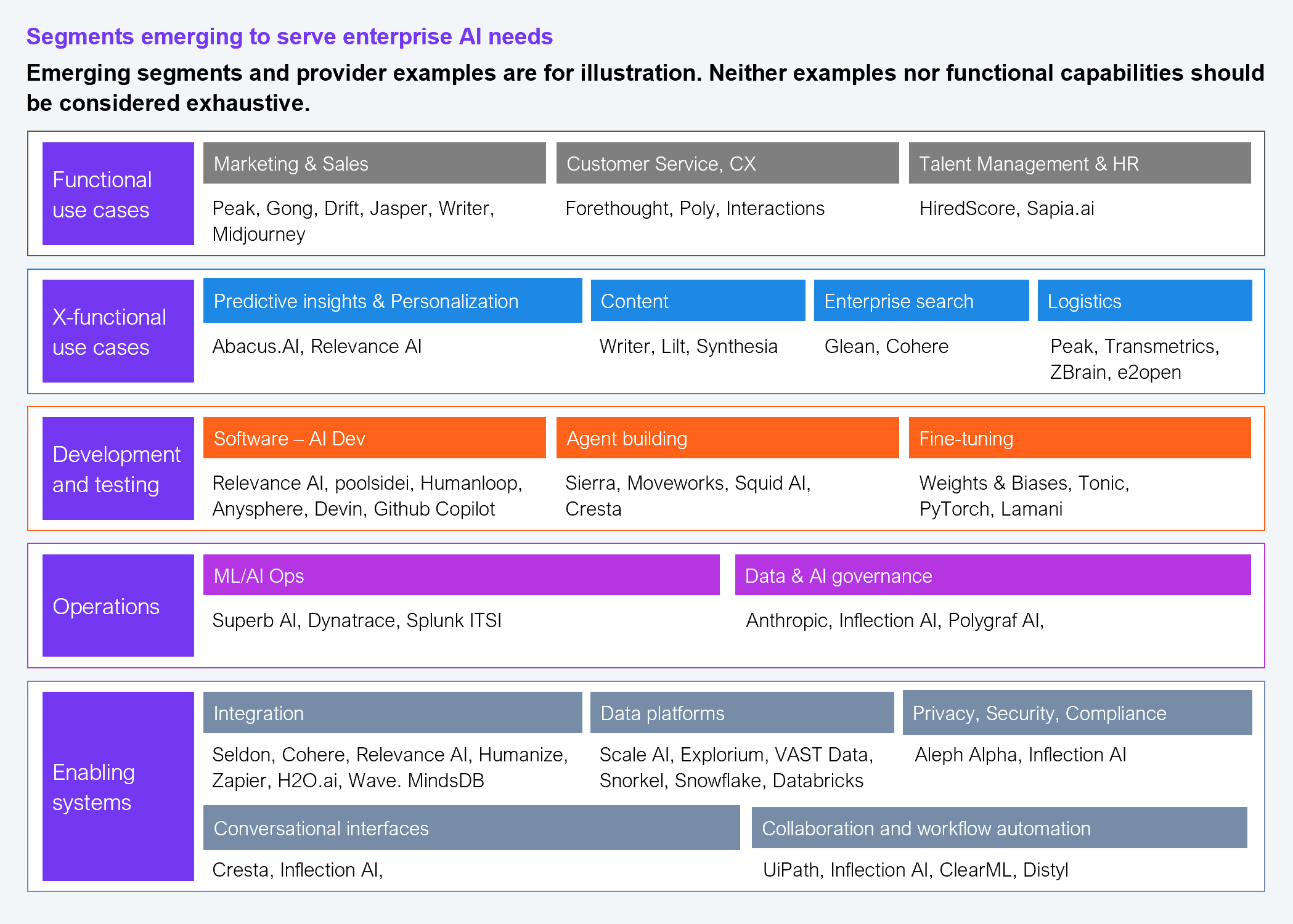
Note: Emerging segments and provider examples are for illustration. Neither examples nor functional capabilities should be considered exhaustive.
Such segmentation (see Exhibit 6) is an essential and encouraging step on the journey to the wider adoption of enterprise AI since it offers solutions that are easier to map against specific enterprise needs. Solutions to clear needs will always be easier to sell than enterprise-wide transformation—at least until a multitude of bite-sized solutions prove their value.
Enterprise leaders need solutions tailored to their desired outcomes. These solutions should be persona-aligned and solve C-suite business issues by applying AI systems that deliver insight, process, and validation.
Consumer applications like Copilot Studio are fine for general-purpose data, but they are insufficient when it comes to highly technical or domain-specific data. Enterprise AI must handle complex jargon and specialized data pre-processing.
— Head of AI/machine learning practice, German multinational science and tech firm
The emergence of solutions that deliver insight-process-validation for CPOs in the software development lifecycle (SDLC) demonstrates the efficacy of this approach. For example, Persistent’s SDLC persona focus reveals an affordable path to GenAI adoption across the enterprise by targeting key decision-makers such as CTOs, CIOs, and CPOs. Persistent has aligned its SASVA offering with the tangible pain points of these personas.
Sales teams today navigate a data-rich but insight-poor environment, where success depends on efficiently managing vast amounts of customer data, competitive intelligence, and engagement strategies. AI enhances sales operations by:
For example, Inflection AI integrates with enterprise platforms such as Salesforce, SAP, and Microsoft Teams to act as an AI-powered assistant for sales teams. It pulls real-time insights from multiple data sources, summarizes customer sentiment, competitor activity, and even generates tailored pitch materials. By combining deterministic automation (for structured tasks) with AI-powered probabilistic decision-making, sales teams can drive faster, more effective conversions while focusing on relationship-building rather than administrative work.
While sales is a natural fit for AI-driven transformation, the true power of enterprise AI lies in its ability to optimize multiple business functions. Similar AI-driven systems are driving efficiencies in:
AI’s ability to deliver insights, automate processes, and enhance decision-making can unlock new levels of efficiency and innovation across industries. Whether in sales, marketing, finance, or operations, AI solutions must be tailored to enterprise needs, ensuring governance, security, and seamless integration into existing workflows. Organizations that adopt this holistic approach to AI implementation will be best positioned to drive long-term transformation and sustained competitive advantage.
As firms prepare to embrace AI across the enterprise, Inflection COO Ted Shelton believes you must tackle three simultaneous initiatives.
First, enable employees to use AI effectively and safely. “A component of this employee enablement is certainly making the technology available, but another component is providing the education to employees and the incentives to actually utilize it,” he explains. Without proper education and adoption strategies, AI tools—such as Copilot—will struggle to deliver impact.
A component of employee enablement is making the technology available, but another component, just as important, is providing the education to employees and the incentives to actually utilize it.
— Ted Shelton, COO, Inflection AI
Second, enterprises must redesign processes to fully integrate AI. Many AI initiatives fail because companies cherry-pick narrow use cases instead of addressing their underlying process debt. Shelton highlights that “companies need to embrace a growth mindset” rather than focusing purely on cost-cutting, emphasizing that AI should unlock new ways of working, not just automate existing tasks.
Third, organizations must rethink their products and services to align with AI’s capabilities. Shelton argues that “you don’t do just one of those—you’ve got to do all three,” emphasizing that a fragmented approach leads to failure.
This transformation is becoming more urgent as AI enters enterprises “through the back door” via individual employee use, forcing companies to adapt.
Start by focusing on your most important outcomes. Only this approach will deliver value at the speed you need to compete, opening the door to broader adoption throughout the enterprise. But be under no illusion; even with a series of wins, there will be much work, new costs, and risks to manage.
While partners delivering use case and benefit case-specific solutions will make short-term sense, providers capable of supporting the broader adoption of AI systems across the enterprise will prove better mid- and long-term partners.
Register now for immediate access of HFS' research, data and forward looking trends.
Get StartedIf you don't have an account, Register here |
With the exception of our Horizons reports, most of our research is available for free on our website. Sign up for a free account and start realizing the power of insights now.
Our premium subscription gives enterprise clients access to our complete library of proprietary research, direct access to our industry analysts, and other benefits.
Contact us at [email protected] for more information on premium access.