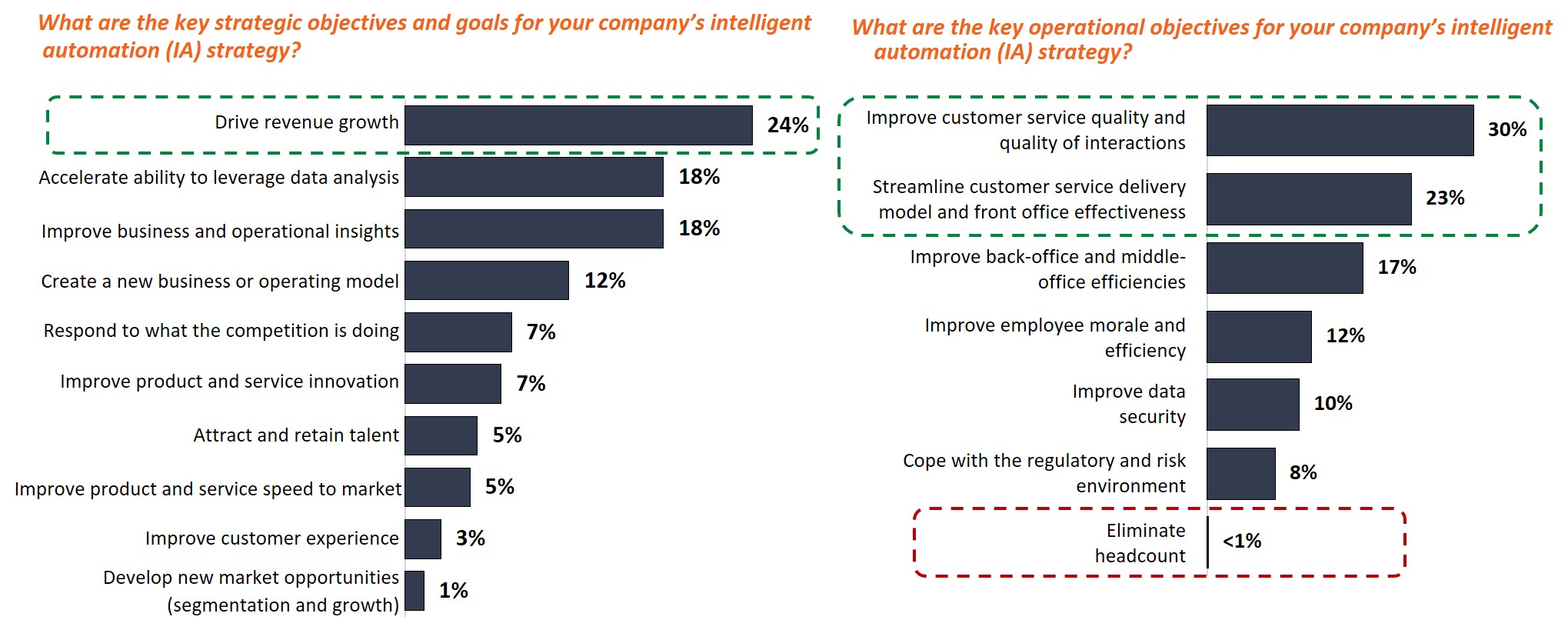
A recent HFS study of 590 global 2000 enterprises found that the top strategic and operational objectives for intelligent automation are revenue growth and improved customer experience (CX) (Exhibit 1). At our June 19 executive roundtable in New York to discuss the potential of integrated automation for elevating customer experience, it was clear that the success of any automation program is in large part dependent on enabling humans, not replacing them.
Exhibit 1: The quest for improved CX tops the list of objectives for intelligent automation
Source: HFS Research in conjunction with KPMG International, State of Intelligent Automation, 2019
Sample = 590 Business Leaders including 100 C-level executives
The delegates, a unique mix of automation strategy and customer experience leaders, agreed that integrated automation (IA) approach is the only realistic way forward for enterprises seeking to maximize the benefits of emerging automation and AI technologies.
In short, the much-lauded business benefits to be gained from process automation software, machine learning, and tools such as cognitive assistants and natural language processing have opened a can of worms for enterprises eager to leap into the AI generation. Any executive dealing with automation initiatives has admitted to investing far more time, resources, and money on revisiting their institutional processes to figure out how they can be rewired to take advantage of automation and AI software.
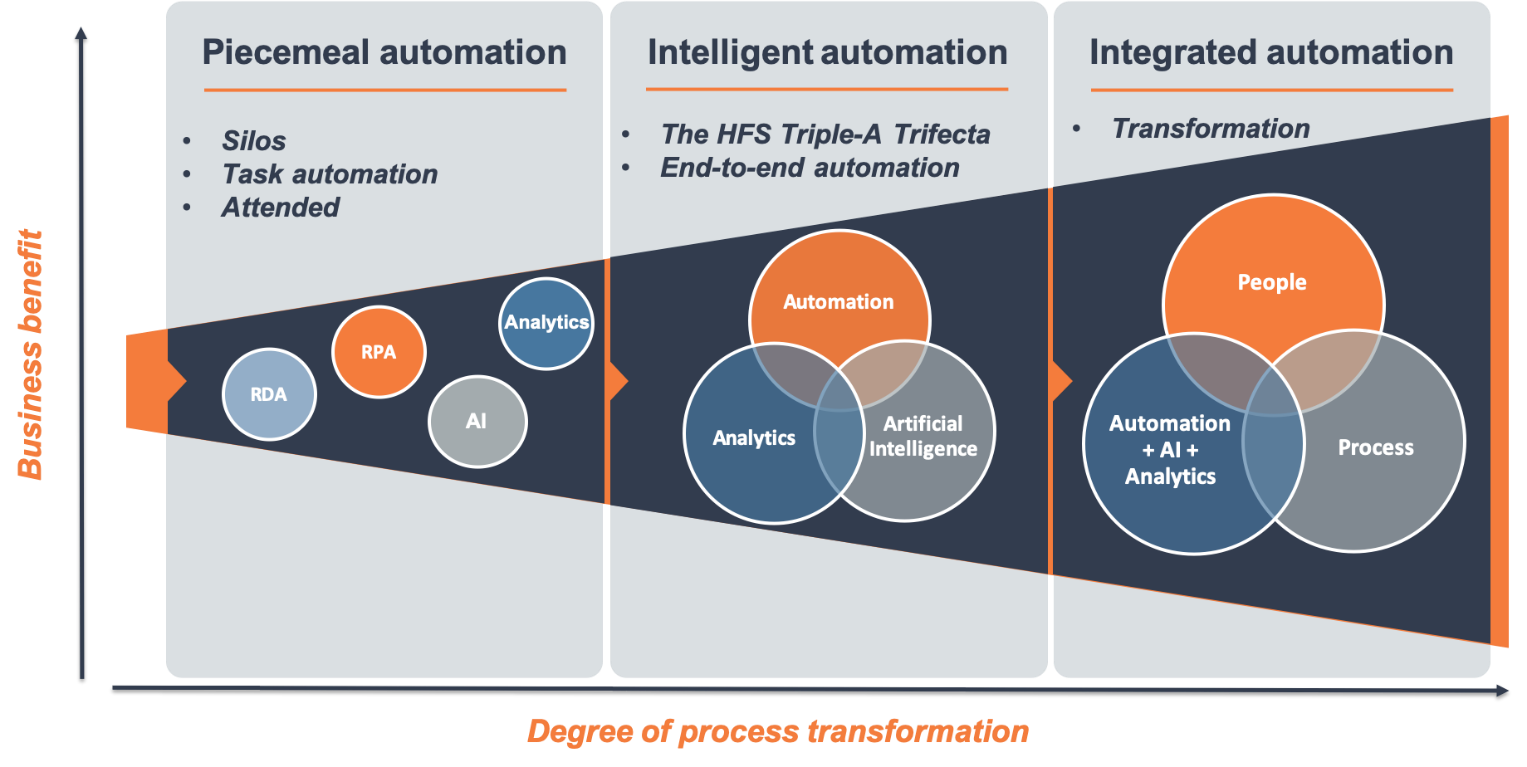
As enterprises dive deeper into the execution of their IA strategies, a (sometimes) painful reality is emerging—you can’t achieve change with technology projects alone. Scads of task-focused proofs of concept (POC) across unintegrated sets of digital technologies have had limited impact, and they often alienate the human users needed to adopt and perpetuate the new and refined processes. This is where integrated automation comes into play—the integration of technology change agents like the “Triple-A-Trifecta” (automation, analytics, and AI) with people and process (Exhibit 2). Delegates noted that this concept is often best enabled by a peace treaty between the age-old corporate holy war of IT versus business operations. Yes, you need to work together.
Exhibit 2: The path to integrated automation
Source: HFS Research, 2019
The role of humans in successful automation programs is critical. While the use of RPA may have started as a means to reduce headcount and automate rule-based tasks, delegates at the roundtable shared a growing realization that it’s actually the inclusion of humans in their automation programs that helps them drive value and results and achieve scale. Or, more pointedly, it’s been pretty much everyone’s experience that just automating work without employees’ buy-in and understanding at every echelon of the company yields limited value, little to no scale, and most certainly no transformation. Key thoughts on how to include and prepare humans for automation include
While there is great potential for integrated automation to positively impact customer experience, our roundtable discussion underscored the palpable need to first ensure alignment with user experience—literally how integrated automation solutions impact those they touch. The patient-zero “users” are typically employees, so getting employee engagement with automation correct is on the critical path for all enterprises trying to drive digital transformation. The role of humans in automation is the gigantic elephant in the room that will block most progress unless your enterprise has a clear plan for driving effective change.
Register now for immediate access of HFS' research, data and forward looking trends.
Get StartedIf you don't have an account, Register here |
With the exception of our Horizons reports, most of our research is available for free on our website. Sign up for a free account and start realizing the power of insights now.
Our premium subscription gives enterprise clients access to our complete library of proprietary research, direct access to our industry analysts, and other benefits.
Contact us at [email protected] for more information on premium access.