This HFS Point of View is for enterprise CIOs and CFOs choosing GCC services partners to set up, scale, and sustain AI-led outcomes across business workflows.
Enterprise CIOs and CFOs are at a crucial phase in choosing the right global capability center (GCC) services partner to set up, scale, and sustain innovation. Over the next 24 months, buyers expect major changes in the scope of IT services, including data analytics, strategy, consulting, managed services, and digital engineering (see Exhibit 1). Delivery economics and AI adoption are transforming how work is structured and scale IT services across the enterprise.
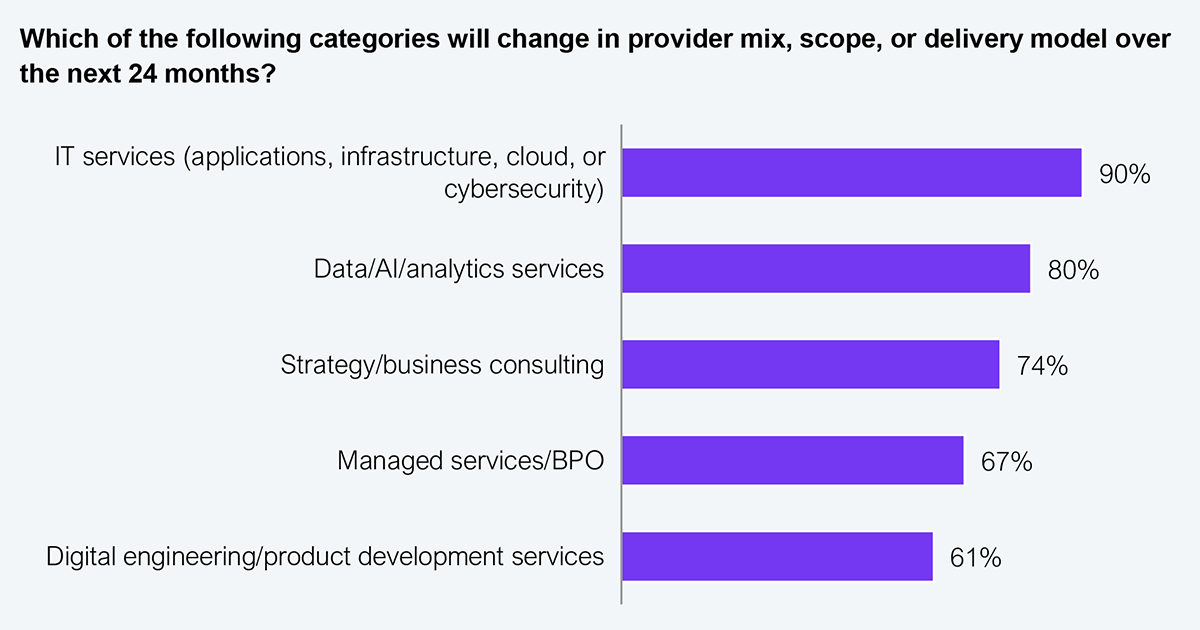
Sample: 202 major enterprise decision makers; total does not add to 100% due to multiple selection option
Source: HFS Research Pulse, 2026
Our GCC Services Horizon Report, 2026 showed that GCCs are playing a bigger role in this AI transformation at the core of enterprise business operations. They are reshaping where work is done, how capabilities are developed, and how talent is accessed, aligning and executing the enterprise’s strategic direction. They are also serving as a testing ground for a bigger change in delivery, as enterprises push more work into software, automation, reusable platforms, and AI-based operating layers.
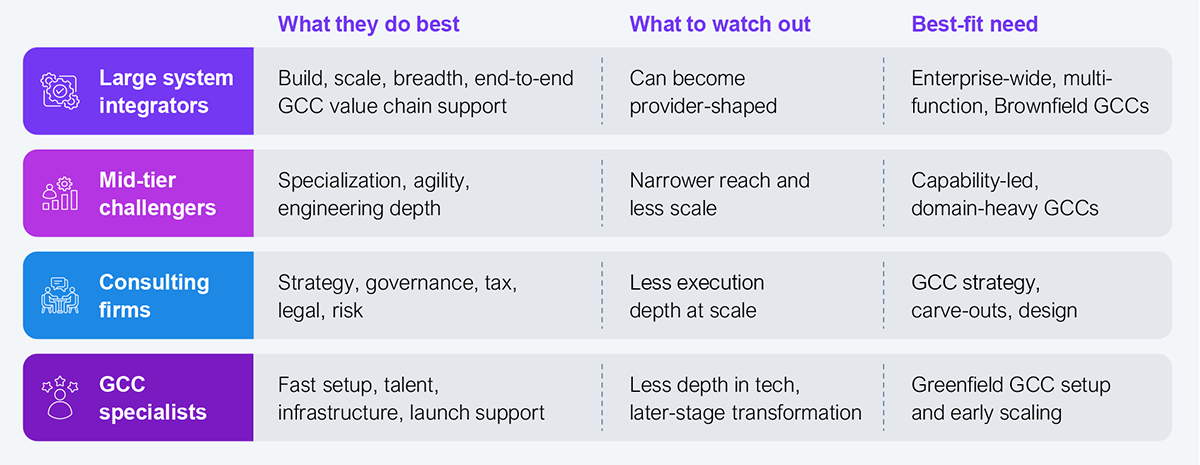
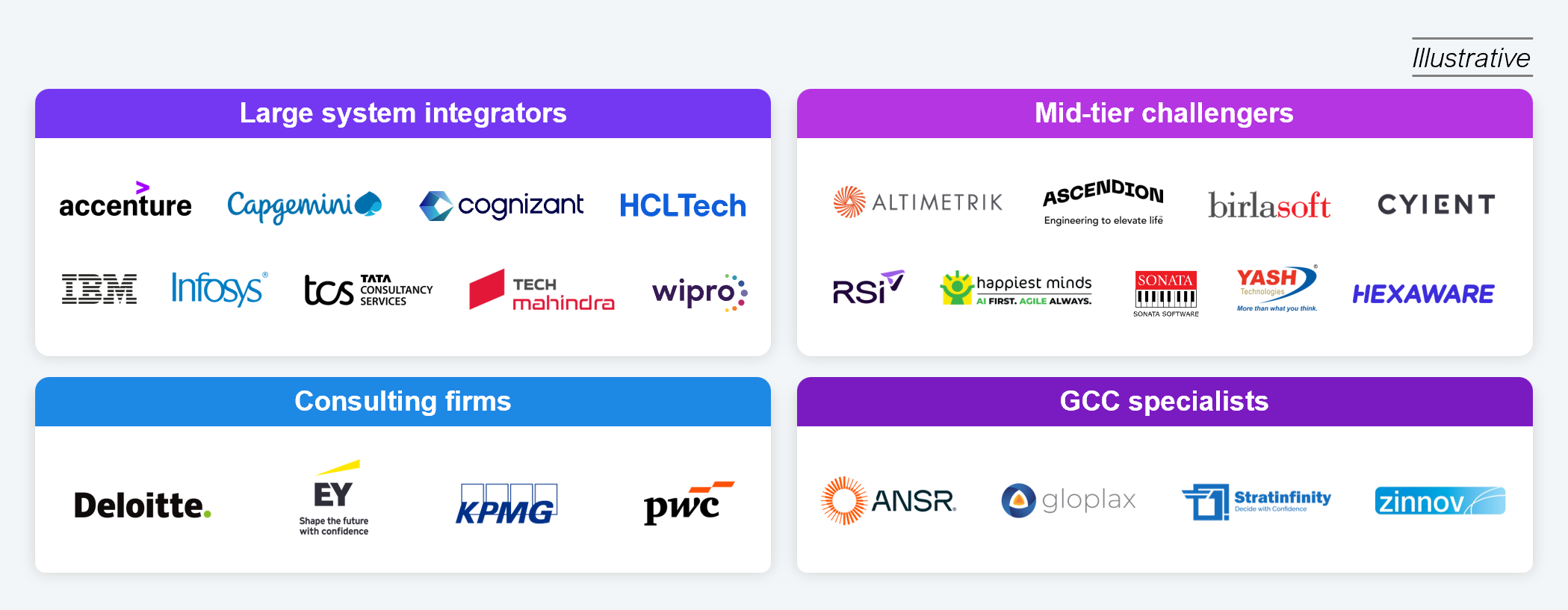
The shift has complicated provider selection for GCCs, as many firms now claim to design, build, run, and innovate the enterprise GCCs workflows. With varied starting points and solutions, choosing a partner is crucial in determining if the GCC will serve as a talent framework, a software-driven engine, or something in between. HFS Research has categorized GCC providers into four archetypes (see Exhibits 2 and 3) based on their capabilities, size, core offerings and success stories.
Source: HFS Research, May 2026
These providers, under each archetype, are positioned uniquely, offering services across the GCC value chain and shared success stories with greater outcomes.
Source: HFS Research, 2026
Large system integrators excel at scale and breadth, covering setup, transition, talent ramp-up, operations, and transformation under a single model. This segment suits large, multi-function GCCs that connect to wider IT, engineering, and operations changes. For example, Infosys has more than 200 active GCC engagements and flexible models such as build, operate, and transfer (BOT), build, operate, and acquire (BOA), and joint venture (JV), along with AI-first offerings. HCLTech has enabled more than 280 GCCs and supported over 46,000 talent seats. The risk is that the GCC operating model could start to mirror the provider’s delivery model rather than the enterprise’s long-term ownership goals. Buyers should explicitly define decision rights, IP ownership, the workforce mix, and the transition from build support to enterprise control to run their operations independently.
Mid-tier challengers are ideal for focused builds where specialization, agility, and engineering depth matter more than size. They excel in domain-heavy GCCs, digital product work, and targeted modernization programs. For example, Altimetrik focuses on AI-industrialization and GCC 2.0, with 23 active GCC clients and roughly 10,000 practitioners. Cyient is another example, with over 5,000 GCC FTEs and expertise in engineering-heavy sectors such as aerospace, rail, automotive, and semiconductors. The drawback is narrower reach and smaller global scale than those of large system integrators.
Consulting firms excel in business case development, operating model design, governance, tax, legal structures, and risk management. EY is a strong example, with over 1,200 GCC engagements, more than 500 global clients, over 200 centers established, and more than 15 BOT setups. PwC too offers strong strategies from setup to execution across transformation, carve-outs, and operating model design. This segment is quite useful in early-stage strategy, carve-outs, and structural redesign. However, enterprises usually need another partner for large-scale execution later, as some of these firms lack AI and transformation capabilities.
GCC specialists excel in legal setup, talent access, employer branding, workspace, and launch support, especially for first-time GCC builders or mid-sized firms. ANSR is a good example, having enabled over 200 GCCs, supported more than 200,000 FTEs, and achieved launch timelines within 2 to 3 months. This segment is strongest in the early stages of GCC building and scaling. However, a deeper enterprise transformation may require additional partners later, as these are small-scale and offer limited-service offerings within the GCC value chain.
Given the types of provider archetypes, enterprise CIOs and CFOs have multiple options and value-driven partners that can drive your vision and help you take the AI journey to create the most efficient GCC to support global operations.
Register now for immediate access of HFS' research, data and forward looking trends.
Get StartedIf you don't have an account, Register here |
With the exception of our Horizons reports, most of our research is available for free on our website. Sign up for a free account and start realizing the power of insights now.
Our premium subscription gives enterprise clients access to our complete library of proprietary research, direct access to our industry analysts, and other benefits.
Contact us at [email protected] for more information on premium access.